
You dream of adopting a donkey, but be careful with the budget. The cost of a donkey exceeds the purchase price from the breeder or the association. Also consider daily expenses, necessary accommodations, and sometimes rental.
This guide to buying a donkey in France provides you with the basic information. It answers one question: how much does a donkey actually cost. It aims to enlighten you on the different options and warn you of mistakes before welcoming the animal.
To define the budget, consider the total cost. This includes the purchase price, annual expenses (hay, hoof care, veterinary) and initial expenses like shelter and fencing.
A crucial aspect is the longevity of the donkey. They live between 25 and 35 years, sometimes longer. This influences the cost calculation as the commitment is long-term.
The differences in the price of a donkey can be explained by several factors. Size, paperwork, color, the reputation of the breeder, and the intended use. The choice between a companion donkey, a working donkey, or one for therapy alters the criteria and priorities.
Key Points
- The donkey price should be understood in the context of the entire project, not just the purchase.
- To know how much a donkey costs, add annual maintenance and initial investments.
- The donkey price varies according to size, paperwork, coat, and the seriousness of the breeding.
- The lifespan (25 to 35 years, sometimes longer) imposes a long-term vision.
- The donkey buying guide France helps compare adoption, breeding, and rental methodically.
- The use (companionship, utility, mediation) influences needs and thus the budget.
Understanding the Donkey Market in France
The donkey market in France is diverse. Two similar ads can have different prices. To understand well, you need to compare and ask the right questions.
Talking about price means discussing purchase, services, and guarantees. The price reflects follow-up and local context. Choosing a companion donkey requires thought and emotion.
Why Prices Vary So Much by Region and Breeding
The region influences the price. In the south, some breeders charge higher prices. This is especially noticeable when demand exceeds supply.
The specialization of the breeding plays a role. A breeding that offers good weaning and regular socialization will sell for a higher price. These details increase the price in the French donkey market.
Companion, Utility, or Mediation Donkey: Impacts on the Budget
The type of use affects the budget due to VAT. For companion donkeys, VAT is often 20%. In agriculture, VAT is at 10%. For breeders, it can drop to 5.5%.
The use also modifies costs. A donkey for mediation must be calm, sociable, and fond of humans. This can increase the price.
| Most Common Use | Stated VAT | Factors Affecting Donkey Rate | To Check Before Purchase |
|---|---|---|---|
| Companion / leisure | 20 % | Temperament, education, ease of handling | Halters habituation, hoof care, stress-free separation |
| Agricultural / brush clearing | 10 % | Hardiness, body condition, ability to walk and carry light loads | Parasitism, hoof quality, endurance on terrain |
| Breeder | 5.5 % | Origins, conformity to model, follow-up, traceability | Fertility, herd behavior, breeding conditions |
| Mediation / asinotherapy | Often close to leisure | Sociability, emotional stability, desensitization | Reaction to noises, gestures, and repeated contacts |
Long-term Commitment: Adoption for 25 to 35 Years (or More)
Adopting a donkey is a long-term commitment. We’re talking about 25 to 35 years, sometimes up to 40 years for some. This is a serious commitment, not just a passing desire.
This commitment concerns everything: organization, budget, and time. A low price does not always guarantee a good purchase. For a successful adoption, a good project and a suitable place are necessary.
Donkey Price: Purchase Price Ranges by Type of Animal
The price of a donkey varies according to its size and official documents. Age and how easy it is to manage also play a role. In France, there are three categories based on size: "small size" for those up to 90 cm, "miniature" for those up to 80 cm, and "micro-miniature" for those smaller than 76 cm.
When looking at the price of a donkey, check if the price is displayed with or without tax. With some sellers, the price is without tax, and VAT must be added. This tax varies according to use: 5.5%, 10%, or 20%.
Dwarf Donkey
A dwarf donkey often costs between 800 and 3,000 €. If the donkey is younger and already accustomed to humans, the price may increase.
If a donkey is small, up to about 90 cm, its health and behavior are very important. These aspects can be more crucial than its color.
Miniature Donkey
The price of a miniature donkey often varies between 1,500 and 4,500 €. This depends on its exact size and pedigree. This is the category where the price can vary the most.
If you see a donkey advertised as "miniature," ask for its height at the withers. Also, inquire about its expected adult size. A fair price for a donkey is based on precise figures.
Micro-Donkey and Micro-Miniature
Micro-donkeys and especially micro-miniatures, which often measure less than 76 cm, are rare. Their price often starts above 4,000 €. It can be higher if the donkey has a good pedigree or is very small.
In this category, look at what is included in the price. This may include identification, initial vaccinations, a veterinary certificate, and advice for welcoming the donkey properly. This way, you won’t have any surprises.
| Type | Reference Size | Observed Purchase Range | What Causes the Most Variation | VAT/Display Point |
|---|---|---|---|---|
| Dwarf Donkey | Small size, up to ~90 cm | 800 to 3,000 € | Age, level of handling, health follow-up | Price sometimes before tax; VAT possible depending on use (5.5% / 10% / 20%) |
| Miniature Donkey | Up to 80 cm max | 1,500 to 4,500 € | Exact size, pedigree, consistency of measurements | Ask for tax included and what is included to compare the miniature donkey price range |
| Micro-Donkey / Micro-Miniature | Micro-miniature < 76 cm | Often above 4,000 € | Rarity, paperwork, very small size, selection | Check before tax/after tax and the VAT applied before confirming the donkey rate |
Dwarf Donkey and Miniature Donkey: Differences Affecting Donkey Pricing
There is much to know when comparing donkey prices. The term “small donkey” is often used, but there are precise differences. They relate to size, weight, and whether the donkey is officially recognized. These details also help better understand the price of miniature donkeys.
Reference Sizes: 91 to 96 cm at the withers, and micro subjects from 45 cm
The size of dwarf donkeys is essential to avoid confusion. The Miniature Donkey Registry sets the maximum size at 91 cm at the withers. But other references go up to 96 cm. This small difference affects how one views the price of a miniature donkey. It matters especially if the seller talks about lineage or uniform size.
There are also very small donkeys, advertised as from 45 cm adult. The smaller they are, the stricter the selection. And the demand for these donkeys, especially in France for companionship, is increasing.
Average Weight and Build: 80 to 120 kg and Implications for Equipment
The average weight of a donkey is between 80 and 120 kg. This weight indicates what equipment to choose: a halter that fits well, a comfortable lead, simple protection, and easy-to-use materials. Even a small donkey is strong. A fence that is too flimsy can pose problems.
This build also influences how the animal is managed. For example, how to load it into a van, secure a ramp, or transport hay without hindrance. These aspects can vary the price of a donkey, especially if the animal is accustomed to transport and handling.
Recognition in France: An Important Benchmark for Finding Serious Breeders
France officially recognized the miniature donkey in 2021, thanks to the French Institute of Horse and Riding (IFCE). For a buyer, this is a good benchmark. It means it is easier to find breeders who follow clear rules (identification, traceability, and breeding practices).
The AFAMAS (French Association of American and Sicilian Miniature Donkeys) also helps find good breeders. Thanks to these benchmarks, one can better avoid surprises. And comparing the prices of miniature donkeys becomes simpler, especially when size is important for your project.
| Criterion | Observed Benchmark | Practical Impact on Purchase | Frequent Effect on Donkey Pricing |
|---|---|---|---|
| Height at the withers | 91 cm (MDR) to 96 cm (other benchmarks) | “Miniature” classification more or less strict, model consistency | The lower and more stable the height, the more the miniature donkey price tends to rise |
| Micro subjects | From 45 cm adult | Rarity, need for serious growth assessment | Possible increase related to selection and demand for miniature donkeys in France |
| Weight | 80 to 120 kg | Choice of halter, leads, transport, and fence security | A well-handled and easy-to-manage animal is valued more |
| Recognition and benchmarks | IFCE (recognition 2021) + AFAMAS benchmarks | Better traceability, more structured breeding, clearer information | More reliable comparison of offers, better-justified differences at equal characteristics |
What Causes the Price of a Donkey to Increase or Decrease
It is surprising to see the price gap between two ads. This price depends on several factors: size, color, health status, and the level of education of the donkey. To choose well, one must examine the entire profile of the donkey, not just its photo.
Predictable Adult Size: The Smaller the Donkey, the Higher the Price
The future size of the donkey plays a significant role in its price. If the donkey is small, its price will be higher because they are more sought after and less available. To guess its size at adulthood, one looks at the size of the parents, their bone structure, and their growth.
Size is very important for those looking for a donkey as a companion. It makes daily life easier.
Rare Coats and Colors: Possible Price Gaps of Several Hundred Euros
Common colors like gray, brown, black, and white are easy to find. But unique colors like piebald, isabelle, or chocolate can increase the price of the donkey by 500 to 800 €.
This price increase does not indicate better health or personality. It merely shows that these donkeys are rare and highly sought after.
Conformation, Temperament, and Quality of Socialization
A well-proportioned donkey, with straight limbs and a regular gait, often has a higher value. Conformation issues or an abnormal gait can decrease the price. Because they may require more care.
The donkey's behavior is also crucial. A calm and easy-to-handle donkey adapts better to its new home. A good level of socialization can reduce its "stubborn" side.
Reputation of the Breeder, Health Follow-Up, and Support
The price also depends on where you buy the donkey. A recognized breeder often offers better health follow-up and post-purchase advice. This makes the purchase safer. A private-to-private purchase might cost less, but one must be more cautious.
Here is a simple guide to understanding how these elements influence the price.
| Observed Criterion | What Can Raise the Donkey Price | What Can Lower It |
|---|---|---|
| Estimated Adult Size | Confirmed small size by parents and regular growth (miniature donkey price factors) | Uncertain size, unseen parents, poorly monitored growth |
| Coat and Color | Sought-after rare colors (piebald, isabelle, chocolate), higher demand | Common colors, less pressure on demand |
| Conformation | Straight limbs, harmonious back, smooth locomotion | Hoof defects, asymmetries, irregular gait |
| Temperament and Education | Handled, sociable, accepts the halter and basic care | Poorly handled, stressed, difficult to approach or touch |
| Sale Context and Health | Followed breeder, health history, advice after purchase | Unclear history, absent care documents, limited support |
Documents, Pedigree, and Registrations: Understanding Price Gaps
Two similar ads can have different prices. This often comes from the documents that certify the origin of the donkey. The MDR papers provide more information about the donkey's family and add to its value.
A donkey without papers can be excellent and robust. But it is more complicated to know its ancestors. With a reliable pedigree and registry, it is easier to make comparisons. Especially if you think about selling it later.
Difference Between Donkey With and Without Papers (Traceability and Value)
The papers help know the identity and family of the donkey. They help track its parents and understand its history. This detail increases trust during the sale and affects the price.
- Traceability: better know where the donkey comes from.
- Genealogy: understand the donkey's family, important for its pedigree.
- Transmission: register baby donkeys according to registry standards.
Impact of MDR Papers on Price: Gap Around 30%
The MDR papers add about 30% to the price. This shows their value, the choice of parents, and the desire for a registered animal. Here’s a table to help you see the price difference.
| Reference Size | Without MDR (before tax) | With MDR Papers (before tax) | Quick Reading of the Gap |
|---|---|---|---|
| Small Size (90 cm) | 1,500–2,000 € | 2,000–2,600 € | Common surcharge related to registration and traceability |
| Miniature (80 cm) | 2,500–3,500 € | 3,200–4,500 € | Significant increase when the miniature donkey pedigree is sought |
| Micro-Miniature (<76 cm) | 3,800–4,800 € | 4,800–6,500 € | Rarity + demand: marked effect on the donkey price |
To have a registrable baby donkey, both parents must be registered with the MDR. If one parent has no papers, their baby cannot be registered.
Reproduction or Leisure Project: How to Decide if Papers Are Essential
If you aim for reproduction or selection, choosing MDR papers is often wise. They maintain the donkey's value, guide breeding, and clarify lineage. Thus, the higher price makes sense.
For a leisure project, the importance of papers may decrease. A donkey without papers can be just as good if the breeding is of quality. The important thing is to check the donkey yourself, prioritizing transparent follow-up, even without a pedigree.
Female, Entire Male, or Gelding: What Impact on Purchase Price
The sex influences the price of a donkey, often more than its color or size. On the market, the price difference can reach 1,000 to 1,500 € for two similar donkeys. To set a good price, one must therefore consider the sex and intended use: companion, mediation, or reproduction.
Female miniature donkeys generally cost more. They can reproduce and are often seen as calmer, important for families. For example, a female miniature can be sold between 3,700 and 4,000 € before tax. This represents 900 to 1,300 € more than a male of the same type.
Entire males have an average price. An entire miniature male can cost around 2,700 € before tax. They require more attention as some may be more active or try to escape to find females.
The gelding is highly sought after for those wanting a donkey as a companion. If the castration is already done, the price remains attractive. Otherwise, expect an additional 150 to 250 € for veterinary fees. The advantages include easier handling and less tension between animals.
| Profile | Cited Range (before tax) | What Influences the Price | Points of Caution |
|---|---|---|---|
| Female Miniature MDR | 3,700 to 4,000 € | Reproductive potential, higher demand, temperament often deemed calm | Managing reproduction if a male is present, enhanced health follow-up |
| Entire Male MDR Miniature | Around 2,700 € | Intermediate rate, possible reproductive interest | More assertive behaviors, risk of escape during heat periods |
| Gelding (castrated male) | Variable depending on whether castration is done or not | Profile sought for family life, simpler management in daily life | If not castrated, add 150 to 250 € and plan for rest and post-operative care |
When comparing, ask what is included in the price. This includes identification, vaccinations, deworming, hoof care, and training level. These elements can significantly change the final price.
How Much Does a Donkey Cost Daily: Realistic Annual Maintenance Budget
You may be wondering about the price of a donkey. It’s not just the purchase cost that matters. The most important thing is what you need to spend each year for its maintenance. This budget varies according to location, the quality of hay, and how often you care for the donkey.
There are two main estimates. Generally, one counts between 800 and 1,200 € per year. This total includes food, hoof care, and veterinary services. On the other hand, the minimum one could spend is around 265 € per year. But this requires very favorable circumstances and good management.
Feeding
The bulk of the diet is grass and hay. It is estimated that a donkey eats about 3 kg of hay per day. This amounts to an annual cost of about 150 €, depending on circumstances. In some households, the food budget rises to 300-500 € per year. Especially if hay is expensive or grass is scarce.
Overfeeding the donkey can become a problem, especially for smaller ones. Concentrated foods should be limited to 200-400 g per day. The donkey needs 20 to 30 liters of water per day, depending on the season, and a salt lick.
Veterinary Care
Each year, budget 200 to 300 € for routine care. This includes prevention like the flu/tetanus vaccine at 40 €. And dewormers at 7.50 € each, to be renewed in the year following the care plan.
Two things can increase the cost: adjusting doses for a small animal and a dental check-up each year. Teeth affect the health and digestion of the donkey. They thus have an impact on the maintenance budget.
Hooves
Regular hoof care is needed, about every two months. According to some sources, this costs between 250 and 300 € per year. Others suggest a rate of 15 € per care session, 2 to 4 times a year. This thus amounts to about 60 €, depending on the situation and if a professional is available.
This cost can increase if the donkey has specific leg problems or moves little. In these cases, the actual cost depends on small recurring expenses.
Setting Aside a Reserve for Veterinary Emergencies
Having a financial reserve helps manage emergencies without stress. A good rule is to set aside 200 to 300 € for emergencies. Like lameness, injury, colic, or an accident. This helps manage surprises without drastically changing the donkey's maintenance cost.
| Expense Item | Minimum Estimate (Based on Favorable Assumptions) | “Broad” Estimate (Based on Regions and Practices) | What Influences the Cost |
|---|---|---|---|
| Feeding (grass + hay) | ≈ 150 € / year (benchmark based on hay) | 300 to 500 € / year | Price of hay, access to grass, dry season, overfeeding |
| Veterinary Prevention | ≈ 40 € vaccine + dewormers (cited benchmarks) | 200 to 300 € / year | Protocol, travel, dosage adjustments, dental check-up |
| Hooves (trimming) | ≈ 60 € / year (15 € x 4) | 250 to 300 € / year | Frequency (up to every 2 months), hooves, geographical area |
| Emergency Reserve | 200 € / year | 300 € / year | Accidents, colic, unplanned care, additional examinations |
| Overall Annual Benchmark | ≈ 265 € / year (minimum estimate cited, excluding significant contingencies) | 800 to 1,200 € / year | Level of service, availability of professionals, quality of resources |
In addition to the annual budget, don’t forget the initial costs. Like shelter, fencing, and equipment. Most people find they need to spend between 2,000 and 4,000 € at the start. This does not depend on the price of the donkey, but on the state of the land and the necessary security.
Necessary Installations Before Purchase: Often Underestimated Expenses
Before buying a donkey, it’s important to look at what is needed on the land. Many forget this and see their budget explode, as these costs come before having the animal. Prepare to spend between 2,000 and 4,000 € to start, depending on the space and its condition.
If your land is wet or difficult to access, the price to prepare it rises quickly. Ideally, there should be a safe, easy-to-manage, and comfortable place year-round. This way, you avoid emergency repairs or dangerous makeshift solutions.
A donkey shelter must be dry, clean, and well-ventilated. Even though a donkey is robust, it must be able to protect itself from cold and rain in a dry place. Using bedding, improving drainage, and providing a firm ground helps avoid mud and accidents.
Do not neglect the fencing. A solid and visible fence prevents accidents and protects your donkey. Also consider installing sturdy gates, good angles, and the possibility of separating a donkey if needed.
| Item to Plan | What It Includes | Why It’s Useful |
|---|---|---|
| Paddock and Movement | Dry area, stabilization, mud management, access for wheelbarrow or small vehicle | Less degraded soil, easier maintenance, daily comfort |
| Water and Storage | Reliable water point, stable trough, frost-free reserve, dry hay storage | Regular hydration, protected hay, less waste |
| Shelter and Bedding | donkey shelter dry, ventilation, bedding, cleaning, protection against wind | Rest, weather protection, hygiene, and healthier hooves |
| Perimeter Security | donkey fence, visible tape, suitable posts, gates, securing access | Reduces escapes, limits accidents and dangerous passages |
| Basic Equipment | Halter, lead, brushes, bucket, simple first aid kit | Calm handling, easy care, more serene routine |
In reality, these items can cost as much as the donkey itself. Planning these expenses in advance helps to choose better when to buy. A good fence and a clean shelter ensure a good foundation for the donkey's comfort.
Space, Shelter, and Fencing: Living Conditions That Affect Cost
Before discussing the price of a donkey, one must think about its living space. A good space reduces stress and injuries, avoiding future costs. Often, this aspect costs more than one initially thinks.
Minimum Area
A donkey needs space to walk, eat, and move freely. It is often recommended to have 1,000 m² per animal. 1,500 m² is ideal for more ease. A varied place makes daily life easier.
If the space is limited, one must organize rotations and cleanings. These solutions can increase costs, even with a low purchase price.
Shelter
A shelter must be protected from wind, rain, and sun. Plan for 2 m² per donkey, with three sides closed. A drained floor is crucial for the animal's health.
A small shelter can cause tensions between animals. A dry and well-placed shelter often avoids veterinary visits.
Fencing
The fencing must prevent escapes and protect from injuries. A height of 1,20 m is suggested. In France, barbed wire is avoided to reduce the risk of injury.
To ensure safety, regularly check the angles and gates. A solid and well-maintained fence protects everyone.
| Element | Simple Benchmark | What It Changes on the Budget |
|---|---|---|
| space for donkey | 1,000 m² minimum, 1,500 m² ideal | Less mud and soil wear, fewer corrective adjustments |
| donkey shelter 2 m² | 2 m²/donkey, closed on three sides, dry and ventilated | Less humidity, fewer minor pathologies, easier bedding management |
| fence 1,20 m | Height ≥ 1,20 m, without barbed wire, well visible | Fewer escapes and injuries, less repair and care costs |
| Reading the donkey price | Compare animal + installations, not just the purchase | A “cheaper” donkey can cost more if the land is not ready |
Donkey Rental and Donkey Rental Price: When Renting a Donkey is a Good Idea
Renting a donkey can be useful for a temporary need without long commitment. It allows you to understand what living with a donkey entails, the time required, and the constraints. The rental cost depends on what is offered and the support provided.
Before renting a donkey, ask yourself if it’s just for an occasion or to truly test before adopting. You quickly learn how the donkey lives, its resting moments, and its need for tranquility. This avoids making a hasty decision.
Common Use Cases: Brush Clearing, Events, Discovery Before Adoption
To maintain land, a donkey can eat grass from certain areas. This helps with light brush clearing, if access to grass is managed. For events, a donkey presence is often requested for a short and supervised moment. The “discovery” option is popular among families considering adoption but unsure.
- Parcel maintenance: ideal for suitable areas, requires secure fencing and clean water.
- Animation: better suited for short moments, in a quiet place without too much noise.
- Trial before adoption: to see how to care for the donkey, guide it, and know the daily routine.
Rental Price for a Donkey: Factors That Affect the Quote (Duration, Transport, Supervision)
The rental price of a donkey changes according to the duration: from a few hours to several days. Transport affects the price as it requires an appropriate vehicle and calculating travel time. If a professional needs to be present, for safety, for example, the quote increases.
Some equipment, like the halter or pack gear, may be included in the price. Insurance, the time of year, and the level of preparation of the donkey (if accustomed to the public, for example) influence the rental cost.
| Quote Element | What It Changes on the Price | Question to Ask Before Booking |
|---|---|---|
| Duration (half-day, full day, weekend) | The longer the duration, the more organization and follow-up are required | Will the donkey have breaks and a quiet place to rest? |
| Transport (round trip) | Requires considering distance, travel time, fuel | Does the delivery point allow access for a transport vehicle? |
| On-site Supervision | Requires a professional for safety and public management | Who will take care of the donkey and interactions with the public, especially children? |
| Provided Equipment | Includes necessary materials adjusted for the animal | Is all the equipment suitable for the donkey and in good condition? |
| Insurance and Responsibilities | Important to cover incidents | What are the guarantees and responsibilities of the renter? |
Points of Caution: Animal Welfare, Insurance, Accommodation Conditions
A good rental depends on the welfare of the donkey: it needs water, shade, and a dry shelter. The place must be secure, safe, and have enough space. A stressed donkey does not serve well; it gets exhausted.
Before confirming, check the insurance, how to handle the donkey, and the program. To properly rent a donkey, plan for quiet moments and avoid too much chaotic contact. The price also indicates the quality of the proposed framework.
Buying Tips in France: Where to Adopt and How to Avoid Mistakes
Preparing to buy a donkey in France is like planning a new chapter in your life. Before settling on the price, think carefully: about your lifestyle, the time you can dedicate, and your budget for its care. Sometimes, a price that seems too good to be true hides insufficient follow-up or an animal not used to human contact.
Visiting the Breeder
It is crucial to go on-site, despite photos that may reassure you. Look closely at the condition of the enclosures, the shelter, the water, and the quality of the hay. Meeting the donkey's parents gives you an idea of its future size and temperament.
When you visit a serious miniature donkey breeder, they present official documents without hesitation: breeding registry, birth certificate, deworming, and hoof care follow-up. A justified price relies on these documents and not on vague promises.
Solitude
The donkey is an animal that cannot stand solitude. Ensure it has at least one companion, ideally another donkey. If this is not possible, a pony, a miniature horse, or even a sheep can do the trick. The important thing is that they get along well.
A lone donkey can lose weight, bray incessantly, or become difficult to catch. This can increase the cost of education and lead to additional veterinary expenses.
Education and Handling
Start early, with a gentle and consistent method. You should aim for the basics: walking on a halter, being brushed, and standing still for care. Forcing the donkey can break its trust and complicate everything.
Prefer short sessions, 15 to 20 minutes, and regular, several times a week. In the context of buying a donkey in France, an animal already accustomed to the halter can justify a higher price, especially if it is a miniature donkey.
Networks and Benchmarks
To avoid mistakes, look for recognized and recommended breeders. The AFAMAS is a good resource for finding contacts and learning about best practices. For American micro-donkeys, the Francarolis Donkey Farm in the Hautes-Pyrénées is often recommended.
Don’t just base your decision on price, but also on the quality of exchanges with the breeder, transparency, and support. A conscientious miniature donkey breeder will take the time to inform you about feeding, hoof care, and integration into the herd. This ensures a better buying experience in France.
| Point to Check | What to Expect On-Site | Impact on Donkey Price and Rate |
|---|---|---|
| Living Conditions | Dry shelter, clean water, safe fences, calm animals | A healthy environment justifies a more stable donkey price, with fewer hidden risks |
| Parents and Socialization | Visible parents, curious foal, handled without stress | Better predictability of temperament, thus donkey rate often more consistent |
| Health Follow-Up | Hoof care, deworming, body condition check, written advice if possible | Reduces catch-up expenses after buying a donkey in France |
| Documents | Birth certificate, registry, identification info, and traceability | A clear file supports the donkey price and limits unpleasant surprises |
| Support | Availability after sale, integration, and education advice | A miniature donkey breeder present may justify a slightly higher donkey rate |
Equipment and Tack: Investing in Durable Material with La Sellerie Française
A dwarf or miniature donkey is smaller than a horse. Its weight often ranges between 80 and 120 kg. Therefore, it is essential to choose the cut of a halter, the width of a girth, and check the strength of the buckles. Good donkey tack reduces friction and avoids pressure points.
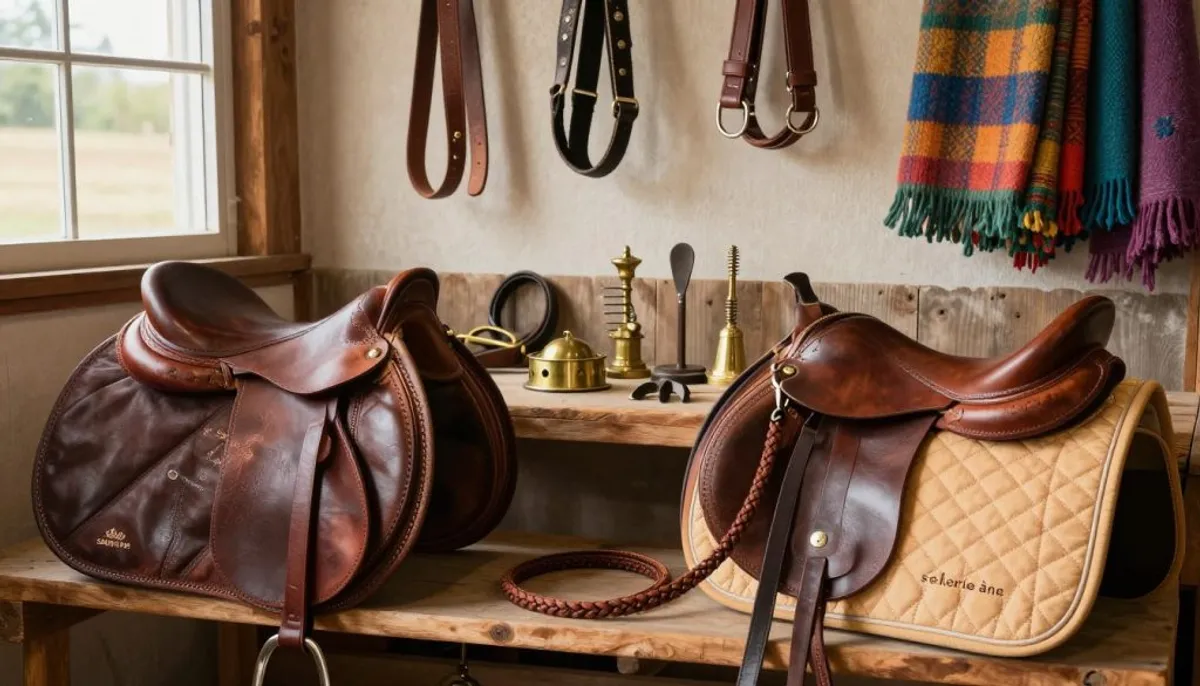
Why Choose High-End for the Comfort and Safety of the Donkey
Equipment that is too large for a miniature donkey can turn, slip, and injure. If it is too tight, it hinders its breathing, making outings difficult. High-end items offer more stability, finesse in finishing, and strong seams.
At first, high-end equipment may seem more expensive. But over time, you save on repairs and adjustments. For an animal living many years, these savings are significant.
Made in France from A to Z: The Artisan Requirement of La Sellerie Française
La Sellerie Française produces everything in France, much more than just labeling. The pieces are made by excellent French artisans. Their work on leather and finishes ensures superior quality. This guarantees optimal comfort, even when the donkey moves a lot.
Custom or Limited Series: Adapting Equipment to Size (Dwarf/Miniature Donkey)
Choosing custom or a limited series allows for perfect adaptation of the equipment to the donkey. Thus, there are no unnecessary buckles or excess leather that hinders. This is essential for the daily comfort of the donkey, especially during learning or walks.
| Point to Check | Why It’s Important | What We Aim for with Custom |
|---|---|---|
| Jaw Circumference and Muzzle | Reduces friction and slipping | Stable support, regular contact, simple adjustment |
| Headpiece and Ear Passage | Avoids pinching on a finer head | Adapted cut, comfort on long outings |
| Strength of Buckles and Seams | Limits breakage risks in hand | Durable assembly, enhanced safety |
| Lead Length | Improves control without pulling or tangling | Good grip, consistency with size |
Useful Link: https://laselleriefrancaise.com
For more information and to compare prices based on finishes, visit La Sellerie Française: https://laselleriefrancaise.com. You will find equipment suitable for small sizes, made to last, and suitable for frequent use.
Conclusion
The cost of a donkey varies according to its type. A dwarf donkey costs between 800 and 3,000 €. For a miniature donkey, it’s between 1,500 and 4,500 €. A micro-donkey can exceed 4,000 €.
The location, the level of socialization, and the reputation of the breeding also influence the price. The official documents of the donkey can increase the price by 30%. Females generally cost more. Include the cost of castration for a gelding, which is 150 to 250 €.
The purchase is only the beginning of expenses. Each year, account for the cost of maintenance: food, veterinary care, and others. Also, set aside an amount for emergencies, between 200 to 300 €.
For the donkey's habitat, investment is necessary. Installations cost between 2,000 to 4,000 €. This includes a plot of 1,000 m² per donkey and a shelter of 2 m². Ensure that the fence is solid and without barbed wire.
A donkey needs a companion; this is essential. If you are unsure, renting a donkey can be an option. It allows you to test your environment. For a successful adoption, choosing good equipment like those from La Sellerie Française is crucial.
FAQ
What is the purpose of this guide on donkey prices in France?
The aim is to explain everything about donkey prices: buying, maintaining, and equipment (shelter, fencing, gear) and donkey rental. It aims to avoid mistakes before getting a donkey. Committing to a donkey requires time and preparation.
What “overall budget” should be planned before buying a donkey?
You need to add the purchase price, annual costs (food, hoof care, veterinary), and initial costs (shelter, fencing, land, hay storage, equipment). There is much to spend even before the donkey arrives.
Adopting a donkey is a commitment for how many years?
Information shows that donkeys often live from 25 to 35 years, some go beyond. There are also miniature donkeys that can live from 30 to 40 years. Think about organization, budget, and time for decades.
Why does the donkey price vary so much by breeding and regions?
Prices change based on region, breeding specialization, support offered, and health guarantees. Specialized breeders, especially in the south, sometimes display higher prices.
Does the use (companionship, agricultural, breeding) change the donkey price?
Yes, the use influences taxes. It is said that 20% VAT is for a companion donkey, 10% for brush clearing, and 5.5% for breeding. Check if the price is before tax or after tax.
How much does a dwarf donkey cost to purchase?
A dwarf donkey costs between 800 and 3,000 €, depending on its size, color, breeder, whether the donkey is sociable, and the available documents.
What is the price of a miniature donkey in France?
The price of a miniature donkey varies between 1,500 and 4,500 €. This depends on the size and pedigree of the animal.
Micro-donkey and micro-miniature: why does the price often exceed 4,000 €?
Their rarity drives up prices. Micro-donkeys and micro-miniatures often cost more than 4,000 €. Size, conformation, socialization, and paperwork influence the price.
What sizes distinguish “small size,” “miniature,” and “micro-miniature”?
“Small size” goes up to 90 cm, miniature is 80 cm max, and micro-miniature is < 76 cm. The dwarf/miniature donkey often has between 91 and 96 cm at the withers. Some micro-foals reach only 45 cm as adults.
Why is predictable adult size the number one criterion for donkey price?
The market prefers small adult subjects. Size is estimated based on the parents and growth curves. If the donkey stays small, its price will be higher.
Does the weight of a miniature donkey change the cost of equipment?
Yes. They weigh between 80 to 120 kg. This affects the choice of halters, leads, and protections. Also, the strength of fences, shelter, handling, and transport.
Do rare coats increase the donkey price?
Yes, the coat influences prices. Rare colors like piebald, isabelle, chocolate can add 500 to 800 € to the price depending on the breeder.
Do conformation and socialization really influence the donkey rate?
Yes. Well-bred and socialized foals are more valued. A donkey accustomed to contact is easier to manage. Gentle education helps against fearful behavior.
Why do some breeders display a higher donkey price?
The premium can be explained by the reputation of the breeder, health follow-up, guarantees, and post-purchase support. There is a significant difference between a quality donkey and one without documents, even if it can be very good.
In France, is the miniature donkey officially recognized?
Yes, in 2021, the French Institute of Horse and Riding (IFCE) recognizes the miniature donkey. This helps find serious breeders.
What does AFAMAS do to help buy at the right price and the right place?
The AFAMAS guides towards reliable breeders, to compare and understand the standards and documents offered.
What is the role of papers and pedigree in donkey pricing?
The documents prove the origin, selection, and can increase value for resale or registration of foals. It’s key for breeding or competitions.
What is the impact of MDR papers on donkey price?
Having or not having MDR (Miniature Donkey Registry) papers can make a significant difference of 30% in price.
What “before tax” ranges are cited according to size and MDR papers?
Without MDR, a small size costs 1,500–2,000 €, with MDR it’s 2,000–2,600 €. For miniatures, without MDR, it’s 2,500–3,500 € and with MDR 3,200–4,500 €. Micro-miniatures without MDR are worth 3,800–4,800 € compared to 4,800–6,500 € with MDR. At these prices, VAT may be added.
Can you get a registrable MDR foal with only one MDR parent?
No, both parents must be MDR for a foal to be registrable MDR. With only one MDR parent, the foal cannot be registered.
Female, entire male, or gelding: what impact on purchase price?
Prices can vary from 1,000 to 1,500 €. Female miniature donkeys cost more due to reproductive potential. Males are slightly cheaper but can be difficult to manage. Geldings are seen as the best choice for a family.
How much does it cost to castrate a donkey, and should it be included in the budget?
Yes, include it as it influences life and expenses. Castration costs between 150 and 250 € at the vet, in addition to the purchase price if the donkey is not already castrated.
How much does a donkey cost daily: what is a realistic annual budget?
Two cases are cited: a “broad” budget of 800 to 1,200 € / year per donkey, and a lower possibility around 265 € / year. Add an initial cost of 2,000 to 4,000 € for equipment.
Feeding: what to plan and what traps can quickly increase costs?
Base it on grass + hay. Watch out for obesity. Plan about 3 kg of hay/day for an annual cost of about 150 €. Limit concentrates to 200 to 400 g/day. Don’t forget 20 to 30 liters of water/day and a salt lick.
Veterinary Budget: what amounts are cited for a donkey?
It is indicated 200 to 300 € / year. For prevention, count about 40 € for vaccines and 7.50 € per dewormer, to be given 2 to 4 times a year. Add an annual dental check-up.
Hooves: how often and at what price should trimming be planned?
Trimming every 2 months is recommended. For the budget, count 250 to 300 € / year. Another approach suggests 60 € / year for 2 to 4 trims.
Why should a reserve for “unexpected” be planned when calculating how much a donkey costs?
Health problems or injuries can be expensive. It is advisable to keep 200 to 300 € for veterinary emergencies.
What installations need to be financed before the arrival of the animal?
Many do not see all the initial costs. It takes between 2,000 to 4,000 € for shelter, fencing, and equipment. Think of everything: land, water, hay, and security.
What minimum area should be planned for the welfare of a donkey?
At least 1,000 m² per donkey is needed, but 1,500 m² is better. This allows managing space and providing them with a good life.
What type of shelter should be installed and what budget might it involve?
They need about 2 m² each, with three closed sides, a dry and ventilated place. Change the bedding regularly. Even though they are hardy, a good shelter is important.
Fencing: what height and what mistakes to avoid?
It should be at least 1.20 m high. Avoid barbed wire to prevent injuries. A good fence is crucial for their safety.
Why is it said that a donkey should never live alone?
Donkeys are social animals. Solitude can cause stress and troubles. They need at least one friend: another donkey, a pony, or even a sheep. This also influences the budget.
How to prepare the education of a donkey (halter, care) without making it stubborn?
Start early with patience and without force. Teach it to walk on a halter, to be brushed, and to stay calm for care. Short sessions of 15 to 20 minutes are best.
What checks to make during a breeder visit before buying?
Always visit. Look at how they live, if they are sociable, and meet the parents if possible. Also check the health and documents of the donkey.
Where to find reliable benchmarks for adopting in France?
Look for quality breeders and well-organized groups, like AFAMAS. The Francarolis Donkey Farm (Hautes-Pyrénées) is a good example for American micro-donkeys.
Donkey rental: in what cases is it better to rent a donkey rather than buy?
Renting a donkey is a good idea for trying or for a temporary need. This includes brush clearing, certain events, or just discovering how it is while respecting the donkey.
Rental price for a donkey: what factors affect a quote?
The price changes according to the duration, transport, if a pro supervises, the equipment, and the insurance. It also depends on where the donkey will be housed.
Renting a donkey: what checks for welfare and insurance?
Check that everything is compliant (land, shelter, fencing), the insurance, and avoid overburdening it. It must be well integrated and respected.
What equipment to plan for a dwarf or miniature donkey, and why avoid approximate material?
Their small size (80–120 kg) requires suitable equipment: halter, lead, protection, and specific harnessing. Poor equipment can cause injuries or be dangerous.
Why mention La Sellerie Française when discussing budget and safety?
Good material increases safety and comfort. La Sellerie Française offers quality products, unique or in limited series. They are made in France by excellent artisans.
Where to find La Sellerie Française?
Useful link: https://laselleriefrancaise.com
In summary, how much does a donkey cost when adding purchase, maintenance, and installations?
Benchmarks suggest a purchase base of 800–3,000 € for a dwarf donkey and 1,500–4,500 € for a