
Being passionate about horseback riding, whether as a horse owner or a professional, mastering the vocabulary in English is crucial. This guide provides support to communicate accurately. It will help you grasp the nuances of English in the equestrian field.
Key Points to Remember
- Discover key terms for equipment, the gaits of the horse, and jobs in the equestrian sector in English.
- Learn to accurately translate technical terminology and idiomatic expressions related to horseback riding.
- Explore equestrian disciplines and competitions to enhance your understanding of equestrian English.
- Benefit from advice on using reliable resources and considering context when translating.
- Become an expert in horseback riding in English with this comprehensive guide.
Introduction to Equestrianism in English
Learning equestrian vocabulary in English is crucial for riders and horse owners. It is useful for communicating with English speakers, reading books, or participating in international competitions. This guide will teach you the key terms of equestrianism in English.
The Importance of Learning Equestrian Vocabulary in English
Learning equestrian vocabulary in English has many advantages. You will be able to:
- Communicate effectively with English speakers, both in work and personal life.
- Understand and express yourself in competitions or international equestrian events.
- Read and interpret technical documentation and books in English.
- Enhance your expertise and credibility in horseback riding.
Challenges of Translating from French to English in the Equestrian Field
The translation of equestrian vocabulary from French to English poses challenges. It is necessary to consider linguistic, cultural, and regional differences. Some terms have no direct equivalent, while others have different meanings. This guide will help you overcome these challenges of equestrian translation.
Basic Vocabulary in English Equestrianism
Let's explore the essential equipment vocabulary for English horseback riding. It is useful for everyone, whether beginners or seasoned riders. It facilitates communication with instructors and other riders.
Names of Equipment and Accessories
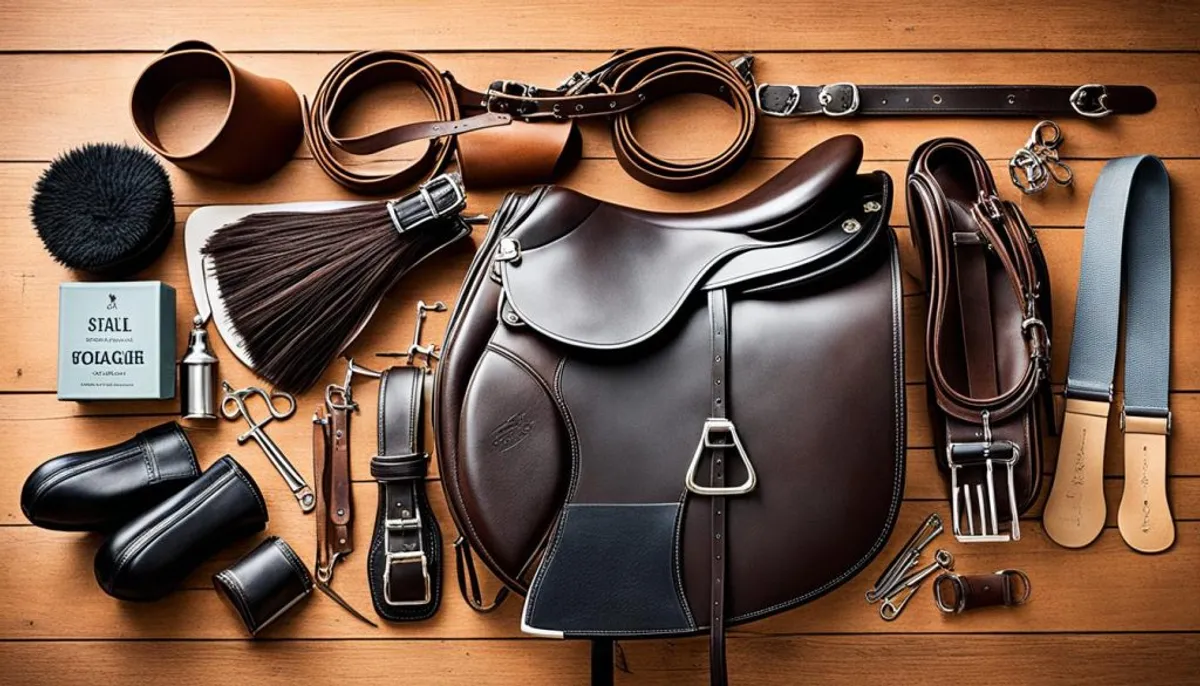
Important accessory names in English horseback riding include:
- The saddle (saddle)
- The bridle (bridle)
- The stirrups (stirrups)
- The whip (whip)
- The spurs (spurs)
Terms for Describing the Gaits of the Horse
It is crucial to know the terms for horse gaits in English horseback riding. The main gaits are:
- The walk (walk)
- The trot (trot), with the variations “sitting trot” (sitting trot) and “rising trot” (rising trot)
- The canter (canter/gallop)
- The backing (backing/rein back)
Learning this equipment vocabulary for English horseback riding and these terms for horse gaits in English horseback riding improves your understanding. You will also be able to express yourself better during riding sessions.
| Equipment/Accessory | Term in English |
|---|---|
| Saddle | Saddle |
| Bridle | Bridle |
| Stirrups | Stirrups |
| Whip | Whip |
| Spurs | Spurs |
Jobs and Roles in the Equestrian Industry
The world of horseback riding is rich and exciting. It offers many essential jobs and roles. Understanding the English terminology for these equestrian jobs in English and roles in the equestrian industry in English is crucial.
The groom, or “groom” in English, takes care of the horses. The farrier, or “farrier,” takes care of the hooves. The riding instructor, or “riding instructor” or “equestrian coach,” teaches the art of horseback riding.
The jockey participates in horse races. The stable manager, or “stable manager,” manages the stables.
- The riding instructor, who teaches this art, is called a “riding instructor” or “equestrian coach.”
- The jockey, on the other hand, is the professional rider who participates in horse races.
- At a management level, there is the stable manager, referred to as “stable manager” in English.
Each equestrian job in English and role in the equestrian industry in English is crucial. Learning their terminology in English facilitates communication with English speakers.
The equestrian industry offers great opportunities. Whether you want to be a groom, instructor, or stable manager, knowing the equestrian jobs in English and roles in the equestrian industry in English is essential.
Equestrian Translation in English
The translation of technical terms in horseback riding is crucial for effective communication. It is important for riders, professionals, or enthusiasts. This guide will help you learn the translation of technical terms in equestrian English and communicate with expertise.
Translation of Technical Terms in Equestrianism
Equestrianism uses many specific terms. They relate to the anatomy of the horse, equipment, care, and competitions. Here are some terms to know:
- Anatomy: mane, neck, withers, cannon, fetlock, hoof, etc.
- Equipment: saddle, bridle, stirrups, crupper, girth, etc.
- Care: farriery, deworming, vaccination, veterinary, etc.
- Competition: dressage, show jumping, eventing, etc.
Idiomatic Expressions Related to Equestrianism
Equestrian expressions can be complex for beginners. Here are some common expressions:
- To hold the reins: to hold the reins
- To put one’s foot in the stirrup: to put one’s foot in the stirrup
- To mount a horse: to mount a horse
- To take the bit between one’s teeth: to take the bit between one’s teeth
- To be on one’s high horse: to be on one’s high horse
Mastering these translation of technical terms in equestrian English and idiomatic expressions in equestrian English is useful. It allows you to communicate clearly, whether you are a beginner or an expert.
Horse Breeding and Reproduction in English
If you are a breeder, owner, or equestrian enthusiast, knowing the vocabulary related to horse breeding and reproduction in English is crucial. You will learn the key terms for the stages, actors, and processes. This will help you communicate well with English speakers.
The Stages of Equine Reproduction
- The breeding: the mating between the stallion and the mare.
- The gestation: the development of the foal in the mare’s womb.
- The foaling: the moment when the mare gives birth to the foal.
- The raising: the care and support of the foal until it reaches adulthood.
The Actors in Equine Reproduction
- The stallion: the male horse for reproduction.
- The mare: the female that carries the foal.
- The foal: the baby horse.
- The owner: the owner of the horse.
- The breeder: the person responsible for breeding.
Understanding equestrian vocabulary in English will allow you to communicate clearly about horse breeding and reproduction. You will be able to discuss with professionals or enthusiasts in the equestrian world.
Equestrian Disciplines and Competitions
The world of horseback riding is rich and varied, with many disciplines. Each discipline has its own vocabulary and unique challenges. Whether you enjoy dressage, show jumping, or endurance, knowing the equestrian vocabulary in English is crucial. It will help you follow and participate in international competitions.
Here is an overview of the main equestrian disciplines and their vocabulary in English:
- Dressage: An event that evaluates the horse's suppleness and flexibility. It includes movements such as “shoulder-in,” “travers,” or “pirouettes.”
- Show jumping: The rider and their horse must jump over obstacles of varying height and width. They must do this in less time and without faults.
- Eventing: This event combines dressage, cross-country, and show jumping.
- Endurance: Long races over hilly terrain. They test the endurance of both rider and horse.
- Horse-ball: A team game where riders throw a ball through rings.
Understanding equestrian vocabulary in English is useful, whether you are a spectator or a participant. It will help you better understand and appreciate the equestrian disciplines and competitions.
Tips for Accurate Translation
To translate equestrian vocabulary accurately, it is important to use quality resources. Specialized dictionaries, glossaries from federations, or recognized websites are perfect. This guide shows you the best sources to improve your knowledge of context in equestrian translation in English.
Using Reliable Resources
Choosing quality resources for accurate equestrian translation in English is crucial. Here are some recommended sources:
- The glossary of the French Equestrian Federation (FFE) is a reference for technical terms in horseback riding.
- The “Equestrian and Horse” dictionary from Larousse Editions offers an accurate translation of equestrian vocabulary.
- The website of the International Equestrian Federation (FEI) provides online resources on equestrian disciplines and their terminology in English.
The Importance of Context in Translation
Understanding context in equestrian translation in English is essential for translating equestrian vocabulary. Terms can have different meanings depending on the context. For example, a word may mean something different in competition than in breeding or horse care. Therefore, it is important to consider context in equestrian translation in English for accurate translation.
| Equestrian Term | Meaning in Competition | Meaning in Breeding | Meaning in Care |
|---|---|---|---|
| Saddle | Riding equipment for competition | Equipment used during breeding | Equipment used for caring for horses |
| Bridle | Control equipment for the horse in competition | Equipment used during breeding | Equipment used for caring for horses |
| Saddle pad | Riding equipment for competition | Equipment used during breeding | Equipment used for caring for horses |
Conclusion
This comprehensive guide has helped you understand equestrian vocabulary in English. Whether you are a rider, a horse owner, or a professional, you now have the tools to speak English. This facilitates communication in an English-speaking environment.
Use this guide often to improve your knowledge. Stay updated with the latest developments in the equestrian lexicon in English. You will know how to translate technical terms and special expressions of equestrianism in English.
You are now ready for the challenges of the equestrian translation guide in English. You will be able to communicate easily in English, opening new doors in your career or equestrian passion.
FAQ
Why is it important to master equestrian vocabulary in English?
Being able to speak English in equestrianism is crucial for riders and horse owners. It helps communicate with English speakers, read books, or participate in international competitions. It gives you a significant advantage.
What are the main challenges of translating equestrian vocabulary from French to English?
Translating equestrian vocabulary into English is difficult. It requires knowledge of linguistic and cultural differences. Some terms have no direct equivalent. This guide will help you overcome these challenges.
What are the main equipment and accessories in horseback riding that I should know in English?
You will learn the English terms for horseback riding equipment. This includes the saddle, bridle, stirrups, whip, spurs, etc. This will facilitate communication during your riding sessions.
How can I learn the terms for describing the different gaits of the horse in English?
You will discover the terms for the walk, trot, canter, and more. You will also learn expressions like “sitting trot” or “backing.” This will help you understand the instructions from your English-speaking instructors.
What are the main jobs and roles in the equestrian sector in English?
You will learn about the jobs and roles in horseback riding, from groom to stable manager. You will also discover the English terms for these roles. This will help you communicate with your English-speaking colleagues.
How can I accurately translate technical terms of horseback riding into English?
This guide will teach you how to translate technical terms in horseback riding. This includes horse anatomy, care, competition, and breeding. You will thus become an expert in your field.
What are the main idiomatic expressions related to horseback riding in English?
Equestrianism has created many idiomatic expressions in English. This guide will help you understand and use them correctly. You will be able to communicate with ease.
How can I learn the vocabulary related to horse breeding and reproduction in English?
Mastering the vocabulary of horse breeding and reproduction in English is essential. You will discover the key terms for the different stages and the actors involved. This will allow you to communicate effectively with your English-speaking colleagues.
What are the English terms used in different equestrian disciplines?
Equestrianism includes many disciplines, such as dressage or show jumping. This guide will familiarize you with the English terminology of these disciplines. You will be ready for international equestrian competitions.
What are the best resources for accurate translation of equestrian vocabulary in English?
For reliable translation, use quality resources. Specialized dictionaries, glossaries from federations, or recognized websites are recommended. This guide provides you with the best sources to improve your equestrian English.
Why is it important to consider context when translating equestrian vocabulary into English?
Understanding context is crucial for translating equestrian vocabulary into English. Some words have different meanings depending on the context. This guide explains how to take context into account for accurate translation.