
Decoding your horse's visual perception is a key element for a harmonious relationship. As Dr. Aude Lhérété points out, these animals are hypersensitive. Their senses, highly developed, are their best asset for survival in the wild.
Their way of perceiving the world directly influences their reactions and behavior on a daily basis. A sudden shadow, a shiny object, or an unusual movement can generate responses that we, humans, misunderstand.
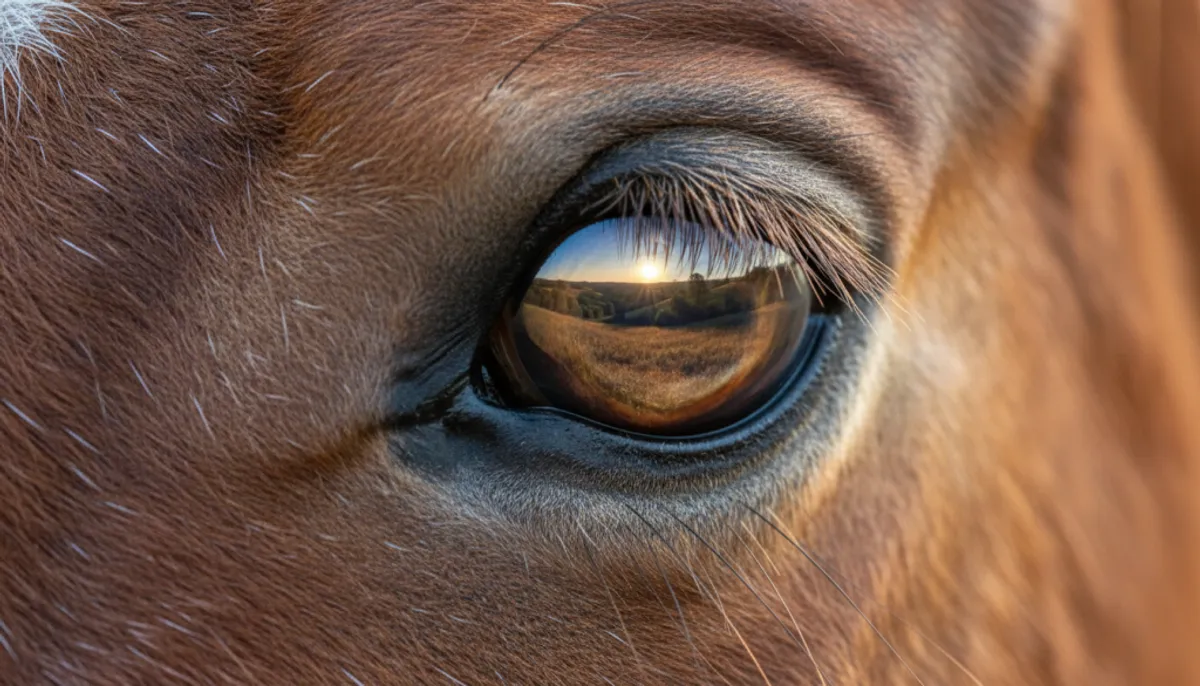
In this article, we will explore the mysteries of their ocular anatomy. This exploration will help you understand how your companion interprets its environment. You will thus be able to anticipate its fears and strengthen a solid trust relationship.
Vision is, for them, an effective survival tool. It allows them to spot their food and detect potential danger with remarkable efficiency. Understanding this complex mechanism is a step closer to their well-being.
Key Points to Remember
- Horses are hypersensitive animals with highly developed senses.
- Their visual perception largely conditions their behavior.
- Understanding their eyes allows us to decode their reactions to the unknown.
- Their vision is an essential survival tool in the wild.
- This in-depth knowledge is fundamental for building a trust relationship.
- Their anatomical specificities explain their field of vision and acuity.
Anatomy and Functioning of the Horse's Eye
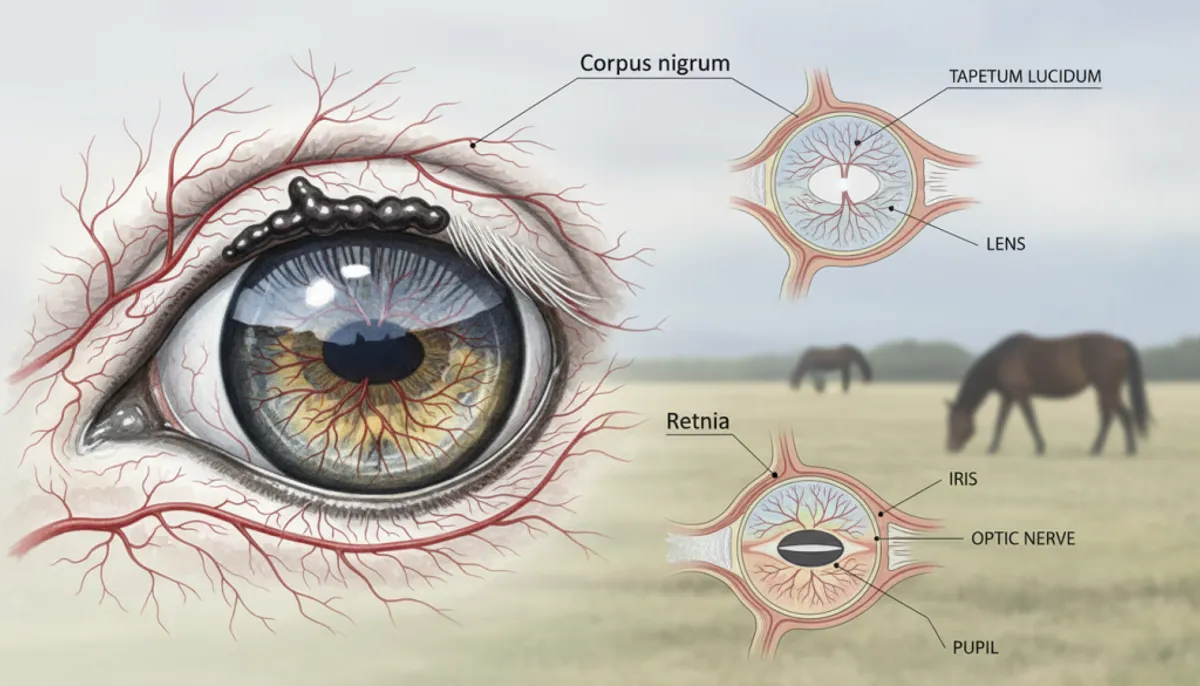
The horse's eyes, the largest among terrestrial mammals, function like sophisticated lenses. Their oval shape, similar to a rugby ball, is a key adaptation. It allows for a sharp focus on both near and distant objects.
Structure of the Eye and Anatomical Characteristics
This unique shape houses a retina rich in cells called rods. These are crucial for effective night vision.
A natural mirror, the tapetum lucidum, reflects the light available. This amplifies sensitivity in dim light.
Widened Visual Field and Blind Spots
Positioned on the sides of the head, the eyes provide a panoramic field of vision of 340°. This is well above that of humans.
In front of them, a small binocular vision zone allows for depth perception. This is essential for judging the distance to an obstacle.
However, there are blind spots. The animal cannot see directly behind its hindquarters or under its nose. You should always announce your approach.
Specificities of Equine Visual Perception
Beyond anatomy, the way the horse interprets light information defines its vision of the world. Two aspects are fundamental: its color perception and its sensitivity to brightness, as well as the distinct use of its two types of vision.
Color Perception and Sensitivity to Brightness
The horse has a dichromatic vision. It does not distinguish the color red, unlike humans. Its world is therefore tinted with shades of blue, yellow, and gray, resembling sepia images.
Its visual acuity is estimated at 20/30. This means it sees clearly enough to detect movement from a great distance, but fine details escape it.
Its retina, rich in rods, makes it very sensitive to low light. However, its eyes take time to adjust to sudden changes in brightness. Quickly transitioning from a dark stable to bright sunlight can disorient it.
Binocular Vision versus Monocular Vision
On the sides, it uses monocular vision. This allows it to scan a wide field without turning its head, ideal for monitoring the horizon. However, it does not perceive depth in this area.
Just in front of it, binocular vision takes over. It is used in a limited manner, primarily to assess the distance of an obstacle. The animal is much more reactive to movement than to stationary objects.
For riders, this perception influences reactions. An obstacle foot of beige color may blend into the ground. A frontal approach is always preferable to be seen clearly.
How a Horse Sees: Impact on Behavior and Interactions
The way the horse perceives the world has immediate practical consequences on its behavior and safety.
Interpretation of Visual Signals in the Environment
An altered vision completely changes the reading of the world. As veterinarian Pauline Cantet explains, scars or synechiae create blurry or opaque zones.
These defects can be perceived as threatening shadows. The animal then reacts with unpredictable jumps.
Comparison Between Horse Vision and Human Vision
Our perception differs radically. The human sees sharply straight ahead.
The equine companion, on the other hand, primarily uses its lateral vision. It turns its head to observe us from the side, as this is where its field is the widest.
Implications for Safety and Daily Behaviors
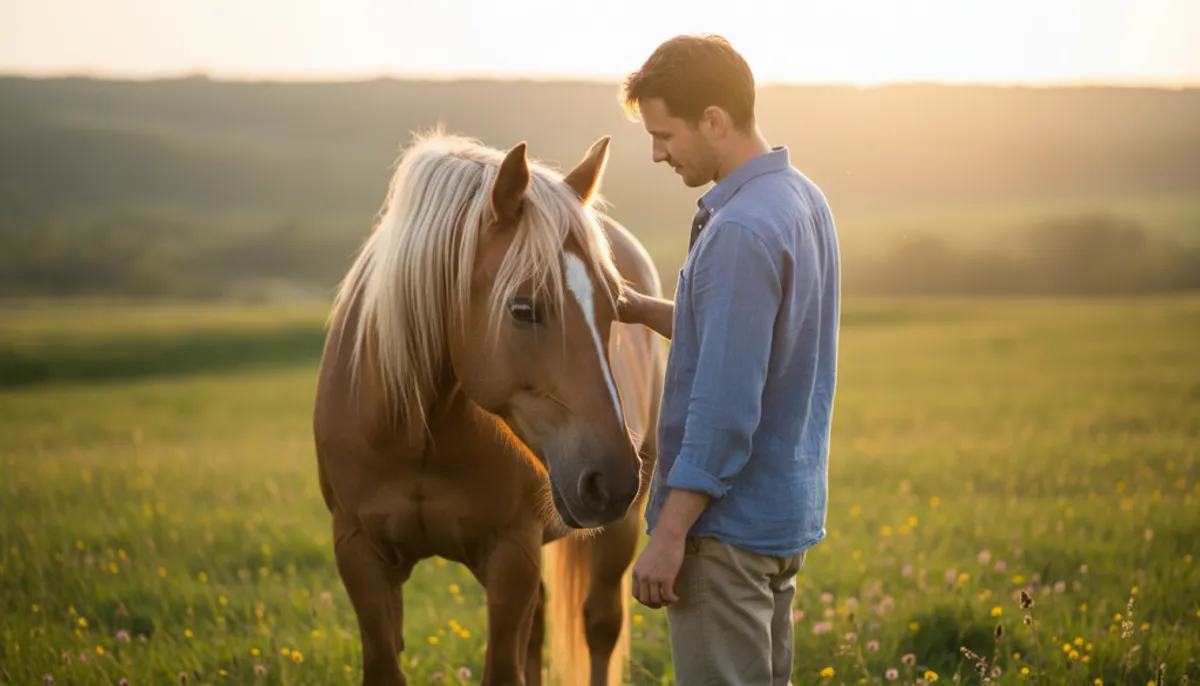
This unique perception dictates essential safety rules. Avoid moving quickly beside them, as they perceive it as a threat.
Give them time to adapt to changes in light, such as when entering a trailer. A stable with a clear view calms their environment.
Finally, a soft gaze is often a sign of a confident and relaxed partner.
Conclusion
The particularities of equine vision, so different from ours, are the key to deciphering many of its behaviors. This complex system is a perfectly adapted legacy for survival in open environments.
Understanding this panoramic field and sensitivity to light changes everything. You thus ensure the safety of your partner by avoiding its blind spots.
Observing its eyes allows for a better understanding of its emotions. Science continually enriches this knowledge, making our practice more accurate and empathetic.
Ultimately, respecting the way the horse perceives the world is the foundation of a lasting relationship of trust and complicity.
FAQ
Do equines distinguish colors?
Yes, but differently from us. Their retina primarily perceives blues and yellows. Shades like red or green appear duller, in shades of gray or beige. This perception influences their reaction to a colored obstacle.
Where are the blind spots in this animal?
It has two main ones. Directly behind its head and just in front of its muzzle, over a short distance. That’s why it’s crucial to approach it from the side and talk to it so it can perceive you, avoiding any startling.
Why does it sometimes startle at a familiar object?
Its vision is excellent for detecting movement, but less so for static details. A bag or a moved stone may seem new and threatening. Its wide field of vision allows it to constantly scan its environment for safety.
How does it perceive the world compared to humans?
Human vision is primarily binocular and focused on details. The animal combines frontal binocular vision to judge distances, with monocular vision on the sides to monitor its surroundings. It sees wider, but with less central precision.
Does brightness affect its way of seeing?
Absolutely. Its eyes have many rods, giving it excellent night vision. However, the adaptation between shadow and bright light is slower. A dark entry into a stable may require some adjustment time.