
You have progressed to level canter 4 in horseback riding. This is an important step to refine your techniques. The French Tack Shop is delighted to assist you in this phase of improvement. You will learn essential tips and exercises to become an excellent rider.
Main Ideas to Remember
- Learn advanced canter 4 techniques to progress in horseback riding
- Discover tips to perfect your riding practice
- Explore specific exercises for level canter 4 to reach a new level
- Benefit from high-end products from The French Tack Shop to support you
- Become an accomplished rider through your mastery of canter 4
Introduction to Counter Canter
The counter canter is a special technique in horseback riding. It means the horse runs in a specific way. Even though it is difficult, it improves many aspects. Such as balance, flexibility, and coordination.
What is counter canter?
The counter canter is a particular gait. The horse uses the outside leg first. It is the opposite of its normal canter. This requires good equestrian technique.
Why learn and master counter canter?
The counter canter is important for anyone who rides. It improves the horse’s balance and flexibility. And it helps the rider to better coordinate with the horse.
If done well, the counter canter aids in many equestrian sports. Such as dressage, show jumping, or cross-country.
The different steps to achieve a good counter canter
- Prepare the horse by working on its balance and flexibility.
- Ask for the change of lead with the correct aids (seat, legs, hands).
- Maintain a good posture to assist the horse.
- Encourage the horse when it makes progress.
Common mistakes to avoid when learning counter canter
- Not preparing the horse before asking for the counter canter.
- Not using the aids correctly. This can destabilize the horse.
- Maintaining your own balance is also important.
- It is essential to encourage the horse properly. Otherwise, it may become discouraged.
To perform the counter canter well, one must follow the correct steps. And avoid common mistakes. This helps the rider and horse to work better as a team. It is beneficial for the balance, flexibility, and coordination of both.
The Fundamentals for Approaching Counter Canter
Before diving into counter canter, let’s understand the essentials. The rider's balance and the horse's role are crucial. As well as the use of aids and the synchronization between rider and horse.
The importance of the rider's balance
Having good balance is essential for counter canter. It helps the rider stay in place and give precise indications. Balance is the secret to a successful counter canter.
The horse's role in the success of counter canter
The horse plays an important role in counter canter. Its flexibility and balance are vital. The dialogue between the rider and the horse is crucial to succeed in this maneuver.
The aids and signals to use to initiate counter canter
To start the counter canter, the rider employs specific signals. This includes the gentle use of legs, seat, and reins. These techniques help guide the horse into the correct movement.
The importance of synchronization between rider and horse
Synchronization is key to learning and mastering counter canter. When the rider and horse are in sync, the counter canter becomes beautiful and natural.
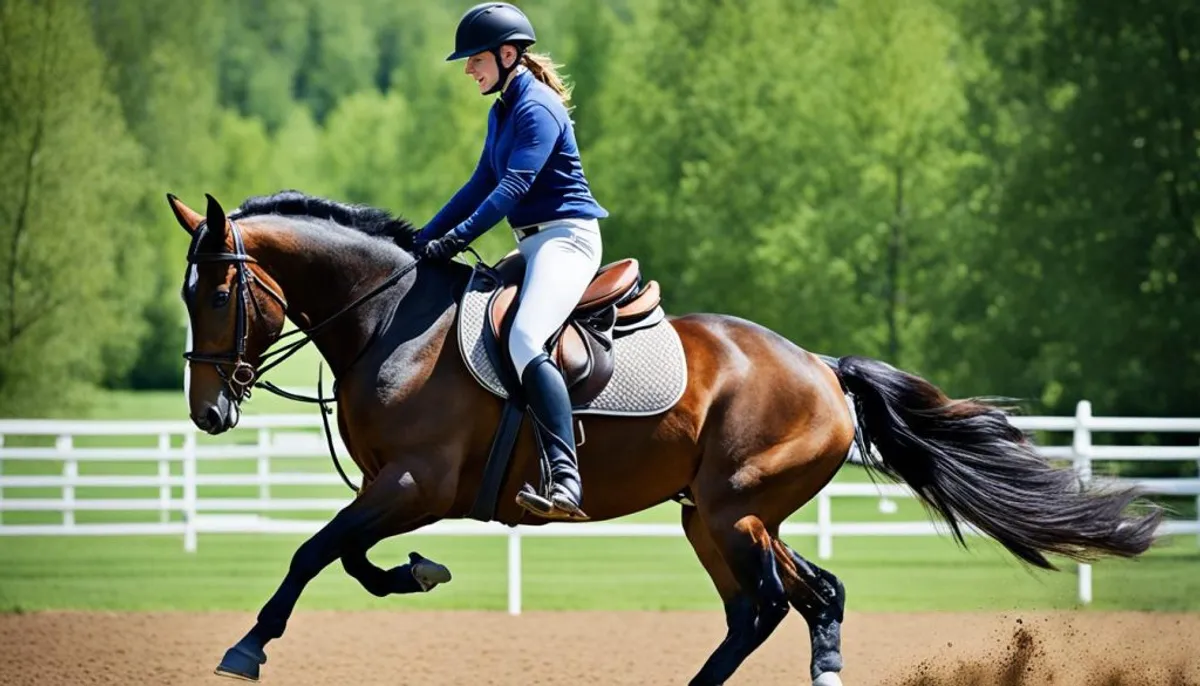
In conclusion, the success of counter canter relies on several elements. The rider's balance, the horse's role, the use of aids, and synchronization are fundamental. Mastering these is crucial for practicing counter canter successfully.
Horseback Riding Canter 4: Master Your Technique
Upon reaching level horseback riding canter 4, one must master advanced equestrian techniques. Whether in flat riding canter 4, show jumping, or cross-country, counter canter is essential. With solid fundamentals and appropriate exercises, you can elevate your level in horseback riding canter 4.
Understanding counter canter is key to improving. It allows you to better train your horse and be more precise in each equestrian discipline.
- Develop optimal rider balance
- Learn to use subtle aids to initiate counter canter
- Perfectly synchronize your movements with those of your mount
- Work on the quality of the stride and the cadence in counter canter
| Exercise | Objective | Benefit |
|---|---|---|
| Counter canter on the circle | Develop flexibility and suppleness | Improve the quality of the counter canter |
| Changes of lead in counter canter | Work on coordination and responsiveness | Master transitions |
| Counter canter in a straight line | Strengthen balance and stability | Gain power and engagement |
These techniques and exercises will truly enhance your horseback riding canter 4. By mastering counter canter, you will shine in all disciplines and achieve great goals.
Exercises to Work on Counter Canter
To master counter canter well, some exercises are necessary. These exercises are ideal, no matter your level in horseback riding. They will help you become better and learn how to execute a counter canter properly.
Basic exercises to start
It is good to begin with simple exercises. For example, you can try changing hands in counter canter. Or transitioning from trot to canter, then to counter canter. This will familiarize you with the horse's movements and the aids for counter canter.
Exercises to improve the quality of counter canter
When you are comfortable with the basics, advance to more challenging exercises. For example, do serpentines or figure eights in counter canter. Or changes of lead. These exercises will enhance your riding and the fluidity of your counter canter.
Exercises to strengthen balance and coordination
Counter canter requires good coordination. To assist you, do balance and stability exercises. Try sitting trot or changes of direction. These exercises will improve your synchronization with your horse.
Exercises to learn to manage speed and cadence
Managing speed and cadence is crucial. For that, do transition, extension, and collection exercises. This will refine your sense of rhythm and tempo.
With these appropriate exercises, you can significantly improve in counter canter. They will set you on the path to becoming a skilled rider.
Counter Canter in Different Equestrian Disciplines
Counter canter is crucial for riders in various equestrian activities. Let’s start by looking at its usefulness in each discipline and how it boosts results. For both the horse and the rider, it is a must.
Counter canter in dressage
In dressage, it is essential for the horse. It improves their flexibility, balance, and coordination. These changes of pace strengthen the connection between the rider and the horse. This enhances control for superior performances.
Counter canter in show jumping
In show jumping, it maintains rhythm and balance in turns. The rider has more control over the horse's movement, crucial in challenging courses. Therefore, knowing how to counter canter here is key for a safe jump.
Counter canter in cross-country
Cross-country requires this skill to manage speed and directions. Being able to counter canter helps navigate around obstacles and curves. It keeps the rider in control, even in challenging terrain.
Counter canter in other disciplines
Other equestrian sports, such as horseball or western riding, also benefit from counter canter. Here, it enhances the horse's maneuverability and responsiveness, giving an advantage to riders.
| Discipline | Role of counter canter | Benefits for the rider and the horse |
|---|---|---|
| Dressage | Develop the horse's flexibility, balance, and coordination | Improves communication and mastery of the horse's movements |
| Show jumping | Maintain the horse's rhythm and balance during changes of direction | Ensures safety and fluidity of the course |
| Cross-country | Manage the horse's speed and direction on varied terrain | Allows the rider to stay in control of their mount in demanding situations |
| Other disciplines | Improve the horse's maneuverability, agility, and responsiveness | Offers a significant advantage to riders |
Counter canter is key in many equestrian disciplines. Whether in dressage, show jumping, cross-country, or others, mastering it boosts communication and control. Thus, it enhances performance in any terrain.
Conclusion
The techniques of horseback riding Canter 4 will help you improve. This applies to dressage, show jumping, and much more. The exercises in this article will facilitate your progress.
Even if you are already experienced, horseback riding Canter 4 can help you. It provides balance, synchronization, and control when you ride. These aspects will make you more comfortable on the horse.
This article will teach you about counter canter in detail. No matter which equestrian discipline you prefer, use your passion. With determination, you will progress to the excellence of Canter 4.
FAQ
What is counter canter?
Counter canter is an equestrian method. It involves making the horse canter on the wrong lead. This helps strengthen balance, flexibility, and coordination. These qualities are important for both the horse and the rider.
Why is it important to learn and master counter canter?
Knowing how to perform counter canter improves the canter. It also helps to better understand the horse. Moreover, it is useful for many equestrian activities.
What are the key steps to achieve a good counter canter?
Before starting counter canter, one must be strong in balance. The rider must know how to move well with the horse. They must also use special aids. Coordination between the rider and the horse is crucial.
What mistakes should be avoided when learning counter canter?
One should avoid underestimating the basics. This includes good balance and the correct movements of the rider. It is also essential to use the right commands and aids.
What are the basic exercises to work on counter canter?
The first exercises include changing hands in counter canter. One can also do transitions from trot to canter, then to counter canter. These advanced exercises help to progress and better control the counter canter.
In which equestrian disciplines is counter canter used?
Counter canter is crucial in several sports such as dressage and show jumping. It is also important for cross-country, horseball, and western riding. It works on the horse's flexibility and balance. It helps maintain a good pace and balance during changes of direction and manage speed and direction on different terrains.