
Whether you are a beginner or an experienced rider, it is crucial to know the different levels of riding. This allows you to progress at your own pace. We will guide you through the techniques, disciplines, and tips to improve your level safely.
La Sellerie Française offers you a selection of high-quality equipment. They are made in France by recognized artisans. These products will help you progress in your equestrian adventure.
Main ideas to remember
- Discover the different levels of riding to progress at your own pace.
- Learn the key techniques and disciplines to improve your level.
- Equip yourself with quality products, made in France by artisans.
- Develop your safety and comfort on horseback.
- Participate in equestrian competitions to put your skills into practice.
The fundamentals of horse training
The training of the horse is a gradual and caring process. It is based on essential fundamentals. The progression scale is an important tool for riders, trainers, instructors, and judges. It is based on six key points.
This approach follows the traditions of the French school of riding. It aims to protect the physical integrity and moral well-being of horses. It also optimizes the use of flexibility and evaluates work objectively.
The progression scale
The progression scale follows the principles of “calm, forward, and straight” and “intimately marrying impulse and flexibility.” It is divided into six fundamental steps:
- The rhythm
- The relaxation
- The flexibility
- The contact
- The impulse
- The straightness
Definitions of key terms
The dressage lexicon defines the key technical terms. This ensures a precise understanding of the concepts. It helps in their application in horse training.
| Term | Definition |
|---|---|
| Rhythm | Regularity and cadence of the footfalls of the walk, trot, or canter. |
| Relaxation | State of relaxation and absence of tension in the horse's muscles. |
| Flexibility | Joint mobility and elasticity of the horse's movements. |
| Contact | Connection between the rider's hand and the horse's mouth, based on lightness. |
| Impulse | Propulsive energy generated by the hindquarters and transmitted to the forehand. |
| Straightness | Alignment of the horse on a straight line, without lateral deviation. |
The goals and principles of dressage
Dressage aims to transform the athletic horse into a confident and attentive partner. It uses harmonious education to achieve this. A well-trained horse is calm, forward, straight, relaxed, flexible, and willing.
It shows qualities of the trained horse such as the correction of gaits and the quality of contact. It is also light in the forehand and its movements are harmonious.
The trained horse shows a perfect understanding with its rider. This proves the success of the goals of dressage and the principles of dressage.
| Goals of dressage | Principles of dressage |
|---|---|
| Transform the horse into a confident and attentive athlete | Harmonious education |
| Achieve a horse that is “calm, forward, straight” | Develop flexibility and relaxation |
| Develop the correction of gaits, the quality of contact, the lightness of the forehand | Establish a perfect understanding with the rider |
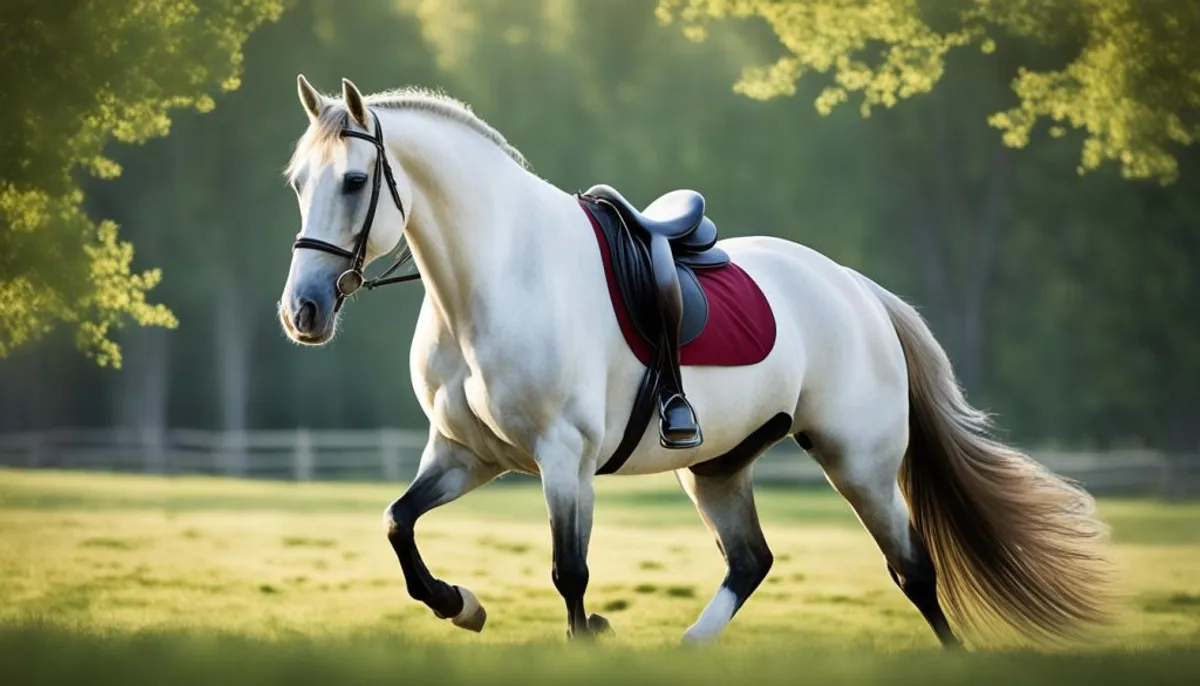
In conclusion, dressage seeks to create a balanced, flexible, and willing athletic horse. It aims for a harmonious union with the rider. This long-term work achieves its goals and principles, offering an ideal partner for riding.
Riding level: The organization of the scale
The progression in riding follows a well-thought-out structure. It uses a training scale for the horse. This organization of the scale ensures a gradual and effective progression.
The three main phases
The progression is divided into three key steps:
- Building the foundations: correction of gaits, flexibility, contact
- Developing propulsion: respecting the foundations, correcting gaits, flexibility, contact, straightness
- Perfecting balance: relying on propulsion and straightness, aiming for collection and expression
The six reference points
The six reference points of the scale correspond to these three phases. They set objectives for daily work and progression in horse training.
This structured organization guides the rider and the horse in their progression and development. It focuses on the key elements at each step.
The correction of the gait
The correction of locomotion and each gait is essential for riders. It relies on three pillars: rhythm, speed, and cadence. These elements ensure the horse's balance.
The rhythm
The rhythm concerns the distribution of time for the horse's limbs to touch the ground. It is crucial for a harmonious correction of gaits.
The speed
The speed must be stable and correct. This guarantees a flawless propulsion. Adequate speed preserves balance and fluidity.
The cadence
The cadence measures the frequency of a reference limb touching the ground. It must remain stable for each gait. A balanced gait cadence improves the quality of locomotion.
By controlling rhythm, speed, and cadence, the rider corrects the gaits of their horse. This ensures optimal balance.
Flexibility and relaxation
Flexibility and relaxation are key for dressage. They help the horse to accept aids well and be ready for all movements. The progression scale allows returning to the basics if needed.
Flexibility and relaxation are essential for the rider. They are demonstrated by:
- A relaxation of the horse's body parts, such as the neck and shoulders.
- A flexibility that allows the horse to respond well to aids.
- An absence of resistance, making work easier and strengthening mutual trust.
By working on these points, the rider creates harmonious dressage. This improves the horse's well-being and performance.
The quality of contact
Building the foundations of riding emphasizes a perfect quality of contact between the horse and the rider. This quality means an absence of resistance from the horse and a lightness of the forehand. These points are crucial for the horse and rider to work in harmony.
Absence of resistance
The quality of horse contact is shown by an absence of resistance from the horse. It must be open to the rider's guidance and respond softly. This openness is the foundation of good collaboration between the horse and the rider.
Lightness of the forehand
The lightness of the forehand is also key for the quality of horse contact. This lightness comes from the horse's impulse and balance. A well-balanced horse that uses its hindquarters properly makes its forehand light and easy to control.
The quality of horse contact, without resistance and with a lightness of the forehand, is essential. It allows the horse to fully develop with its rider. This is an important goal in riding.
Conclusion
The progression scale in riding is very important. It guides riders, trainers, and judges towards a balanced development of horses. It is based on six key points to protect horses and improve their training.
This method offers a useful framework while allowing the freedom to choose exercises. Thus, progress in riding is achieved gradually and sustainably. This goes from beginner to the highest competition level.
Whether you are a beginner or experienced, these tips will help you improve your level. They will also help you create a harmonious relationship with your horse. By following these principles, you can achieve fulfilling riding.
FAQ
What are the different levels of riding and how can I progress at my own pace?
We will show you the different levels of riding, from beginner to expert. You will learn the techniques and how to improve your level. All this will be done safely, at your own pace.
What products does La Sellerie Française offer?
La Sellerie Française offers high-quality products, made in France by reputable artisans. They are unique, custom-made, or in limited series. They exceed the standards of “made in France” and the “Origine France” certification.
What is the progression scale in riding?
The progression scale is a tool for riders, trainers, and judges. It is based on six key points for the safety of horses and the evaluation of their work.
What are the goals and principles of dressage?
Dressage aims to transform the horse into a confident and attentive athlete. It seeks harmonious education. A well-trained horse is calm, forward, straight, relaxed, flexible, and willing.
How is the progression scale in riding organized?
The progression scale is divided into three phases: building the foundations, developing propulsion, and perfecting balance. It includes six reference points related to these phases.
What is essential for the correction of gaits?
The correction of gaits relies on three key elements: rhythm, speed, and cadence. These factors ensure the horse's balance.
Why are flexibility and relaxation priority goals?
Flexibility and relaxation help the horse to respond well to aids. They are essential for good movement and transitions. The scale helps to return to these basics in case of problems.
What is essential for the quality of contact?
The quality of contact is shown by a lightness of the forehand. This comes from impulse and balance. This quality is crucial for good understanding between the horse and its rider.