
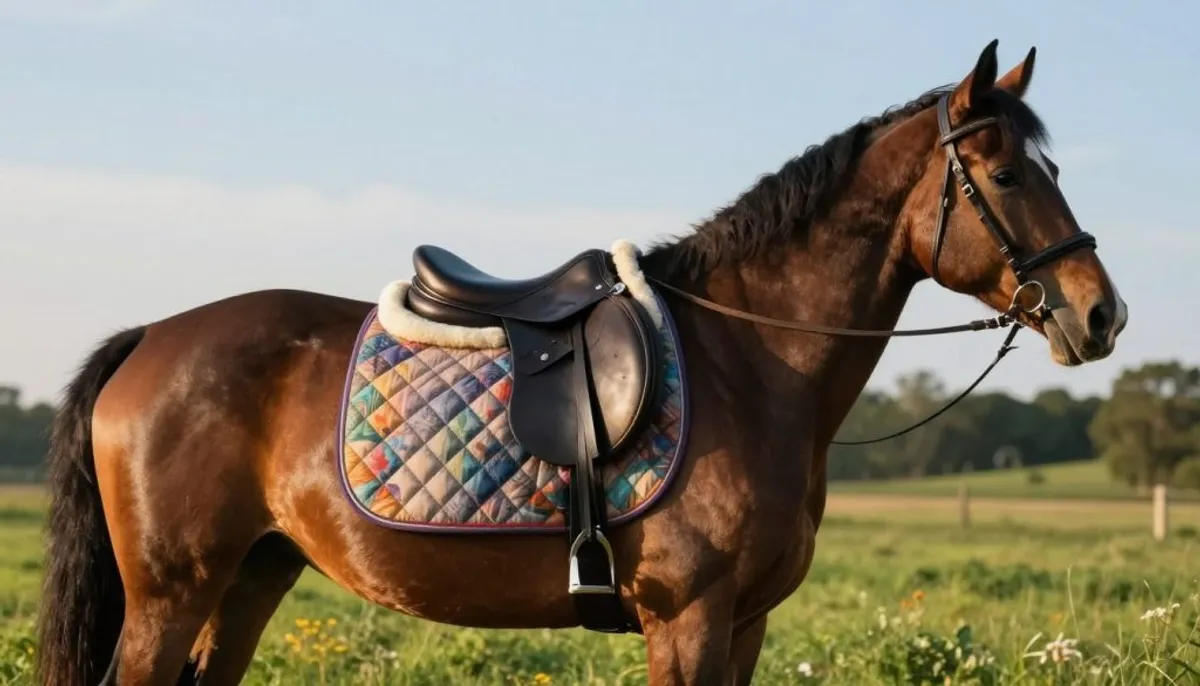
Choosing a saddle pad in style is important. We see it everywhere: in the stable, at competitions, and on social media. This pad is not just stylish; it also enhances comfort during training.
The term “saddle pad” encompasses several types. There are classic models, western pads, pads, and some shock absorbers. The cut and material affect the look and comfort, depending on the equestrian discipline.
The goal is to combine aesthetics and functionality. A good pad ensures hygiene, good contact between the horse and the saddle, and better stability. It also allows for coordination of the whole set: bonnet, wraps, and colors.
Head to Equitation PADD to explore trends and smart choices. The objective is to find what suits you best to create a harmonious setup. It should match your practice and budget while being aesthetic.
Key Points
- A trendy saddle pad can be both beautiful and useful.
- “Saddle pad” also includes pads, western pads, and some shock absorbers.
- The right choice depends on the discipline, cut, and material.
- Equitation PADD highlights selections designed for everyday use and competition.
- In Equitation PADD store, we look for both style and ease of maintenance.
- The right set fits within equestrian equipment in France, balancing comfort and finishes.
Why the saddle pad has become essential (style, hygiene, performance)
The saddle pad was initially there to protect and absorb. Now, it adds comfort and style to the equipment. When chosen carefully, it simplifies the horse's hygiene.
Protecting the saddle from sweat, dirt, and hair
Sweat and dust can accumulate under the saddle. A saddle pad acts as a barrier. This makes cleaning easier and better protects the saddle.
Regular maintenance is crucial. The pad should be brushed after each session, air-dried, and washed regularly. These actions preserve the horse's hygiene and prevent irritations.
Creating a comfortable “joint” between the horse and the saddle
The saddle pad does more than just look good. It ensures a soft contact between the horse and the saddle. This is very useful, especially during long sessions.
The important thing is to choose the right shape and material. In stores, look for models that limit creases and keep moisture away.
Composing a matching look (pad, bonnet, wraps) appreciated in competitions as well as training
Style has become essential: with varied colors and designs. Sets with bonnets and wraps give a polished look. Equitation PADD accessories help create a unified look.
Start with a well-chosen pad, then add matching touches. Sometimes, a bit of color on the bonnet or wraps is enough. This allows you to avoid overloading and stay consistent with what you already have.
| Need in saddle | What the saddle pad brings | Simple gesture to remember |
|---|---|---|
| Limit soiling | Absorption of sweat, barrier against hair and dust | Brush after the session to support horse hygiene |
| Improve comfort | More stable “joint” effect between back and saddle, fewer creases | Lay flat, without tension before girthing |
| Caring for presentation | Coordinated set with Equitation PADD accessories | Choose a dominant color, then a subtle reminder |
Focus equitation padd: spotting trendy saddle pads at Equitation PADD
Searching for a trendy saddle pad becomes easy when you know the tips. Equitation PADD offers stylish pads that maintain their shape after many uses. For riders in France, choosing the perfect pad is as important as selecting a bonnet or wraps.
What makes a “trendy” selection: colors, finishes, cords, logos, and decorations
There is a wide range of colors, from the most subdued to the brightest. Style is seen in the details: topstitching, padding, and decorative cords. A discreet logo or a few rhinestones add a fashionable touch without being over the top.
In the Equitation PADD store, quality pads are recognized by several factors. They have sturdy fabric, clean borders, and durable decoration. A good pad stands out while being useful in everyday life.
Adapting style to use: daily, competition, seasonal collections
For training, choices lean towards simple colors and a clean style. In competition, an impeccable look is sought, with precise finishes. Collections change with the seasons, offering trendy colors and styles.
| Use | Style that works | Details to prioritize |
|---|---|---|
| Daily | Easy-to-wear colors, clean look | Durable fabric, stable edges, discreet logo |
| Competition | Coordinated set and “clean” appearance | Contrasting cords, even padding, clean finishes |
| Seasonal collections | Current shades and trendy touches | Visible topstitching, small patterns, controlled decorations |
Where to search according to your needs: Equitation PADD store and PADD online saddlery
The Equitation PADD store is perfect for those who prefer to see products up close. The PADD online saddlery is convenient for a quick search by criteria. No matter your choice, look for a style you like, easy maintenance, and a stable pad.
Understanding different formats: rectangular pad vs. saddle-shaped pad
When choosing a pad, we often think of comfort. But, it’s mainly the shape that makes the difference. On PADD equitation, two silhouettes stand out.
Differences in cut: more visible fabric vs. cut close to the saddle
The rectangular pad shows more fabric under the saddle. It highlights the color and line of the mixed saddle.
The saddle-shaped pad is cut closely. It hugs the curves and shows less fabric, offering a discreet and neat look.
| Point to compare | rectangular pad | saddle-shaped pad |
|---|---|---|
| Visual effect under the saddle | Well-visible surface, assertive look | Profile close to the saddle, clean appearance |
| Visible fabric area | Large, especially at the back of the flaps | Reduced, follows the saddle's cut |
| Impression in motion | Highlights the color and borders | Becomes forgotten, more understated line |
Advantages of the rectangular format for decorations (cords, rhinestones, small logos)
The rectangular pad offers a large surface for style. Perfect for contrasting cords, piping, or logos.
It also showcases details like topstitching, rhinestones, or graphics. Often, in saddlery, this format catches the eye.
When to prioritize a “shape” pad according to the saddle and desired aesthetics
The “shape” pad is ideal for a clean aesthetic, without extra fabric around. It pairs well with sophisticated saddles or for a sleek look.
To decide easily:
- choose a shape for a discreet look, close to the saddle;
- opt for the rectangular to highlight colors, cords, and details.
The technical functions to know beyond the look
An elegant pad is not just for decoration. It also helps improve posture and distribute pressure. These technical details are as important as color or padding in equestrian equipment.
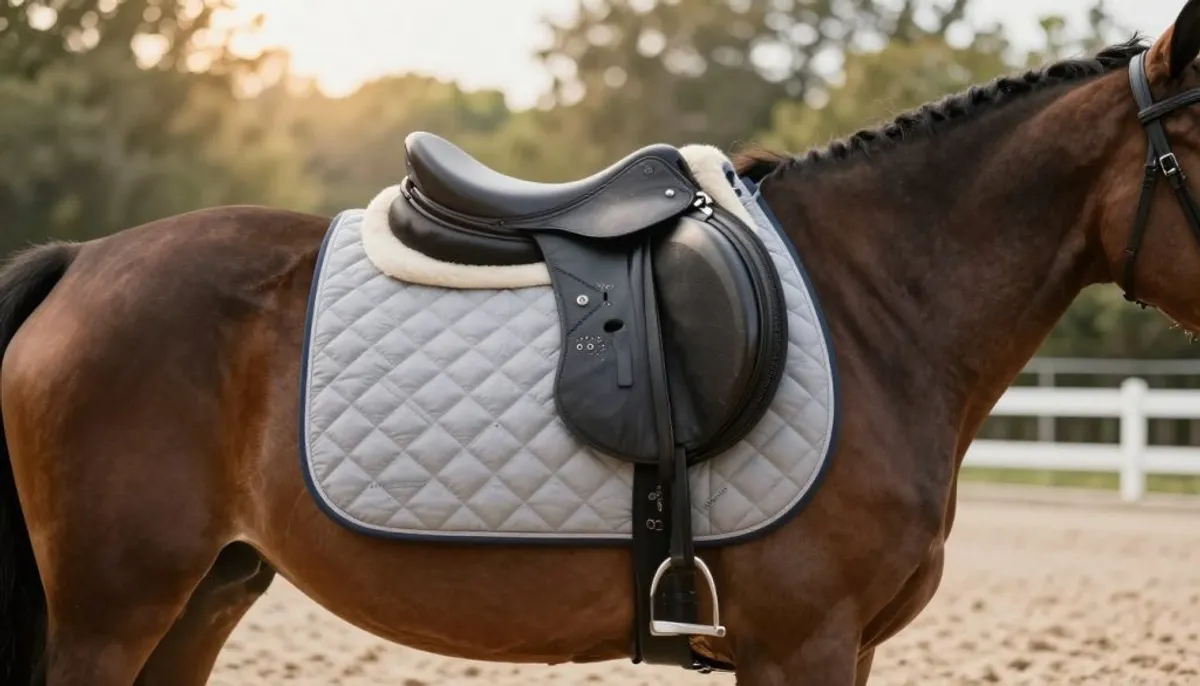
Think about your feelings while riding and the state of the horse's back after a session. A good pad makes the saddle more stable. It also improves the horse's back comfort, especially during intensive training.
Stability
If your saddle moves, some pads with non-slip zones can help. This is useful depending on the horse's shape, the discipline, or how the girthing adjusts.
It’s not about fixing the saddle at all costs. The goal is to reduce slips that cause creases. We want stability without having to tighten excessively.
Shock absorbers
A shock-absorbing pad is useful if the horse's back is not perfectly symmetrical. It helps adjust the saddle for perfect balance.
Pay attention to the thickness of the shock absorber. Too much can alter the position and fit. The important thing is to maintain comfort for the horse's back and stable contact.
Anatomical cut
An anatomical cut follows the shape of the back better. It reduces pressure points and keeps the pad in place. This is essential for comfort during movement.
To quickly see the differences, here are three points to check.
| Function | What you observe while riding | What to look for in the pad | Expected effect |
|---|---|---|---|
| Stability | Saddle moving on mounting or varied terrain | Non-slip zones, solid keepers, shape that stays centered | Better saddle stability, fewer creases |
| Shock absorption | Sensitive back, small asymmetries visible after effort | shock-absorbing pad with measured thickness and breathable material | Softer pressures, more consistent horse back comfort |
| Anatomy | Marks at the withers, pad that slides back or “bridges” | Cut for withers, pre-shaped back line, well-distributed padding | Less discomfort, neater placement under the saddle |
By choosing well, you create a suitable set, from girthing to pad. This is what makes equestrian equipment so effective: well-thought-out choices for successful training.
Choosing the right size and cut to avoid friction
Having a well-fitted pad is essential. With the right padd equipment for riding, stability is improved and irritations reduced. The perfect fit of the saddle pad is crucial: it should neither be too short nor too long and must remain centered.
First reflex: always check the space around the withers. Even so-called “anatomical” models can deform after several washes. To prevent this, reshape the pad after each wash to avoid pressure on the withers.
Then, align the pad well under the saddle. Place it correctly without pulling it excessively backward. The goal is to avoid creases or excess thickness and to maintain a line following the horse's back. This ensures the horse's comfort from the start.
In practice, you need to be attentive. Watch for signs of overheating, friction areas, and abnormal sweating (dry areas, distinct lines). A dirty pad or one full of hair can cause more friction, even with good padd equipment for riding.
| Quick check | What to look for | Simple action |
|---|---|---|
| Clearance of the withers | Visible space, fabric that “lifts” from the top of the withers | Reshape the pad while drying and lift it slightly before girthing |
| Surface under the saddle | No creases, no excess thickness at contact | Smooth by hand, check after a few steps at a walk |
| Marks after the session | Regular sweating, no hot or rubbed areas | Adjust the saddle pad fit and clean the pad more often |
| Condition of the pad | Soft, clean fabric, without hard seams or rigid edges | Brush, remove hair, let dry “open” to preserve horse comfort |
Materials and thicknesses: comfort, breathability, and maintenance
The material of the pad affects your comfort immediately. Every aspect, like the lining and padding, is crucial for a stable saddle and a supple back. Advanced fabrics control both temperature and humidity, especially during intense work.
“Just right” thickness
A pad that is too thick can create a distance between the saddle and the horse's back, harming your connection. Opting for a moderate thickness is generally the best option, including for western. Most riders choose between 2 to 3 cm of thickness to maintain clear contact and minimize pressures.
Flexibility and grip
A flexible pad adapts better and grips the horse's back more, avoiding creases. This better grip reduces the need to tighten excessively, thus minimizing discomfort and pain. Additionally, some equipment like non-slip pads and thin shock absorbers allow for fit adjustments without layering too many layers.
Easy-care textiles
A breathable pad dries quickly and remains comfortable, even if the horse has sweated. After getting wet or washed, let it air dry and hang it up to maintain its shape. Proper maintenance of your equipment reduces friction and preserves padding longer.
| Material choice | What you feel while riding | Impact on equipment maintenance | When it’s most useful |
|---|---|---|---|
| Mesh lining in technical textiles | Less heat, drier contact | Dries faster in the open air, less odor | Intensive work, horses that sweat a lot |
| Quilted cotton | Soft touch, correct stability | Simple washing, but may stay damp longer | Regular use, stable with rotating pads |
| Wool (often in pads) | Natural cushioning, good thermal regulation | Frequent brushing, careful drying, less frequent washing | Long sessions, seeking long-lasting comfort |
| Fine, dense foam filling | Closer feel, clear support | Sensitive to heat: avoid aggressive drying, reshape well | When you want to avoid the “too thick” effect |
Western pads and pads: options and uses according to the discipline
In the western world, the choice of pad is crucial for comfort and stability. It’s not just about protection but maintaining constant and soft contact under the saddle. This avoids hard points that can bother the horse.
On PADD equitation, we find solutions tailored to every need. Whether related to the type of exercise, the horse's shape, or its tendency to sweat. A quality pad acts as a cushion. It absorbs shocks, distributes pressure, and reduces friction.
Reminder of the objective: A good saddle/pad duo must stay in place at all times. It is important that it allows the horse's back to “breathe,” especially during long sessions.
The main types: We distinguish the liner, which is thin and placed under another pad. It is made of felt or neoprene and has no leather border. The show blanket, more aesthetic, goes over the liner. This changes the look without altering comfort.
Neoprene is practical and durable, perfect for daily use or competitions. It cleans easily. Some models have leather reinforcements, a textile top, or felt. The composite combines several materials like felt or foam into one pad. It offers optimal comfort with a sheep lining against the skin.
| Option | What you feel while riding | For what use | Point of caution |
|---|---|---|---|
| Liner (lining) | Stable and simple contact, regular cushioning base | Daily work, fine adjustment under the saddle | Choose with the right thickness to avoid “lifting” the saddle |
| Show blanket | Neat look, close feel to the liner if placed correctly | Presentations, competitions, harmonizing colors | Does not replace a liner suited to the morphology |
| Neoprene | Good hold, quick maintenance after a session | Versatile, practical when the horse sweats a lot | Monitor overheating and cleanliness to avoid irritations |
| Composite | Integrated cushioning, more “guided” pressure distribution | Seeking overall comfort, all-in-one solution | Weight and volume to check according to the saddle and withers |
It is advisable to test before buying, especially in western. Even with similar horses, reactions to a pad can vary. An expert can help understand signs like sweating. They can also check that the saddle is well balanced. This is true even if you already have an idea of what you want from PADD equitation.
Maintaining your saddle pad daily for the horse's skin health
A clean pad is very important. It prevents friction, allows air circulation, and protects the horse's skin. Equestrian centers know that these gestures prolong the life of the equipment.
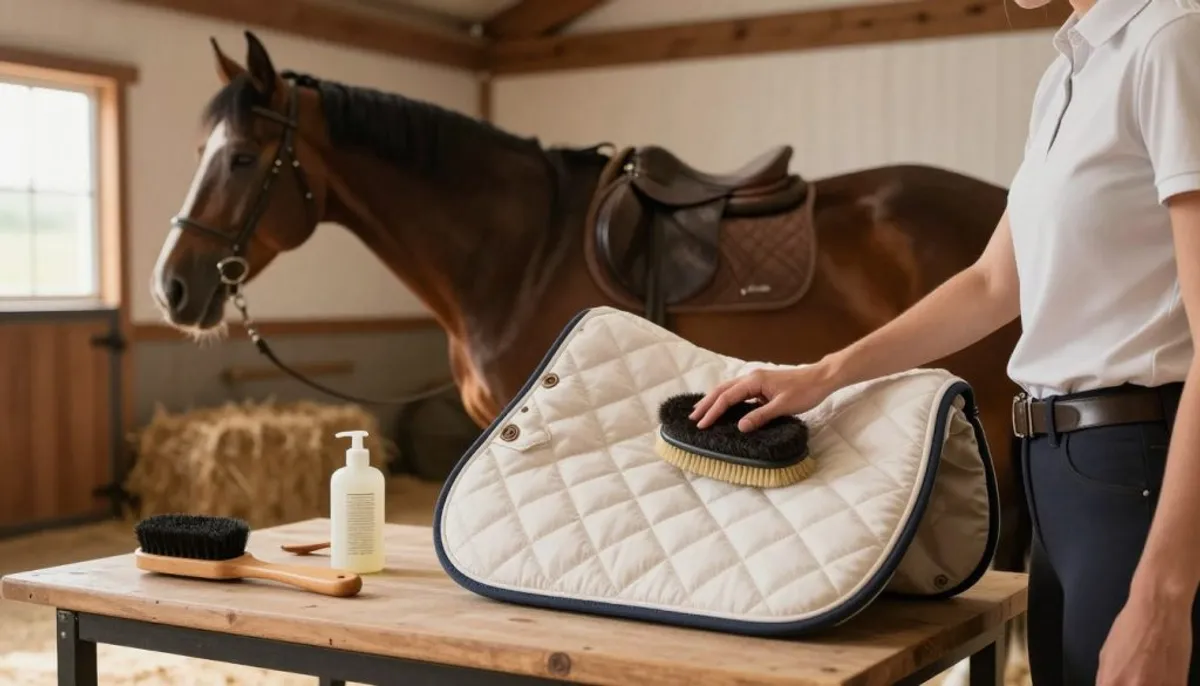
After each session: brush, remove sweat/dirt/hair
After removing the saddle, shake and brush the pad. Removing sweat, dirt, and hair prevents residues from remaining. This avoids irritations, especially for sensitive horses.
Also check the gullet and girth area. These areas quickly accumulate sweat. A simple but frequent cleaning is preferable.
Smart drying: hang “open” to avoid mold and bacteria
Hang the pad without folding it in a ventilated place. Air should circulate from all sides. This prevents bacteria and mold from developing.
If you have several pads, change them regularly. An aired pad remains comfortable and safe.
To avoid: radiator, direct sunlight, tumble dryer (risk of deformation)
Heat can damage seams and foam. Do not place the pad near a radiator, in direct sunlight, or in the tumble dryer. It could deform and cause marks on the horse's skin.
Prefer a slow natural drying to preserve your equipment.
| Daily gesture | Objective for the horse | What you gain | Common mistake |
|---|---|---|---|
| Brush after the session (top + bottom) | Limit friction and overheating, support horse skin health | Less odor, softer fibers, saddle pad maintenance easier | Letting sweat dry before brushing |
| Check the girth area and gullet | Avoid accumulation of salt and hair at pressure points | More stable contact, clearer feel under the saddle | Forgetting the edges and seams |
| Hang “open” in a ventilated place | Reduce bacteria and mold at contact with the back | Pad stays light, less risk of stains | Folding the pad over a bar or placing it in a ball |
| Dry at room temperature | Preserve the skin and regularity of padding | Shape preserved, better durability (logical equitation padd) | Radiator, direct sunlight, tumble dryer |
Machine washing: when and how to wash a saddle pad
A clean pad glides less and is more comfortable for the horse's back. It needs to be washed when quick cleaning is not enough. Especially if the fabric smells bad or is sticky.
If you don’t know how to do it, look at the condition of the fibers and not the appearance. The PADD online saddlery has tips by type of material.
The right time
It’s time to wash when the pad no longer absorbs sweat. If moisture remains on it, it becomes uncomfortable.
A dirty pad can rub and injure the skin. This is true if you often use the same padd equipment.
Recommended settings
Choose a gentle cycle at 30°C without fabric softener. Fabric softener can damage fibers and reduce breathability.
Before washing, close the Velcro and brush the pad. Make sure there is enough space in the machine. PADD saddlery can tell you if your pad withstands frequent washes.
Drying
Dry the pad in the open air. Avoid the tumble dryer to not damage the pad.
Reshape the pad during drying to keep its ideal shape. This is important for maintaining the horse's comfort.
| Step | What to do | Why it helps |
|---|---|---|
| Before machine | Brush off hair and dust, close Velcro, check seams | Less friction and a saddle pad wash more effective |
| Program | 30°C, gentle cycle, moderate spin, delicate textile detergent | Preserves fibers, limits padding compression |
| To avoid | Fabric softener, too hot water, overloading the drum | Reduces absorption and can leave a film on the fabric |
| Drying | Hang “open”, in fresh air, reshape the back line | Maintains the cut and protects comfort at the withers |
| Rhythm | Wash as soon as absorption decreases, even if the pad “looks” clean | Better hygiene and more pleasant use of PADD equestrian equipment |
Buying well: guidelines for choosing on padd equitation and in padd equestrian saddlery
Choosing a pad involves considering colors, cuts, and materials. On padd equitation, the approach is to start with your discipline. Then, examine the fit and small important details during work.
Filtering by use
You must first decide what you are looking for: stability, balance, or style. For dressage, cleanliness of lines and good positioning at the withers are essential. In jumping events, a pad that stays in place is sought.
Western riding requires pads and liners that are thick enough for constant contact. Adding a shock absorber? Be careful not to thicken too much and affect the feel of the saddle. The important thing is that the equipment improves your practice, not just the appearance.
Checking finishes
An essential criterion is the anatomical cut that ensures lasting stability. Observe the seams and reinforcements where there is friction, as well as the quality of the padding. A poor pad can deform, creating discomfort and creases.
Also consider the pad's resistance to washing. Avoid direct heat that can alter certain textiles. Choose a model that retains its shape, especially if you use it frequently.
Thinking “set”
The pad is part of a set. Coordinating a fly bonnet, wraps, or a halter creates a polished look. Accessories allow you to unify your equipment without replacing everything and adapt your style to the season.
Finally, keep an eye on your budget. There are simple or more elaborate options in all price ranges. At padd equitation, you can compare cuts, finishes, and colors in one place. Then, choose the rest of your equipment according to your habits.
| Need | To check before buying | What it changes while riding | Practical guide on padd equitation |
|---|---|---|---|
| Dressage | Long cut, clearance at the withers, regular padding | More stable saddle, clean lines, fewer pressure points | Filter “dressage” + check profile photos for shape |
| Jumping | Compact shape, clear girth passage, breathable fabric | Less slipping, fewer creases, better sweat evacuation | Filter “jumping” + read details on reinforcement areas |
| Mixed / daily | Versatility, easy maintenance, good shape retention | Constant comfort over several sessions, easy use | Compare materials and choose according to your washing frequency |
| Western / pads | Consistent thickness, even surface, pressure distribution | More homogeneous contact, better cushioning according to the back | Filter “western” + check the type of pad (liner, composite) |
| With shock absorber | Layering of layers, stability, absence of excess thickness | More accurate balance if well dosed; otherwise, less precise saddle | Choose a compatible model and complement with useful Equitation PADD accessories, not layered |
Premium alternative: La Sellerie Française and high-end made in France
If you love stylish saddle pads, you might want something unique and durable. La Sellerie Française offers an excellent option, focusing on quality materials, cut, and precision of work. It’s an interesting choice, especially if you’re looking for the best quality.
What distinguishes the offer
La Sellerie Française offers high-end products with unique, custom, and limited edition items. It focuses on a clean style, meticulous finishes, and a perfect fit.
They target riders looking for superior quality equipment. They want items that last without needing to buy new ones every season.
A committed manufacturing, from A to Z
Their main asset is fully French manufacturing, carried out by demanding local artisans. Their goal goes beyond the simple “made in France” label. They guarantee quality and durability, from fabrics to seams.
This promises a better quality product that retains its shape and withstands washing. It’s reassuring on a daily basis.
Why compare with a more “trendy” selection
Comparing allows you to choose based on your needs: intensive practice, competitions, or just for style. Having several options allows for easy variation in your look. However, La Sellerie Française emphasizes durability and attention to detail.
| Point of comparison | Trendy selection (rotation logic) | Premium artisan option |
|---|---|---|
| Style | Colors and finishes that follow collections | More timeless aesthetic, very neat finishes |
| Use | Ideal for varying by discipline, season, and competition | Designed to accompany a horse/rider pair for a long time |
| Manufacturing | Standardized production, variable quality control depending on ranges | Made in France claimed, workshop work and high demands |
| Value over time | Good choice for frequent indulgence | Investment in more durable premium horse equipment |
By keeping these points in mind, you can easily make the right choice. Whether for high-level equipment or a pad that matches your outfit.
Conclusion
The saddle pad is very useful. It keeps the saddle clean and offers better contact with the horse. A matching set also adds a touch of elegance, for training or competitions.
Choosing the right pad depends on a few key points. You need to consider the shape, functionalities like stability and comfort. These details impact the horse's stability and well-being.
Caring for your pad extends its life. You should brush it after use, let it air dry. For washing, a gentle temperature without fabric softener is recommended. Avoid the tumble dryer to keep it in good condition.
In France, Equitation PADD guides you in your choice of pad. Whether your purchase is in-store or online, they offer a wide selection. And for a touch of exclusivity, La Sellerie Française offers high-end products made entirely in France.
FAQ
Is a saddle pad, a pad, and a shock absorber the same thing?
No, they are different. The saddle pad includes various products like classic pads and western pads. Pads and shock absorbers are also included. They differ in shape, thickness, and function (comfort, stability).
Why has the saddle pad become essential (style, hygiene, performance)?
A good pad offers style and utility. It ensures hygiene and comfort. This goes beyond aesthetics, improving well-being and performance.
What is the historical purpose of the saddle pad?
Historically, it protects the saddle from sweat, dirt, and the horse's hair. It preserves the saddle and facilitates its maintenance.
Does the pad or saddle really help the horse's comfort?
Yes. The pad acts as a “joint” between the horse's back and the saddle. Thus improving comfort and distributing pressure.
Why has the pad become a modern style element?
The pad has become an equestrian fashion accessory. It often coordinates with other Equitation PADD accessories to create a harmonious set.
How to recognize a trendy saddle pad at Equitation PADD?
Trendy pads feature various designs, colors, and finishes. On Equitation PADD, choose according to your needs while caring for aesthetics.
How to adapt the style of the pad to its use (daily, competition, collections)?
For daily use, opt for a practical and easy-to-maintain pad. For competitions, choose distinctive colors and finishes. Seasonal collections offer modern and functional options.
Where to quickly search according to your need: store or online saddlery?
Visit a Equitation PADD store to see products up close. Or use PADD online saddlery to search by budget and color. Both approaches help find the best model.
What is the difference between a rectangular pad and a “shape” pad?
The “shape” follows the saddle's shape more closely. The rectangular pad offers more space for decoration and has a distinct look.
Why is the rectangular pad so popular in “fashion”?
It is popular for its large visible surface. This allows for adding decorative elements like decorative cords or rhinestones.
When to choose a “shape” pad rather than a rectangular one?
Take a “shape” for a close and clean style. Choose a rectangular for more visibility and decorative details.
What technical roles can a pad have beyond the look?
Besides protection, pads can stabilize the saddle, offer cushioning, and anatomically follow the back for more comfort.
Can a pad help a slipping saddle?
Yes, some can stabilize an unstable saddle. They are useful depending on the horse's shape and the type of work.
What are the roles of shock absorbers under the saddle?
Shock-absorbing pads can increase comfort by better balancing the saddle. They promote an even distribution of pressure.
Is anatomical cut important?
Yes, it follows the shape of the back better. This reduces pressures and discomfort, especially for sensitive backs.
How to avoid friction at the withers?
Ensure good clearance at the withers and adjust the pad correctly. Dry it well after washing to maintain its shape.
How to properly position the pad under the saddle?
Place it correctly, without creases. Check before girthing to prevent discomfort.
What signs indicate that a pad is unsuitable or too dirty?
Watch for signs like overheating, friction areas, or excessive sweating. Adjust the pad if necessary.
What thickness to choose, especially in western?
Choose a moderate thickness, ideally between 2 to 3 cm. This ensures a good balance between comfort and contact.
Can a soft pad avoid over-tightening?
Yes, a soft pad can reduce the need to tighten hard. This improves comfort but requires proper maintenance.
What materials to prioritize for breathability and maintenance?
Choose based on use. A good pad should manage moisture and dry properly to avoid friction.
In western, does the pad only serve to protect?
No, it also enhances comfort by adjusting pressure. This is essential for the horse's well-being.
What types of western pads exist?
There are the liner, the show blanket, and neoprene pads. Some composite models are “all-in-one”.
Should you test before buying a pad or technical saddle pad?
Yes. Needs can vary. Consulting a professional and testing if possible is the best way to choose a suitable product.
What maintenance routine after each session?
Brush the pad to remove sweat and dirt. This maintains hygiene and limits friction.
How to dry a pad without damaging its shape?
Hang it open in a ventilated place. This prevents mold and preserves its shape.
What mistakes to avoid during drying?
Avoid the radiator, direct sunlight, and the tumble dryer. Strong heat can damage the pad.
When should a saddle pad be washed in the machine?
Wash when it no longer absorbs sweat. A dirty pad can create hygiene and comfort issues.
What washing settings are recommended?
Wash at 30°C with a gentle detergent. Avoid fabric softener to protect the pad.
How to dry after washing to preserve the anatomical cut?
Let it dry in an airy place. Adjust the shape of the pad during drying to maintain its anatomy.
How to buy well on PADD equitation and in PADD equestrian saddlery?
Choose according to use and check the finishes. In a PADD equestrian saddlery, also compare materials and prices.
How to compose a matching outfit with the pad?
Match the pad, bonnet, and wraps for a coordinated outfit. This enhances the equestrian ensemble during competitions and training.
Where to find complementary equipment and accessories at PADD?
A Equitation PADD store or PADD online saddlery offers PADD equestrian equipment to harmonize your outfit. Other accessories are also available.
What premium alternative to Equitation PADD for a high-end pad?
A: La Sellerie Française (https://laselleriefrancaise.com) offers high-end and unique pads. They provide artisanal quality and finishing for those seeking exclusivity.
What distinguishes La Sellerie Française in manufacturing?
Products are made in France, promising excellent quality. They aim for durability and exceptional manufacturing.
Why compare Equitation PADD and La Sellerie Française before buying?
Comparing allows you to choose between style and exclusivity. Depending on your needs, a choice between Equitation PADD and La Sellerie Française is necessary.