
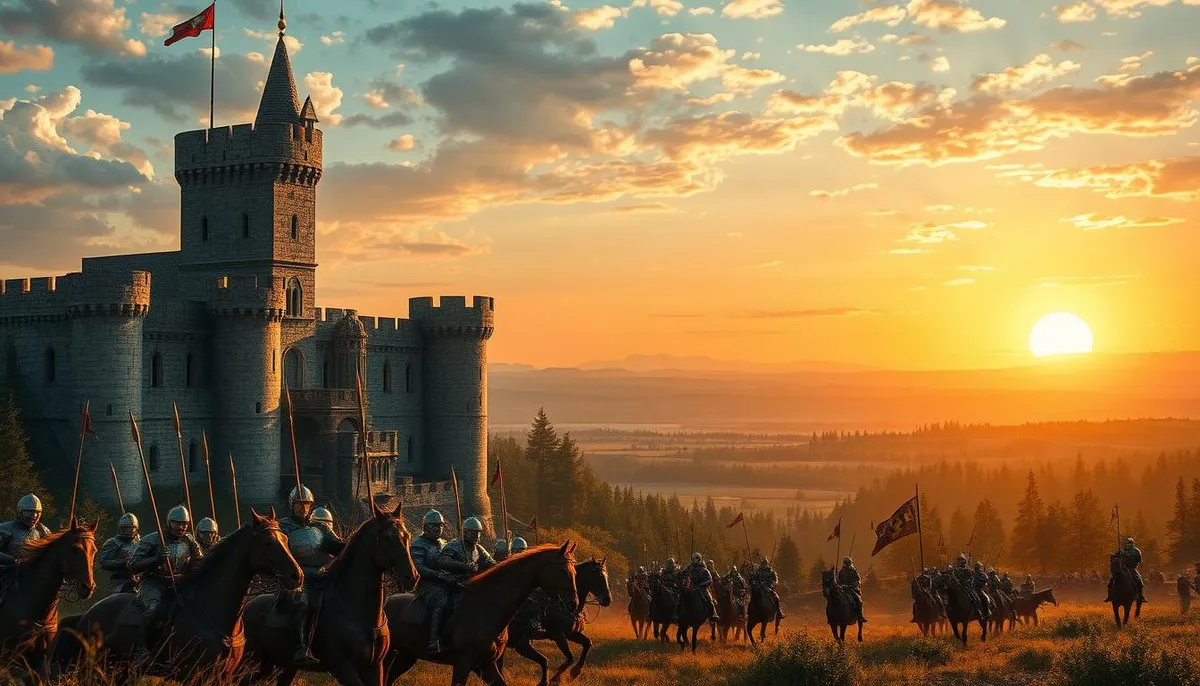
The knight is a symbol of the Middle Ages, uniting nobility and bravery. It appears after the fall of the Western Roman Empire and during the rise of feudalism. The Catholic Church and strong alliances filled the void left by Rome.
Knights formed an elite, both militarily and socially. They distinguished themselves by their combativeness and spirituality. Their conduct was guided by courtesy, honesty, and generosity. They sought to achieve an ideal based on nobility, Christian values, and bravery in battle.
Chivalric culture has inspired many stories, such as that of King Arthur. This tradition has been present both in tales and in reality. Historical figures like Godfrey of Bouillon marked this era. The boundary between the real and the imaginary remains blurred, still influencing our culture today.
This text explores how chivalry developed, its codes, its training, and its armaments. It also discusses tournaments, iconic heroes, and how this tradition has survived over time. The role of the French knight in Medieval Europe is also highlighted.
Key Points
- Chivalry emerged after 476, in a world reorganized by the Church and feudalism.
- The knight unites nobility, bravery, Christian faith, and military skill.
- Central codes: courtesy, honesty, generosity, loyalty, and service.
- Literature and history influence each other: from Arthur to William the Marshal.
- The French knight plays a major role in the Middle Ages in the West.
- The article discusses origins, training, armament, tournaments, and great figures.
- Despite military decline, the chivalric imagination remains alive today.
Origins of Chivalry in Medieval West
Chivalry begins as a combat technique. The Latin word caballarius, derived from “caballus” (horse), referred to a horseman. Over time, an elite of horsemen equipped with expensive medieval armor formed. They adopted practices and oaths that established the codes of chivalry.
From caballarius to chivalry: etymology and birth of a warrior order
The term caballarius originally meant a horseman, succeeding the Roman equites. In the langue d’oïl and d’oc, it evolved into “chevalier,” then into “chivalry.” This change came from the cost of the horse, the necessary training, and lordly support.
Military practice and social prestige merged. Thus, literature and epic poetry celebrated this order, reinforcing the codes of chivalry. But they retained their real basis: paid service and the equipment of medieval armor.
Mero vingian Roots and Carolingian Heavy Cavalry
Under the Merovingians, military groups formed around leaders. Charlemagne established heavy cavalry. This included stirrups, lances, and compact formations. The expensive medieval armor limited this elite.
This elite formed a warrior hierarchy. The terms miles, nobilis, and caballarius existed together. This is shown by the studies of Jean Flori and Dominique Barthélémy. Chivalry became professional and joined the aristocracy.
From the Fall of Rome to the Rise of Feudalism: Church, Lords, and Vassalage
After 476, the Church supported kings and counts. Oaths of loyalty structured vassalage. Thus, land became the basis of power and armed service.
This system favored feudalism over centuries. Elite knights, connected by homage, supported the powers. The codes of chivalry validated their rights and privileges.
| Period | Key Term | Characteristic | Social Role | Equipment |
|---|---|---|---|---|
| Late Antiquity | equites / caballarius | Cavalry inherited from Rome | Imperial service | Light equipment, lances, shield |
| Merovingian Era | miles / caballarius | Armed companionship around kings | Elite warriors in training | Reinforcement of harness and hauberk |
| Carolingian Age | miles | Heavy cavalry and discipline | Warrior aristocracy | Mail hauberk, helmet, shield |
| 11th–13th Centuries | knight / chivalry | Feudalism and vassalage consolidated | Lordly elite | Complete medieval armor, lance at rest |
| Christian Culture | codes of chivalry | Morality and warrior norms | Religious legitimation | Rituals of armament and symbols |
Chivalry, Codes of Chivalry, and Christian Ethos
Chivalry was much more than warriors on horses. It was an ideal.
This ideal was based on courage, honor, and devotion, inspired by Christian faith. The codes of chivalry displayed these values to nobles and kings.
Historians like Martin Aurell, Nigel Saul, and Aude Mairey explain how war, nobility, and faith were intertwined. The stories of the Matter of France and Brittany showed the example to follow for knights.
Polysemy of Chivalry: Social Group and Ideological Corpus
Chivalry was both a social order and a moral way of life.
The codes defined the rules of combat, loyalty, and aid to the weak.
These codes were shaped by Christian beliefs, from oaths to behavior in a court.
The courts of princes were where this ethics shone. Tournaments, generosity, and renown were essential. The stories of the Matter of France and Brittany provide a language for these ideals.
Key Virtues: Loyalty, Generosity, Courage, Courtesy, and Devotion
Loyalty strengthened the bonds between lords and vassals.
Generosity helped build a good reputation and unite people.
Courage was crucial, both in battles and in duels.
Courtesy guided behavior, from speech to gestures. Devotion integrated into Christian life: respect for holy places, aid to widows and orphans, fasting, and pilgrimages.
Matter of France and Brittany: Roland, Arthur, and the Round Table
The Song of Roland values fidelity and sacrifice. With Charlemagne, these tales advocate justice through arms.
They offer life lessons to knights.
The stories of Arthur, Lancelot, and the Round Table in the Matter of Brittany combine courtly love and chivalry.
This creates an imagination that educates the elites in their Christian faith.
Training of the Knight: Training, Dubbing, and Court Life
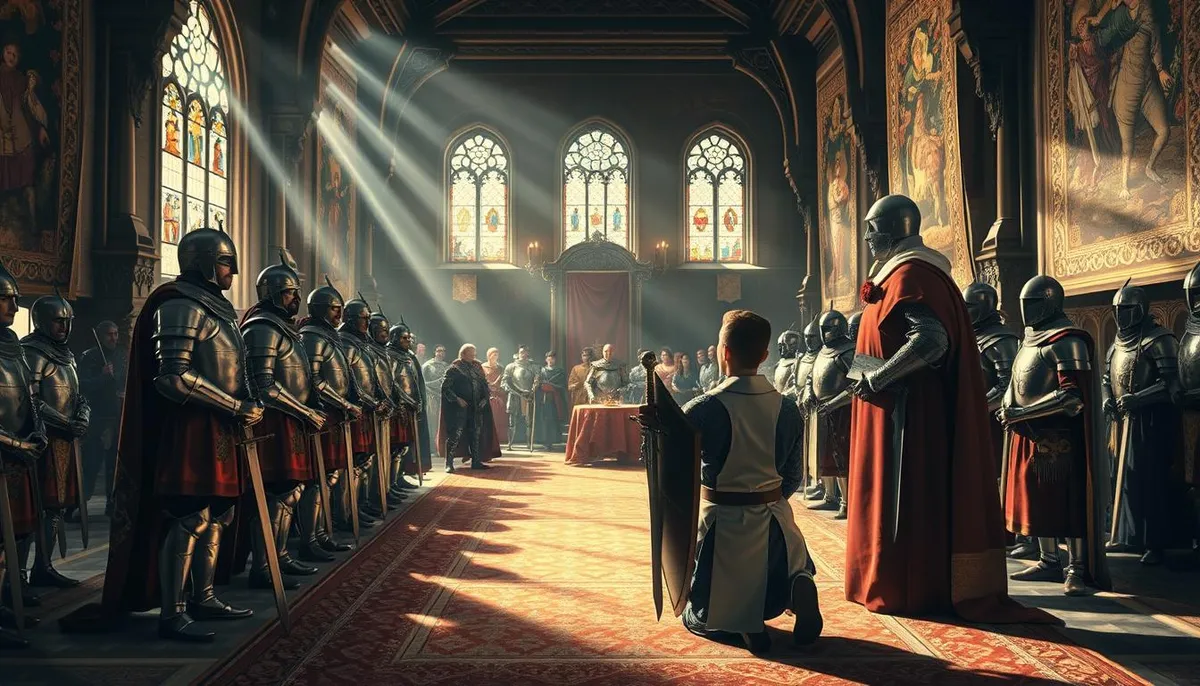
The training of a knight begins at a young age. It combines learning weapons, letters, and etiquette at court. This comprehensive journey prepares young men to become fighters, participants in rituals, and to integrate into the nobility.
From page to dubbing, this tradition has its roots in medieval Europe. The stories of William the Marshal and Boucicaut show the demands of this training. It has long influenced the model of the French knight.
From Squire to Knight: Learning, Hunting, Reading, and Chess
First, as a page, the young boy learns by serving and observing. Later, as a squire, he practices the lance, sword, and rides a war horse. Hunting teaches him endurance and calmness, while developing a relationship with his horse.
Reading exemplary stories and playing chess sharpens the mind. Under the tutelage of William of Tancarville, William the Marshal practices command before his dubbing in 1166. Boucicaut, for his part, recounts his exhausting training, such as mounting without assistance, demonstrating his physical strength.
Oaths of Loyalty and Integration into Court Customs
The dubbing symbolizes a sacred commitment. The vassal pledges to serve and advise, and in return, the lord protects him. This pact opens the court society with its banquets, religious functions, poetry, and the art of speaking well before the prince.
The French knight thus adopts appropriate behaviors, attire, and self-control. Etiquette becomes a discipline and a public arena. His reputation spans from Paris to the courts of Burgundy.
Nobility, Military Prowess, and Christian Values as Pillars
The chivalric training rests on three pillars: nobility, courage, and faith. Nobility is acquired by birth or merit. Competitions and battles test courage and skill.
Christian faith frames the use of force. It teaches the protection of the weak, respect for the Church, and fidelity to one's word. This creates a moral authority for the common good and the king.
| Stage | Key Objectives | Historical Examples | Major Skills | Link to Court Life |
|---|---|---|---|---|
| Page | Domestic service, observation of rites | Lordly houses of Île-de-France | Good posture, memory of customs | Learning etiquette and measured speech |
| Squire | Martial training, hunting, readings | William the Marshal with William of Tancarville | Lance, sword, riding, chess | Introduction to ceremonies and sociability |
| Dubbing | Oath, belt of arms, consecration | Boucicaut, made knight at 16 | Mastery of combat, moral discipline | Access to royal and princely courts |
| Knight | Command, renown, service to the sovereign | Campaigns of Roosebeke, jousts in France | Tactics, patronage, reputation | Participation in councils, patronage, and feasts |
- Chivalric training: balance between the arts of war and written culture.
- Dubbing: rite of entry that seals loyalty and honor.
- French knight: public figure, master of arms and codes.
- Court life: stage where prestige, speech, and alliances are tested.
Armament and Medieval Armor: Knight's Sword, Lance, Helmet, and Shield
The Codex Manesse illustrates a knight in armor, galloping. One admires his sword, lance, helmet, and colored shield. These images show us how knights charged into battle.
To withstand shocks, armor changed over time. Helmets and shields protect the knight. Lances and swords were essential in combat. The horse's equipment also helped keep the knight stable.
Horses were chosen for their strength. Warhorses were valued more than other types. Knights in heavy armor stood out due to their complete equipment. Images of Ulrich von Liechtenstein in mail show the importance of mastery of the horse and weapons.
| Element | Function | Dominant Materials | Historical Milestones |
|---|---|---|---|
| Medieval Armor | Body protection and shock absorption | Mail, steel plates, leather | Transition from mail to plate, 13th-14th centuries |
| Helmet | Head and face protection | Iron, steel | Closed helmet then bascinet with visor |
| Shield | Deflection of blows and heraldic sign | Wood, leather, metal | Large cavalry shield, variable shapes |
| Lance | Shock weapon for the charge | Ash, steel tip | Lowered lance, widespread adoption in the West |
| Knight's Sword | Close combat and cutting blows | Tempered steel | Oakeshott typology pommels, 14th century |
| Equipment | Mastery of the seat and transmission of momentum | Saddle, harness, metal and leather stirrups | Reinforced harnesses for heavy cavalry |
| War Horse | Mobility, power at impact | Selective breeding, training | Prestigious destrier, high-stepping palfrey |
All these pieces formed a complete system. The knight, well secured on his horse, charged with his lance. The shield and helmet protected him. Finally, the sword served to finish the fight. This ensemble, seen in the Codex Manesse, shows the skill necessary for warriors.
Knights' Tournaments and Jousts: Glory, Generosity, and Strategies
In the 12th century, knights' tournaments became serious. They were miniature battlefields where every attack counted. The jousts led by the lance occupied the day, before the final melee.
Capturing an enemy allows for a ransom to be demanded. This generosity transforms earned money into respect. Thus, a knight builds his reputation as much through combat as through feasts.
Tournaments as "battles": capturing, ransoming, forging one's fame
Tournaments resemble real battles. Knights fall, rise again, and capture their enemies. The ransom helps buy horses and armor.
Teams work together with a precise strategy. They aim to defeat a specific enemy or defend their banner. This realism reinforces the spirit of chivalry.
Generosity: generosity, prestige, and loyalties
Generosity means sharing the spoils, paying for feasts, and giving gifts. This creates strong bonds and shows the greatness of a lord. The jousts would be too costly without generosity.
Knowing how to spend is as important as winning. It weaves a network of allies, secures relationships, and demonstrates the knight's generosity.
Example of William the Marshal: master of jousts and chivalric model
William the Marshal experienced ten years of victories. He defeated over five hundred opponents, sold their equipment, and his generosity opened important doors for him.
He was the advisor to the young Henry the Young King and loyal to John Lackland. Having climbed the ranks, his marriage to Isabel de Clare and his role in the Magna Carta perfectly illustrate how glory and generosity can forge a destiny within chivalry.
| Aspect | Practice in Tournament | Desired Effect | Link to Chivalry |
|---|---|---|---|
| Jousts | Lance charges in head-to-head | Quick renown, selection of champions | Mastery of horse and public honor |
| Melee | Group combat, encirclement maneuvers | Captures and ransom | Team spirit and banner strategy |
| Spoils | Harnesses, saddles, recovered horses | Resources to finance the career | War economy of the knights' tournament |
| Generosity | Gifts, feasts, salaries paid to followers | Prestige and loyalties | Central virtue of chivalry |
| William the Marshal | Victories, captures, princely service | Legitimate social ascent | Model of jousts, generosity, and strategy |
Famous Knights and the Order of the Knight: Crusades and Tales
Famous knights emerged during the Crusades. They also distinguished themselves in the accounts of chroniclers. Their mission was to serve, protect, and leave a mark, by sword or pen.
Godfrey of Bouillon: Advocate of the Holy Sepulchre and Legend of the Swan Knight
Godfrey of Bouillon, from a great family, distinguished himself during the First Crusade. He refused to become king of Jerusalem in 1099, choosing instead to be the Advocate of the Holy Sepulchre out of piety.
He is at the heart of epic tales, known as the Swan Knight. He is a model of a knight devoted to his faith.
Richard the Lionheart, William the Marshal, and the Magna Carta
During the Third Crusade, Richard the Lionheart became known for his courage and strategies. William the Marshal, his companion, was known for his valor and political acumen.
As regent, he protected the kingdom against John Lackland and supported the Magna Carta. His victory in 1217 affirmed the importance of the knightly order in the defense of the state.
Ulrich von Liechtenstein: Minnesänger, Courtly Love, and Codex Manesse
Ulrich von Liechtenstein was knighted in 1223 by Leopold VI. His poems and jousts celebrate courtly love.
Disguised as Venus and then as King Arthur, he faced many rivals. His story is immortalized in the Codex Manesse.
Boucicaut: Marshal of France, Orders of Chivalry, and European Campaigns
Jean II le Meingre, known as Boucicaut, traveled across Europe with the Teutonic Order. He fought in Spain, the Balkans, and the Levant. He created the Order of the White Lady with the green shield for women from knightly families.
Christine de Pizan praised him. He participated in the late Crusades and defended the values of chivalry.
Military Decline: From Chivalry to Modern Cavalry
Around the 14th and 15th centuries, battlefields began to change. The old idea of chivalrous combat was replaced. Now, disciplined lines and long-range fire dominated. The medieval armor, once a symbol of prestige, became cumbersome and expensive in the face of new mobility and ranged attacks. Leaders began to value efficiency. This marks the beginning of a modern cavalry, organized and paid.
Agincourt and the Longbow: New Tactics, Masses of Infantry
In 1415, at the Battle of Agincourt, English archers with their longbow halted the advance of knights. The latter were weighed down by their medieval armor. The muddy ground stopped their charges, and barricades halted the horses. The infantry, advancing in compact formation, concluded the fight in close combat. This battle proved that the precision of shots and discipline are more important than individual heroic acts.
Gunpowder and Firearms: Obsolescence of Armor
In the 15th century, the introduction of gunpowder led to the use of arquebuses and muskets. These weapons could pierce most armors, rendering medieval armor obsolete. Combat tactics evolved: troops fired in coordinated volleys and used pikes for defense. The modern cavalry adapted by prioritizing pistol fire and attacking enemy flanks rather than making frontal charges.
Monarchical Strengthening, Taxation, Permanent Armies, and Decline of the Church
Kings increased taxes and consolidated their judicial systems to finance permanent armies. They began to more strictly control territories. The importance of religious orders in conflicts diminished. At the same time, the state took charge of logistics and war financing, including the supply of gunpowder. The nobility retained a role in command, but the art of war became more professional and streamlined.
| Period | Decisive Factor | Tactical Impact | Effect on Chivalry |
|---|---|---|---|
| 1415 (Agincourt) | Archers with longbow | Charges halted, dominant infantry | Decline of the frontal charge in medieval armor |
| Mid 15th Century | Generalization of gunpowder | Fire at range, volleys, pikes | Armor became heavier then obsolete |
| Late 15th – 16th Centuries | Monarchical centralization | Discipline, logistics, standardization | Birth of a permanent army and a modern cavalry |
| 16th Century | Weakening of ecclesiastical influence | State-driven conflicts | Knightly orders became mostly symbolic |
Knight
Knights are symbols of courage and elegance that have marked history. Their influence is still visible today, from Europe to films and books. They remind us of the importance of honor, faith, and equestrian art.
The Persistent Imagination: Literature, Arts, Fantasy, and Popular Culture
Stories, games, and films reinvent the adventures of knights. They speak of quests, honor, and the knight's sword. They use simple yet powerful themes such as courage and loyalty.
On stage and screen, armor speaks without words. The iconography of the Middle Ages enriches our visual world, linking the ancient to the new.
Hospital Orders and Hagiographies: From the Siege of Rhodes to Malta (1565)
The hospital orders reinvented themselves after losing Rhodes and Tripoli. The event of Malta 1565 strengthened their unity and devotion. They fought heroically from Saint Elmo to the Mediterranean seas.
Writers like Giacomo Bosio and Pierre de Boissat preserved history. They wrote about the sacrifice, discipline, and generosity of knights.
Iconography: Matteo Perez d’Aleccio, Caravaggio, and the Staging of Virtues
Matteo Perez d’Aleccio captured strategy and prayer in his art. His works on the Siege of Valletta show the collective effort.
Caravaggio and Mattia Preti enriched this vision. Their paintings show marked faces and gestures of faith. They celebrate the oath and mission of a modern knight.
Focus France: Legacies of a French Knight and National Influence
In France, the chivalric tradition combines elegance and prudence. Riding schools and museums transmit this culture. They share techniques, stories, and movements.
This tradition highlights the knight's sword, saddles, and equipment. These elements can be found even in modern creations inspired by the past.
The French Saddlery: Exceptional Craftsmanship, Made in France, from Custom to Limited Editions
The French Saddlery combines artisan craftsmanship with quality materials. Everything is made in France. Their demand reflects the perfectionism of bygone times.
Their products, such as saddles and harnesses, are inspired by the traditions of knightly orders. They show that tradition, utility, and beauty can go together.
| Reference | Major Contribution | Link to the Knight | Integrated Keywords |
|---|---|---|---|
| Hospital Orders (Saint John of Jerusalem) | Rescue of pilgrims, defense in the Mediterranean | Collective heroism and discipline | hospital orders, Hospital of Saint John |
| Siege of Malta (1565) | Founding victory after Rhodes and Tripoli | Renaissance of the chivalric ideal | Malta 1565 |
| Matteo Perez d’Aleccio | Narrative frescoes and engravings | Scenes of arms and shared prayer | Matteo Perez d’Aleccio, iconography |
| Caravaggio | Dramatic realism, chiaroscuro | Virtues embodied by light | Caravaggio, iconography |
| The French Saddlery | Excellence in manufacturing and traceability | Saddles and harnesses inspired by history | The French Saddlery, made in France |
| Equipment | Function and symbol united | Weapon and rank attire | knight's sword |
Conclusion
Chivalry transformed Europe, from the post-Roman era to the feudal world. It linked the sword and faith with lordly courts. Over time, it became a military force and an ideal. These ideals were guided by the codes of chivalry and Christian ethics.
Stories like those of Roland and King Arthur created a model for knights. This model was followed by figures such as Godfrey of Bouillon and Richard the Lionheart. They shone in tournaments and were known for their generosity.
Despite the advent of new military technologies, such as the longbow and gunpowder, chivalry has retained its aura. Its image has survived, from the defense of Malta in 1565 to today. Traces of this legacy can be found in literature, the arts, and popular culture.
In France, the chivalric tradition still influences national identity and equestrianism. Precision and attention to detail are examples of this. The French Saddlery illustrates this heritage well.
Chivalry still symbolizes courage and loyalty. For the knight of yesterday and for us today, these values remain important. They show that an ideal can survive changes and continue to inspire our actions.
FAQ
What do we mean by knight and chivalry in medieval West?
Chivalry is a military elite that fights on horseback. It also follows a Christian code of conduct. A knight must be noble, courteous, honest, generous, and valiant.
The notion of chivalry comes from the Latin word “caballarius.” It develops with the feudal society and the influence of the Catholic Church.
Where does the word knight come from and how is chivalry born?
“Knight” comes from the Latin “caballarius,” which means “horse.” Initially, it referred to the mounted fighter. Over time, “chivalry” evoked a noble social class defined by behavioral codes.
These codes were enriched by tales like the chansons de geste and the stories of Arthur.
What roles do the Church, kings, and lords play in the rise of chivalry?
After 476, the Church and local lords organized society. They legitimize the authority of kings and limit violence. Oaths of loyalty weave the bonds of feudal society.
These alliances strengthen the military role of knights over five centuries.
What are the key virtues of a knight according to the codes of chivalry?
A knight must demonstrate loyalty, generosity, courage, courtesy, and Christian devotion. These qualities express themselves through the protection of the weak and faithful service to the lord. Courtly culture greatly influences this ideology.
How does one become a knight?
Becoming a knight begins by being a page, then a squire before dubbing. The training is comprehensive: hunting, riding, reading, chess, and combat techniques. This journey integrates the young noble into court and circles of power.
What medieval armor did a knight wear?
The armor evolved: first in chain mail, then in plate armor. It includes helmet, shield, lance, sword, and dagger. Completed by the equipped war horse, this armor required training and financial resources.
How did knights' tournaments differ from jousts?
Tournaments were group combats, similar to small wars. Jousts opposed two knights in duel. Tournaments valued renown and skill while financing the knight's generosity.
Who is William the Marshal and why is he central?
William the Marshal, a hero of the 12th-13th century, is famous for his victories and political influence. He supported the Magna Carta and won the Battle of Lincoln. His life perfectly illustrates the chivalric model.
Which famous knights mark history and the Crusades?
Godfrey of Bouillon, Richard the Lionheart, William the Marshal, and Boucicaut are among the most illustrious. They symbolize the union between the chivalric ideal and political reality.
What is an order of the knight and what do chivalric orders serve?
Chivalric orders are fraternities with their own rules and symbols. Some, like the Order of Saint John, combine combat, aid, and protection. Others support royalty and cultivate prestige.
Why does knightly cavalry decline militarily?
The Battle of Agincourt in 1415 reveals the weaknesses of cavalry. The invention of firearms renders armor obsolete. The permanent armies of kings then supplant the knights.
What role do the Matter of France and the Matter of Brittany play?
They establish the examples to follow: Roland and the paladins for France; Arthur and his knights for Brittany. These stories greatly influence chivalric culture.
How does the knightly imagination survive today?
The chivalric imagination lives on through literature, films, games, and the world of fantasy. It also inspires modern activities such as historical reenactments and equestrianism.
What do hospital orders contribute to chivalric iconography?
The Hospitalers value the notions of sacrifice and faith, as shown in the works of Valletta. Their art combines heroism and spirituality, enriching chivalric history.
Who is Ulrich von Liechtenstein in the history of chivalry?
Ulrich von Liechtenstein is a knight famous for his writings on courtly love. His jousts and image are carefully preserved in the Codex Manesse.
What is generosity in chivalric culture?
Generosity is the knight's generosity, manifested by sharing spoils. It builds his reputation and strengthens his social network, especially during tournaments.
How to distinguish knight's sword, lance, and other weapons?
The sword is for close combat; the lance for charging; the dagger for final blows. The shield and helmet protect the knight. Each element is adapted to combat methods.
What does it mean to be a French knight in the national imagination?
It means embodying chivalric values and equestrian excellence, from William the Marshal to Boucicaut. This heritage still influences our culture and craftsmanship.
Are there today any material legacies of chivalry?
Yes, in modern equestrianism and luxury saddlery. Brands like The French Saddlery preserve the traditions of leatherwork and equestrian equipment.
RelatedRelated articles
- 21 Dec 2025·10 min readEquestra: Quality Equestrian EquipmentGeneral
 Equestra stands out as the leading tack shop in France. It focuses on the needs of horses, riders, and stables. It offers equipment for competition and leisure, ensuring durability and innovation. From fly masks to blankets and helmets, everything is...