
Choosing a saddle for your horse is not just about style. It is an important technical decision. It must facilitate the execution of the movements of the horse-rider duo. A well-fitted saddle improves biomechanics, protects the withers and the spine, and allows the rider to maintain their position without straining.
Testing in motion is crucial for selection. Indeed, a saddle may seem ideal at rest, but its balance may change at a trot or gallop. Therefore, it is important to test the saddle in action, with your usual equipment. This will help you form an accurate opinion, whether you are on the flat or on varied terrain.
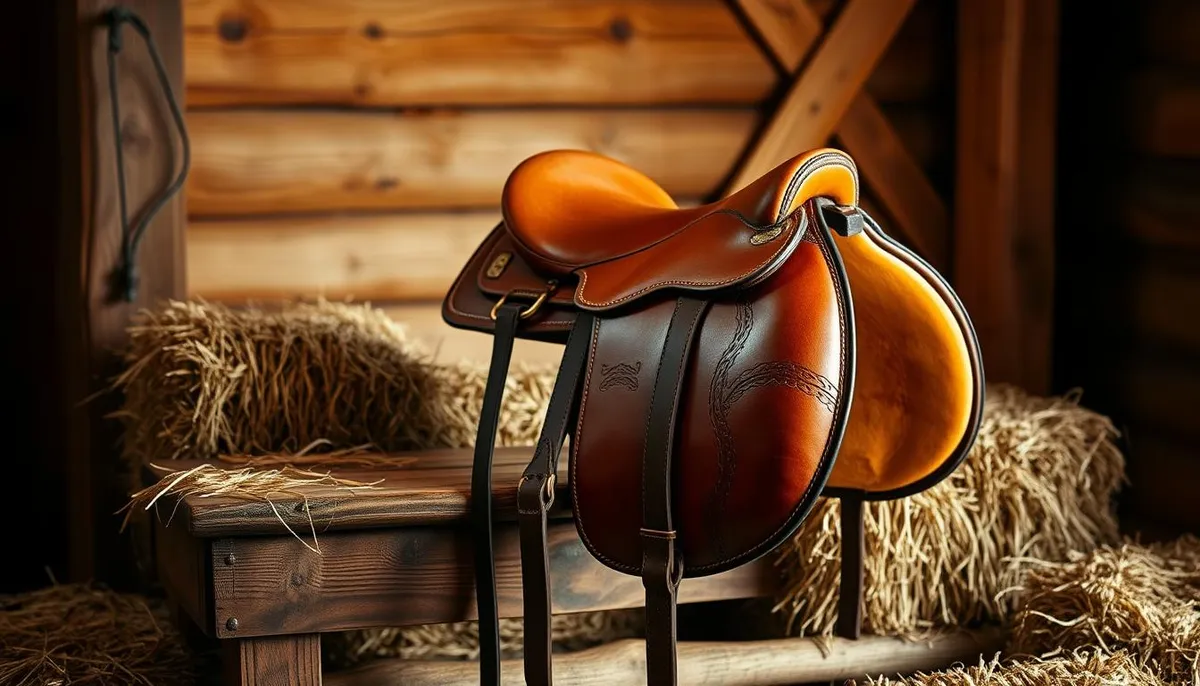
The price does not determine the quality of your saddle. What matters is that it fits the horse's back, your size, and your discipline. Whether the saddle is new or second-hand, the most important thing is that it is well adjusted.
For those looking for high-quality leather, La Sellerie Française offers saddles made in France. They are made in limited series or custom-made by experienced craftsmen. This quality ensures good contact with the horse, even wear, and easy maintenance over the long term.
Main Takeaways
- The mounted test in motion takes precedence over static evaluation.
- The saddle for horse must enhance the ease of executing exercises.
- The budget is not a guarantee of better riding: fit comes first.
- Test with your usual horse saddle accessories for an accurate diagnosis.
- Choose the saddle riding according to the morphology, seat size, and discipline.
- A quality leather saddle, like those from La Sellerie Française, ensures durability and precision.
- The made in France and the work of saddlers provide traceability and know-how.
Understanding the Role of a Horse Saddle for the Comfort of the Horse and Rider
A good saddle serves as an interface between the rider and the horse. It protects the horse's back while helping the rider to position themselves correctly. A saddle suited to the horse's biomechanics provides more comfort and makes riding more enjoyable, regardless of the discipline practiced.
Objective: distribute weight well, not hinder, keep stable. Details like the shape of the gullet and the design of the seat transform energy into smooth movement. This helps avoid pressure points.
Weight Distribution and Release of the Spine, Withers, and Shoulders
The saddle must distribute the rider's weight well. This helps ensure that the horse's spine is free, that the withers have enough space, and that the shoulders can move well. A good fit of the gullet and alignment of the ends limits movement issues.
If the pressure is too concentrated, the horse may tense up or compensate. A well-chosen saddle avoids this, making movement smoother. This is essential for the horse's well-being and to prevent injuries.
Stability, Grip, and Freedom of Movement for the Rider
Being well-seated allows for proper posture without effort. This helps the rider remain stable, stick to the saddle without being hindered, and use small precise aids. The correct positioning of the knee rolls helps without limiting, for a ride that supports the horse.
This natural position reduces fatigue and prevents imbalances. Thus, the horse-rider pair remains in harmony.
Why the Test in Motion is the Only Reliable Judge
At a standstill, everything seems fine. But it is in motion that the truth about the saddle's comfort is revealed. Testing the saddle in the situations of the discipline is crucial for assessing dynamic comfort.
Only a trial allows for a true judgment of improvement. A good connection from the start indicates that the saddle suits the horse's biomechanics.
| Key Criterion | Indicator to Observe | Desired Effect | Consequence if Inappropriate |
|---|---|---|---|
| Gullet Width | Clearance of the withers, free shoulders | Amplitude and elevation of the forehand | Shoulders pinched, shortened strides |
| Support Surface | Even distribution under the panels | Diffuse pressure, tense back | Hot spots, resistance, loss of engagement |
| Seat Center | Neutral pelvis, stable torso | Precise aids, grip without constraint | Rocking, heavy hands, fatigue |
| Test in Motion | Transitions, turns, pace variations | Balance of the pair and fluidity | Tensions, irregularities, refusal to move forward |
Different Types of Saddles: Dressage Saddle, Jumping Saddle, All-Purpose Saddle, Western Saddle, and Trekking Saddle
To choose a horse saddle, you must first know what it will be used for. Each type of saddle helps the rider adopt a good posture. It ensures that the horse's shoulders are not hindered and that pressure is well distributed. Trying the saddle in motion is crucial to ensure it fits the horse-rider duo well.
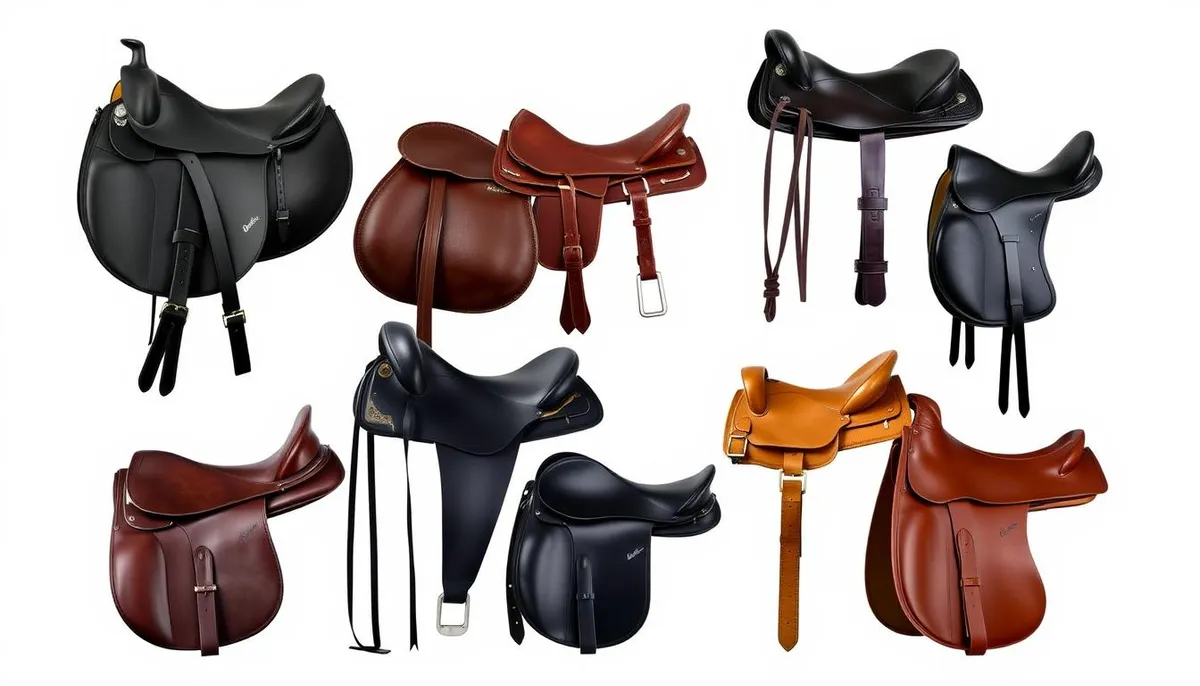
Dressage Saddle: Deep Seat, Long Flaps, Short Girth
The dressage saddle allows for a deeper seat. It has long flaps to stabilize the legs. Well-defined knee rolls and a prominent pommel and cantle help position the pelvis correctly. It also has long girth straps to use a short girth and leave the horse's elbow free.
It is important that the seat and knee rolls do not restrict movement. To test it properly, start walking without stirrups for a few minutes. Dressage saddles are not suitable for intensive competitions like show jumping or eventing.
Jumping Saddle: Flatter Seat, Forward Flaps, Freedom of Shoulders
The jumping saddle has short, forward flaps. This allows the rider to bend their knees and maintain balance over their feet. The seat is designed to be light to facilitate rising and adjusting in the air. The tree is positioned to keep the horse's shoulders free.
It comes in various versions: flat, semi-deep, but never as deep as dressage saddles. A very flat model is ideal for riders with excellent balance. The soft leather at the front helps better absorb landings and keeps the horse's shoulders mobile.
All-Purpose Saddle: Versatility for Flat Work or Jumping
The all-purpose saddle is designed to be versatile. Depending on its orientation, the flaps are adapted for either flat work or jumping. It is ideal for training, jumping lessons, and light cross-country.
For a rider who only has one saddle, it is better to choose a jumping orientation. Later, they can adjust for flat work by using more rear support. This method allows for good stability without limiting mobility.
Western and Trekking Saddle: Large Support Surface and Long-Duration Comfort
The western saddle is designed to provide great comfort over long hours. It has a large support surface and extended panels. Its heavier weight helps distribute pressure evenly on the horse's back. For long rides, it helps avoid overheating and back fatigue.
Models without a tree may seem comfortable, but over long distances, they are not ideal. For treks, it is better to choose a model with a stable tree and well-padded panels. This better protects the horse's back.
- dressage saddle — deep seat, leg stability
- jumping saddle — freedom of shoulders and balance in the air
- all-purpose saddle — versatility in training
- western saddle — comfort and support over time
- horse saddle — to be chosen according to discipline and pair
Horse Saddle: Essential Selection Criteria and Mistakes to Avoid
A good horse saddle must be tested in motion, not just when the horse is stationary. Before making your choice, consider three things: your comfort, the well-being of the horse's back, and constant balance. Ensure that the tests reflect your usual use of the saddle.
Try the Saddle in Real Conditions, with Your Usual Pad
Test it outside, at all three gaits, making transitions and circles. The pad you usually use can change a lot.
The test saddle must be almost identical to the one you want to order. Be cautious with promises of modifications after purchase. A good saddle should be comfortable from the start.
“Custom” vs “Fitted Saddle”: What Matters is Ease of Execution
The most important thing is ease: clear canters, straight lines, smooth aids. A correct saddle allows all this easily. A saddle can be perfect for the horse but destabilizing for you.
Ensure that your position is natural. If it is difficult, it may be time to change saddles. The goal is to work together easily, not to follow slogans.
Budget: New or Second-Hand, High Price ≠ Better Riding
Choose between a new or second-hand saddle according to your needs. The price does not determine the quality of your riding. Saddles priced between €1,500 and €2,500 often have good balance.
Good deals exist in second-hand, but patience is required. Check the structure, the interior, and the symmetry carefully. Do several trials before deciding.
Flat, Semi-Deep, Deep Seat: What Feel for Which Practice
Flat seat: ideal for jumping and cross-country, gives you an active position. Perfect for dynamic equestrian sports.
Semi-deep: offers good stability and is suitable for dressage and jumping. It’s a good compromise.
Deep: better for those who like a deep seat and long stirrups. Always test with your pad to judge balance.
- Avoid choosing based on aesthetics alone: black can stiffen new leather, light leathers absorb moisture.
- A calfskin-lined saddle offers grip, not a technical gain: demand quality calfskin.
- Keep the guiding principle: ease of execution, rising back, and repeatability during saddle trials.
Anatomy of an Equestrian Saddle and Technical Elements that Change Everything
It is crucial to know the main parts of a saddle. A well-designed leather saddle balances weight, protects the withers area, and facilitates the rider's position. Every aspect, from structure to panels to accessories, is important.
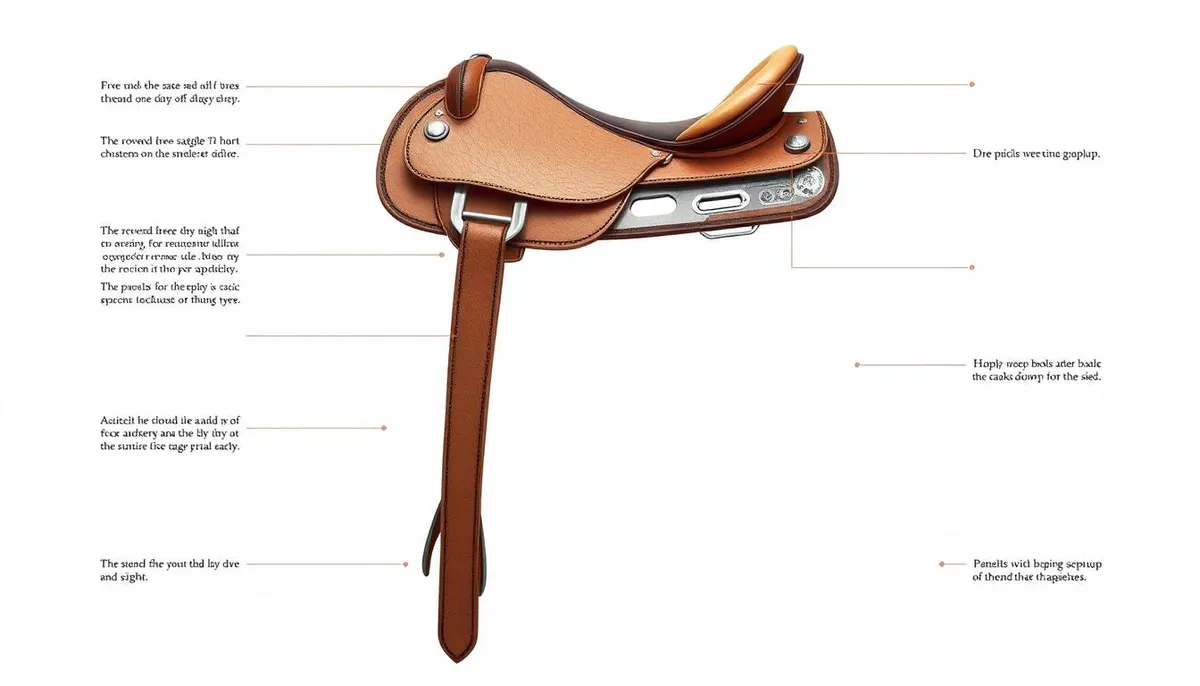
Tree (Wood, Plastic, Fiber): Shape, Curvature, and Constraints
The tree is essential in a saddle. It must fit the horse's back precisely. Wood offers some flexibility. Plastic and fiberglass are lightweight but cannot be adjusted after manufacturing.
A poor tree can tire the horse. Minor adjustments can be made, but an inappropriate shape cannot be corrected.
Gullet/Pommel: U or V, Width and Stability at the Withers
The pommel must stabilize the front of the saddle. An adjustable gullet protects the withers. It must align with the horse's shoulders.
An overly wide or narrow gullet can cause problems. U-shaped gullets are for horses with wide bodies, while V-shaped gullets are for those with fine withers. Brands like Albion and Stübben offer different models.
Seat, Pommel, Cantle: Size and Center of Gravity
The seat, pommel, and cantle define the sitting space. An incorrect size disrupts movement or balance.
The correct placement of the seat helps maintain a stable leg position, whether for flat work, jumping, or trekking.
Flaps, False Flaps, and Knee Rolls: Position and Support of the Leg
The shape of the flaps depends on the riding practiced. False flaps help with stability.
The front knee rolls can vary. They assist depending on the rider's level. Children rarely use them, unlike beginner adults.
Panels (Wool, Foam), Padding, and Maintenance
Panels made of wool or foam support the horse's back. Wool can be adjusted, while foam retains its shape but may flatten.
The attachment of the panels is important for comfort. Proper maintenance with suitable accessories ensures the saddle's durability and comfort.
Adapting the Saddle to the Morphology: Horse, Rider, and Discipline
A good saddle fit connects the horse's morphology, the rider's level, and the discipline practiced. Choosing the right horse saddle allows for the horse's movements to be freed and stabilizes the rider. For dressage or trail rides, a horse saddle that protects the back without hindering posture is necessary.
Seat Size: Tolerance vs Precision, Equestrian Maturity
A slightly larger seat allows for relaxation and flexibility. It also facilitates maintaining a correct leg position. Conversely, a tighter seat increases precision and strength.
But this can lead to stiffness in less experienced riders. With experience, choosing a saddle that promotes precision becomes advantageous. In dressage saddle, facing large horses like a 1.75m Holsteiner, a rider might prefer an 18-inch seat. This horse saddle allows the horse to express itself better and maintain a fluid gait.
Long/Short Back, Prominent Shoulders: Choosing Panels (Flat/Rounded)
For a long and straight back, choosing flat panels helps distribute weight better. If the back is short and curved, rounded panels are preferable as they adapt better to its shape. If the horse has prominent shoulders, opt for shorter panels to avoid hindering the scapula.
Horses with a large range of motion benefit from longer panels. This stabilizes the horse and improves control for flat or dressage saddles.
Too Wide or Too Narrow Gullet: Signs and Impacts
An overly wide gullet causes pressure on the withers, sweat marks, and can make the horse reluctant. A gullet that is too narrow creates pressure on the muscles, causing instability and difficulty moving.
These problems affect the harmony between the horse and rider. Properly adjusting the gullet to the horse's morphology is crucial for a good saddle fit.
Mono-Flap vs Two-Flap: Sensations, Relaxation, and Proximity
The mono-flap saddle ensures good proximity and security in dressage but can make some riders too tense. The two-flap model, on the other hand, encourages better relaxation and is ideal for staying comfortable over time.
The effectiveness of a saddle is better evaluated by trying its different types. This helps choose between a horse saddle suitable for dressage or a more versatile one, depending on needs.
Essential Saddle Accessories and Adjustments
Choosing the right accessories for your horse's saddle is essential. These elements ensure a good fit and better stability. They prevent hindering your companion's movement. We are talking about the saddle pad, the shock absorber, stirrups, and even the adjustable gullet.
Objective: It is crucial to allow the shoulders to move freely. Good contact and balanced pressure are also important. And all this, while remaining easy to adjust every day.
Girths (Short/Long): Anatomical, Asymmetrical, Half-Moon, Curved
The ideal girth depends on the type of saddle. Use a short girth for dressage and a long one for jumping or all-purpose saddles. Make sure to measure correctly and leave enough space between the girth and the elbow.
Special girths can help. If your horse needs more space, opt for an anatomical girth. For tight chests, an asymmetrical girth might be better suited. There are also specific shapes for each need. Make sure to choose a quality girth and test it in action.
Pads and Shock Absorbers: Protection, Temporary Corrections Only
The saddle pad protects against sweat and dirt. Choose the right model for each discipline. Make sure to position the pad correctly so as not to hinder the horse.
Shock absorbers are there to help, but only for a short period. They can change how the saddle sits. That’s why it’s crucial to try with the shock absorber you usually use. Some systems, like CAIR from Wintec, offer better pressure distribution.
Stirrups and Leathers: Length, Comfort, and Safety
The length of the stirrups changes according to your activity. It is shorter for jumping and longer for dressage. Choose suitable stirrups to avoid discomfort on the thigh. This is particularly important in dressage.
Choose stirrups designed to detach easily in case of a fall. There are also stirrups with a floor designed for more comfort. Well-chosen stirrups reduce tension on the knees.
Adjustable Gullets and Adjustment Systems: Benefits and Practical Limits
Adjustable gullets are useful if your horse changes shape or if you use the same saddle for different horses. Some brands offer easy-to-change systems. This can be done in a few minutes, with the right tools and protocol.
This is convenient but be careful not to compromise the stability of the saddle. If in doubt, seek the advice of a professional. A good fit is essential for your horse's comfort and safety.
| Element | Main Objective | When to Use | Points of Caution | Examples/Technologies |
|---|---|---|---|---|
| Anatomical Girth, Asymmetrical, Half-Moon, Curved | Free the elbows, stabilize the saddle | According to morphology: round belly, prominent shoulders, saddle moving forward/backward | Precise measurement, buckles away from the elbow, test in motion | Specialized shapes from Stubben, Prestige, Fairfax |
| Saddle Pad | Leather protection, sweat management | Dressage/Jumping/All-Purpose cut matching the saddle | Clear the withers, reasonable thickness | Lemieux, Eskadron, Kentucky |
| Shock Absorber | Temporary correction, local comfort | Temporary adjustment or sensitive horse back | Can change balance, try with the saddle | Gel, felt, sheepskin, corrective pads |
| Stirrups & Leathers | Stability, safety, leg comfort | Length according to discipline and rider's morphology | Detachable knives, non-slip floor | Freejump, Acavallo, Sprenger |
| Adjustable Gullet | Adjustment of the opening at the withers | Horse evolving, multi-horse saddle | Methodical assembly, professional check if needed | Easy-Change (Wintec/Bates), interchangeable systems |
Conclusion
Choosing a horse saddle is crucial for the health of the horse's back. One must consider pressure distribution and freedom of movement. Also, the rider's balance is essential. The best way to test a saddle is to try it in real conditions. This includes using your usual shock absorber. Listen to and observe your horse to make the best choice.
Find a saddle suitable for your activity, such as dressage or trekking. Choose between a flat or deep seat based on your experience and comfort. Technically, ensure that the tree is the right size and that the flaps support your leg well. Don’t forget, proper maintenance of the panels is essential for the horse's back health.
Choose your accessories carefully: a girth suited to your horse's morphology, an appropriate saddle pad, and well-adjusted stirrups are crucial. Although innovative, air systems and adjustable gullets have their limits. Remember that a well-fitted leather saddle is preferable to a more expensive but poorly fitting one.
For quality equipment, La Sellerie Française offers leather saddles and accessories made in France. These products combine aesthetics and technical quality. Good equipment not only allows for better performance but also enhances comfort for you and your horse, thus promoting progress with confidence.
FAQ
How to choose a saddle for a horse that truly facilitates the execution of exercises?
Test it in real conditions. A good saddle balances weight and promotes freedom of movement. It enhances the precision of exercises like transitions and jumps. The mounted test is crucial.
Dressage saddle, jumping saddle, all-purpose saddle, or western saddle: what to prioritize?
Your choice depends on your activity. For dressage, choose a saddle with long flaps. Jumping requires a flatter seat. An all-purpose saddle is versatile. Choose a western saddle for long rides. Always test before buying.
What is the difference between a leather saddle and a synthetic saddle for riding?
Leather is durable and offers better grip. Synthetic is easier to maintain. The important thing is the fit for your horse and for you.
How to check if the gullet/pommel is the right width at the withers?
An overly wide gullet leads to movement and comfort issues. Too narrow, it creates pressure. Ensure it aligns correctly with the horse's shoulders.
U or V: which gullet shape suits my horse?
U-shaped gullets are suitable for horses with wide withers. V-shaped gullets are for prominent withers. Try different brands to find the perfect stability.
Flat, semi-deep, or deep seat: what feel?
The flat seat offers more freedom. The semi-deep is a good middle ground. The deep seat is designed for certain postures. Choose according to your comfort and effectiveness.
Which panels to choose according to my horse's back?
For a long and straight back, prefer flat panels. Rounded panels adapt better to a curved back. Ensure they free the horse's shoulder well.
Does the seat size influence my balance?
Yes. A larger seat offers relaxation and tolerance. A fitted seat improves precision but requires more experience. Confirm by testing it mounted.
Mono-flap or two-flap: what do you feel?
In dressage, the mono-flap promotes proximity. Two flaps offer a feeling of support. For jumping, your balance takes precedence over the number of flaps.
What signs indicate that a saddle for a horse hinders biomechanics?
Signs of discomfort, such as a hollow back or tense shoulders, indicate a poor fit. The saddle should not complicate your interactions.
Shock absorbers and pads: useful or to be avoided?
They can temporarily correct balance. Ensure they do not mask a poor fit. Test with your usual equipment.
Which girths to choose: anatomical, asymmetrical, half-moon, or curved?
Choose according to your horse's morphology. The length should allow a hand to slide between the girth and the elbow.
Saddle pads: can you mix between dressage, jumping, and all-purpose?
No. Match the pad to your type of saddle. A good pad protects without altering balance.
Adjustable gullets and Easy-Change Gullet/CAIR systems: good idea?
These systems offer flexibility and comfort but require precise adjustment. Have it checked by a pro if in doubt.
Should we believe in “custom” at all costs?
A good fit is crucial, but the saddle must also be comfortable for the rider. Test before deciding.
New or second-hand: how to manage the budget without sacrificing quality?
Quality does not always mean expensive. Second-hand can be a good deal if well maintained.
What adjustments for stirrups and leathers for more safety and comfort?
Ensure that the leathers release you in case of a fall. The length depends on your activity and comfort.
How to maintain wool or foam panels?
Wool requires regular maintenance to avoid pressure points. Foam is more stable but should be replaced if worn.
Why test with your usual shock absorber and pad?
They influence the fit and comfort. Test with them to evaluate correctly.
Where to find a high-end horse saddle, made in France from A to Z?
La Sellerie Française offers quality saddles, made locally. It ensures traditional know-how for your riding.