
The gallop seems easy: you start, you follow, you turn. But if the rhythm is lost, everything becomes complicated. The trajectories become imprecise, the hands move, and the horse gets excited. The goal in equestrianism is to gallop in a controlled manner, without rushing.
This article guides you towards perfect mastery of the gait, with simple tips. You will learn through training, working on the track, and easy exercises in the arena. This method is aimed at everyone, whether you are in a club or a horse owner.
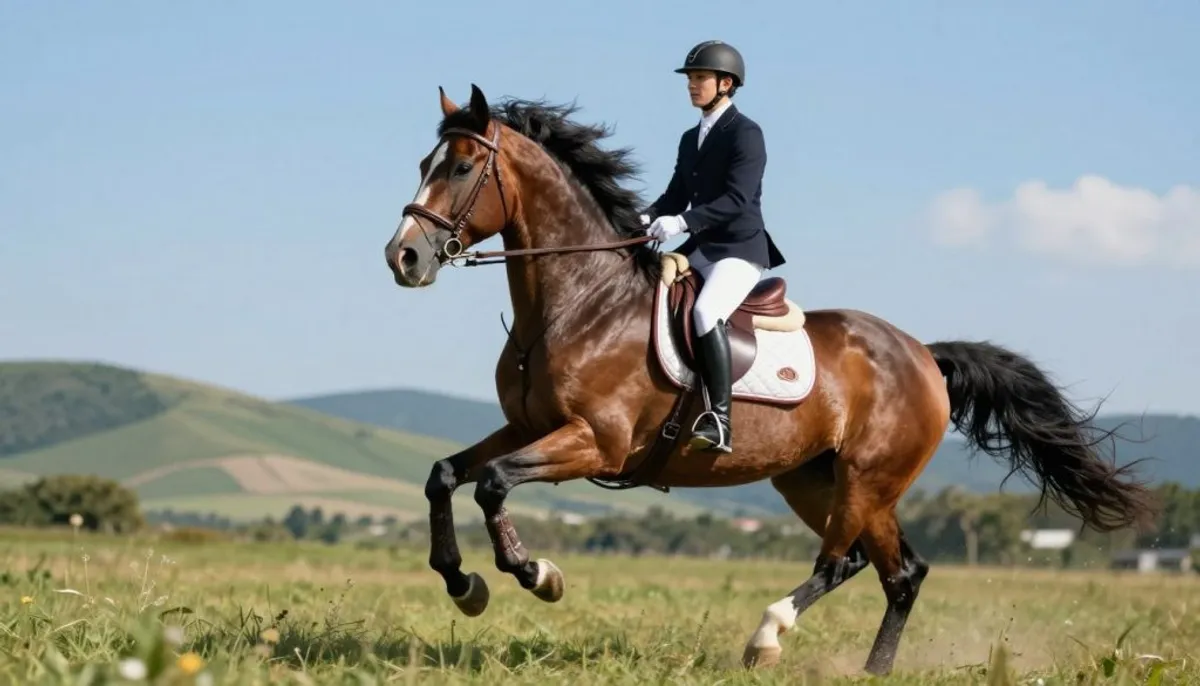
We will start with the basics: understanding the gait, ensuring calmness, and straightness. Then we will move on to flexibility, relaxation, and good contact. Gradually, we will address straightness, variations, transitions, and even the counter-gallop.
It is also crucial not to neglect the equipment. A well-fitted saddle is essential for the horse to be comfortable and for the rider to be precise. La Sellerie Française (laselleriefrancaise.com) offers high-end products made in France, custom-made or in limited series, by excellent craftsmen.
If improving your gallop is your goal, you are in the right place. Together, we will work with clear advice for elegant equestrianism and lasting control of the gait.
Key Points
- A controlled gallop remains regular, balanced, and unhurried.
- Progression follows a logic: understanding, basics, flexibility, contact, straightness, variations.
- Working on the track helps stabilize the rhythm and check direction.
- Training provides simple benchmarks to improve mastery of gaits.
- The comfort of the French rider and the precision of the aids also depend on appropriate equipment.
- La Sellerie Française focuses on high-end made-in-France products, with custom options and limited series.
Understanding the gallop: rhythm, cadence, and projection
A good gallop in a horse is easy to recognize. It is clear, stable, and easy to follow. In dressage, the most important thing is to correct the gait. A mistake in rhythm can be costly. Even when turning or on a straight line, the movement must remain logical.
If the horse loses its unity or rushes, the stride is no longer coherent. In these moments, it is pointless to continue if the rhythm is poor. One must seek a natural gait, not faster.
The three-beat gallop and the projection phase
The gallop is broken down into three beats and a projection phase. This projection is a leap forward, full of life and energy. Unlike a simple suspension, the horse's body continues to move.
When the projection is correct, the stride naturally widens. The back works, the support is secure, and the movement seems fluid.
Difference between rhythm and cadence: benchmarks for the rider
Rhythm is the sequence of movements and their distribution. The cadence is like the tempo in music. It corresponds to the regularity of the steps. With the same cadence, the rhythm can remain constant even if we adjust slightly.
| Benchmark | What you observe | What you feel in the saddle |
|---|---|---|
| rhythm | Three clear beats, then projection, without mixing supports | A clear stride, maintaining the same sequence |
| cadence | Steps can be closer or spaced but maintain the three beats | A regular tempo, similar to a metronome, without irregularities |
| Alert signal | If the horse accelerates and disrupts the beats, or loses its unity | You feel discomfort, the movement becomes difficult, you feel like you are running |
Why speed does not guarantee the quality of the gait
Speed alone does not define a good gallop. A fast horse can still lose its rhythm and rush. On the other hand, a slow gallop can be of better quality with good projection and a stable cadence.
The best test is simple. Whether turning, on a circle, in corners, or straight lines, the gait must remain constant. If the horse maintains its rhythm and cadence, the quality of movement is preserved, without forcing.
Establishing the basics in equestrianism: calm, forward, and straight
To progress in equestrianism, three simple principles are key: calm, forward, and straight. Calmness helps the horse focus. The "forward" maintains its energy. And the "straight" prevents bad movements. These principles work everywhere, providing safety and clarity.
Building trust and responsiveness to aids
Trust is shown when the horse obeys without tension. We seek a clear response to the aids, then reward with relaxation. This makes the horse receptive and the impulse easy to manage.
If the horse resists, we simplify. We make a shorter and simpler request and then calm it down. Quality is more important than quantity, especially at the beginning.
Preserving the correctness of the gait before any exercise
Before any exercise, we ensure a good rhythm. A stable rhythm, natural activity, and a regular cadence are needed. If the gait is lost, we simplify and then start again. This prevents reinforcing mistakes.
In the arena, it quickly becomes apparent if something is wrong. If a horse accelerates or does not stay straight, it needs correction. We must find a good balance before asking for more.
Working on the outdoor track and indoor tracks to check straightness
On the outdoor track, the rail can help but also hide problems. To check straightness, move away from the rail. Try to stay straight without deviating. This is essential for control.
Good control shows if the aids are effective. If things become complicated away from the rail, it is a sign. Adjust the path and posture. Prefer to regulate energy rather than force.
| Control Point | What you observe | Simple adjustment | Desired effect |
|---|---|---|---|
| Calm | Regular breathing, stable neck, absence of rush | Shorten the exercise, brief pauses at the walk, more discreet requests | Horse available and attentive |
| Impulse | Active gait without accelerating, clear responses | Short encouragement with the leg, then immediate relaxation | Useful energy, without tension |
| Straightness | Straight trajectory, shoulders in front of hips on the indoor track | Look far, outside rein stable, legs framing | Horse straight without leaning on the rail |
| Quality of aids | Quick response, calm mouth, no struggle | One aid at a time, lighter, better timed | Permeability and cooperation |
Flexibility and relaxation: the foundation of a fluid gallop
Flexibility and relaxation go hand in hand in dressage. They ensure the proper holding of gaits from the start. For a fluid gallop, aim for a constant rhythm rather than using force.
Mental relaxation
Relaxation starts in the horse's mind. It appears calm, attentive, without tension. It has a peaceful gaze and listens to leg and voice requests.
A relaxed horse has moving ears. It listens to its rider and its environment. Its breathing is calm, and it gently chews the bit.
On the other hand, an anxious horse shows signs like grinding teeth or a tense neck. This can cause disruptions in its rhythm and posture.
Physical flexibility
Physical flexibility is all about ease of movement. We want steps that can easily extend or shorten. A supple back indicates good carrying under the rider.
When turning, a flexible horse can bend and stretch naturally. Its tail moves harmoniously, and its hind legs support its balance.
If the horse's back stiffens, its steps shorten, and it loses its balance. This also affects the regularity of its movements.
| Observed Indicator | Available Horse | Tense Horse |
|---|---|---|
| Rhythm at the gallop | Regular, even in corners | Rhythm faults, rushing or slowing down |
| Back | Elastic back, "carried" saddle | Stiff back, hard bounce, short strides |
| Mouth and neck | Pleasant contact, permeable neck | Clenched mouth, rigid neck, unstable head |
| Tail | Soft and centered swinging | Stiff tail, repeated swishing |
Testing availability
To test this, try to loosen the reins while maintaining the same gallop. The horse should stretch its neck down and forward without changing its speed.
If the horse remains balanced, it is well relaxed and supple. If not, gently regain contact and try again.
Quality of contact and connection: stabilizing the gait without resistance
True contact is not about "holding" the horse. It is a clear relationship between the rider's hand and the horse's mouth. This is achieved with adjusted reins without pulling. Thus, the horse remains confident and balanced, with true stability in both reins.
The connection starts with the hindquarters, not the fingers. Energy first rises through a supple back, then through a flexible neck and poll. The horse then seeks the bit by itself, instead of resisting it.
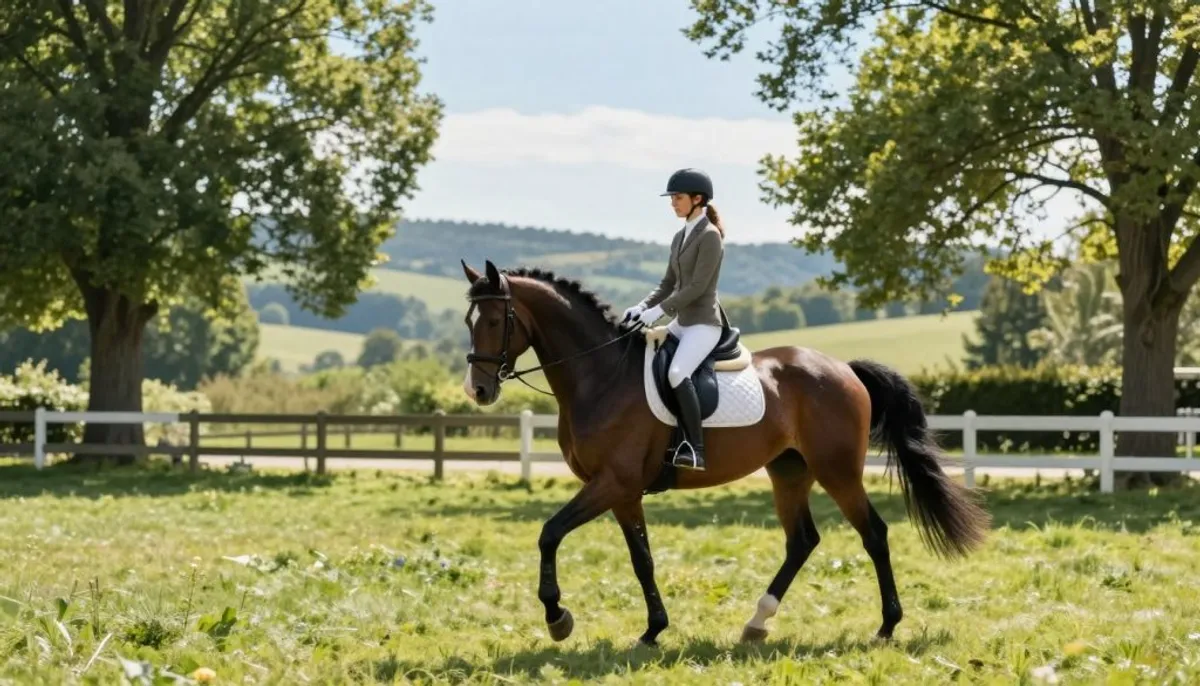
When the horse is well connected, it becomes apparent quickly. The horse's forehead is slightly forward. Its mouth gently chews, and the neck relaxes on request. This allows for easy adjustment of the horse's attitude without losing rhythm.
A good contact also helps control speed and balance at the gallop. It is possible to reduce pressure to a minimum, then return to firmer contact if needed. Lightness does not come from the absence of reins but from a calm and responsive hand.
| What you feel | What you observe | What it means | Simple adjustment to try |
|---|---|---|---|
| "Elastic" reins, equal weight in both hands | Calm mouth, neck unfolding, supple neck | Regular contact, stability useful for regulating the gait | Keep hands fixed, add a light impulse from the legs |
| Empty hand then jolts, the horse retreats at the bit | Horse behind the hand, tongue tense, neck locked | Break in contact, lack of trust | Shorten a transition, then reopen the neck without pulling |
| Heavy weight in the fingers, need to "carry" | Too firm support on the bit, rigid neck | Horse leaning, insufficient work from the hindquarters | Alternate more active strides and return to calm, without hardening the hand |
| Horse "round" but hard, feeling of confinement | Below the vertical, sometimes grinding teeth | Excessive bringing back, back freezing | Advance hands a few centimeters and encourage with the legs |
| Unstable contact, broken bend | Neck breaking, poll not at the highest, marked angle in the middle | False connection, energy no longer flows | Straighten, ask for a gentle bend, then stretch the neck |
It is essential to maintain lightness and monitor regularity. If the hand becomes hard, the gait stiffens. If the hand weakens, we lose the frame. Aim for a lively and discreet contact, but constant enough. Thus, the horse stands well without resisting.
Gallop horse: achieving a slow, regular, and balanced gallop
A comfortable gallop depends on stability, not speed. We seek to maintain an easy rhythm. The horse's back should remain flexible while keeping its balance everywhere.
One must master the gaits, slowing down without losing energy. Olivier Gradwohl explains the importance of this mastery for precise speed control.
Aim for the slowest gallop possible without falling into the horse trot
The goal is to achieve the slowest gallop without transitioning to a trot. Imagine making "little jumps" rather than braking. Keep a firm hand and active legs.
If your horse hesitates, do not be too harsh. Gently ask for the gallop again. The important thing is to maintain a regular cadence, even if the amplitude decreases.
Straightening the gallop with a slight shoulder forward
Many horses tend to tilt their hips inward. Slightly positioning the shoulder forward helps align the shoulders and hips. This facilitates straightness without forcing.
This correction improves balance and prepares for collection. The horse becomes more stable, leaning less. You can then gradually slow down without falling into a trot.
Maintaining the gait with the legs to avoid transitioning to a trot
Once the rhythm is found, maintain the horse with your legs. The legs stimulate, while the hand controls the amplitude. This is essential for managing gaits on a daily basis.
Introduce transitions within the same gait. Alternate between short strides and a slight rebalancing. This method allows for a controlled gallop, with the shoulder forward.
| Objective | What you do | Simple benchmark | Common mistake |
|---|---|---|---|
| Slow down without changing gait | Reduce amplitude with small requests, active legs | Identical cadence, gallop horse still "bouncy" | Braking hard and falling into the horse trot |
| Straighten balance | Install a light shoulder forward on the track | Shoulders in front of hips, easier trajectory | Let the hips come in and lose straightness |
| Prepare for more control | Intra-gait transitions, then return to slow gallop | Stable contact, horse available without tension | Confusing collection and blockage |
Straightness in the arena: shoulders in front of hips
When galloping in the arena, straightness becomes immediately apparent. You should try to keep the shoulders in front of the hips. This helps the horse stay stable and straight. If the shoulders and hips are not aligned, balance is lost. Consequently, the horse does not gallop regularly.
Why hips often come in: understanding the "crossed" horse
A "crossed" horse has its hips not following the straight path. Its body does not go straight, even if its head is well placed. Thus, it does not remain straight, and its gallop becomes less fluid.
Hips often come in due to the rider poorly controlling the front. The outside rein is not well held, causing an imbalance. The horse attempts to rebalance itself by getting crooked. Without a good guide, its hind legs do not follow the right direction.
Straightness exercise: doubling in length while controlling the shoulders
While galloping on an inner line, double the length. Focus on the movement of the shoulders rather than the hips. Use the outside rein to guide the forehand without forcing.
Maintain energy with the inside leg, following the rhythm of the gallop. If the hips start to deviate, change lines to simplify. Then resume the doubling with precision.
| Point to control | Sign of a crossed horse | Simple correction | What you should feel |
|---|---|---|---|
| Inner line trajectory | The horse "cuts" and the hips come in | Stabilize the outside rein and aim for a narrow corridor | Shoulders stay in front, without zigzagging |
| Cadence and impulse | Gallop slows down or rushes | Maintain with the inside leg, through short touches | A regular gallop, that "carries" the rider |
| Control of hips | Hindquarters slipping inward | Outside leg back, brief intervention then relax | Hindquarters pushing straight, without lateral escape |
| Contact in the hand | Forehand falling or leaning | Tonic outside rein, stable hand, supple elbows | A stable contact, without heaviness or break |
Posture benchmarks: rider in the middle of the saddle, shoulders at the same height
Start by sitting in the middle of the saddle. Ensure your shoulders are at the same height. An upright posture facilitates work.
Next, organize your movements. The outside rein guides the shoulders while the inside leg promotes impulse. Keep your gestures calm and regular for better precision in the arena.
Transitions and variations: improving ease at the gallop and horse trot
Using transitions helps control speed without destabilizing the horse. The goal is to maintain posture while modifying the energy deployed. Whether on a straight line or in a circle, we seek a regular cadence, including when varying the amplitude of movements.
Variations of gait should be performed calmly, with clear aids that are quickly relaxed. To energize the trot, stimulate the horse's hindquarters rather than pulling on the forehand. If the rhythm slows down, propulsion and impulse are lost.
Be careful not to brake too much during downward transitions. Aim for a quick response: contract the pelvis, support with the leg, then relax. This way, the horse remains dynamic, and the transition occurs smoothly.
Transitions within the gallop are beneficial for a horse already well balanced. They consist of alternating between a few more collected strides and others more extended, without transitioning to a trot. This promotes better balance and makes the gallop more harmonious.
| Felt objective | Exercise on the track | Sign that it's right | Common mistake |
|---|---|---|---|
| Stable cadence at the trot | Medium trot ↔ working trot transitions on a large circle | Neck positioned, quick hindquarters, equal contact | Lengthening in front without pushing behind |
| Controlling balance at the gallop | Variations of gait on the diagonal, then return to the track | Shoulders in place, regular strides, trajectory held | Leaning, losing straightness in corners |
| Making the aids finer | Gallop ↔ walk transitions on a straight line, then immediate departure | Clear departures, free neck, back remaining supple | Dragging steps and departure "with strong leg" |
The technical mastery of the rider is refined through these transitions. The body remains upright, the hands guide without forcing, and the leg stimulates without excess. Depending on the level, working on the collected gallop can help find the right tempo and avoid unnecessary movements of the pelvis.
- Make transitions at precise points to be more regular.
- Alternate between straight lines, corners, and curves to better manage balance.
- Maintain a "forward" dynamic, even when slowing down.
Effective relaxation on the equestrian track: making the horse attentive and regular
A good relaxation aims for a responsive and relaxed horse. It does not consist of tiring it out. On the track, a few minutes of quality are better than a long aimless work session.
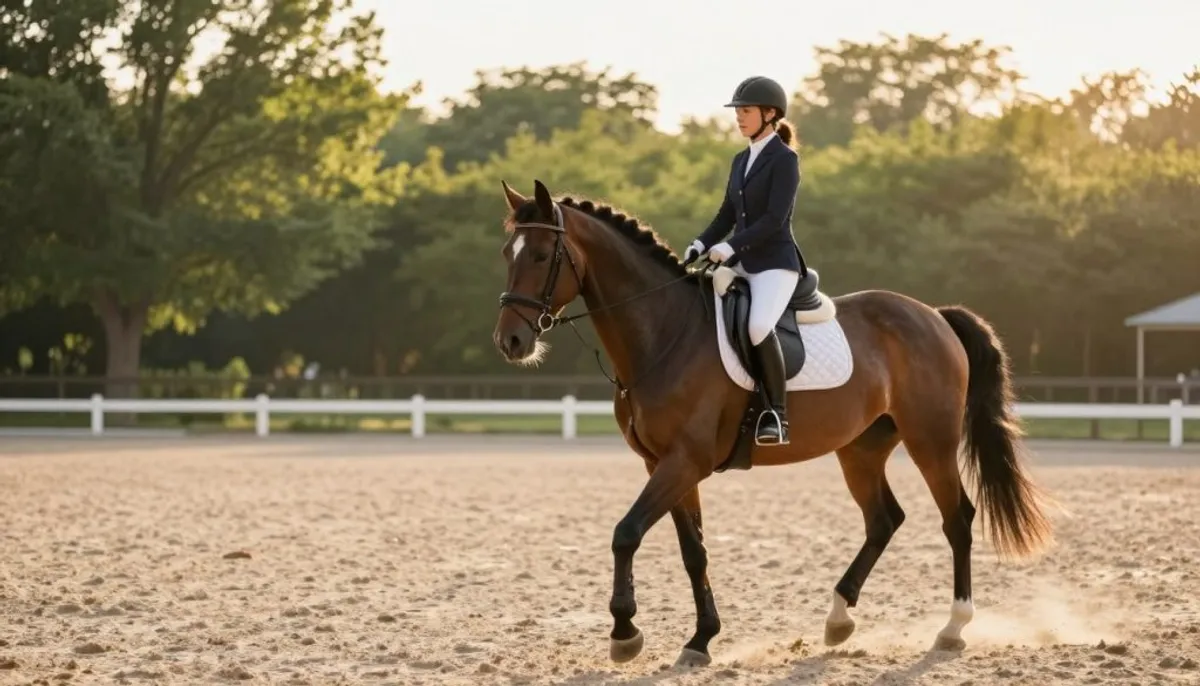
From the start, the rider must be attentive to the horse: breathing, flexibility of the neck, assured walk. The gait must be constant. This creates a solid foundation before adding more complex techniques.
Transitions, changes of bend and flexion to awaken the aids
Make clear and close transitions. Think about obtaining a response, not speed. A good transition maintains the horse's balance and a soft contact.
Then, vary the changes of bend and flexion in wide curves. Alternating direction stimulates the horse and prevents it from resting on the rider. On the circle, seek a flexible neck and mobilization of the hindquarters.
Maintaining regularity and cadence at all three gaits on precise paths
After establishing good responses to the aids, aim for consistency at all three gaits. Maintain a clear cadence along the entire line. The courses should be simple: large circles, diagonals, lightly marked serpentines.
Try to move two meters on an inner track. This helps your horse walk straight, without relying on the barrier. If the trajectory distorts, choose a simpler course and support better with the outside aid.
Prioritizing ease in the saddle: free pelvis, relaxed legs, toned back
The rider's posture is crucial. A mobile pelvis allows following the movement without resistance. The legs should remain supple and ready to intervene.
A firm back and supple arms ensure continuous contact. If the hands harden, the horse stiffens and loses its relaxation. A simple posture keeps the horse straight and attentive.
| Point to check | Sought sign | Immediate adjustment |
|---|---|---|
| Transitions | Quick response without rushing | Shorten the request, relax as soon as there is a response, start calmly |
| Bend and flexion | Supple neck, ribs rounding, no shoulder drop | Reduce the angle, enlarge the curve, stabilize the outside rein |
| Paths | Line held to the centimeter, prepared turn | Look early, place the shoulders, maintain the same rhythm |
| Regularity and cadence | Equal gait, neither faster nor slower | Legs through touches, discreet half-halt, return to walk if needed |
| Inner track | Straightness without support from the rail | Realign the shoulders, reduce the inside hand, guide with the body |
| Rider comfort | Free pelvis, supple shoulders, stable hands | Breathe, relax thighs, keep elbows close to the torso |
Counter-gallop: a complete exercise for balance, propulsion, and weight transfer
The counter-gallop helps the horse and rider understand each other better. They follow a path without changing leads to stay balanced. This also helps to quickly identify and correct mistakes.
For the rider, it is an opportunity to learn the right rhythm and maintain it. If the energy weakens or the front of the horse drops, the exercise reveals it. Thus, aiming for a good weight transfer becomes a clear objective.
What the counter-gallop develops: straightness, propulsion, weight to the back
In counter-gallop, we must build straightness step by step. The horse improves when its strength moves from back to front in a balanced manner. If the impulse decreases, balance is lost.
One must seek to have a soft contact without pulling on the reins. The outside rein helps keep the horse's shoulders in place. The more it rebalances, the better the weight transfers.
| Observed Point | Sign that it is right | Simple adjustment |
|---|---|---|
| Balance | Identical strides, stable turn, no "fall" on the shoulder | Stand tall, breathe, maintain a laid-back cadence |
| Propulsion | Living gallop without accelerating, clear responses to the legs | Inside leg at the girth in brief actions, then relax |
| Weight transfer | Withers rising, back carrying, easier transitions | Straighten the torso, support activity behind rather than braking in front |
| Outside rein | Guided shoulders, controlled bend, faithful trajectory | Supported outside rein, stable hand, without retreating |
Exercise "straightening the gallop" on the diagonal: upper body orientation and supported outside rein
While galloping to the right, take a diagonal. Think about holding yourself well during the curve to align the horse. Maintain the outside rein so that the shoulders do not move.
Before reaching X, prepare your change of direction. Keep the horse stable, without leaning. Use the inside leg to push, and adjust with the outside leg if necessary.
Counter-change of hand: keeping the lead, controlling shoulders and hips
The counter-change of hand maintains the gallop during a change of line. Even in a small space, the path must remain clear. If it is too tight, use the sides of the track.
Keep control of the shoulders with the outside rein, and be gentle but firm with the legs. The horse must remain straight and balanced. Thus, it will easily follow your guidance.
Horse dressage: following the progression scale for a lasting gallop
Horse training follows a progression scale as a guide. The French Equestrian Federation (FFE) has made it a standard. This standard helps riders, instructors, and judges speak the same language, especially in competition.
This guide is essential for evaluating without haste. If we want to improve impulse or balance, we know where to return when the rhythm weakens or contact is lost.
The six reference points: gait correction, flexibility, contact, impulse, straightness, collection
The six key elements follow each other but combine in practice. We cannot dissociate straightness and collection: everything is linked, especially at the gallop.
- Gait correction: a clear three-beat gallop, without rushing.
- Flexibility and relaxation: a flexible back, a supple neck.
- Quality of contact: stable hands, a receptive mouth.
- Impulse: energy that spreads throughout the body, without stiffness.
- Straightness: shoulders and hips aligned, balance in managing the hands.
- Collection: concentrating more weight on the hindquarters while maintaining the energy of the gallop.
| Key Point | What we observe at the gallop | If it deteriorates | Simple path to restore |
|---|---|---|---|
| Gait correction | Three well-marked beats, regular jump | Disordered gallop, too fast or disunited | Regain rhythm on a large circle, adjust before asking for more |
| Flexibility | Stretched neck, well-mobile back | Stiffness in the body, short steps, tense horse | Vary between gentle bends and straight lines, relax your pelvis |
| Contact | Light but firm contact, calm hands | Horse evading the hand or leaning too much | Play with transitions without forcing, soft hands, leg present |
| Impulse | Engagement of the hindquarters, high shoulders | Gallop weakening or becoming chaotic | Bring forward a few steps then return to gallop, without forcing |
| Straightness | Straight horse, stable on the diagonal | Deviation of hips, shoulder drop | Shoulders in front of hips, on a simple route, with control of the outside rein |
| Collection | Higher and shorter cadence, without loss of dynamics | Horse tensing or slowing down | Start with impulse and contact, then gradually collect |
Returning to fundamentals in case of disorder: rhythm, relaxation, contact
When facing an issue, we return to the basics according to the progression scale. A rhythm problem is fundamental, as everything relies on it.
Next, we work on relaxation. It is crucial for the quality of movement. After that, we consolidate contact. A clear connection facilitates speed control and balance, without struggle.
Moving towards collection: seating the horse on its hindquarters with balance
Aiming for collection does not simply mean slowing down. It involves shifting the horse's weight to the back while maintaining impulse and the rise of the withers.
A common piece of advice is to place the shoulders in front of the hips. This method allows for reducing the gallop while keeping its energy. It also helps to seat the horse more firmly on its hindquarters without forcing the hand.
Sporting applications: show jumping, path, and gait control
In show jumping, going fast is not the most difficult part. Staying fluid is what counts. With a regular gallop, we count the strides without stress. The goal? To have room to adjust calmly.
Finding the right path starts with the basics. Straight lines and diagonals provide benchmarks. On closed terrains, it prevents the horse from deviating for better direction.
Before jumping, prepare everything in the last gallop. Thinking about aligning shoulders and hips ensures good balance. Then, slightly vary the gait. Result: a smooth ride and constant balance until the jump.
The equipment also plays a big role. La Sellerie Française offers quality gear, custom-made in France. With a good saddle, we are more precise, and the horse follows the path better.
| Situation on course | Path benchmark | Adjustment at gallop horse | Desired effect |
|---|---|---|---|
| Line of 5–6 strides | Straight line, look far | Stable cadence, legs present, calm hands | Constant strides, serene approach in show jumping |
| Tight turn after an obstacle | Quarter line and "drawn" corner | Shoulders in front of hips, light control of the outside rein | Straightness and balance, without loss of impulse |
| Isolated obstacle after transition | Diagonal with precise entry point | Small variation in amplitude, without breaking the gait | Available horse, adjusted distance for competition |
| Last meters before the jump | Axis of the standard, centered shoulders | Breathing, maintained cadence, soft contact | Straight approach, clearer jump, control of the path |
Conclusion
Mastering a gallop does not just mean going fast. It relies on a precise three-beat rhythm and a stable cadence. This allows for maintaining a light and clear gait.
In equestrianism in France, the method remains the same in case of problems. We drop a level to focus on rhythm, relaxation, and contact. With a soft contact and flexibility, the horse quickly regains its balance.
Straightness is paramount in the arena: the shoulders must be aligned in front of the hips. Vary the tracks and diagonals to test alignment and the horse's response. These movements help avoid mistakes and maintain good propulsion.
Variations and counter-gallop improve weight transfer and back posture. When everything is in place, the gallop becomes slower, more regular, and sure. Whether daily or for competitions, this method ensures reliable work at each session.
FAQ
What is a controlled gallop in equestrianism?
A gallop horse that is regular, balanced, and unhurried. It is not about going fast. The goal is to have a stable gait. This includes curves, straight lines, and work on two tracks. A horse must be attentive. And the rider precise.
How does the three-beat gallop work, and what is projection?
The gallop follows a rhythm of three beats. It is followed by a marked projection phase. The projection is a dynamic moment. It is differentiated from a more "static" phase. The latter is often mentioned in other gaits.
What is the difference between rhythm and cadence in the gallop?
The rhythm is the order of movements of the limbs. It also includes the duration between the beats (three beats + projection). The cadence, or tempo, is the frequency of beats of a given limb. We seek a just and stable cadence. One must not confuse cadence and rhythm.
Why does speed not guarantee the quality of the gallop?
Speed (in m/min) is not a good quality indicator. A horse can go fast but without control. In horse dressage, we seek a natural activity. It must respect the rhythm, without rushing.
Why is a rhythm fault considered a serious fault in dressage?
Because a good gait is fundamental. If the rhythm is poor, the exercise loses its meaning. We cannot build balance, contact, or collection healthily. This shows the importance of rhythm in dressage.
What is the principle of "calm, forward, and straight," and what is its purpose?
"Calm, forward, and straight" serves to establish foundations. It includes a calm mindset, clear impulse, and a straight trajectory. Before asking for counter-gallops or collections, these fundamentals must be in place.
Why is it said that no exercise is useful if the horse alters the rhythm?
Because regularity is essential everywhere. This includes corners, circles, and straight lines. If an exercise disrupts the rhythm, we simplify. Then, we gradually resume.
How to check straightness without the horse leaning on the rail of the arena?
Work at 2 m from the rail. Without a "wall" of support, the horse must keep its shoulders in front of the hips. If the horse deviates, work on straightness.
What signs indicate true mental relaxation at the gallop?
A relaxed horse is calm and serene. You see calm breathing, attentive ears, and a soft jaw. Even on the track, these signs must be present.
What are the markers of good physical flexibility?
Flexibility is seen through an elastic back and supple movements. A regular rhythm and the ability to bend correctly are needed. These criteria are important in horse trot and gallop.
What signs should alert to a lack of flexibility or relaxation?
Signs like a stiff back, a stiff tail, or rhythm faults are alerts. One should also be attentive to a clenched mouth and a rigid neck. At the slightest sign, simplify the work.
How to perform the neck extension test without losing balance?
The goal is to let the reins slide for a neck extension forward and downward. One must not change gait or lose balance. If the horse accelerates or becomes disunited, work on its availability.
What is good contact, and where does it come from?
Good contact is a gentle relationship between the rider's hand and the horse's mouth. It is confident, stable, and symmetrical. It comes from the energy of the hindquarters, via a supple back. Thus, the horse "seeks" the contact.
How to recognize good contact in practice?
The horse should move confidently towards the hand. The muzzle stays in front of the vertical, and the mouth is supple. This contact allows for controlling speed and balance without tension.
Does the absence of contact equate to lightness?
No. Absence of contact ≠ lightness. Lightness is characterized by light but precise contact. A horse behind the hand does not show lightness but avoidance.
What are typical alterations in contact to watch for?
If the horse is behind the hand or gets trapped, it is a problem. A neck not high or too strong a support is also an issue. Each case requires a return to flexibility and activity of the hindquarters.
How to achieve "the slowest gallop possible" without falling into the horse trot?
The goal is to maintain vigor, even at low amplitude. This challenge requires finesse. If the horse slows down too much, encourage it. Then, rebuild the movement.
What does straightening the gallop with a slight shoulder forward mean?
It means improving balance by keeping the shoulders in front of the hips. We seek more control and better collection. This straightening also corrects certain deviations.
How to maintain the gallop to avoid transitioning to trot?
One must keep the horse “in the legs.” The activity of the hindquarters remains lively. In transitions, do not slow down the cadence. Keep the speed while adjusting the amplitude.
Why is a horse often "crossed" at the gallop in the arena?
A "crossed" horse has its hips slipping. This often happens in curves. It causes a loss of straightness and balance. This is particularly noticeable when the horse leans on the rail.
What simple exercise helps gain straightness at the gallop?
A good exercise is to double in length of the gallop. Using the outside rein to guide the shoulders helps. The inside leg supports the impulse. The outside leg assists if necessary.
What posture markers help the rider stabilize the gallop?
The rider must remain centered in the saddle, balanced on their seat. The arms and shoulders should help with soft contact. The legs support without ceasing. This posture is key, even for dynamic exercises like the collected gallop.
What are the purposes of transitions and variations to improve gallop and horse trot?
They improve speed and balance control without sacrificing rhythm. This refines the seat and makes the horse more responsive and supple.
How to organize effective relaxation on the equestrian track?
After warming up, awaken the horse's attention with transitions and changes of flexion. Then, maintain regularity and cadence on different paths. Include inner tracks to test straightness.
Why is counter-gallop so formative in dressage?
The counter-gallop improves straightness and propulsion. It helps the rider correct imbalances without tension. The aids must remain stable and the contact soft.
How to work on "straightening the gallop" on the diagonal in counter-gallop?
On the diagonal, maintain impulse and control the shoulders. Use a supported outside rein in the curve. Orient the body for the new direction. If necessary, adjust the hips with the outside leg.
How to succeed in a counter-change of hand while keeping the gallop lead?
The goal is to correct the path and control movements without losing rhythm. Precision and a soft contact are essential. In a tight space, work on the quarter line to simplify.
What is the Progression Scale of the French Equestrian Federation?
It is a guide by the French Equestrian Federation (January 2020 edition). It serves as a common reference among riders, trainers, and judges. It helps identify and correct problems.
What are the six reference points of the scale, and why are they linked?
The key points are: gait correction, flexibility, quality contact, impulse, straightness, and collection. They are interdependent. If one aspect falters, we often return to the basics before going further.
How does gallop mastery help in show jumping?
In show jumping, a good gallop helps stabilize and clarify jumps. The principles remain the same: control, balance, and good contact are essential.
What is the connection between path, precision, and performance in the arena?
A good path indicates good balance. It is necessary to maintain rhythm and straightness, even on inner tracks. In competition, the precision of the path is crucial.
What equipment can help improve comfort and precision of aids?
Appropriate equipment makes the aid finer and improves contact. La Sellerie Française (laselleriefrancaise.com) offers quality gear, made in France. They are durable and precise.