
In France, clay is often used for horses in stables. It helps after exertion, relieves sensitive areas, or reduces swelling in the limbs. It is a valued natural treatment.

The use of clay for horses offers quick results. However, it is important to understand how it works. The differences between green clay and pink clay should also be considered.
We will explain how to use clay step by step. This includes preparation, the thickness to apply, the duration of application, and tips for maintaining moisture. We will also address the most common cases where it is useful.
Good care equipment is crucial, just like quality materials. La Sellerie Française (https://laselleriefrancaise.com) offers high-end products. Everything is made in France by artisans.
Key Points
- Horse clay is a common ally for recovery and local comfort.
- The benefits of horse clay depend on the composition, application, and contact time.
- The color (green clay, pink clay) provides clues but does not tell the whole story.
- Good use of horse clay relies on a well-prepared paste and a sufficiently thick layer.
- Common uses involve tendons, swelling, bruises, summer dermatitis, and scratches.
- An effective care kit also relies on reliable and well-designed materials.
Why Clay is Essential for Natural Horse Care
In a stable, clay is seen as a simple and effective remedy. Understanding its true qualities changes the way it is used. Clays are not just simple muds. They consist of unique natural materials in texture and action.
This helps us identify the good properties of clay. This avoids creating unsuitable mixtures. Thus, we save time and better meet needs.
A sedimentary rock extracted from the ground, rich in minerals
Clay, a sedimentary rock, comes from the earth. It is dried and sometimes sifted. It carries the "signature" of its origin due to its minerals and silicates. These mineral elements justify some of its properties in external treatments.
The origin influences its texture. Fine clay is easier to work into a paste. This is especially true for poultices after exertion.
The “mille-feuille” structure: what it changes for effectiveness
Up close, clay resembles a mille-feuille of crystals. This complex structure influences its effectiveness. The layers contain compounds that react with water.
This unique structure helps clay adhere to the skin and hair. It is a good way to recognize certain properties of clay.
| What we observe | What it means | Practical impact with horse clay |
|---|---|---|
| Overlapping layers (mille-feuille effect) | Large contact surface between the sheets | More homogeneous poultice, more even application |
| Presence of ionic compounds | Possible exchanges upon contact with moisture | Helps understand the properties of horse clay and the importance of clean water |
| Fine or coarser granularity | Smoother texture | The finer it is, the easier it is to smooth on limbs and sensitive areas |
Swelling upon contact with water: understanding texture and action in poultice
When water is added, clay swells. This creates a pasty and cool texture. On horses, this allows for the formation of a stable thick layer.
It is important to let the clay absorb the water before mixing. Avoid metal utensils. They can affect the ionic balance of the clay, especially to achieve a stable paste.
Understanding the Types of Clays and Their Particularities
Before choosing a clay for your horse, it is useful to understand terms like “bentonite” or “kaolin.” The textures and how the clay stays on the limb are as important as the label. Depending on what you want, you can look for a clay that cools, adheres well, or is easy to remove.
Smectite, bentonite, kaolinite: families with similar and complementary properties
Smectite clays swell with water. They form a soft poultice that adheres well and remains moist. They are often used in green clay for horses because they provide good hold.
Bentonite is a specific type of smectite. It is known for its creamy texture and ability to adhere well. It prevents the clay from running, especially on thin limbs or after wetting the horse.
Kaolinite is softer and swells less, resulting in a lighter paste. It is perfect for a less occlusive feel or for sensitive areas. These different clays can complement each other for effective care.
Why Commercial Clays are Often Mixtures
Clay products for horses are often mixtures. The idea is to create a stable and easy-to-apply paste. A good mixture dries at a regular pace and removes effortlessly. It also helps ensure a consistent texture.
There are enriched clays, like Antiphlogistine, based on green clay. They may contain arnica, aloe vera, or menthol. These ingredients alter the sensation but require caution on irritated skin.
Marine clay is often chosen for its beneficial marine elements. Whether pure or enriched, it is crucial to check its composition before use.
| Type of clay | Texture and hold | Common interest in horse clay | Points of attention |
|---|---|---|---|
| Smectite | Soft paste, swells well, stays moist longer | Poultice that adheres and covers evenly | Can be very sticky if too thick |
| Bentonite | Creamy, strong adhesion, good stability on the limb | Provides hold to mixtures, useful after exertion | Requires patient rinsing if it has dried too much |
| Kaolinite | Lighter, swells less, easy application | Gentle option for delicate areas, less “heavy” paste | May not hold well on a vertical area alone |
| Commercial mixture | Calibrated, homogeneous texture, ready to apply | User-friendly for regular use of horse clay | Read the additives (essential oils, menthol, plants) |
“Ready-to-use” clays vs powder clay to dilute
Ready-to-use clay is very convenient. You open it, apply it, and it is always the right consistency. It is a good choice for quick treatments or for a uniform texture.
With powder clay, you have more control. You can adjust the water and thickness according to your needs. It is often more economical for those who use it frequently.
If you seek simplicity, choose ready-to-use clay. If you want to adapt the texture, powder is better.
Properties of Clay for Horses and Mechanisms of Action
The properties of clay for horses come from its special structure. It is often referred to as a “mille-feuille” structure. Ionic compounds move between the layers, and it swells in the presence of water. It is therefore effective as a poultice and in other more specific uses.
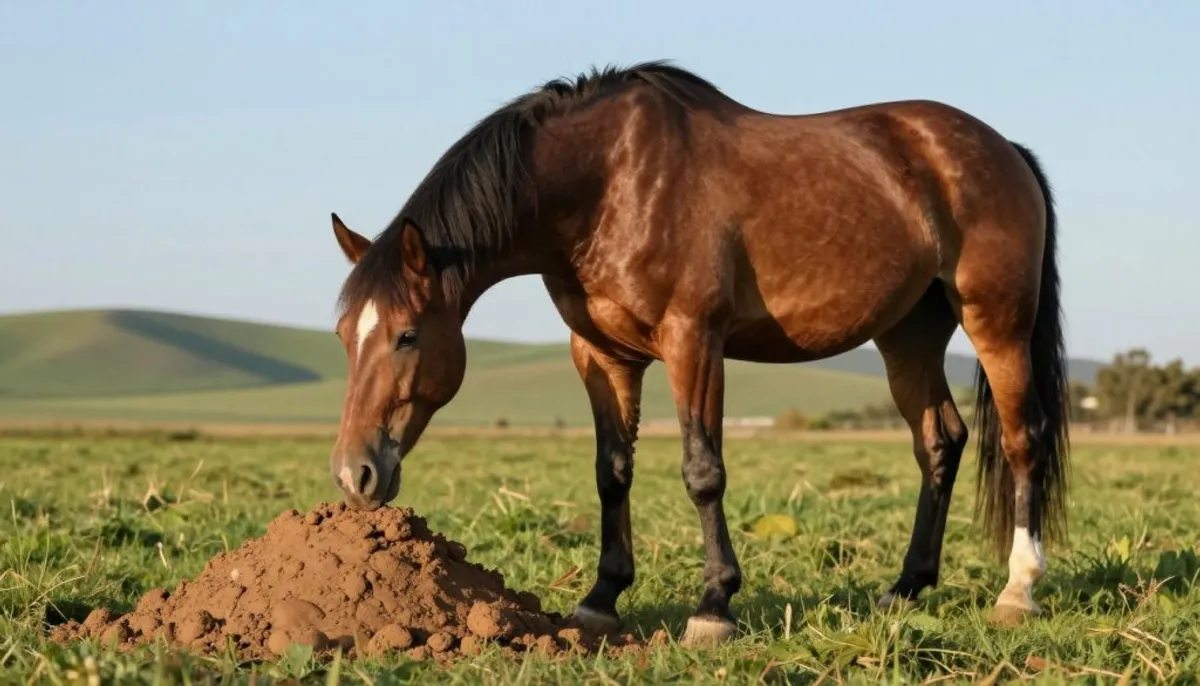
When a poultice dries, it begins to “tighten.” This shows how the clay becomes compact and forms an active layer. In practice, the benefits of clay can be explained by four simple principles.
Absorption Power: Capturing Liquids and Secretions Like a Sponge
Like a sponge, clay absorbs liquids and certain secretions. It is useful on skin that is not irritated. On tired limbs, it can reduce inflammatory fluids. This helps the horse after exertion.
It is also beneficial for the digestive system. It can reduce excess liquid in the intestine. But it must be used cautiously to avoid disrupting hydration.
Adsorption Power: Retaining Toxins and Microbes on the Surface
Clay retains toxins and microbes on its surface due to its structure. That is why it is seen as a natural antibacterial in external treatments. Once used, it should not be reapplied as it retains the impurities it has captured.
Astringent Effect: Tightening Tissues and Supporting Recovery
The astringent effect is observed when the poultice dries. It can help a stressed area, such as a tendon or a joint. This effect comes from its absorption and adsorption power.
In a recovery routine, clay supports well. A thick layer should be applied and removed before it completely dries, especially on sensitive skin.
Protective Covering Effect: Interest in Digestive Support (Supervised Oral Use)
A carefully selected clay forms a protective film. In oral use, it helps against acidity and certain microbes. This is often mentioned to prevent gastric irritation.
Depending on their composition, some clays are praised for their role in coagulation. They must be chosen and used carefully, especially if the skin is sensitive.
| Mechanism | What Clay Does | Where it is Most Observed | Point of Attention |
|---|---|---|---|
| Absorption | Captures liquids like a sponge and helps dry excess moisture | Swollen limbs, warm areas after work, digestive support in case of excess liquid | Keep the clay moist to avoid too much “tightening” sensation |
| Adsorption | Traps toxins and microbes on the surface of the sheets | Poultices on dirty or exposed areas, managing impurities on contact | Never reuse clay that has already been applied |
| Astringency | Slightly tightens tissues and supports local recovery | Tendons, joints, stressed areas after exertion | Adjust the duration if the skin reacts or tightens |
| Protective Film | Deposits a covering layer; in supervised oral use, can support the mucosa | “Dressing” approach in digestive support, gastric comfort | Oral use must be supervised and adjusted according to context |
Horse Clay: Benefits and Most Common Indications
Horse clay helps after work by providing comfort. It is useful if a limb is warm, swollen, or sensitive. It should be applied precisely.
It is good for tendons, fetlocks, and hocks, as well as for the back. It also helps sensitive feet. You can choose between pure clay or one with added ingredients.
Recovery of Tendons and Joints After Exertion
After work, applying clay to the tendons helps to feel better. It tightens the tissues, reducing heaviness. It should be applied cleanly to a targeted area.
Decongesting Limbs (Preventive or After Work)
Clay helps horses that tend to have swollen limbs. Used 2 to 3 times a week, it makes the legs feel lighter. It complements regular care, such as recovery walks.
Bruises, Hematomas, Bumps: Soothing After a Minor Trauma
After a small accident, clay soothes and improves comfort. Avoid using it on damaged skin.
Summer Dermatitis: Forming a Protective Poultice on Irritated Areas
During summer dermatitis, it creates a protective layer. This calms and reduces friction. A soft texture should be chosen to avoid further irritation.
Inflammation of the Scratch: Limiting or Soothing Local Inflammation
For a sensitive scratch, clay helps against inflammation. It should be used regularly, without exaggeration. If the pain is severe, seeing a veterinarian is preferable.
| Frequent Need | Target Areas | What to Expect on the Ground | Examples of Cited Products |
|---|---|---|---|
| Recovery After Exertion | Tendons, fetlocks, hocks, back | Comfort sensation, “cleaner” tissues, heat management | Astrinjambe (ESC Laboratoire), Audevard – Tendilax Antiphlogistic |
| Decongestion | Limbs, stasis areas | Less swollen appearance, lighter legs, routine 2 to 3 times/week | Aqua Cheval Marine – AC Marine Active Marine, AC Marine Double Action |
| Scratches | Around joints, synovial pockets | Targeted decongestion, better tolerance to work | Alodis Care – Gun Tare |
| Sensitive Feet | Thin sole, sensitive frog | Local comfort, managing sensitivities after hard ground | Alodis Care – Hoof Clay |
| Reactive Skin | Irritated areas (including summer dermatitis) | Protective layer, soothing, gentler removal | Alodis Care – Sensitive Clay |
It is important to carefully observe horse clay: heat, swelling, and sensitivity. The benefits are visible with regular use. For clays with additives, consider skin tolerance and sports regulations.
Green Horse Clay, Pink Horse Clay: What Does the Color Say About the Composition?
The color is not just for aesthetics. It gives us clues about what composes the clay, which is important for its function during grooming. Colors range from white to pink to green. This depends on where and under what conditions the clay is found.
The Role of Iron and Its Oxidation State in Color
Iron plays a significant role in the color of clay. When clay oxidizes, its color changes. Chemically, it is often said that green clay is due to the oxidation of iron to Fe2+, and pink clay to Fe3+.
This helps us understand, but it is not everything. The particle size, the water present, and other minerals also play a role in the benefits of clay.
Green Clay: The Most Common for Its Combination of Care Properties
Green clay is popular for its effective mix of qualities for external care. It often contains useful minerals like montmorillonite, kaolinite, and illite. It is also rich in silica.
Its green color comes from iron, but also from magnesium and calcium. These elements are chosen for their purifying and regenerating effects. They are useful after exertion or for caring for certain areas.
Pink Clay: Understanding Its Place in a Routine (Gentleness and Targeted Use)
Pink clay is preferred for its gentle effects. It is well-suited for sensitive skin or for short uses. Its color comes from a more oxidized iron (Fe3+). But the final feel also changes depending on the mixture and fineness of the clay.
It is often used for specific needs, alternating with other clays. This depends on the season and how the skin reacts. It is important to choose according to need, keeping in mind the benefits of the clays.
| Reference Point | Green Horse Clay | Pink Horse Clay |
|---|---|---|
| Color Index and Iron | Iron mostly associated with Fe2+ (common reference) | More oxidized iron, associated with Fe3+ (common reference) |
| Often Cited Minerals | Montmorillonite, kaolinite, illite | Frequent kaolinite, often finer texture depending on origins |
| Elements Associated with Hue | Iron, silica, magnesium, calcium | Oxidized iron, pinkish hues related to mixture and degree of oxidation |
| Place in a Routine | Versatile choice, widespread for its combination of uses | Softer option, interesting for targeted and alternating use |
| What the Color Does Not Indicate | Does not solely inform about purity, granularity, or additives | Does not guarantee tolerance alone: local testing useful depending on the horse |
Application of Horse Clay: Preparation and Gesture for an Effective Poultice
Before applying clay to the horse, prepare it well. A good texture makes contact with the skin easier. It prevents clay pieces from falling off. Simple preparation ensures a consistent poultice, even on hairy areas.
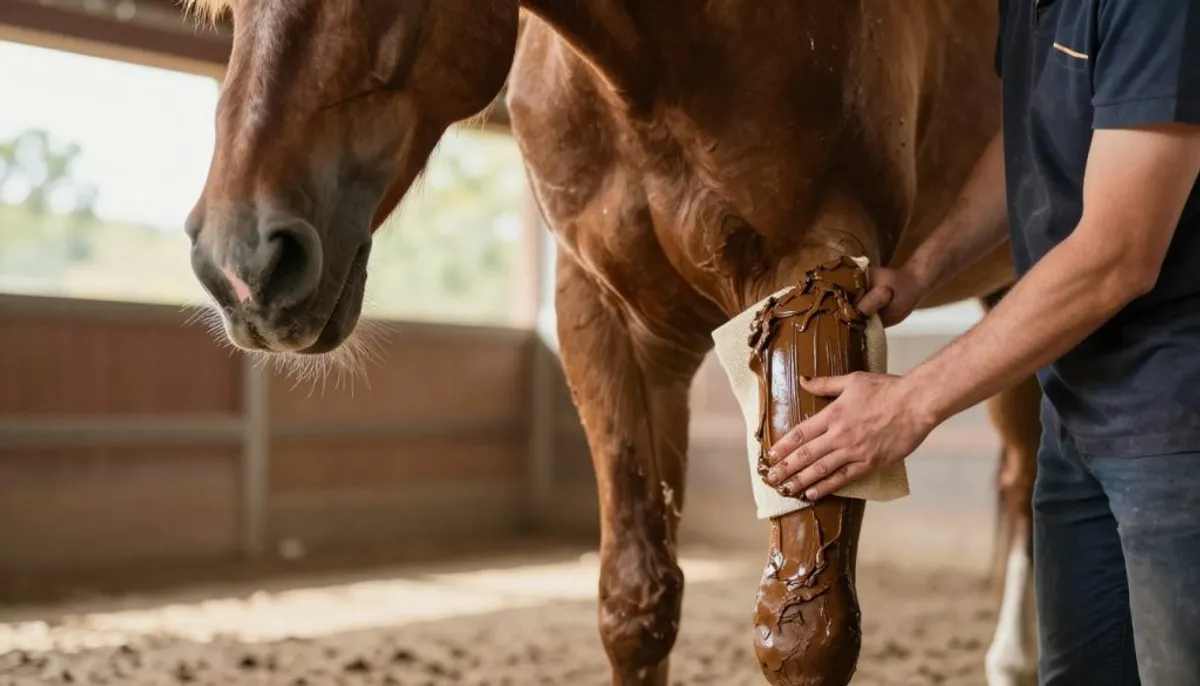
Let the Powdered Clay “Drink” for 15 Minutes to 1 Hour Before Mixing
Start by pouring water over the clay without mixing right away. Let the clay drink for 15 minutes to 1 hour. This makes it smooth and easy to spread. This process improves contact with the skin, for a solid hold on the treated area.
Gently mix to obtain a thick paste, like cream. If too liquid, it slides; if too dry, it pulls the hair. For regular applications, keep the same consistency each time.
Avoid Metal and Plastic to Preserve the Ionic Structure
Use a glass, ceramic, or wooden bowl to maintain the quality of the clay. Avoid metal and plastic to protect the ionic structure of the clay. A wooden spatula or bamboo spoon ensures a homogeneous mixture.
Apply in a Thick Layer Against the Hair, Then Smooth in the Direction of the Hair
Start on a clean area by spreading the clay against the hair. This allows it to get as close to the skin as possible. Finishing by smoothing in the direction of the hair gives a smooth surface. This method is perfect for sensitive areas like tendons and joints.
Another technique is to apply a thin layer before massaging and adding a thick layer. It is effective for sensitive areas. Be careful not to stretch the clay like fine paint.
Application Time: Act While the Clay Remains Moist, Then Remove with Water/Brush
The clay works as long as it is moist. The duration varies from 2 to 24 hours, depending on thickness and temperature. If it dries and cracks, it is no longer effective.
To remove it, use a soft brush or rinse with warm water. This avoids pulling the hair and makes removal more comfortable.
| Step | Recommended Gesture | Simple Reference | Objective |
|---|---|---|---|
| Hydration | Pour water, wait before stirring | 15 min to 1 h of resting | Smoother paste, better hold |
| Mixing | Stir gently with wood/glass/ceramic | “Dense cream” texture | Easy to spread without running |
| Application | Thick layer against the hair, then smoothing | Regular surface to the touch | Optimal skin contact, better adherence |
| Removal | Brush or water, without scraping | When it starts to dry | Clean removal, limit irritation |
Use of Horse Clay: Cover, Leave Exposed, and Optimize Action Duration
After applying clay on the horse, it is important to keep the poultice moist. This allows for all the benefits, especially after exercise or on a swollen part.
Exposed: When It's Sufficient
Leaving the clay exposed allows it to dry gradually. This is good for daily use. If the horse does not move too much, it is often the best choice, especially for areas protected from dust.
A thick layer on a limb slows down drying. But if the clay dries too quickly, its effect diminishes and can become less comfortable.
Gauze, Resting Bandages, Newspaper: Options to Extend Moisture
To increase the action time, covering with a non-occlusive material is beneficial. Gauze allows the skin to breathe while resting bandages hold everything in place without compressing.
Another technique, more traditional but effective, is to use newspaper under resting bandages. The goal is the same: reduce evaporation without completely enclosing.
Cellophane: Interest in Keeping Moisture Longer (to be Handled According to Objective)
Cellophane retains moisture, thus extending the effect of the poultice. However, this alters the sensation, with a more “confined” effect. This may be desired or not, depending on what you seek to achieve.
Some products, like AC Marine Double Action, specify their use. Exposed, the clay has a cooling effect. Under cellophane, it warms. This detail allows for adjusting use according to needs.
Never Reuse Already Applied Clay: Hygiene and Absorption/Adsorption Logic
Used clay has absorbed liquids, impurities, and sometimes bacteria. Reusing it means putting these elements back on the skin, contradicting the benefits of clay.
Therefore, the old poultice must be removed, cleaned if necessary, and then a new one applied. This is a simple but crucial rule for effectively using clay.
| Covering Option | Main Objective | What It Changes on Moisture | When to Consider It |
|---|---|---|---|
| Exposed | Simple routine, skin that breathes | Natural drying, average duration | After light work, clean area, easy monitoring |
| Gauze + Resting Bandages | Protect and maintain without strong occlusion | Extended moisture, more stable poultice | Transport, box, horse rubbing, need for longer application |
| Newspaper + Resting Bandages | Limit evaporation with an economical method | Moisture better preserved than exposed | Extended application when gauze is not available |
| Cellophane | Maximize moisture retention | Very low evaporation, potentially longer action | According to the desired effect (cooling vs heating) and skin tolerance |
Precautions, Common Mistakes, and Frequency of Use According to Needs
Before using clay on a horse, check the condition of its skin. Clay can help, but it does not replace veterinary advice. Especially if the area to be treated is warm, painful, or if the horse has difficulty walking.
Open Wounds: Most Enriched Clays Should Be Avoided
Most clays should be avoided on open wounds. Especially those containing additives like menthol or essential oils. These can irritate the wound. For safe use, apply clay around the wound and not directly on it.
Small Wounds: Prefer Only Pure Green Clay
For small wounds, use pure green clay, with nothing added. In France, a good example is Argile Verte (ESC Laboratoire). It is 100% natural. Just mix the powder with water and apply it cleanly to the skin.
Recommended Rhythm in Case of Swelling: 2 to 3 Times a Week
In case of swelling, apply clay 2 to 3 times a week. This allows the skin to breathe while benefiting from the effects of clay. Monitor progress between applications.
Adjust Frequency According to Work Intensity and Skin Sensitivity
During periods of intense work, clay can be used daily for a short period. Normally, 1 to 2 times a week is often sufficient. Adjust the frequency if you notice that your horse's skin reacts.
| Need | Practical Frequency | What to Monitor | Common Mistake to Avoid |
|---|---|---|---|
| Regular Swelling | 2 to 3 times a week | Local heat, limb size, comfort at a walk | Letting it dry “completely” without a strategy to keep the clay moist |
| Intense Period (Sustained Work) | Daily for a short window | Skin reaction, areas drying out, hair breaking | Reusing already applied clay (hygiene and saturation) |
| Maintenance and Prevention | 1 to 2 times a week | Sensitive skin, itching, small irritations | Choosing an enriched clay on a fragile area |
| Preparation of the Mixture | At each application | Homogeneous texture, absence of grains, neutral smell | Mixing with a metal utensil or certain plastics |
The important thing is to apply the clay well, then remove it correctly. It is the contact that matters, not the quantity. A simple and regular method makes application pleasant for you and your horse.
Conclusion
Clay for horses is an incredible natural solution, as simple as it is effective. It is formed like a sedimentary rock with a special structure called mille-feuille. This gives it unique powers: absorption, adsorption, an astringent effect, and a covering effect. It is also useful for digestive well-being. However, its oral use must be closely monitored.
Applied regularly, green clay is perfect after exertion to soothe tendons and joints. It helps reduce swelling when used 2 to 3 times a week. It is adapted according to activity and skin sensitivity. In cases of bruises, hematomas, summer dermatitis, or inflammation, pink clay is ideal. It targets specific areas such as legs, back, feet, or ankles.
For a good poultice, preparation is crucial. Let the clay rest for 15 minutes to 1 hour before use. Then, apply it generously while maintaining moisture as needed. Remove it with water or a brush, and do not reuse already used clay.
It is vital to be careful during application: avoid enriched clays on open wounds. Use only pure green clay on minor injuries, and consult a professional if in doubt. In France, La Sellerie Française stands out for its high-end equestrian products, made from A to Z in France. They are designed for a high-quality care and equipment routine.
FAQ
What is horse clay, and why is it an essential natural treatment?
Horse clay is derived from the ground. It is full of minerals beneficial for horse health. It aids in recovery and comfort after exertion.
How does the “mille-feuille” structure explain the properties of horse clay?
Clay is made of small stacked crystals. This structure helps the clay soak up water. Thus, it becomes a useful paste for healing, thanks to its unique properties.
What families of clays are most often found for horses?
We mainly use smectite, bentonite, and kaolinite. They have similar effects and complement each other well. Available products mix these clays to target specific needs.
Ready-to-use clay or powder clay to dilute: which to choose?
Ready-to-use clay is quicker to use. But powder clay is often cheaper. It also allows adjusting the consistency according to need.
What is the difference between pure clay and enriched clay (plants, essential oils, menthol)?
“Pure” clay focuses on the natural benefits of clay. “Enriched” clay targets specific effects through its additives. Be cautious, as some areas are more sensitive to these components.
What are the mechanisms of action: absorption, adsorption, astringency, covering?
Clay acts like a sponge, absorbing liquids. It traps toxins and microbes on the surface. Its astringent effect tightens tissues, good for tendons after exertion. It also forms a protective film.
What are the most sought-after benefits of horse clay in routine?
We seek to recover muscles and decongest after exertion. It also helps with summer dermatitis or inflammation. It is a versatile support.
On which areas can horse clay be applied?
Clay is often applied to the limbs, back, feet, and scratches. Each area has its needs.
What frequency for green horse clay in case of swelling?
Use it 2 to 3 times a week in routine. The frequency can increase during intense periods, paying attention to skin reaction.
Green horse clay vs pink horse clay: what does the color say?
The color changes with the iron composition. Green clay is the most used. Pink clay is gentler, for sensitive areas.
What minerals are often found in green clay, and what are they associated with?
Green clay notably contains montmorillonite and kaolinite. These minerals give it purifying and regenerating properties.
How to prepare a poultice with powdered clay?
Mix powdered clay + water and let it rest. After 15 minutes to 1 hour, the paste is ready. It will be smooth and effective as a poultice.
What utensils to avoid for preparing clay, and why?
Do not use metal or plastic. They can alter the structure of the clay. Opt for neutral materials.
What is the right gesture to apply clay on a horse?
Apply a thick layer against the skin. Then smooth. To maximize contact, start with a thin base before adding thickness.
How long to leave the clay on, and how to remove it?
Keep the clay moist for it to work. The duration varies from 2 to 24 hours. Remove with a brush or water, prolonging the effect.
Should you leave the clay exposed or cover it to optimize action?
Exposed, it dries quickly. Covering helps maintain moisture longer. This choice depends on the desired effect.
Can you reuse already applied clay?
No. It would have captured too many impurities. This goes against hygiene and effectiveness principles.
Can clay be applied to an open wound?
Generally, no. Many clays contain additives that can irritate. If in doubt, consult a veterinarian, especially for delicate wounds.
And for a small wound: which clay to choose?
For small wounds, choose pure green clay. For example, Argile Verte (ESC Laboratoire) is suitable for this use.
What common mistakes reduce the effectiveness of using horse clay?
Do not let the clay dry without maintaining moisture. Do not reuse clay. Be cautious about choices on sensitive areas and preparation.
What products illustrate the different approaches on the market (recovery, marine actives, antiphlogistine)?
Among the products, there is Astrinjambe (ESC Laboratoire) for limbs. Aqua Cheval Marine offers a version enriched with marine actives. And Audevard – Tendilax Antiphlogistic is good after exertion or for localized pain.
What is the purpose of a “care kit” with clay for horses?
Clay allows for quick intervention for various treatments. It is essential for reaction and prevention.
Where to find a “quality & craftsmanship” approach to complement a care and equipment routine in France?
A: La Sellerie Française (https://laselleriefrancaise.com) offers equestrian equipment made in France. They provide unique, custom-made, or limited series pieces.
Marine clay, green horse clay, pink horse clay: how to choose without making a mistake?
Choose according to the need and the horse's sensitivity. Marine clay is useful for draining. The green is standard; the pink is gentler.