
The Icelandic horse makes rides exceptional. It is comfortable and smooth from the start. In France, discovering it is often a joyful surprise that brings us back.
This horse comes from Iceland, a land of winds and lava. This wild nature has made it strong and close to people. Its calm invites us to appreciate every moment.
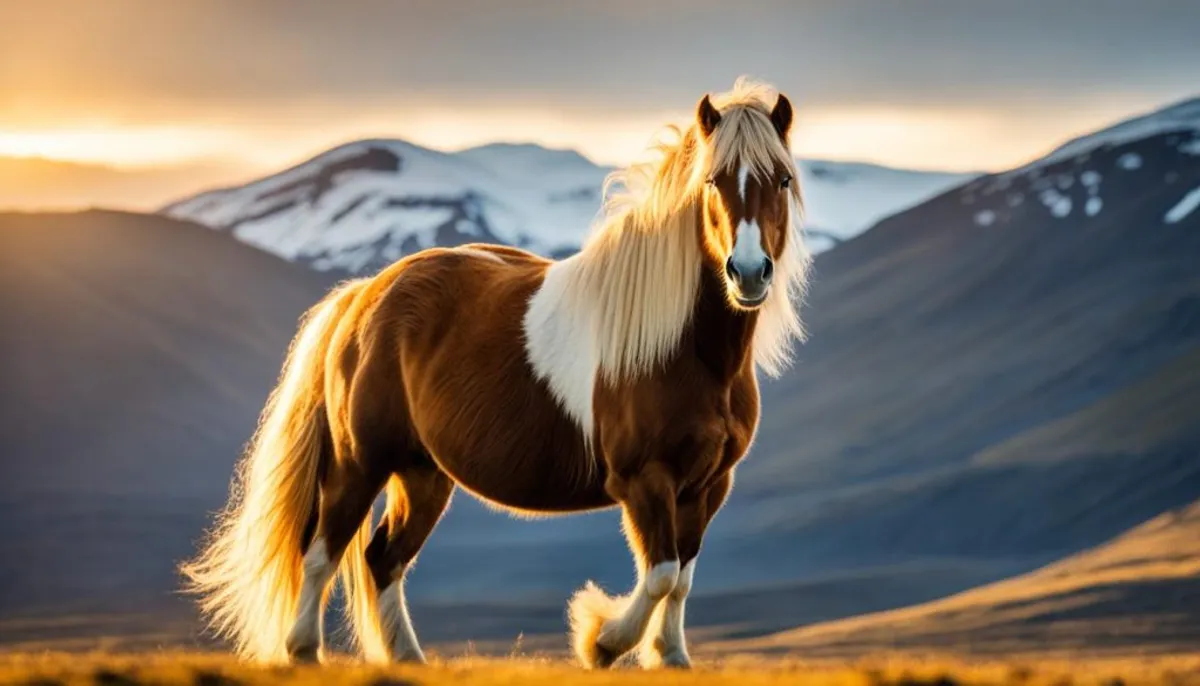
This article explains the attraction to Icelandic horses. We will discover what their island has brought them. We will discuss the 5 gaits, comfort in horseback riding, and how to progress joyfully. The goal? A riding experience focused on trust, for everyone.
Key Points to Remember
- The Icelandic horse is sought after for its comfort and stability.
- The horse from Iceland has adapted to a volcanic and changing environment.
- Icelandic horses are known for their calm temperament and closeness to humans.
- The 5 gaits offer new sensations, even for experienced riders.
- The article also offers practical advice: travel, equipment, progression.
- A “pleasure” and “trust” approach guides the entire discovery.
Why the Icelandic horse is so fascinating in France
In France, the Icelandic horse captivates many riders. With its compact size, thick mane, and tranquility, it invites adventure. Many appreciate its simplicity and direct approach with humans.
It is often discussed among enthusiasts for its ability to surprise without disturbing. Its comfort, reassuring temperament, and for those considering riding in Iceland, it represents a glimpse of the journey.
A “unique in the world” breed that leaves a mark from the first encounter
Antoine and Charlotte, both riders and instructors, share a memorable experience. While visiting Icelandic breeders, they discovered a distinctive horse, wild yet affectionate. This horse knew how to approach people gently.
The first encounter is unforgettable. The way the Icelandic moves and presents itself captures the eye. It recalls the difficult terrains and harsh weather conditions of its homeland.
New sensations under the saddle thanks to the 5 gaits
When ridden, the Icelandic horse offers unique experiences thanks to its 5 gaits. The tölt, in particular, is impressive for its smoothness and comfort.
These different gaits add variety to riding. They allow for working on rhythm, balance, and precision. This also evokes riding in Iceland, where the conditions are ideal for these gaits.
| Gait | Feeling experienced | What the rider works on |
|---|---|---|
| Walk | Calm cadence, observation of the terrain | Direction, relaxation, forwardness |
| Trot | Regular energy, more pronounced bounce | Rhythm, clear transitions, suppleness |
| Canter | Impulse, dynamic balance | Stability of the torso, trajectories, control |
| Tölt | Comfort, feeling of “rolling” without jolt | Finesse of aids, posture, consistency |
| Amble | Speed and fluidity, a more “tense” sensation | Channeling energy, straightness, safety |
A horse appreciated for its kindness and the sense of trust it inspires
Antoine and Charlotte value its tolerance for mistakes. This quality makes the Icelandic ideal for learning. Its gentleness reduces stress, especially for beginners.
It inspires confidence with its willing character and calmness. For many, it’s its mix of comfort and authenticity that attracts. This encourages regular practice and interest in riding in Iceland.
Origins and history of Iceland, a backdrop that shaped the Icelandic horses
To grasp the secret of Icelandic horses, one must explore Iceland. A place of contrasts: between sea and mountains, winds and clearings. This mix has created a robust horse, energy-efficient, and very agile on diverse terrains.
The tale of Viking explorers and the name “Iceland” that blurred perceptions
The name “Iceland” comes from an old story. Over 1150 years ago, a Viking chose this name to deter others. He wanted to keep the island for himself and his kin. Thus, Iceland was seen as a very cold place.
This misunderstanding grew when “Greenland” was named, an even colder place. This confusion left misconceptions about Iceland. The Icelandic horses, however, live more with the wind and humidity than with constant cold.
A climate influenced by the Gulf Stream, more changeable than polar
Iceland benefits from the Gulf Stream all year round. In Reykjavik, the average temperature in December is -5 °C. Sometimes, it doesn’t snow enough to ski for three years.
The weather changes rapidly: sun, clouds, rain, and wind can follow one another in a single day. This variable climate encourages Icelandic horses to adapt. They have thick coats and remain calm in the face of surprises.
Light varies greatly as well. With three months of night in winter and three months of day in summer. The horses get used to these extreme changes, which influences their behavior.
An island of hardened lava, between legends, raw nature, and UNESCO heritage
The Icelandic soil is mostly made up of solidified lava. This makes agriculture difficult, and the paths are rugged. These conditions have created unique landscapes, sculpted by nature.
Iceland mixes wild nature and cultural riches. For example, Thingvellir is a UNESCO site. It shows that the history of the country is both cultural and natural. The legends of mythical beings such as trolls and elves are alive. Icelandic horses are not just a symbol; they are an integral part of these landscapes.
| Landmark in Iceland | What is observed on site | What this implies for Icelandic horses |
|---|---|---|
| Name “Iceland” inherited from the Vikings | An image of a “repulsive” country that circulated for a long time | A breed perceived as rustic and enduring, often rightly so |
| Influence of the Gulf Stream | Winter less polar than imagined, around -5 °C in Reykjavik in December | An Icelandic horse prepared for humid cold and gusts, more than for severe frosts |
| Snow sometimes absent | Three years without opening the three ski resorts, due to lack of snow | More frequent outings on bare ground, with a need for stability and traction |
| Extreme light | Three months of night (Dec.-Jan.-Feb.) and three months of day (June-July-August) | Life and activity rhythms favoring sobriety and regularity |
| Volcanic rock and hardened lava | Raw reliefs, uneven terrain, sometimes sparse vegetation | Solid hooves, a calm mind, and a sure step outdoors |
| Thingvellir (UNESCO) and traditions | A country where nature, history, and beliefs coexist | A strong link between local culture and the breeding of Icelandic horses |
Icelandic horse: physical characteristics and temperament
It is often seen as a small robust horse. In France, its mix of compactness, balance, and gentle energy fascinates. Riders find it easy to ride from the start.
A compact build, a true strength
This horse resembles the Icelandic pony due to its small size and compact shape. It is well-built, with a solid back and a broad chest. Thus, it can easily carry different riders.
Its neck is powerful, and its legs and hooves are sturdy. Its low build gives it a regular walk, even on varied ground. This makes it perfect for daily leisure activities.
A calm mind, comfort that instills confidence
The strong point of this horse is its comfort. It offers stability that reassures, ideal for beginners. It is also gentle during grooming and easy to saddle.
Its temperament is calm, and it is very attentive to its rider. It quickly understands what is asked of it and enjoys routine. This helps create a soothing environment that fosters learning.
An ideal companion for shared riding
The Icelandic pony appeals to children and families. The same horse can be adapted to different riders with good guidance. This flexibility encourages equestrian practice across generations, whether on rides or in lessons.
To choose well, consider the back, the walk, and the horse's availability. A healthy and well-trained horse makes outings more enjoyable. Thus, riding becomes an enriching experience week after week.
| Observed point | What we see on the Icelandic horse | What this changes for the rider |
|---|---|---|
| Build | Compact body, carrying back, wide chest | Better carrying capacity, feeling of stability |
| “Horse/pony” impression | Type close to the Icelandic pony, but solid and enduring | Suitable for various sizes, family practice facilitated |
| Comfort | Regular gait, natural balance, smooth movement | Less apprehension, easier to find the seat |
| Temperament | Calm mind, kind, attentive to aids | Climate of trust, faster learning |
| Use | Leisure, riding school, outdoor outings | A versatile horse, useful for children and adults |
The 5 gaits in riding in Iceland and elsewhere: a pleasure to discover
Icelandic horses are famous for their different gaits. In Iceland, riding goes beyond a simple ride. It offers unique experiences.
On an Icelandic horse, riders learn to be attentive. They discover the importance of rhythm and balance. This often inspires a desire to improve in riding.
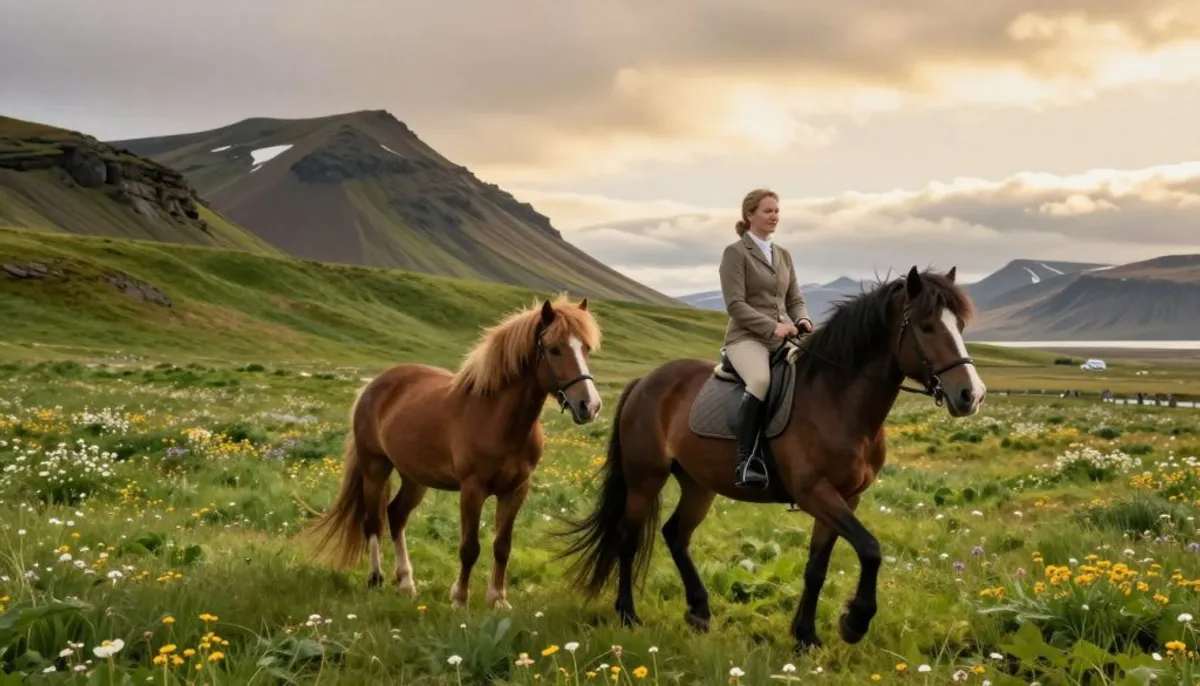
Why the 5 gaits change the rider's sensations
Beyond the walk, trot, and canter, there are the tölt and amble. The tölt offers a unique gliding sensation. It also provides a more stable seat.
The amble is a bit more complex and requires good timing. These special gaits completely change the way of riding a horse.
Working on technique to refine mastery of the gaits
The key to progression often lies in the details. Stabilizing rhythm and clarifying aids makes riding more comfortable.
Three simple markers can help: light contact, responsive pelvis, and good transitions. This distinguishes a rushed tölt from a calm tölt, which is better for everyone.
| Gait | Sensation under the saddle | Technical objective | Common mistake |
|---|---|---|---|
| Walk | Calm cadence, observation time | Direction, straightness, breathing | Too short reins that block the neck |
| Trot | More tonic, marked bounce | Stable impulse, clear transitions | Tensing up and losing cadence |
| Canter | Carrying, sometimes surprising on soft ground | Calm departures, balance in curves | Wanting to go fast instead of sitting up |
| Tölt | Gliding, very comfortable if regular | Constant rhythm, free neck, discreet aids | Confusing speed with gait quality |
| Amble | Lateral swinging, “rolling” sensation | Timing, straight line, relaxing the pelvis | Forcing the gait instead of letting it come |
How a training track helps progress independently
A training track offers an ideal setting. With a consistent surface, visual markers, and space to practice, it is perfect for Icelandic horses.
It allows for working alone while following an instructor's advice. This reassuring environment promotes stress-free practice. It helps to experiment and understand how horses react to different aids.
From leisure to progression: rides, sessions, and learning
The Écuries d’Air Pur invite you to discover the Icelandic horse in a relaxed manner. You start by enjoying the outdoors and then progress at your own pace. This type of horse is ideal for this approach because it is reliable and willing, suited for various terrains. This attracts many families and those seeking well-being while having a structured learning environment.
Waterfront and inland walks: the “nature” experience
Walks take place year-round, along rivers or through fields. The aim is to breathe fresh air, find calm, and explore various paths to awaken our senses. Riding an Icelandic horse makes these simple moments particularly enjoyable, allowing us to admire the landscape as much as to ride.
The constant rhythm of the Icelandic calms its rider. We learn to understand the terrain, to make smooth transitions, and to maintain a light hand. Even on a walk, these aspects make a big difference.
Pedagogical approach: imparting accessible technical know-how
When one wishes to improve, Antoine and Charlotte offer simple yet effective guidance. The goal is clear: to become more precise, feel the movement better, and control one’s mount. With an Icelandic horse, every exercise becomes clearer thanks to its good response to simple requests.
The lessons include clear markers such as posture and rhythm. Riding an Icelandic horse allows for gradual progression and seeing improvements over time. This makes learning motivating and rewarding.
Creating a place of sharing and trust around the horse
The Écuries d’Air Pur represents a community and trust space, open to all. People come to ride, but also to understand, ask questions, and take their time. This philosophy aligns well with the Icelandic, known for its close bond with humans.
| Moment | What you experience | What you learn |
|---|---|---|
| Riverbank ride | Regular rhythm, soft terrain, listening to the horse | Managing trajectories, simple transitions, breathing |
| Inland outing | Changing paths, relief, variety of gaits | Balance, anticipation, leg stability |
| Guided session | Short exercises, clear objectives, immediate corrections | Precision of aids, regularity, control of rhythm |
Wild horse or domesticated horse: myths and realities surrounding the Icelandic
In Iceland, the horizon seems endless. You find fields of lava and thick moss. This gives the impression of being on another planet. Many people think they see a wild horse at every corner.
Near the Blue Lagoon, surrounded by dark rocks, it is surprising. You distinguish silhouettes in the distance, under a cold wind and changing light. In this setting, the Icelandic horse seems to emerge from an old story.
The Icelandic horses seen together belong to someone. They live outdoors, in limited freedom, on large grounds. This way of life is dreamy. Yet, it is well managed.
What travelers imagine in the face of vast volcanic spaces
The vast landscapes change our perception. They amplify silence and the feeling of space. In front of these expanses, one can easily imagine wild horses. Sometimes, we confuse their freedom with a life without human contact.
In fact, groups of horses are well organized. Their movements are monitored, their health is checked, and they are observed for limping. The place is wild, but they are constantly cared for.
The role of breeding and human work in the horse's character
The kindness of Icelandic horses comes from attentive breeding. It is the result of selection and gentle care from a young age. This facilitates interactions for many riders in France.
Ground exercises, getting used to being ridden, and training build their confidence. Even living outdoors, they remain close to humans. They react calmly, thanks to well-established routines.
| Frequent image | What is observed on the ground | What this changes for the rider |
|---|---|---|
| A wild horse “without rules” | Herds followed, identified, and grouped by age and work level | More safety, more predictable behavior on outings |
| “Nature” horses, therefore necessarily easy | Social horse, but educated: halter, loading, care, progressive work | A quicker handling, especially on trails |
| A robust animal that needs nothing | Monitoring of weight, hooves, and adaptation to the season | Durable comfort and less stress on varied terrains |
Respect for the environment: a cultural context that influences practices
Riding respects the environment in Iceland. Ecology is important because nature is vulnerable. We think of volcanic soils and fragile moss. The paths and how we ride are chosen to protect these places.
Chemicals are avoided in agriculture and breeding. This influences daily habits. This economical approach includes well managing the land, protecting wetlands, and sustainable care. Thus, the wild horse is an icon, while the Icelandic horse is a true partner.
Traveling in Iceland and experiencing the “horse” in the heart of the landscapes
In Iceland, we discover vast open spaces. The roads and the wind dictate our movements. Many choose Iceland for horseback riding. Because here, nature dictates where we go. On an Icelandic horse, we traverse vast terrains under constantly changing light.
The most memorable excursions take us through parks, waterfalls, and black sand beaches. We go from gravel paths to green valleys, and to lava fields. Riding Icelandic horses, the contrast between the softness of the animal and the rugged landscape is striking.
Parks, waterfalls, black sand beaches: views that make excursions unique
At Seljalandfoss, you can walk behind the waterfall. The legend of the “bride’s veil” is often mentioned. And it’s easy to understand why. But beware, it’s almost certain that you’ll end up soaked, especially if the wind changes direction.
Further east, the beach at Vik takes our breath away with its black sand. The Reynisdrangar emerge like rock peaks amid columns of basalt. But be cautious in the evening as darkness quickly envelops the landscape, making distances hard to gauge.
Skogafoss, often photographed, divides the scenery with its white waterfall. The place is misty, and the ground can be slippery. There, combining riding with a little walk is perfect, followed by a quiet horseback ride.
Thingvellir (UNESCO), Geysir, Gullfoss: when nature becomes the backdrop for a horseback adventure
At Thingvellir, a UNESCO site, the journey takes on another dimension. The Almannagjá fissure clearly shows the separation between two continents. The deep silence of this place is ideal for connecting with Icelandic horses.
At Geysir, Strokkur erupts approximately every 8 minutes. You find very hot springs, emitting a sulfur smell. These moments are best experienced slowly, in harmony with our horses.
Gullfoss impresses with its power, especially at high flow. The droplets hit our faces, and the noise is deafening. It’s a place where sensations remain etched in us, more than the captured images.
Reykjavik and its surroundings: popular excursions, including horseback rides
Reykjavik is a practical base to start the adventure. It has about 120,000 inhabitants. The international airport is a 45-minute drive away. Between two adventures, visiting Harpa, Perlan, or the geothermal beach of Nautholsvik is a good idea. This beach has white sand from Spain and water heated by geothermal energy.
Near the capital, horseback riding is very popular. It allows for discovering Icelandic riding easily. The Icelandic horse is recognized for its stability and gentleness.
For a mix of culture and riding, Fridheimar is a must-stop. In these tomato greenhouses, a family also raises Icelandic horses. They offer shows during the summer in a small arena. It’s an opportunity to see these magnificent horses in action, in a friendly atmosphere.
| Place | What stands out on site | Detail to keep in mind |
|---|---|---|
| Thingvellir (UNESCO) and Almannagjá | Spectacular fissure, feeling of space, easy paths | Opening between two tectonic plates, site exposed to the wind |
| Seljalandfoss | Passage behind the waterfall, light and spray | You come out wet; ground often slippery |
| Vik, black sand and Reynisdrangar | Strong contrasts, basalt columns, powerful sea | In the evening, lower visibility on black reliefs |
| Geysir area (Strokkur) | Regular eruption, sulfur smell, mineral colors | Strokkur erupts approximately every 8 minutes; springs near 100 °C |
| Reykjavik and surroundings | Practical base, cultural breaks, quick access to excursions | International airport about 45 minutes away; Nautholsvik heated by geothermal energy |
Icelandic climate: how to equip and adapt your practice to the weather
In Iceland, the weather changes quickly, from sun to rain to wind, sometimes all in the same day. To ride there, the trick is to prepare adjustable clothing and be ready to change paths.
In December, it is often around -5 °C in Reykjavik. The cold is manageable if you protect yourself from the wind. And it sometimes snows little: for three years, the ski resorts did not open due to lack of snow.
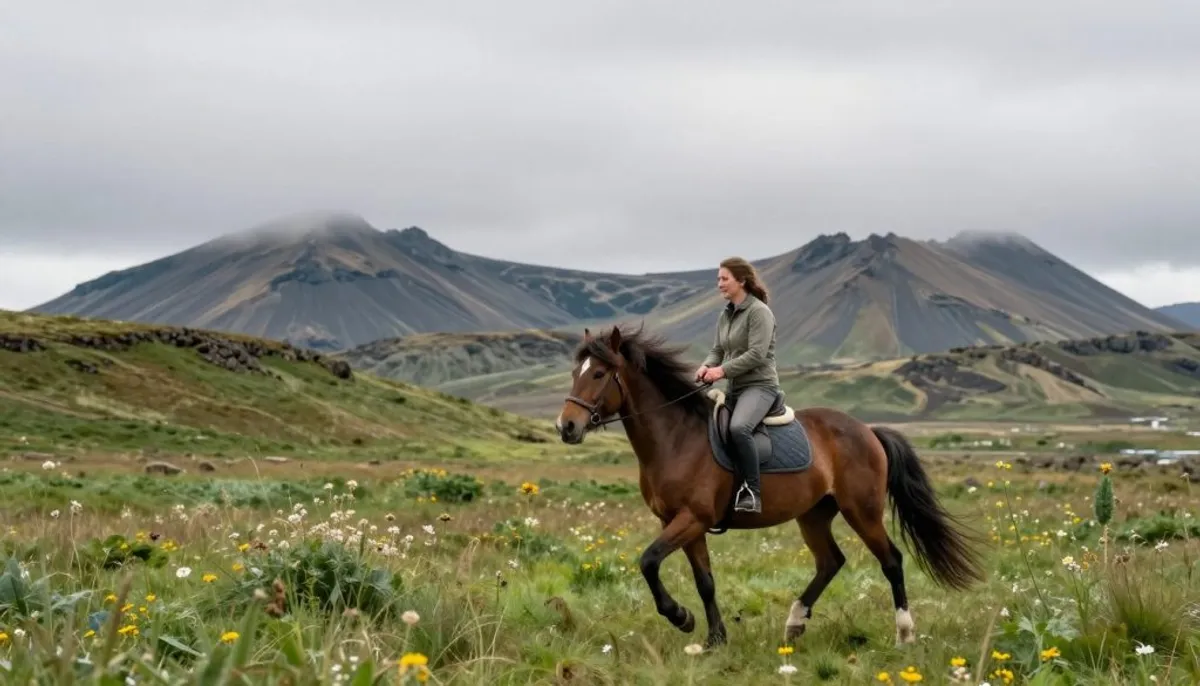
The wind and rain often catch you off guard. Near the Langjökull glacier, icy rain and strong gusts can make riding difficult. But with an Icelandic horse, you remain stable. Comfort mainly depends on the equipment.
Light is also important. In winter, the sun can stay down until 10 a.m. In Iceland, this means taking shorter rides, looking for the brightest moments, and ensuring visibility.
- Breathable base + thin fleece: easy to open or close on the go.
- Waterproof windbreaker: priority for the torso and wrists.
- Rain over-pants: useful even without snow, especially with splashes.
- Warm gloves + spare pair: rain cools fingers quickly.
- Neck warmer and thin beanie: effective under the helmet, without hindrance.
| Frequent situation | Risk for the rider | What really helps | Adaptation in riding in Iceland |
|---|---|---|---|
| Strong wind on plateau or plain | Rapid cooling, fatigue, numb hands | Waterproof windbreaker, warm gloves, neck warmer | Sheltered route, short breaks, check the tightening of gear |
| Cold rain with gusts (e.g., towards Langjökull) | Wet clothes, heat loss, discomfort in the saddle | Waterproof jacket, over-pants, technical socks | Flexible outing, possible turnaround, maintain a steady rhythm |
| Lower temperatures at night, in the north or in the mountains | Cramps, stiffness, decreased attention | Layering, warm drink, hand warmers | Later departure, reduced duration, listening to the group and the Icelandic horse |
| Late light in winter (sometimes after 10 a.m.) | Lack of landmarks, reduced visibility | Reflective elements, headlamp, visible colors | Schedules centered on clarity, known routes, clear instructions |
| Dry cold around -5 °C in Reykjavik in December | Discomfort at rest, sensitive fingers and ears | Thin beanie under helmet, under-gloves, insulating layer | More gradual warm-up, active breaks, check the comfort of the Icelandic horse |
Thanks to these tips, Iceland seems less complex. We prepare, equip ourselves, and enjoy. The landscapes and weather change quickly, and riding here remains an exciting adventure.
Icelandic culture: ecology, geothermal energy, and respect for places
In Iceland, nature plays a key role in daily life. This influences the heating of homes and outdoor activities. For someone coming to see Icelandic horses, it also changes how to interact with these animals and spaces.
A country powered by geothermal energy, even in daily life
Iceland is recognized for its energy autonomy. It uses geothermal energy for heating and electricity production. The heat from the ground is accessible even in cities.
In Reykjavik, you will find Perlan, based on geothermal reservoirs. At Nautholsvik, a heated beach surprises with its warmth despite the cool air. Places like Fontana and the Blue Lagoon testify to the love for hot water in Iceland.
A strong attention to the environment, with a valued “nature” approach
The Icelanders are keen to keep their natural sites clean. Their agriculture and breeding are chemical-free. This reinforces the image of a clean island. Reykjavik is considered one of the least polluted capitals.
During horseback rides, respect for nature is essential. It is necessary to avoid damaging the trails and to respect wildlife. Icelandic horses lend themselves well to this gentle and respectful approach.
Tourism, fishing, traditions, and tales: the atmosphere surrounding the Icelandic horse
Fishing, tourism, and the aluminum industry are important in Iceland. Agriculture is limited by lava and climate. That’s why resources are managed carefully.
The Icelandic culture values legends and tales of elves and trolls. Places like Snorrastofa show the importance of Nordic myths. This makes the experience in Iceland unique.
Spas are a key element of social life. Showering before bathing is mandatory, a sign of great importance placed on hygiene. The rules are strict but respectful of everyone.
| Cultural landmark in Iceland | What we experience on site | What this changes for a horseback outing |
|---|---|---|
| Geothermal energy (heating, hot water) | Baths, hot showers, visible warmth in town and around sites | Better recovery after walking, and the rider's comfort remains stable |
| Respect for places and soils | Marked trails, clear instructions, attention to fragile areas | The horse moves on sometimes delicate terrain, and the group remains disciplined |
| Fishing and tourism as pillars | Active villages, seasonality, crowding at certain spots | We choose calm times and less frequented routes to keep a horse serene |
| Legends and heritage (Snorrastofa, Edda) | Told stories, places filled with meaning, storytelling atmosphere | The horse from Iceland becomes a thread connecting landscape, tale, and local culture |
| Spa rituals (mandatory shower) | Simple rules, sometimes open-air showers, relaxed spirit | After effort, we adopt a slower pace, useful for taking care of oneself and the horse |
In Iceland, everything seems coherent: energy, nature, stories, and daily actions. Traveling with a horse allows one to quickly understand this balance. We learn to do less, but better.
Tips for starting with an Icelandic horse with confidence
Starting with an Icelandic horse is about seeking to practice gentle riding. These horses are known for their kindness, which helps you feel good quickly. They are strong enough to carry both children and adults, making it practical to share the same mount.
Choosing guidance that emphasizes safety and gentleness
As a beginner, having good guidance is crucial. Antoine and Charlotte prioritize an approach based on trust and gentleness. On the track, you will learn to maintain a good distance, manage your speed, and interpret the horse's reactions without stress.
Before mounting, it is essential to take your time on the ground. Properly fastening the halter and walking while holding the horse by the lead teaches solid foundations. If the pony tests your patience, staying consistent will help calm the situation.
Progressing step by step: from comfort on rides to precision in gaits
Starting with simple rides is very enjoyable. Exploring rivers, dirt paths, and hilly trails showcases the agility of the Icelandic. This allows for working on posture, breathing, and learning to look ahead without pressure.
More technical sessions come next. You will refine directional control, transitions, and discover the different gaits. The goal is to remain fluid and precise in your commands, not to rush things.
- To remember: short and regular sessions are better than a long tiring one.
- Alternating rides and tracks helps keep the Icelandic pony motivated.
- Requesting immediate feedback prevents developing bad habits.
Sharing horseback riding as a family: organization and good practices
When riding as a family, good organization simplifies things. Even though the Icelandic pony can adapt to different riders, one must consider the least experienced. A calm horse reassures, especially if the same rules apply to everyone: always ride under adult supervision, check the equipment, and finish on something easy.
To ensure everyone has their moment, regularly change roles. For example, a child can hold the horse while an adult adjusts the saddle, then switch. This rhythm establishes a routine for the Icelandic, which quickly understands what is expected of it.
| Step | Objective | Simple exercise | Point of vigilance |
|---|---|---|---|
| Ground welcome | Create calm and listening with the Icelandic | Walking on a lead, stopping, backing up 2 steps | Keep a loose lead, do not pull |
| First rides | Establish comfort and trust | Regular gait on flat path, stopping by voice | Do not “pilot” continuously, breathe |
| Track session | Gain precision and balance | Transitions walk-trot, wide circles | Stay upright, hands low and stable |
| Family routine | Share an Icelandic horse without stress | Prepare together, take turns riding | Adapt duration to the youngest, frequent breaks |
Equipment and saddlery: the demand for comfort for both rider and horse
With an Icelandic horse, comfort is astonishing from the start. The saddlery plays a key role: it must offer a stable seat and good contact. It should also allow free movement with the horse. Whether in Iceland or elsewhere, these small details enhance the experience.
Why comfort matters even more when exploring multiple gaits
Changing gaits impacts both the horse and the rider. If the saddle is uncomfortable or restricts movement, it can hinder the horse. And the rider must then adjust. But if everything is in place, maintaining good posture becomes easy, even at high speeds.
The weight must be well distributed on an Icelandic horse. This prevents overloading its back, especially during long outings. On the varied terrains of Iceland, good stability is essential for comfort.
| Point to check | What you should feel in the saddle | Direct impact on the horse |
|---|---|---|
| Tree and opening width | Seated position, no tilting, stable pelvis | Back relaxes, stride becomes longer |
| Padding and bearing surface | Uniform pressure, no hard spots | Less defensiveness, better availability |
| Blocks and position of flaps | Leg close, fine aids, easy balance | Shoulder freer, better cadence |
| Girth and accessories | Free breathing, support without tightening | Less friction, fewer irritations |
La Sellerie Française: high-end products, made in France, unique
The quality of the equipment is essential for movement. La Sellerie Française offers luxury gear, designed in France. They are made to last and provide precise contact. The quality is evident, especially when used frequently.
Their excellence is clear: it’s better than the Made in France label, better than the Origin France certification. Everything is produced entirely in France. For riding in Iceland, this means having durable and comfortable equipment.
Custom-made or limited series, made from A to Z in France by the best French artisans (https://laselleriefrancaise.com)
Choosing custom-made or a limited series allows for adapting the equipment to your needs. This ensures comfort, whether you are on long rides or working on precise movements. Good equipment helps the horse remain comfortable and the rider to be more precise.
Ask yourself three questions before choosing: the shape of your horse's back, the natural position of your leg, and whether you seek comfort for the outdoors. The answers will guide you to the most suitable equipment for your Icelandic horse and you.
Conclusion
The Icelandic horse charms from the start. Its kindness, trust, and comfort are evident. This reassures even hesitant riders. Moreover, discovering its 5 gaits makes the experience unique, smoother, and more stable than imagined.
In Iceland, these horses seem even more magical. The climate is mild thanks to the Gulf Stream. Yet, the weather changes quickly, adding excitement to the adventure. We traverse varied terrains: hardened lava, black sand beaches, and sites like Thingvellir (UNESCO), Geysir, Strokkur, and Gullfoss. These landscapes are unforgettable.
We often speak of the Icelandic horse as a wild creature. However, this conceals careful breeding and a deep respect for nature. Geothermal energy is a daily aspect here, reflecting an ecological awareness in interactions with these animals.
No matter if you explore these horses in Iceland or France. What matters is quality guidance and comfortable equipment. For discerning riders, La Sellerie Française offers high-end gear suited for these unique experiences. With Icelandic horses, we live a true adventure, not just a simple activity.
FAQ
What makes the Icelandic horse so different from a “classic” horse?
The Icelandic horse is unique for its calm temperament and strong bond with people. It offers 5 special gaits. These characteristics make riding more enjoyable and comfortable, enchanting many riders.
Why is the Icelandic horse so appealing in France?
It is popular due to its comfort, kindness, and the trust it inspires. Beginners and experienced riders find in the Icelandic an ideal companion, for pleasure or teaching.
Who are Antoine and Charlotte, and why do they speak of a “special” breed?
Antoine and Charlotte, riders and instructors, were marked by a meeting with Icelandic breeders. They perceived the Icelandic as a special breed. They highlight the unique bond and emotional stability of these horses.
Is the Icelandic pony the same as the Icelandic horse?
Despite its small size, which earns it the name “pony,” the Icelandic horse can carry various riders. This ability makes it a perfect choice for families, suitable for both children and adults.
What are the 5 gaits, and why do they change everything?
Beyond the classic gaits, the Icelandic offers two unique gaits for their comfort. These new gaits bring an unprecedented experience to riders, mixing pleasure and trust in the saddle.
How to progress with an Icelandic, beyond just riding?
To evolve, start with rides to get used to it. Then add technical exercises. Antoine and Charlotte recommend a gentle progression, based on precision and relaxation.
How does a training track help work on the 5 gaits?
A training track offers an ideal setting to practice the 5 gaits. It allows for independent progression while having the possibility of being accompanied, making learning safer and more effective.
Is the Icelandic horse suitable for family riding?
Absolutely, this is a great advantage. Thanks to its stability and kindness, it is suitable for activities with children and adults. Outings can be varied and adapted to each rider’s level.
Is it a wild horse?
The idea of the wild horse is inspired by Icelandic landscapes. However, the amiable character of the Icelandic also comes from its breeding. This breed benefits from special attention and good training.
Where does the name “Iceland” come from, and why does it blur perceptions?
According to a legend, a Viking chose “Iceland” to deter other explorers. Another named a colder land “Greenland.” This created a persistent confusion in our imagination.
What is the real Icelandic climate for practicing riding in Iceland?
Iceland benefits from the Gulf Stream, offering mild winters in Reykjavik. Despite little snow, the weather is very variable. This includes sun, rain, and wind, with more variations at night and in certain regions.
How to manage the extremes of light in Iceland (day and night)?
Iceland experiences three months of long nights and three months of endless days. During winter, the sun rises late. It is important to adjust activities to available light and reinforce safety precautions.
Why do volcanic soils matter in the history of Icelandic horses?
Lava soils make agriculture difficult. However, they enrich the bond with nature and equestrian practice. These rugged landscapes define Iceland's identity and influence the riding experience.
What places make a horseback outing unforgettable in Iceland?
Places like Thingvellir and Seljalandfoss, tied to history, mark visitors. Beaches and waterfalls offer unforgettable memories. Geysers, such as Strokkur, add to the magic with their regular eruptions.
Is Reykjavik a good starting point for a “horse” excursion?
Yes, Reykjavik is ideal with its popular horseback excursions. With easy access from the airport, it’s an excellent way to discover Icelandic horses without traveling the entire country.
Can you link horse and culture during a trip?
Certainly, at Fridheimar for example, where tomatoes meet equestrian shows. This family combines agriculture and passion for horses, offering performances that shine a light on Icelandic equestrian culture.
How to equip for riding despite the changing weather?
Prepare with modular clothing and protect yourself from rain and wind. The experience near Langjökull highlights the importance of reliable equipment, especially outdoors.
Does ecology influence equestrian practice in Iceland?
The environment matters a lot here. Agriculture and breeding are conducted without chemicals. This eco-responsible approach shapes outdoor riding practice in Iceland.
Is geothermal energy concrete for travelers?
Yes, geothermal energy supports Iceland's energy autonomy. Visit Perlan, Nautholsvik, or the Blue Lagoon to observe its daily use and enjoy its benefits.
How to start with an Icelandic horse “with confidence”?
It is essential to choose teaching focused on safety and gentleness. With a Icelandic horse that is naturally reassuring, proper training transforms ease into mastery.
What progression do you recommend between rides and technique?
Start with rides to familiarize yourself, then add technical training. This strengthens progression, improves interaction, and allows full use of the 5 gaits while remaining relaxed.
Why does equipment matter even more with the 5 gaits?
Equipment plays a crucial role in staying comfortable. A good saddle ensures stability and a good relationship with the horse. Thus, the equipment adapts to sensations for optimal comfort in all situations.
What does La Sellerie Française offer for comfort-oriented riding?
A: La Sellerie Française (https://laselleriefrancaise.com) provides exceptional equipment, crafted in France. Their range, in custom-made or limited series, is designed by excellent artisans for unparalleled comfort.
Are Icelandic horses suitable for a rider mainly seeking leisure?
Absolutely. The Icelandic is perfect for those looking to relax on horseback. For those wanting to evolve, it also offers opportunities for technical learning without losing the playful aspect.