
The pommel horse symbolizes a major challenge in men's gymnastics. It requires a continuous and smooth movement, with a line close to horizontal. In gymnastics, executing movements well on this apparatus depends on the precision of the leg circles, the alternation of supports, and a smooth change of position.
Mastering this technique demands great consistency and maintaining a perfect body alignment. The rules are strict: any defect in posture leads to penalties. It is crucial to maintain a good pace and a constant tempo to score points.
Researchers like Ludovic Baudry have found that real-time auditory feedback can improve posture. This feedback remains useful even after the exercise, proving its value during training.
Practically, the evaluation focuses on horizontal alignment and the quality of leg circles. Good control of movements and a steady rhythm are essential for a performance recognized by judges.

Key Points
- Continuity of movement and horizontal trajectory as foundations.
- Technique on the pommel horse focused on a clean and regular leg circle.
- Constant trunk-thigh alignment to avoid penalties.
- Real-time auditory feedback: measurable and lasting improvement.
- Execution across the three zones of the apparatus with tight legs prioritized.
- Stable rhythm and alternating supports for a readable gymnastics performance.
Understanding the apparatus and technical requirements in competition
The pommel horse demands great precision. Athletes use only their hands for support. They must maintain a regular horizontal movement throughout. The technique on the pommel horse requires a precise trajectory. The supports must be clear on the center and the ends.
A regular, continuous, and horizontal movement
A constant rhythm is essential, without jerks. The hips must remain elevated. The torso and thighs follow a horizontal movement. Thus, the momentum is renewed with each support. This demonstrates mastery of the technique on the pommel horse.
Circles of both legs, front/back scissors, and alternating passes
The foundation consists of circles of both legs. They are followed by front-back scissors and zone changes. All of this must be performed without interrupting the flow on the pommel horse.
Dominance of tight leg circles and rhythm management
The routine is dominated by circles with tight legs. This requires a constant rhythm. Impressive movements are integrated without disrupting the horizontal movement. Every link demonstrates competence in technique on the pommel horse.
Common penalized errors: rhythm breaks and alignment losses
Judges penalize rhythm interruptions and poor posture. A decrease in amplitude, an unstable support, or misalignment affects the quality of circles of both legs and front-back scissors.
| Key Requirement | Visible Indicator | Impact on Score | Point of Caution |
|---|---|---|---|
| Movement consistency | Constant rhythm, recycled momentum | Enhances execution | Avoid pauses and rebounds |
| Horizontal alignment | High hips, aligned torso | Reduces deductions | Control angle closure |
| Dominance of tight circles | More circles than scissors | Meets expectations | Maintain amplitude at the end of the pommel |
| Clarity of families | Circles of both legs and front-back scissors readable | Consistent composition | Clean transitions between zones |
| Stability of supports | Fixed hands, balanced pressure | Maintained fluidity | Limit repositionings |
Pommel horse
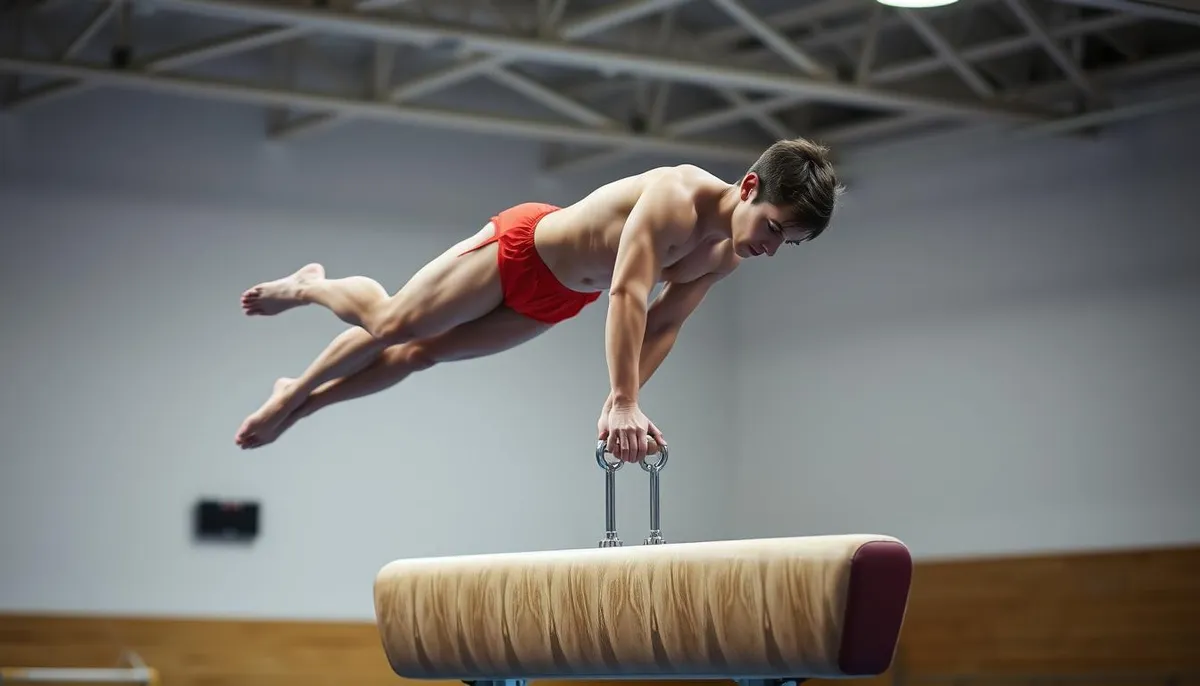
The pommel horse requires precise control of the body, almost horizontal. Gymnasts make circular movements with their legs, changing support on their hands. They must keep the upper body and thighs aligned for a smooth movement.
Good preparation combines physical training and real-time feedback. This helps connect body movement to spatial perception. Following simple instructions helps maintain a good position and makes movements smoother.
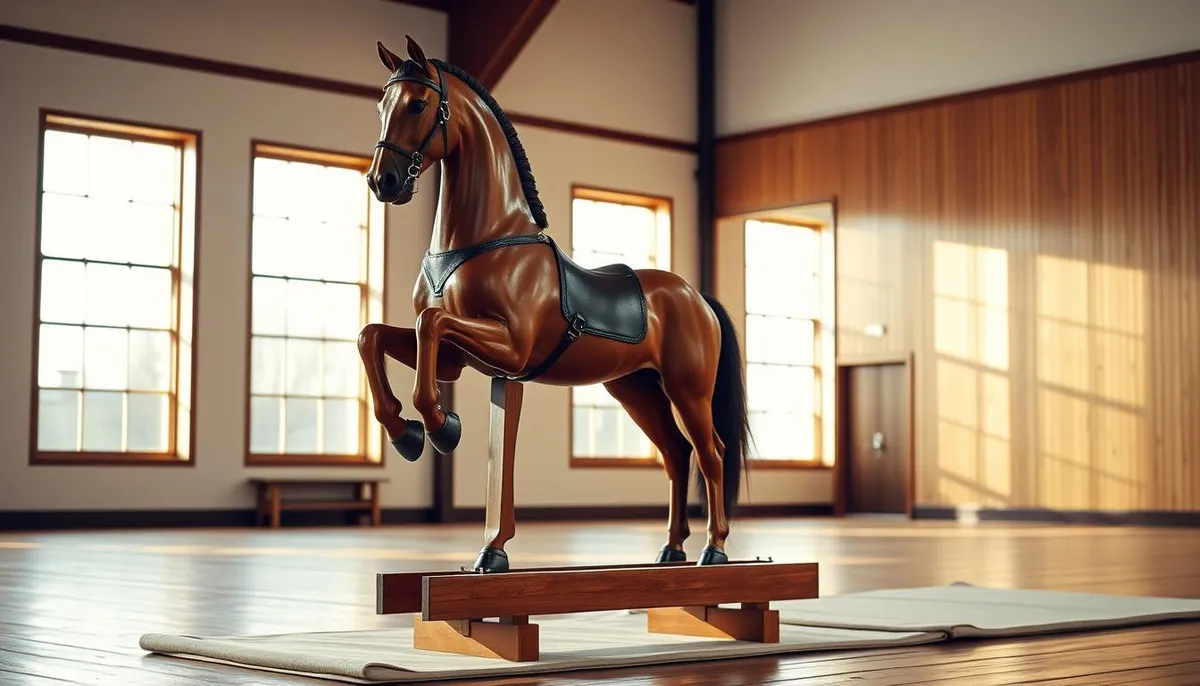
Thinking about horseback riding can help improve posture. Like on a horse, the gymnast aims for a balanced, open, and relaxed position. Tips inspired by the equestrian world help to properly place the hands and feel wide and stable.
Discussing equestrian equipment helps to understand movement. It concerns contact, pressure, and how to distribute weight. These reference points clarify the path, improve rhythm, and reinforce continuous movement.
Optimizing body alignment through concurrent auditory feedback
On the pommel horse, it is essential to maintain a stable line for better movement. An audible concurrent feedback helps correct posture from the start. This allows for creating reliable reference points without affecting the rhythm of movements and improving performance session after session.
Why trunk-thigh alignment is crucial on the circle
The trunk-thigh alignment is crucial for maintaining horizontal alignment. If the angle decreases, the center of gravity lowers, and the figure loses amplitude. Judges immediately notice this error, especially on the sides, which lowers the score.
Maintaining this alignment allows for smooth and regular movement. This makes the performance on the pommel horse visually clearer.
Reference study: significant improvement via real-time sound signal
A study by Christophe Baudry, Didier Leroy, and Didier Chollet (Journal of Sports Sciences, 2006) found that an instant sound signal can help. Eighteen elite gymnasts saw their performances improve. They particularly progressed in lateral movements.
The results show they could better perceive their errors. This was due to increased concentration and motivation. It helped them move better and enhance performances.
Practical device: back/knee sensors and triggering during angle closure
A simple device includes a box with a buzzer on the back, connected by a wire to a sensor on the knee. The buzzer sounds if posture is not correct.
This signal does not interrupt the exercise. It helps the athlete correct their posture to maintain proper alignment.
Lasting effects: stabilization of performance in delayed post-test
The authors of the study found a stabilization of performance. This means that learning was effective and lasting. Good movement techniques are maintained even without actively thinking about them.
Athletes show better consistency during training and competitions. They make fewer minor errors.
Application to training: frequency of feedback and error correction
Initially, use concurrent feedback often to establish good movements. Then decrease the frequency to encourage independence. Alternating between guided and free sessions helps reinforce the correct gesture.
- Set up blocks of 6×10 circles with sound reference.
- Target the lateral phase, most sensitive to angle closure.
- Validate the maintenance of trunk-thigh alignment in series without signal.
By following this method, the leg circle becomes wider and more regular. This supports improved and lasting performance on the pommel horse as well as better movement optimization.
Technical progression and specific physical preparation
On the pommel horse, a clear progression and targeted physical preparation are essential. The goal is to have a stable rhythm and continuous movement. It relies on sensory reference points and an adapted load.
Strengthening the abdominal belt and proprioceptive control
The abdominal belt is key to supporting the pelvis and maintaining shoulder-hip alignment. Core strengthening and adding exercises for body control are necessary.
Tip: To improve, use sounds to guide breathing and pressure. Then, work without them to better control your body.
Targeted drills: circles on three zones of the apparatus and smooth transitions
Make circles with tight legs in the middle and at the ends of the pommel. This helps achieve a smooth and secure movement.
- Center: stable body, calm shoulders.
- End pommel: neat entry, control of momentum.
- End pommel: controlled exit, proper hip orientation.
- Use front/back scissors measured for better precision.
Balance and mobility exercises for movement continuity
Work on unstable supports for better balance. Improve hip mobility and torso movement. This helps control movement on each circle.
- Hip mobility with active lunges.
- Shoulder stability in support.
- Balance board: gentle movements to stay centered.
Warm-up routines to maintain horizontal alignment and amplitude
A good warm-up prepares the body while focusing on horizontal alignment. It is necessary to find a steady rhythm and maintain wide movements.
- 3–5 min cardio activation.
- Technical exercises: start with small circles and then enlarge them.
- Use elastic bands to work on shoulder-pelvis alignment.
By combining strengthening, body control, and progressive sequences, the pommel horse becomes more stable and precise.
Equipment, sensation, and equestrian transfer to improve riding position
On the pommel horse, we seek the same stability as on a horse. Having a neutral posture, a well-placed pelvis, and aligning shoulders with the pelvis helps significantly. This allows for fluid movement. Equestrian tips help to improve riding position. They also help maintain a constant rhythm.
From equestrian technique to circles: postural references and alignment
When in the saddle, we want a stable trunk and flexible hips. The gaze should guide the direction. On the pommel horse, these principles remain the same. They help avoid abrupt movements and maintain continuous movement.
Choosing quality equestrian equipment: horse saddle, riding saddles, and horse tack
Good equestrian equipment makes the sensations of contact and balance sharper. A well-fitted horse saddle and well-chosen riding saddles help significantly. They allow for better control and stability. The right horse tack also enhances our perception of movements.
La Sellerie Française: high-end equestrian equipment, made in France, custom-made
La Sellerie Française offers high-quality equipment, manufactured in France. They use choice leathers and are finely crafted. Customization ensures unique comfort, equal pressure distribution, and great durability. This helps maintain a good position in the long term.
Feelings and references: how equestrian exercises help improve riding position
Special exercises strengthen sensation and coordination. They help understand the right moment to move and how to position oneself correctly. This attention to the body helps improve riding position. It allows for maintaining good alignment without losing rhythm.
Conclusion
Mastering the pommel horse is all about consistency, continuity, and maintaining a horizontal trajectory. The circles with tight legs dictate the rhythm. Then, movements like scissors are added seamlessly.
Being well-aligned is crucial. If the body is not properly positioned, points are lost. A study shows that with immediate audio feedback, thanks to a sensor, alignment improves and scores remain stable.
To progress, specific physical preparation, mobility, and good balance are needed. Exercises help create continuity and control rhythm. Audio feedback is very helpful, especially for perfecting tight circles.
Equestrian techniques also help improve posture. Having the right equipment, like that from La Sellerie Française, plays a significant role. The goal is to become autonomous, with fluid and precise movements, respecting the rules, for a successful performance.
FAQ
What is the pommel horse and why must the movement remain horizontal and continuous?
The pommel horse is an important apparatus in men's gymnastics. Athletes perform circular leg movements, staying close to horizontal. They change hand supports on the handles. Scoring values continuous, regular, and horizontal movement without interruption across the entire apparatus.
What technical elements are expected in competition?
In competition, several elements are expected. This includes circular movements with the legs, scissor movements, and smooth transitions between different parts of the apparatus. Movements with closed legs are preferred for a better score.
What are the most penalized errors on the pommel horse?
Errors such as interrupting rhythm or misaligning the body are heavily penalized. They break fluidity and decrease the score. Alignment errors and lack of consistency in rhythm are also costly.
Why is trunk-thigh alignment crucial during circles?
Maintaining good alignment helps stay horizontal and continue movement without errors. If this alignment is not maintained, performance suffers and the score decreases.
Does concurrent auditory feedback improve alignment?
Yes, according to a cited study. Using a sound signal helps gymnasts correct their posture in real-time. This improves their alignment and results are lasting.
How does the feedback device work in practice?
A device placed on the back and connected to a sensor sounds when posture is not ideal. This immediate sound signal helps the gymnast adjust during the exercise.
How often should feedback be used in training?
Initially, using it frequently helps to learn the correct posture. Then, reducing usage encourages independence. The goal is to align well without external help.
What drills should be prioritized to build a regular and fluid routine?
Focus on practicing precise circular movements, smooth transitions, and specific movements without interruption. This includes paying special attention to entry and exit movements.
What specific physical preparation supports horizontal alignment?
Strengthen the abdominals, trunk stability, and hip mobility. This helps maintain good posture and stabilize movement.
How to structure the warm-up to avoid rhythm breaks?
Start with short, regular movements for the trunk and hips. Then, slowly increase amplitude while maintaining a constant rhythm.
What links exist between equestrian technique and the pommel horse?
Both require stable posture and proper pelvis placement. Experience in horseback riding improves alignment and fluidity on the pommel horse.
What equestrian equipment can help refine postural references?
Using a well-fitted saddle and quality equipment helps improve contact and balance. This brings benefits for gymnastics.
Where to find high-quality and durable equestrian equipment?
La Sellerie Française offers high-quality equestrian equipment, made in France. These products provide comfort and improve posture and rhythm.
Can equestrian exercises help improve riding position both on horseback and on the pommel horse?
Yes. Practicing horseback riding improves stability and placement. These skills are useful both on horseback and in gymnastics.
How to integrate Thomas circles and other spectacular elements without losing fluidity?
Include them when the movement is already stable. Position them so as not to interrupt the flow, with careful transitions.
How to measure progress on alignment and consistency?
Use slow-motion video, sound feedback, and tempo references. Observe the consistency and precision of movements on the apparatus.