
The elegance and power of this equine have always captivated humanity. Its ability to move with such grace and strength makes it an exceptional companion and athlete.
When it gallops, its fastest gait, this animal unleashes phenomenal energy. The average speed during this run typically ranges between 15 and 21 km/h under normal conditions.
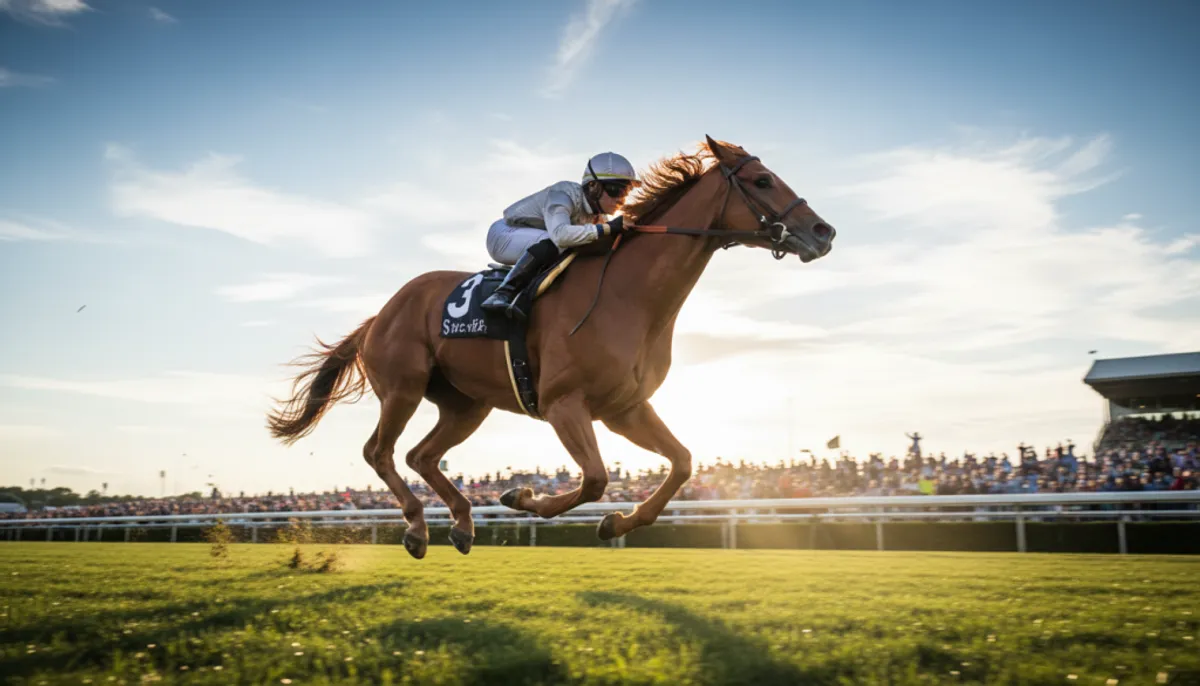
However, the best specimens, true champions, can reach impressive peaks. They are capable of crossing the symbolic barrier of 60 km/h over short distances, a feat for a terrestrial mammal.
Understanding this performance is fundamental for all enthusiasts. It allows for a full appreciation of the athletic potential of each individual in the various equestrian disciplines practiced today.
Key points to remember
- The gallop is the fastest gait of the equine.
- Its average speed at this gait varies between 15 and 21 km/h.
- The top performers can exceed 60 km/h in full action.
- This ability is an essential criterion for judging performance.
- It is influenced by biological factors and the environment.
- Knowing this potential is crucial for riders and professionals.
Introduction and context
For centuries, the relationship between humans and the horse has been built around a common quest: to push the limits of speed.
This guide offers a detailed analysis. It relies on scientific data collected since the 19th century to dissect each factor of performance.
Guide overview
Each chapter provides a clear vision. You will understand how the fastest gait influences the unique bond between the rider and their mount.
The interest and fascination for horse speed
The fascination with racing is historical. Humans have always sought to measure the maximum potential of this athlete.
Studying this speed allows for an appreciation of the power deployed. It transforms each training session into a technical and enriching experience for any enthusiast.
History and evolution of equine performance
The quest for speed has profoundly influenced the development of modern horse breeds. This search has transformed the equine into a specialized athlete for competition.
From origins to modern horse racing
The history of the Thoroughbred begins in the 17th century. This lineage was born from the crossing of local runners and Arabian horses.
The Arabian ancestors brought legendary robustness and endurance. These qualities laid the foundation for creating an exceptional racehorse.
The major milestones in speed evolution
The selection of the fastest individuals has been a true revolution. Breeders have systematically favored the reproduction of the best runners.
This process has allowed for the development of unique physical traits. The heart of a Thoroughbred is thus almost twice the normal size.
This evolution has shaped the movement and capabilities of the modern athlete. The Thoroughbred is now used to enhance the performance of other equine breeds.
The criteria determining a horse's speed
The speed of an equine depends on two key factors: the length of its stride and its cadence. These technical elements define its efficiency during exertion.
The stride and push angle
The stride length is the main factor. It represents the distance covered in a single leap. The larger it is, the faster the animal moves.
The stride angle measures the gap between the front foot and the rear foot during the push. A high angle indicates exceptional propulsion power. It helps predict the flattening distance of the athlete.
The role of stride rate and cadence
The stride rate, or cadence, counts the number of leaps per minute. A racing horse typically maintains between 130 and 140 strides. This steady rhythm is essential for competition.
The top performers can reach a cadence of 160 strides per minute. This frequency demonstrates rare muscular coordination and movement efficiency. A regular cadence is crucial for optimizing energy.
Comparison between fast horse breeds
Enthusiasts often wonder about the differences between the main racing lines. Each type has specific anatomical characteristics and talents.
Some excel on long tracks, while others are born sprinters. This diversity makes the world of racehorses particularly captivating.
Thoroughbred and its characteristics
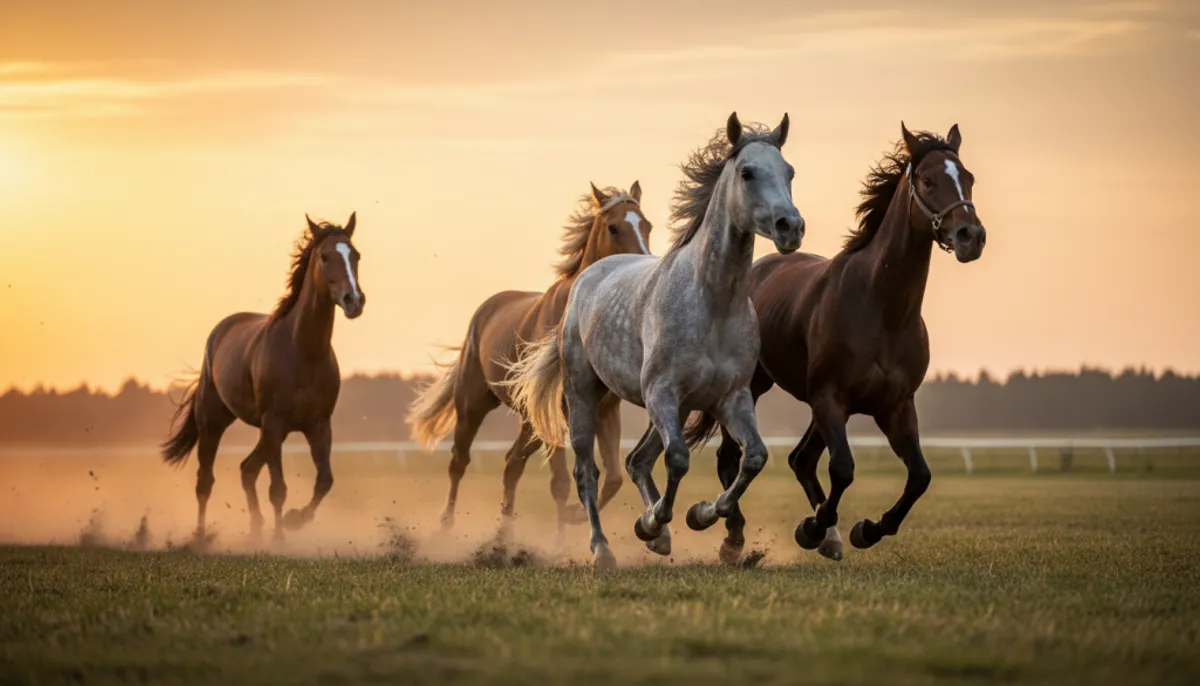
The Thoroughbred is a legend on the racetracks. Its body is slender, very muscular, and its legs are long.
This morphology is ideal for endurance events. It is nicknamed the lord of the racetracks for its long-distance performances.
Quarter Horse, Standardbred, and other varieties
The Quarter Horse is a true speedster over short distances. It can reach phenomenal peaks, close to 95 km/h.
Its official record is 86 km/h over 400 meters. Its secret? An extremely powerful hindquarters.
The Standardbred, on the other hand, shines in harness racing. It covered 1600 meters in 1 minute and 46 seconds, a record time.
| Breed | Key characteristics | Speed record | Favorite distance |
|---|---|---|---|
| Thoroughbred | Slender body, long legs, endurance | ~70 km/h | Long distance (2400m+) |
| Quarter Horse | Massive hindquarters, explosive power | 86 km/h (400m) | Very short distance (400m) |
| Standardbred | Regular gaits, endurance at a trot | Record time over 1600m | Medium distance (1600m) |
These three horse breeds dominate the global rankings. Their exceptional genetics make them unbeatable in their respective disciplines.
Horse maximum speed: definition and explanations
Defining the maximum speed of an equine means exploring the peak of its athletic capabilities. It is the moment when the animal mobilizes all its energy for ultimate propulsion.
What is a horse maximum speed?
This expression describes the peak capacity of a runner during intense exertion. It is usually measured at the gallop, its fastest gait.
Over a short distance, an exceptional athlete can reach nearly 60 km/h. Over a longer course, it often maintains a speed between 50 and 55 km/h.
The gallop is a three-beat sequence. It is followed by a brief suspension phase where the animal seems to fly.
This performance depends on morphology and respiratory power. Each individual expresses its speed peak differently.
Training and genetics play a key role. They allow the equine to reveal its full potential.
The impressive records and statistics
Exploring equestrian statistics reveals truly astonishing figures. The world of competitions holds memories of performances that seem to defy the laws of physics.
The record of Winning Brew and its performances
The mare Winning Brew holds a unique title. The Guinness Book ranks her as the fastest equine on the planet.
In 2008, she was clocked at 71 km/h. This feat took place at the Penn National Race Course.
The achievement is even more remarkable given that Winning Brew was only two years old. The average winner of the Kentucky Derby runs around 60 km/h.
Statistics and records in the racing world
The data shows a constant evolution. Genetic selection regularly pushes the limits of speed.
Winning Brew remains an absolute reference for enthusiasts. Her record symbolizes the current peak of athletic capabilities.
| Record / Performer | Speed (km/h) | Year | Distance | Notes |
|---|---|---|---|---|
| Winning Brew (Thoroughbred) | 71 | 2008 | Short (¼ mile) | Guinness record, aged 2 |
| Average Kentucky Derby winner | ~60 | Variable | 2000 m | Average performance in classics |
| Evolution of records | Increasing | Ongoing | All | Thanks to genetics and training |
The mechanics of galloping and movement
The beauty of the gallop lies in its biomechanical complexity, where each part of the body plays a precise role.
This spectacular gait is much more than just a run. It is a perfectly oiled sequence that requires total coordination.
The phases of the gallop: impulse, suspension, and recovery
The gallop is a three-beat gait. It begins with a strong impulse from the hindquarters that propels the equine forward.
Next comes the suspension phase. The animal seems to fly, all its limbs lifted off the ground.
Finally, the front legs cushion the impact upon landing. Breathing is synchronized with this movement, at a rate of one breath per stride.
In full action, an athlete can reach 150 respiratory cycles per minute. This synergy is vital for intense exertion.
The influence of morphology on movement
The power of the hindquarters is the engine of propulsion. It generates the necessary force for the take-off phase.
The back plays a crucial shock-absorbing role. It flexes with each stride to absorb impacts.
Simultaneously, the neck extends to balance the whole. The length of the limbs and the flexibility of the hindquarters directly influence the quality of the gallop.
A harmonious morphology allows for a movement that is more efficient and less energy-consuming.
The impact of training and nutrition
Behind every achievement on the track lies a rigorous training program and precision nutrition. These two pillars are essential to reveal the full potential of the athlete and ensure optimal performance.
Training strategies to optimize speed
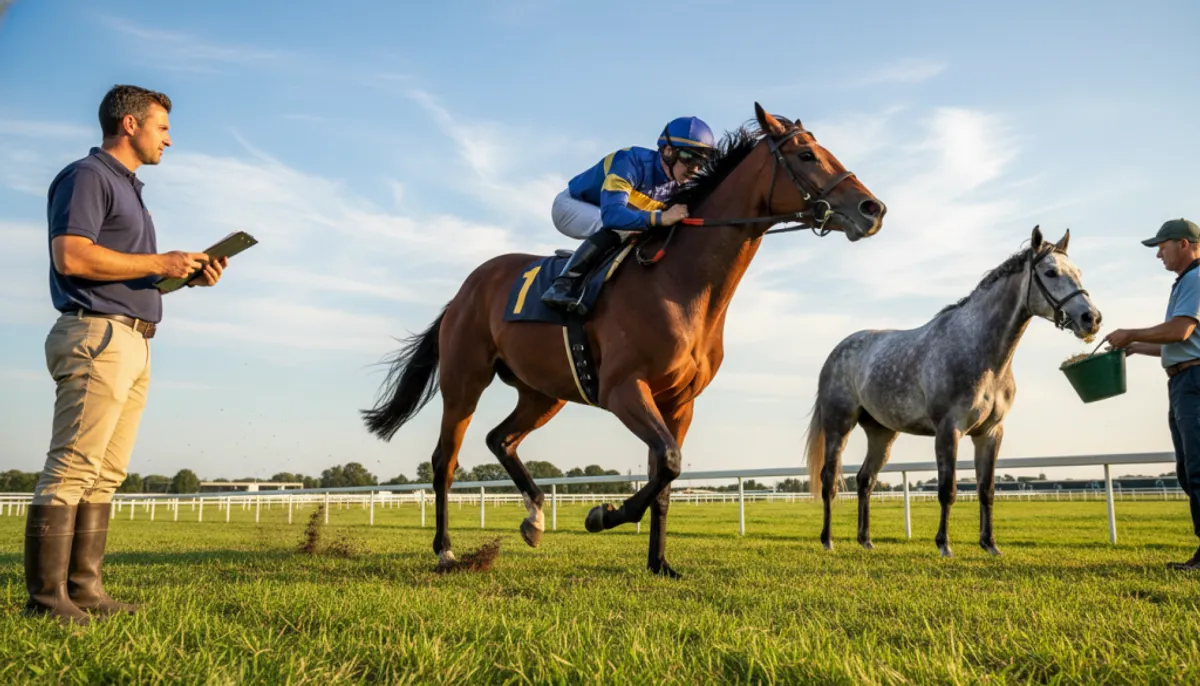
The so-called interval training is a key method. It alternates between trotting, moderate galloping, and short sprints.
This work helps strengthen stamina and the heart rate. In full action, a racehorse's heart can beat at 220 beats per minute.
Science has also identified the MSTN gene, nicknamed the speed gene. It directly influences muscle development and the endurance of the animal.
The nutrition and recovery of racehorses
Proper nutrition is fundamental. It should be rich in fiber, grains, and electrolytes.
This diet supports intense exertion without overloading the body. It promotes rapid and complete recovery.
The cardiac volume, which can reach 6 liters, allows for optimal oxygenation of the body. This ensures better endurance over time.
Good energy management is crucial. A tired athlete loses motivation and efficiency, which negatively impacts their performance and rhythm.
The role of the rider and riding techniques
A factor often underestimated greatly influences the results: the rider-mount relationship. This symbiosis is at the heart of the final performance.
The role of the human goes far beyond mere guidance. They are a partner whose every action is analyzed by the equine.
The rider's influence on performance
The total weight carried is decisive. It includes the rider and their equipment, notably the saddle.
A light mount can gain several km/h. This is why jockeys are selected with a very strict build.
The seat technique is equally crucial. The rider must accompany the movement without creating resistance.
Amplified oscillations waste the athlete's precious energy. Thus, a discreet and harmonious position is essential.
Training techniques and gait adjustments
Dressage is not just an artistic discipline. It is a fundamental tool for improving the natural balance of the equine.
By working on flexibility, the response to aids is refined. The rider then controls the gaits with greater precision.
Mutual trust releases the full potential. It removes fear and unnecessary tension from the animal.
This complicity allows for maintaining optimal performance throughout the effort. It is the key to a successful collaboration.
| Factor | Impact on performance | Recommendation |
|---|---|---|
| Total weight (rider + saddle) | Significant reduction in speed if excessive | Favor lightweight equipment and a rider with an appropriate build |
| Seat technique | Amplified oscillations = energy loss | Accompany the movement with flexibility and discretion |
| Level of training | Improves balance and response to aids | Regular work on flexibility and trust |
| Rider-mount complicity | Releases potential by removing fear | Develop a trusting relationship through gradual work |
Natural gaits vs gaits obtained through training
The walk, trot, and gallop form the basis of all communication between rider and mount. These three natural gaits define the fundamental movement of the equine.
The different types of gaits and their meaning
The walk is a four-beat gait. It offers perfect stability with an average speed of 7 km/h.
The trot is a two-beat gait. It allows for covering ground at about 14 km/h.
The gallop, in three beats, is the fastest. Its speed typically ranges between 21 and 27 km/h.
Analyzing the placement of the foot requires precise tools. A high-speed camera capturing 100 images per second is often necessary.
Artificial and fanciful gaits in dressage
Dressage pushes these natural foundations further. It refines and stylizes the movement to create spectacular gaits.
These figures are always inspired by innate gestures. The tölt of Icelandic horses is a remarkable example.
This four-beat gait is renowned for its exceptional comfort. It showcases the richness of natural possibilities.
Future perspectives and innovations in the equestrian field
Advances in genetics and technology are redefining the limits of equine performance. The world is investing in science to ensure that every athlete reaches their full potential.
Genetic research and performance enhancement
Breeders now use precise DNA analyses. This allows for guiding the breeding of racehorses with great reliability.
This science selects the best breeders for each discipline. The goal is to improve performance and endurance on the track.
Research also explores the physiological limits of the athlete. Better understanding these mechanisms helps to push records further.
Technological innovations in race tracking
In the world of racing, technological tracking has become central. It optimizes the training and recovery of equines.
New methods integrate real-time biometric data. This monitors progress and health during exertion.
This innovation aims to improve safety during competitions. It maximizes results while protecting the athletes.
The future of the sport relies on this technological integration. It allows for adjusting programs for better endurance.
Conclusion
At the end of this exploration, it is clear that equine performance results from a complex synergy. Genetics, rigorous training, and complicity with the rider form an inseparable whole.
Records, such as that of Winning Brew, showcase the potential of Thoroughbreds. Understanding the gaits, from trot to gallop, remains fundamental for optimizing results.
The evolution of techniques and genetic research opens bright perspectives. Whether for sprinting or endurance, each athlete possesses unique traits.
These characteristics deserve daily respect. The world of racing continues to celebrate the beauty of movement and the quest for speed.
FAQ
What is the fastest racing breed in the world?
The Thoroughbred is often considered the fastest over classic distances. However, the American Quarter Horse surpasses it over short distances, holding the absolute speed record with Winning Brew (88.5 km/h).
How does a rider influence their athlete's performance?
A good rider is crucial. They optimize the rhythm, preserve the animal's energy, and adopt an aerodynamic position. Their trust relationship and direct training techniques impact the final time.
What training factors improve peak speed?
An adapted program combines hill work, interval sessions, and active recovery. A nutrient-rich diet and care for the musculature and legs are equally crucial for reaching maximum gallop.
Why are morphology and stride so important?
A powerful hindquarters, a strong back, and long legs favor a large stride. The push angle and optimal cadence allow for converting this power into efficient movement, limiting energy expenditure.
Can the future see even faster racehorses?
Genetic research and technological tracking of performances open new perspectives. Data analysis and rigorous selection could further enhance the potential of future generations of champions.