
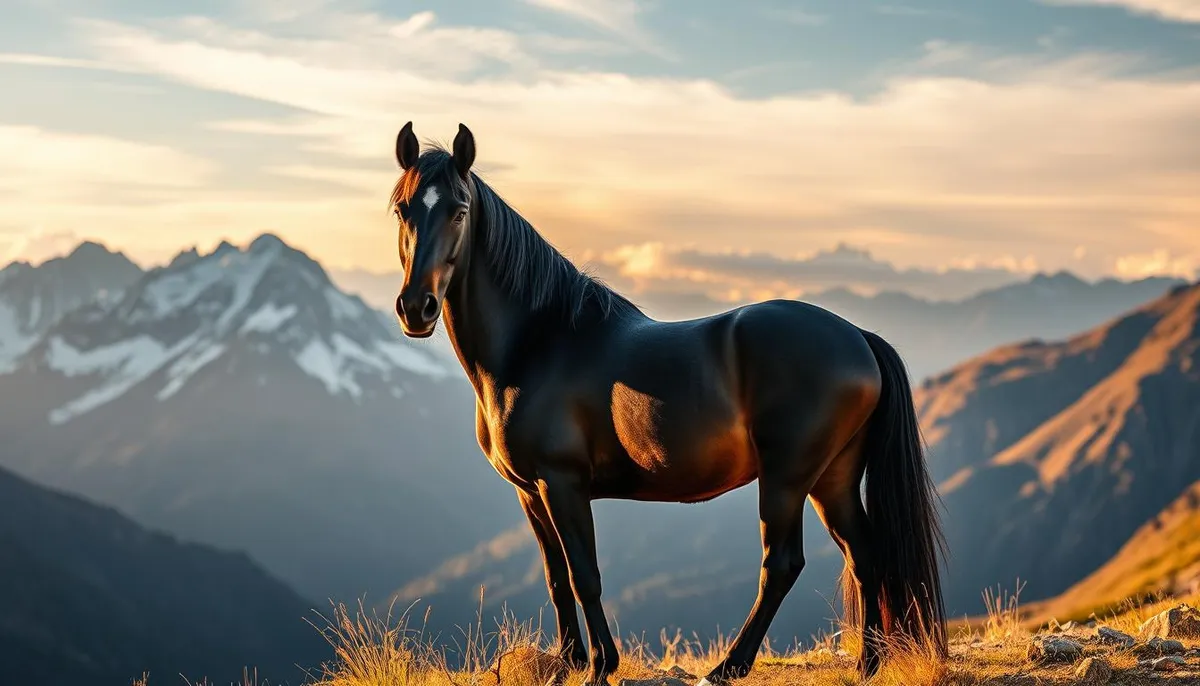
The Mérens comes from the high valley of Ariège, in the Pyrenees. This horse, also known as the Mérens horse or Ariégeois, is the perfect mix of elegance and robustness. It is known as the “little black prince” due to its deep black color and graceful shape.
It has a medium size, measuring between 1.45 m and 1.55 m at the withers. It weighs between 400 and 650 kg. With its thick mane, solid hooves, and confident gait, it is perfect for the mountain paths of the Pyrenees. It is a strong and reliable animal, known for its endurance.
People love it for hiking, driving, TREC, vaulting, and other competitions. It is also appreciated for training and helping to manage land ecologically. In the past, the Mérens nearly disappeared, but today, thanks to the efforts of breeders in Ariège, it is no longer endangered.
This article will address its origins, how it is used, its breeding here and in Europe, and the equipment for the mountains. Ready for an adventure with the Mérens horses, the pride of the Pyrenees?
Key Points
- French horse breed originating from Ariège, in the heart of the Pyrenees.
- Black coat, model of 1.45 m to 1.55 m and reputedly hard hooves.
- Nicknamed “little black prince” for its appearance and presence.
- Versatile: hiking, driving, TREC, vaulting, CCE, and ecological maintenance.
- FAO status not threatened thanks to exemplary conservation in the 20th century.
- Symbol of elegance and robustness, ideal for mountainous terrain.
Origin of the Mérens horse and history: from the Pyrenees to modern revival
The Mérens horse finds its roots in Ariège, specifically in Mérens-les-Vals. Historically, since the 19th century, this breed was known by various names. It was only in the late 1990s that the name “Mérens horse” was officially adopted.
Archives and fairs in Tarascon-sur-Ariège testify to its importance. Breeders, supported by a dynamic Mérens association, played a significant role. The Haras de Tarbes and other organizations also supported the breed.
Ariège roots and a “little black prince” of the mountains
The Mérens, nicknamed the “little black prince,” comes from the mountains. Its black color, long mane, and strength make it perfect for farmers’ work. It is different from the Castillonnais, although they are both from the Pyrenees.
Herds move according to the seasons in search of fresh grass. This outdoor life has shaped their robustness and endurance.
From Cathar myths to Charlemagne: a Pyrenean cultural symbol
The Pyrenean legends often mention the Mérens. In Pamiers, it was said that knights departed for the Other World with their mounts. Esclarmonde de Foix is also associated with this breed, riding a black stallion at Montségur.
From antiquity to the Carolingian era, Charlemagne and his horse Tencendur are mentioned. These stories enrich the cultural heritage of the Mérens, blending rites, Catharism, and mountains.
Near extinction in the 20th century and revival of breeding in the 1970s
The arrival of motorized vehicles nearly eradicated the breed. In the 1960s, the future of the Mérens stud-book was uncertain, with very few births.
Fortunately, the 1970s marked the beginning of its reintroduction as a “leisure pony.” Local efforts revitalized the breed, increasing the number of animals between 1975 and 1985. This growth even extended to Europe, with exports to several countries.
Role of associations and stud-book: SNECM, SHERPA, and Haras de Tarbes
Strong institutions have been essential for the conservation of the breed. The genealogical register, supervised by SHERPA, benefits from the support of the national stud farms. The Haras de Tarbes assists in selection, while the SNECM handles promotion and coordination of breeders.
Thanks to an engaged Mérens association, various actions have been implemented. These range from typing to testing, as well as promoting standards. This collective strategy ensures the breed's future, in Ariège and beyond.
| Period | Highlights | Actors/Institutions | Impact on the breed |
|---|---|---|---|
| 19th century | Mentions of Ariégeois and Mérens at regional fairs; agricultural and pack use | Breeders from high Ariège, markets of Tarascon-sur-Ariège | Local dissemination and consolidation of the mountain type |
| First half of the 20th century | Military requisitions and decline with motorization | Armies; rural communities | Decline in numbers and threats to transmission |
| 1960s | Drop in births; alert on the Mérens stud-book | National stud farms; breeders | Near extinction and local mobilization |
| 1970s | Revival “leisure”; competitions and media coverage | SHERPA, SNECM, Haras de Tarbes | Recovery of numbers and return to visibility |
| 1980s-1990s | Exports to Europe; structuring of breeding | Breeders, Mérens association | Genetic stabilization and opening of markets |
Characteristics of the Mérens horse: morphology, coat, and temperament
Solid and harmonious, the Mérens is appreciated for its typical traits. It comes from the Ariège valleys. These horses have a compact shape, a beautiful black coat, and a recognized spirit. Their physique is made for the mountains and long journeys.
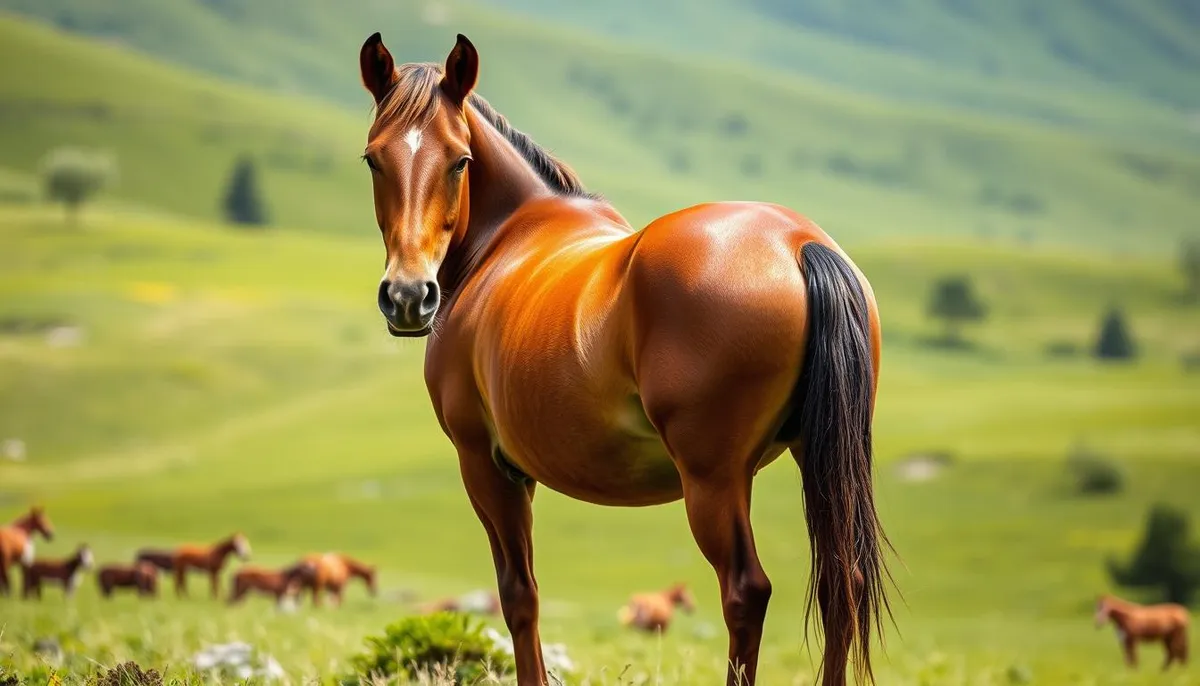
Height, weight, breed standard: 1.45 m to 1.55 m, jet black
The height of the Mérens ranges from 1.45 m to 1.55 m, sometimes even 1.60 m. They weigh between 400 and 650 kg, depending on gender and type. Their coat is deeply black, with plenty of mane. They have a short back, a strong neck, and a straight head with expressive eyes.
Sure-footed, hard hooves, thick mane: adaptation to the mountainous environment
The Mérens has reliable feet with strong legs and good conformation. Their dark hooves are very resistant. They are perfect for rocky terrains and slopes. Their thick fur protects them from bad weather, suitable for the Pyrenees.
Calm, docile, and reliable character: a companion for all levels
Their calm and curious nature makes learning easy. The Mérens gets along well with humans, making them reliable. This trait is great for beginners and experts alike. They maintain their liveliness for work.
Hardiness and endurance: assets for summer pastures and rugged terrains
Their robustness makes them resistant to cold and hunger in the mountains. Their endurance is ideal for carrying over long distances. With stable feet and good lung capacity, they are very versatile in the mountains.
Keywords: characteristics of the Mérens horse, breed standard, black coat, sure-footedness, endurance, docile temperament, Mérens horses.
merens
The term merens refers to the Mérens horse, originating from Mérens-les-Vals in Ariège, in the heart of the Pyrenees. Also called black horse breed, it is compact and rustic. Its official name was adopted in 1998, but it was already referred to as Ariégeois or Ariège pony. It symbolizes an Ariège identity linked to the valleys of Foix and high Ariège.
This horse, both a riding and light draft horse, often lives in semi-freedom. Thanks to summer pastures and transhumance, it has developed a sure-footed step and great sobriety. Used for work, carrying, and movement in the Pyrenees, it is part of local stories and legends.
The merens is celebrated during pastoral festivals and summer pastures, representing the Ariège identity. Today, this breed promotes equestrian tourism and the appreciation of landscapes. Its reliable temperament is highly valued, whether for hiking or family activities.
After nearly disappearing in the 20th century, the Mérens horse is experiencing a renaissance. Thanks to breeders and associative networks, its presence in equestrian leisure is secured. Thus, the merens remains rooted in the Pyrenees and beyond Ariège.
| Aspect | Key Characteristics | Territorial Anchoring | Cultural Value |
|---|---|---|---|
| Typology | Small black horse, riding and light draft; rustic and enduring | Mérens-les-Vals, Foix, high Ariège, Pyrenean massifs | Emblem of the Ariège identity and mountain traditions |
| Lifestyle | Semi-freedom, transhumance, sure-footedness, and thick mane | Pyrenean summer pastures, pastoral valleys | Festivals, itineraries, transmission of know-how |
| Current Uses | Leisure, hiking, light driving, mediation | Networks of breeders in Ariège and neighboring regions | Asset for tourism, landscape reading, living heritage |
| Recognition | Official designation “Mérens horse” (1998) | Stud-book and reasoned selection | Pyrenean symbol cited in local stories and memories |
Uses and versatility: from agricultural work to equestrian sports
The Mérens is versatile: it goes from wooded valleys to mountain passes in the Pyrenees. It adapts well between leisure, sport, and work in the mountains.
Hiking and equestrian tourism: challenging terrains and riding comfort
In hiking, it provides confidence thanks to its hard hooves. Equestrian tourism enthusiasts in Ariège appreciate its stability and endurance.
It excels on difficult courses, crossing fords and steep paths. Its endurance enhances lodges and trekking centers.
Driving, vaulting, TREC, endurance, and eventing
It is powerful for driving and consistent in vaulting. That’s why trainers choose it.
It is skilled in TREC, impresses in endurance and competitions. It is appreciated in dressage and eventing at all levels.
Logging, ecological maintenance, equine therapy, and milk production
It is used in logging in steep forests. Its pulling method protects paths, aiding in their conservation.
Its calm character is perfect for equine therapy. Some breeders also produce its milk for artisanal purposes.
Leisure-oriented horse breeding and more athletic selection since the 1980s
Since the 1980s, breeding has focused on leisure. But it is also developing a more athletic and agile type.
This dual aspect satisfies equestrian tourism and sports like TREC. It retains the qualities of driving and mountain adaptations.
Breeding and selling Mérens horses in France and Europe
In Ariège, the breeding of Mérens horses uses proven methods. The genealogical register, or stud-book, is very strict. The market for this breed benefits from a strong network of breeders and a high demand for hiking and driving. The export of Mérens to Europe is increasing due to their robustness and reliable character.
Transhumance and summer pastures: mares and Mérens foals in semi-freedom
With the arrival of spring, the herds move to summer pastures. The mares, in semi-freedom, take care of each foal until autumn. This practice makes the horses agile, resilient, and calm. These qualities are highly valued for the sale of Mérens, especially for hiking.
Stallions, Mérens stallions, and lineage management: genetic diversity
The selection of horses relies on recognized stallions. Each Mérens stallion must be approved by the stud-book. The Mérens association and the stud farms ensure genetic diversity to avoid inbreeding. They seek a balance between traditional horses and those with more athletic profiles.
Breeder networks, Mérens association, markets, and exports (Belgium, Italy, Germany, Netherlands)
The SNECM and SHERPA organize competitions and events to promote Mérens. Thanks to them, the market is developing, especially in Tarascon-sur-Ariège. Their work also increases the export of Mérens to Belgium, Italy, Germany, and the Netherlands. All this contributes to strengthening breeding in the Pyrenees.
Buying advice: characteristics to evaluate and prices according to use
Before buying, it is important to examine certain points such as conformation, hooves, and temperament. It is also essential to check the registration in the stud-book and the horse's lineage. A Mérens foal is less expensive than a already trained horse. Prices vary depending on the intended use: leisure, driving, sport, or work in the forest.
Choosing a horse raised in summer pastures ensures good adaptation to the terrain. Request to test it outdoors or in harness if necessary. Ensuring the compatibility between the size, the original stallion, and the intended use is essential. This secures the purchase and enhances the Mérens market.
Origins and influences: Iberian hypotheses and Pyrenean adaptations
The origins of the Mérens have been explored through genetic studies published in Nature in 2021. These studies show that the domestic horse began to develop in the Pontic steppe around 2000 BC. The culture of Ariège recalls the drawings of horses found in the Niaux cave. This creates a link between local stories and current scientific discoveries, offering us a more nuanced understanding.
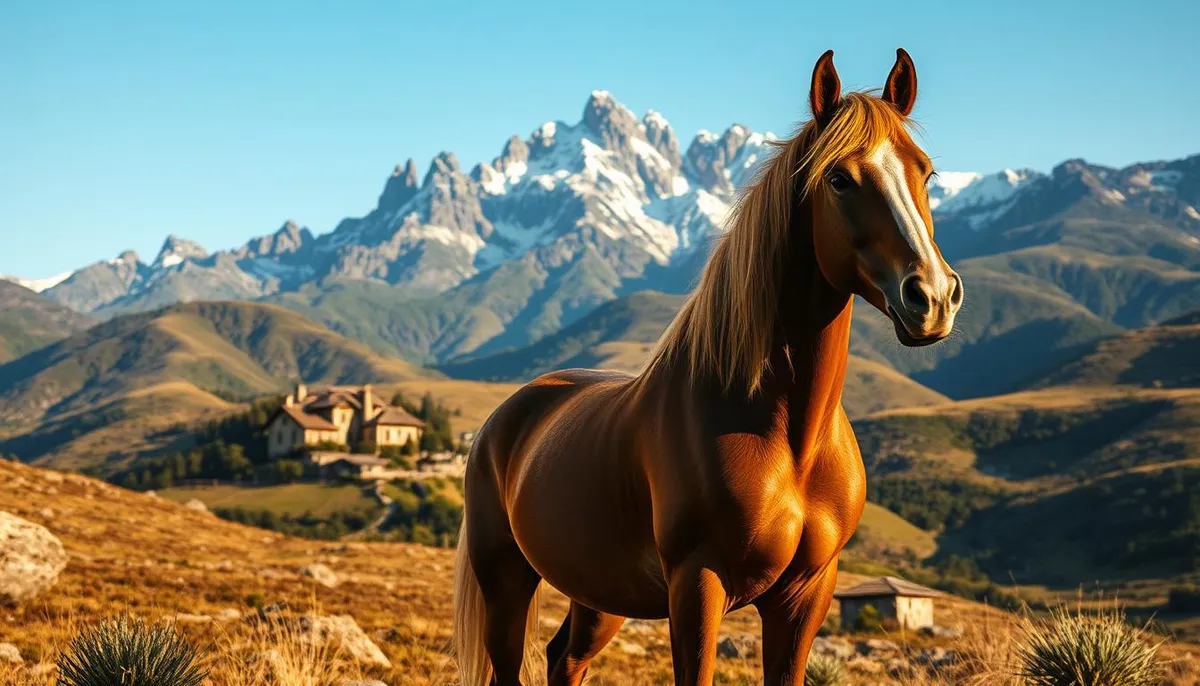
Some physical traits suggest an Iberian influence on the Mérens. For example, sometimes curly manes, a low-hanging tail, and good endurance on difficult terrains. Their physical type, close to that of the Garrano, Pottok, and Jaca Navarra, indicates a regional connection. This kinship is also found in some British breeds, such as Fell and Dales ponies, and even with the Exmoor, which is known for its robustness.
It has been suggested that the Mérens may also have Eastern origins. Some theories highlight an Arab influence on a local Celtic pony, while others cite similarities with Iberian and Barb horses. Occasional crossings with breeds such as Percheron, Breton, Arab, Anglo-Arab, French Trotter, Friesian, or Welsh Cob may have left their mark, diversifying the genetic heritage of the Mérens without standardizing it.
The living conditions in the Pyrenees have strongly influenced the Mérens. Isolation, long winters, and harsh summer pastures have played a role. They have shaped a breed of compact horses, with a robust neck and exceptional sure-footedness. These characteristics are a direct result of life at altitude, allowing the Mérens to move efficiently on difficult terrains and withstand the cold.
| Comparative Axes | Mérens | Close Groups | Synthetic Reading |
|---|---|---|---|
| Genetic Origin (broad framework) | Linkage to lineages from the Pontic steppe | Exmoor, Fell, Dales, Garrano, Pottok, Jaca Navarra | Convergences of hardiness in harsh environments |
| Regional Signatures | Thick manes, low tails, dominant black coat | Pottok (Basque mountain), Garrano (North-West Iberian) | Indicators in favor of an Iberian influence |
| Function on steep terrain | Sober gaits, sure-footedness, effective carrying | Fell, Dales (British hills), Exmoor (moorlands) | Pyrenean adaptations comparable to Atlantic environments |
| Crossbreeding History | Possible contributions without dilution of type | Percheron, Breton, Arab, Anglo-Arab, French Trotter, Friesian, Welsh Cob | Controlled influences, dominant local selection |
| Cultural Heritage | Echoes of the painted horses of Niaux | Pyrenean mountain traditions | Identity narrative coexisting with modern genetics |
The combination of the origins of the Mérens, Iberian influence, and Pyrenean adaptations creates a robust and economical breed. The proximity to breeds like Exmoor, Garrano, Pottok, and Jaca Navarra enriches our understanding. The parallels with Fell and Dales add to this comparative analysis, confirming the variation and resilience of the Mérens in the face of environmental challenges.
High-quality equipment for Mérens horses: comfort, robustness, and style
A well-equipped Mérens is comfortable and responsive, even on rocky paths. The Mérens equipment protects its muscular back and supports its thick mane well. The French saddlery meets these needs with high standards.
Exceptional French saddler: bridles, saddles, harnesses adapted to the horse breed
The Mérens requires a well-balanced saddle, suited to its back. Fitted headstalls and soft nosebands are suitable for its calmness. The Mérens harnesses resist moisture and temperature variations.
In hiking, stable saddlebags and stainless steel fittings are essential. A well-fitted Mérens equipment avoids pressure points and protects on long journeys.
The French Saddlery: made in France products, unique, custom-made, or in limited series
The French saddlery, La Sellerie Française, offers high-quality leathers. It provides hand-stitched finishes and sturdy fittings. Its custom-made products fit perfectly to the horse.
Each piece, whether in a limited series or unique, combines comfort, durability, and style. This ranges from bridles to cruppers, including hunting collars.
100% made in France manufacturing, from A to Z, by the best artisans
Everything is made in the workshop in France, from skin selection to final inspection. This expertise ensures strong seams and a lasting finish.
The Mérens harnesses are tested in real conditions. Thus, the Mérens equipment is reliable, perfect for the Pyrenees.
Choosing equipment for a Mérens: robustness, fit, and durability in the mountains
- Robustness: treated leathers, saddler seams, stainless steel or solid brass fittings.
- Fit: arch, padding, and girth that stabilize without blocking the shoulder.
- Durability: easy maintenance after mud and rain, slow drying, suitable greases.
For driving, opt for padded harnesses and compatible shafts. In TREC and endurance, prioritize lightness and balance. For hiking, choose compact saddlebags. La Sellerie Française offers custom-made products that meet these needs.
Visit https://laselleriefrancaise.com to equip your Mérens horses
The French saddlery and the made in France requirement ensure safety. La Sellerie Française creates equipment suitable for mountains and long hikes.
| Mérens Needs | Technical Solution | Key Benefit | La Sellerie Française Option |
|---|---|---|---|
| Short and straight back | Saddle with suitable padding and adjustable arch | Pressure distribution, shoulder freedom | Full-grain leather saddle, custom-made products |
| Thick manes, muscular neck | Anatomical headstall, soft noseband | Comfort for sensitive areas | Hand-stitched bridle, stainless steel fittings |
| Rocky and uneven terrains | Reinforced driving harness, hunting collars | Stability, safety in traction | Mérens harnesses tested in the mountains |
| Humid climate and thermal variations | Tanned and treated leathers, saddler seams | Durability and finish retention | 100% made in France manufacturing |
| Long-distance hiking | Compact saddlebags, secure anchor points | Balance, zero friction | Dedicated accessories, custom-made products |
Conclusion
The Mérens is a perfect blend of grace and strength. Originating from the Pyrenees, this black horse is known for being easy to manage, enduring, and very confident. It is adapted to cold and high altitudes, making it robust and elegant.
It is at the heart of Ariège traditions and nearly disappeared in the twentieth century. Thanks to the efforts of SHERPA, SNECM, and the national stud farms, like that of Tarbes, its population has been revitalized. Today, the merens excels in many equestrian sports and also contributes to tourism and nature conservation.
Mérens breeders practice transhumance and ensure pure origins through strict lineage management. Their work is supported by an active association in Europe and even in Réunion. This helps maintain the genetic diversity of the breed, influenced by Spain and adapted to the Pyrenean mountains.
To get the best out of a Mérens, whether for work or pleasure, suitable mountain equipment is necessary. High-quality saddles made in France should be chosen. The Mérens, a true icon of the Pyrenees, remains a reliable and appreciated companion in the French equestrian world.
FAQ
Where does the Mérens horse come from and why is it called the “little black prince of the Pyrenees”?
The Mérens comes from the high valley of Ariège, near Andorra. It is called the “little black prince” because it is always black, elegant, and robust. This horse is linked to the stories of the Ariège villages, their transhumances, and the fairs.
What are the characteristics of the Mérens horse (size, weight, morphology)?
The Mérens measures between 1.45 m and 1.55 m at the withers, sometimes 1.60 m. It weighs between 400 and 650 kg. It has a straight head, a muscular neck, a short back, strong shoulders, and a black coat. Its legs are dry with solid joints.
Is the Mérens really versatile and for what uses?
Yes, the Mérens is used in hiking, TREC, driving, and in other sports. It is sure-footed and has a good temperament, perfect for leisure and sport. It is also used for pulling light loads and for ecological maintenance of the mountains.
What is the temperament of a Mérens for a beginner rider?
The Mérens is calm, docile, and intelligent. It is suitable for beginners and experienced riders. It is curious and stable, which is reassuring outdoors, on different terrains.
Why are its hooves reputed to be so strong?
Its black and compact hooves come from natural selection on rocky terrains. They are grippy and enduring on difficult paths, making them perfect for hiking.
What is the origin and modern history of the breed?
The Mérens, coming from Ariège, nearly disappeared in the 1970s. Its revival depends on breeders, stud farms, and the SHERPA and SNECM associations. Leisure has revitalized the breeding and sale of these horses in France and Europe.
What is the stud-book and who manages the selection of the Mérens?
Opened in 1947, the stud-book controls the registration and genetic management of the horses. The SNECM and SHERPA handle selection, competitions, and promotion with the stud farms. They aim to maintain the standard and genetic diversity.
How does transhumance work for the mares and Mérens foals?
In spring, they move to summer pastures. The mares live in semi-freedom with their foals until autumn. This way of raising improves their endurance, mental balance, and stability.
What is the status of the breed according to the FAO?
According to the FAO, the Mérens is not threatened. It is a beautiful example of conserving a local breed thanks to breeders, associations, and the popularity of leisure.
What is the difference between the traditional model and the more athletic type?
The traditional model is more massive, perfect for driving and ecological maintenance. The athletic type, developed since the 1980s, is lighter and ideal for dressage and endurance.
What origin influences are mentioned for the Mérens?
There are several theories: Iberian origin, similarity with British mountain breeds, and Barb influences. Modern genetics suggests domestication of horses in the Pontic steppe.
How to choose a Mérens for purchase?
Ensure it is registered in the stud-book, check its origins, legs, temperament, and if it matches your project. Prices vary according to age, training, and use. Try it outdoors.
Where to find breeding and networks of Mérens horse breeders?
Consult the SNECM and SHERPA for a list of breeders. They are located in Ariège and throughout France, with exports to other countries. Regional markets and competitions help sell these horses.
What equipment is best suited to the morphology of a Mérens?
Choose saddles for a short back, stable padding, anatomical headstalls, and sturdy harnesses. The leathers should withstand moisture and friction.
Why choose La Sellerie Française to equip a Mérens?
The French Saddlery offers high-end equipment, made in France. Ideal for hiking and driving in the mountains, they guarantee quality and durability.
Is the Mérens suitable for challenging mountain hiking?
Yes. With its robustness and solid hooves, it is perfect for long distances. It remains calm and sure-footed, even in the mountains.
Is a Mérens stallion suitable for a small family breeding?
This requires specific facilities and careful planning. Many prefer artificial insemination or breeding with stallions approved by associations.
What sports disciplines best highlight a Mérens?
TREC, endurance, driving, and eventing are perfect for it. In dressage, it shines with its diligence, especially among amateurs.
Is the Mérens confused with other black breeds like the Friesian?
No. Although they share the same coat color, the Mérens is more compact and adapted to the mountains. It comes from a different selection than the Friesian.
Where to buy a Mérens and what budget to plan?
Contact the SNECM/SHERPA breeders and participate in competitions. A young Mérens costs less than an adult trained horse. The price varies depending on several factors.
How to maintain equipment after hiking in rocky terrain?
Clean mud and dust, dry, then grease the leathers. Check the seams and buckles. These products are made to be durable in the mountains.
Is the Mérens suitable for equine therapy?
Yes. Its gentle and patient nature makes it ideal for this therapy. It is reassuring for those in need.
How to prepare a Mérens for driving in the mountains?
Work on its condition, obedience, and maneuverability. Use a well-fitted harness and sturdy equipment. Be gentle on slopes and take breaks.
Where to discover and equip your Mérens horses?
Visit https://laselleriefrancaise.com for equipment suited to the Mérens. Find custom-made options made in France for various activities.