
The piebald coat of horses is eye-catching and often raises questions. In this guide, we discover everything about these horses, their patterns, their genetics, and how to care for them properly in France. You will learn to understand, choose, and care for them with ease.
There is more to know about piebald horses than just their spots. We explain the role of piebald genes, why they are special, and their impact on breeding, training, and purchasing.
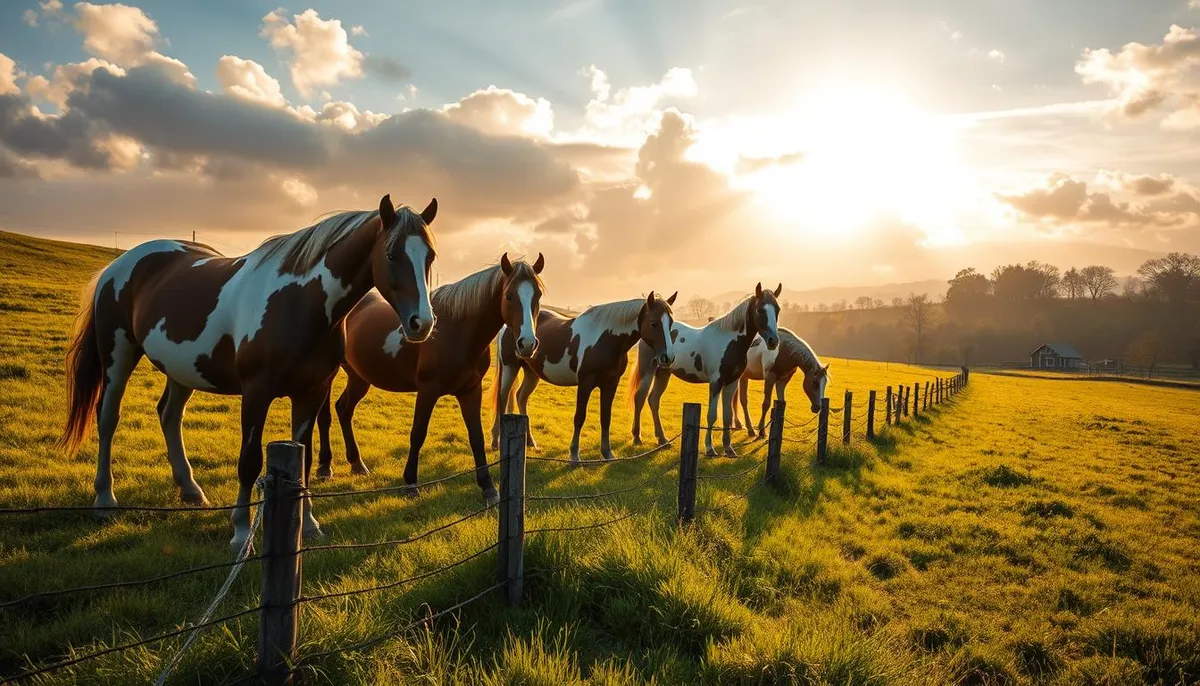
It is important to know that color is not related to breed. For example, the Palomino gets its hue from the cream gene, which can be found in several breeds. However, the patterns of piebald horses come from unique genes, not from the breed.
Caring for a light coat requires a lot of attention, such as frequent cleaning, the use of specific shampoos, and protection from the sun. Foot care is crucial: trimming, maintaining a clean and dry environment, inspections, exercise, and proper nutrition are essential.
These horses excel in dressage, jumping, driving, and even in shows. We also discuss purchasing these animals in France, from trials to veterinary care, not forgetting the custom equipment from La Sellerie Française, entirely made in France.
Key Points
- Understand the piebald horse coat and its patterns before purchasing.
- Distinguish color from breed: the Palomino illustrates the difference.
- Identify the characteristics of piebald horses related to piebald genes in horses.
- Caring for the light coat: grooming, dedicated shampoos, and UV protection.
- Preserving the foot: wall, sole, frog, with regular trimming and dry ground.
- Highlight versatility in discipline and choose the appropriate equipment.
- Prefer guided purchases in France, with trials and veterinary checks.
Introduction to the piebald coat and its features
The piebald horse coat is fascinating with its striking contrasts. It is present in many breeds, from Thoroughbreds to Shetlands. It is also noticed in the piebald pony in clubs. This coat is not only beautiful, but it also helps to recognize the horse, care for it well, and showcase it during competitions.
Definition of the piebald coat and differences with other coats
The piebald coat combines white and the base color in large patches. It is distinct from solid coats, such as chestnut or bay, and from spotted patterns like the Appaloosa. Unlike the Palomino, the piebald coat is not just a color. It is a specific pattern of white on a colored background. This can be seen in the piebald pony and large horses.
Overview of the most common piebald patterns
There are several piebald coat patterns. The tobiano has large vertical white patches, often with white legs. The overo and frame have more irregular markings, with white that does not always cross over the back. The sabino offers splashes and high socks. The splash gives a "drenched" horse effect, with a very light head and lower legs. These patterns can be found in piebald ponies and sport horses.
Why the piebald coat fascinates riders and breeders
The piebald coat is very attractive in shows, parades, and competitions because it draws attention. The contrasts make horses easy to identify in competition and stimulate the imagination of equestrian enthusiasts. For the breeder, understanding these patterns helps to choose the best crosses. This is true even for those looking to obtain an attractive and photogenic piebald pony.
Genetic origins and piebald genes in horses
The piebald genes in horses determine where and how white appears on their coat. They generate unique patterns that vary from one horse to another. Understanding this is essential for breeding and appreciating piebald horses.

Basic principles of piebald gene transmission
The transmission of piebald genes follows specific rules. Some genes are dominant, while others are recessive. Specific combinations influence the amount of white.
A horse may show little white but pass on a distinct pattern to its offspring. This is why genetic testing and knowing the ancestry are important.
Difference between coat color and breed (e.g., Palomino vs. piebald)
The color of a horse's coat does not define its breed. The Palomino has a beautiful golden coat, present in several breeds. In contrast, the piebald coat can be found in various breeds without defining them.
The characteristics of piebald horses add to the lineage and temperament of the horse. This influences the choice for equestrian sports or as companions.
Influence of crossings and breeding precautions
Choosing the right breeding partners is fundamental. This helps maintain the health and diversity of the piebald coat. Knowing the family history and conducting veterinary checks is beneficial.
Beauty is secondary to the horse's health and capability. Considering these aspects makes breeding piebald horses more successful.
Characteristics of piebald horses and identification points
The characteristics of piebald horses are primarily seen in their large white markings. These markings are clear and well-defined on the body and legs. The skin under the white is often pink, while under the colored areas, it is pigmented. The hairs can be of two colors, marking a clear line on the neck and tail.
The head shows different markings such as a straight or deviated stripe, socks that can be high or low, and an extended cap. Partial masks may also be noticed. The edges of the white markings can be sharp or resemble those of a sabino, with jagged edges.
The piebald horse coat can be found in all horses, from piebald ponies to saddle horses. The SIRE in France describes in detail each white marking and the particularities of the head and legs. This ensures reliable identification on a daily basis and during competitions.
Some white areas require special attention. The light skin is more vulnerable to the sun. Proper protection and regular care are essential to maintain skin health and the beauty of the piebald horse coat.
| Criteria | Visual Description | Identification Index | Practical Advice |
|---|---|---|---|
| White Areas | Large clear patches on the trunk and limbs | Sharp contours or sabino-like with jagged edges | Photograph each side for the SIRE file |
| Underlying Skin | Pink under the white, pigmented under the color | Possible mottling around the nostrils | Apply sunscreen on pink areas |
| Hair | Two-tone, visible separation | Light streaks/stripes on neck and tail | Gently brush to avoid breaking light strands |
| Head | Stripe, cap, partial masks | Frequent asymmetry, unique to each individual | Note the width and direction of the stripe |
| Limbs | Variable height socks | Sharp transition line with colored hairs | Clean the lower limbs after training |
| Size and Type | From piebald ponies to sport horses | The piebald horse coat is not a breed | Check stud-book standards and markings |
| Documentation | Accurate diagrams of patches and stripes | Photo/ID sheet concordance | Update after clipping or new photos |
| Care of White Areas | Bright appearance but soiling | Increased sensitivity to UV | Gentle shampoo, sun protection, quick drying |
Care, maintenance, and well-being: from hoof to coat
Caring for the coat of a piebald horse enhances its mobility. The white areas of the characteristics of piebald horses require more attention. Consistency and gentleness in the care routine are essential.
Grooming, sun protection, and stain management
Daily brushing removes dust and makes the coat shine. Choose a special shampoo to avoid irritating the skin. Harsh products can harm the skin.
To manage stains, a gentle soap followed by a damp cloth works. In summer, use UV sprays or light blankets. Applying an unscented moisturizer on sensitive areas also helps.
Anatomy and health of the hoof: wall, sole, frog
The hoof wall, rich in moisture, acts as a shield. It has a complex structure that absorbs shocks. It contains different parts, such as the toe and heels.
The sole, less hard, plays a protective role. The frog, spongy, supports the hoof. Each has an essential role for the comfort of the horse.
Understanding these elements helps keep the horse comfortable. This complements the observation of the piebald horse coat and the attention given to piebald genes in horses.
Good practices: trimming, dry environment, nutrition
Regular trimming ensures good support. Cleaning the hooves daily and checking their condition is crucial. Preventive visits avoid problems.
Keeping the stable dry prevents diseases. Daily movement is good for hoof health. A rich and appropriate diet gives strength and shine to the coat. These actions take into account the characteristics of piebald horses and the effects of piebald genes in horses.
Breeding piebald horses: good practices and selection
Breeding piebald horses focuses on three essential aspects: health, temperament, and coat. Piebald genes create special patterns, but not a breed in itself. Breeding criteria are added, such as the diversity of the Quarter Horse or the beauty of the Arabian Thoroughbred, to choose the right type and use.
Morphological objective: we seek a balanced distribution of patches, sharp contours, and a uniform color. The quality of the skin, hooves, and coat is crucial. Breeders examine how the horse moves and recovers after exertion to judge its potential.
Behavior: the goal is to achieve intelligent obedience. The reaction ability varies by breed, so education must be adapted from the start, as well as handling and paddock exercises. Close monitoring allows understanding the link between temperament, genetics, and environment. This ensures the long-term success of breeding.
Health management: regular hoof care, annual veterinary checks, and thoughtful deworming are necessary. Keeping a dry and clean environment helps prevent hoof problems. The white areas of the coat require special attention to avoid damage from the sun and fungi. The diet must be well-balanced, with enough fiber and minerals for the hooves.
Genetic caution: it is important to know the piebald genes well to avoid problematic crossings. Healthy animals with a good history should be selected, and if necessary, genetic testing. Breeders use clear photos and descriptions to track the evolution of the coat.
- Clear objectives: athletic ability, breed type, readable pie expression.
- Selection: balanced patterns, quality fabrics, functional model.
- Well-being: hoof hygiene, sun management, calibrated nutrition.
- Traceability: photo file, pedigree, tests related to piebald genes in horses.
- Choice of breeders: recognized piebald horse breeders, health history, and performance.
Piebald horses in disciplines and daily life
Piebald horses attract attention with their unique coat. This appearance helps them stay in the minds of judges and the public. By considering their particularities, tailored programs are created, from leisure to competition. For young riders, a piebald pony is both visible, safe, and easy to care for.
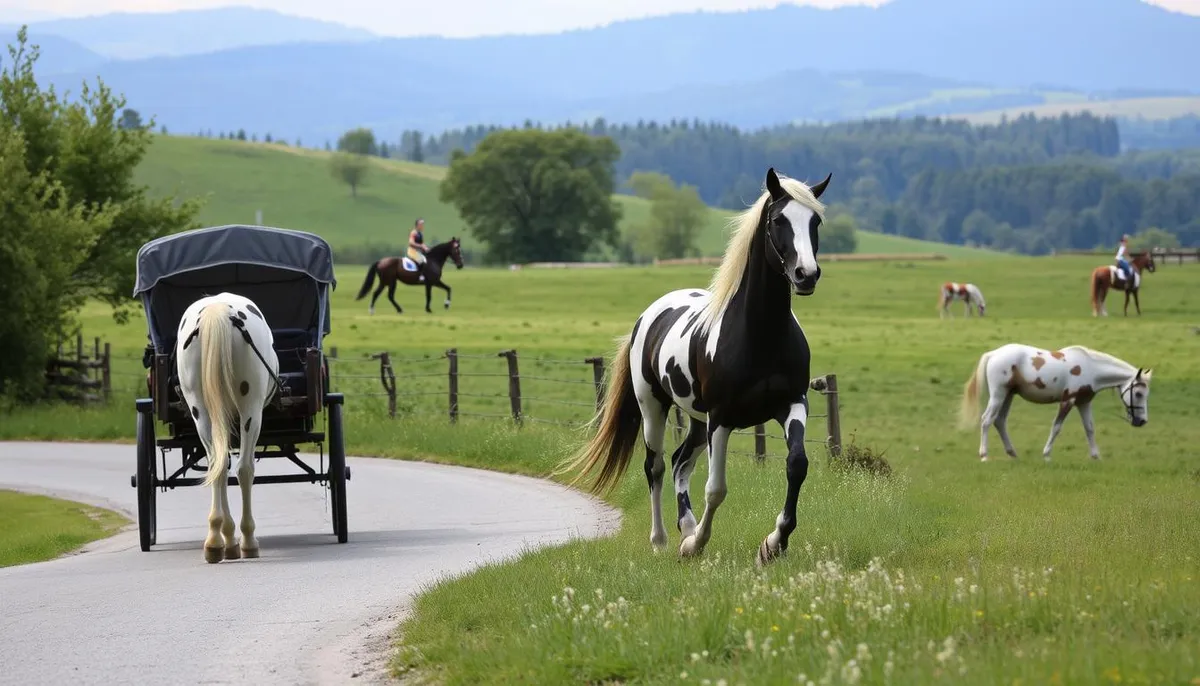
Versatility in dressage, jumping, driving, and shows
Piebald horses stand out with specific training. In dressage, they must show consistency and straightness. Their appearance enhances their performance without hiding their technique. In jumping, balance and sincerity are crucial, as is rhythm control. For driving, they show beautiful coordination, perfect for their coat.
In shows, lights and music enhance their contrasts. This has been seen in performances like Cavalia or Puy du Fou. Their coat captures as much attention as the choreography.
Exhibition, parades, and image management in competitions
Preparation is essential for perfect piebald horses. Use a whitening shampoo for light areas. Apply sunscreen on sensitive parts to avoid discoloration. The equipment must be clean and well-fitted for a harmonious appearance.
- Before entering the arena: clean around the eyes and nose, use a wipe on stains.
- In parades: make short braids for a beautiful neck.
- In the stable: keep a clean flannel for last-minute touches, and a bucket for specific cleaning.
Choosing the right mount based on temperament and use
Character is paramount in the choice. Some piebald horses are calm, while others are livelier. For leisure, choose a quiet horse with a comfortable gait. In competition, favor those with good dynamics and a strong back.
For children, focus on safety and ease. In shows, look for confident and calm ponies. For driving, a compact and sturdy horse is ideal.
- Leisure: comfort, healthy feet, good character.
- Dressage and jumping: flexibility, responsiveness, quick recovery.
- Parades and shows: stress management, concentration, charisma.
Brush thoroughly to maintain a shiny coat. Protect your horses from the sun. This way, they will remain beautiful, ready for any presentation or competition.
Sale of piebald horses in France: breeders, budget, and purchasing advice
In France, the market for piebald horses is dynamic. To make a good choice, set a budget. It should take into account the horse's age, skills, and paperwork.
Tip: make a short list and visit several breeders. This helps compare and choose the best piebald horse.
Where to find piebald horse breeders and piebald horses for sale
Look for farms specializing in piebald horses. Breeds like the Paint Horse and the Gypsy Cob are known for their piebald coats. Use sales websites and attend events where these horses are showcased.
Inquire about the pedigree, history, and identity of the horse. Recognized registries and performance in competitions are good indicators.
Assessing the conformity of the piebald coat and overall health
Carefully check the coat of the piebald horse. Photos, descriptions, and diagrams are essential. The coat must match the official documents perfectly.
Examine the skin and hair closely, especially on the white areas sensitive to the sun. Also, check the health of the hooves and the quality of the walk.
Contracts, mounted trials, and veterinary checks
Arrange trials to assess the horse in different contexts. This allows testing its temperament and abilities.
A thorough veterinary visit is crucial before purchase. Request a complete assessment and ensure you have a contract detailing all aspects of the sale.
High-quality equipment: La Sellerie Française
Good equipment is essential from the start. La Sellerie Française offers quality gear, made in France. They are perfect for competitions or shows.
Choose accessories suitable for your piebald horse. They should be durable, easy to maintain, and fit its morphology.
Conclusion
Piebald horses uniquely combine style and function. Their special coat does not define their breed. This is important, as shown by the Palomino, where the color comes from a special gene.
This idea is essential for properly selecting and breeding these horses. One must consider their temperament, physical shape, and health, not just their color.
Caring for them daily requires attention. They need to be brushed often, use special shampoos for their white areas, and be protected from the sun. Their well-being also depends on the health of their hooves.
Regular monitoring, a clean habitat, exercise, and good nutrition keep them fit.
When purchasing a piebald horse, it is wise to choose recognized breeders. It is also important to have the horse examined by a veterinarian and properly document its coat. A good health record, riding trials, and traceability are crucial.
La Sellerie Française offers quality equipment for these horses. Everything, from leisure to high-level sport, is designed for their well-being. Careful selection, attentive care, and the right equipment ensure their health and presentation, both in the stable and in competition.
FAQ
What is a piebald horse and how does its coat differ from a solid or Appaloosa spotted coat?
A piebald horse has clear white and colored patches, regardless of its base color. This is not the same as a solid coat. The spots are different from those of the Appaloosa, which has a specific pattern. The pie is a coat pattern, not a breed.
Is the piebald coat a breed of horse?
No. "Piebald" just describes a coat pattern, like the Palomino. It is not a breed. The piebald coat can be found in many breeds.
What are the most common piebald patterns in horses and ponies?
There are several patterns: tobiano, overo, sabino, splash, and frame. These patterns vary in size, shape, and placement of the white patches. They are present in many horses and ponies.
How are piebald genes transmitted in horses?
The genes that control the white patches follow simple rules of heredity. Testing and studying lineages help determine if a horse will be piebald or not.
What breeding precautions should be taken for piebald horses?
It is important to know the genes of the horses to avoid problems. Keep clear goals for health and temperament. Closely monitor health and coat color is crucial.
What characteristics of piebald horses should be examined when purchasing?
Look closely at the patches, skin, and hair color. It is also important to check the overall health and hooves of the horse. The white areas require special attention.
What specific care is needed for the white areas of a piebald coat?
Clean and moisturize the light skin well. Use specific gentle products to avoid irritation. Protect the skin from the sun to prevent burns.
How to care for a piebald horse's hooves on a daily basis?
Daily cleaning and monitoring the condition of the hooves are essential. A good farrier and proper nutrition help keep the hooves healthy.
What should be known about hoof anatomy (wall, sole, frog)?
The different parts of the hoof have important roles for the horse's health. A good understanding helps prevent problems.
Do piebald horses have particular sensitivities to the sun?
Yes, especially the skin under the white areas. Use appropriate sun protection and avoid strong sunlight to protect your horse.
Are piebald horses suitable for dressage, jumping, or driving?
Yes, their suitability depends more on their breed and training than on their coat. The piebald coat adds aesthetic appeal in competition.
How to choose a piebald pony for a young rider?
Focus on temperament and ease of handling. Ensure suitability for the intended activity. A trial and veterinary examination are essential.
Where to find piebald horses for sale in France?
Look for recognized breeders, on specialized websites, and in equestrian networks. Carefully check the horse's history and health.
What documents and checks are needed for the sale of piebald horses?
Request a detailed description, photos, official documents, and health records. A complete veterinary visit is essential before purchase.
What budget should be planned for a piebald horse or pony?
Prices vary according to several factors. Plan a budget for the purchase, but also for daily care and equipment.
What equipment enhances a piebald horse in competition?
Choose equipment that highlights the coat. La Sellerie Française offers quality options, perfect for competition.
How to differentiate a tobiano from an overo on the ground?
The tobiano has white patches that cross over the back. The overo has more irregular patches that do not cross the back.
Can piebald genes pose health risks?
Yes, certain crossings, especially overo frame, pose risks. Hence the importance of genetic testing and professional advice.
Do the care of white areas differ in winter?
Yes, avoid frequent washing. Prefer brushing and ensure that the skin and hair remain dry.
Does the piebald coat influence character?
No, temperament comes from breed and environment, not from coat color.
How to properly document a piebald coat for the stud book and sale?
Take clear photos, note the details of the patches, and indicate them on the official papers.
Are there specific breeding standards for the piebald coat?
The standards take into account the main breed. Aesthetic appearance should not overshadow function.
What supplements can support coat and hoof quality?
Biotin, omega-3, and vitamins can improve quality. These supplements are useful in addition to a balanced diet.
How to prepare a piebald horse for a parade or show?
Clean the coat well, apply a shine product and sun protection. Choose equipment that enhances the overall appearance.
What visual indicators confirm the good health of the hoof?
A healthy hoof has a solid wall, a clean sole, and a firm frog. Proper maintenance is vital.
Do piebald horse breeders favor certain breeds in France?
Yes, some choose specific breeds for their suitability. The piebald coat simply adds visual interest.