
Horse training is not limited to competitions. It is the foundation for simplifying all disciplines, from leisure to competitions. In equestrianism, it is common to say that navigating an obstacle course is largely about groundwork. Without balance or control, jumps can quickly become a challenge.
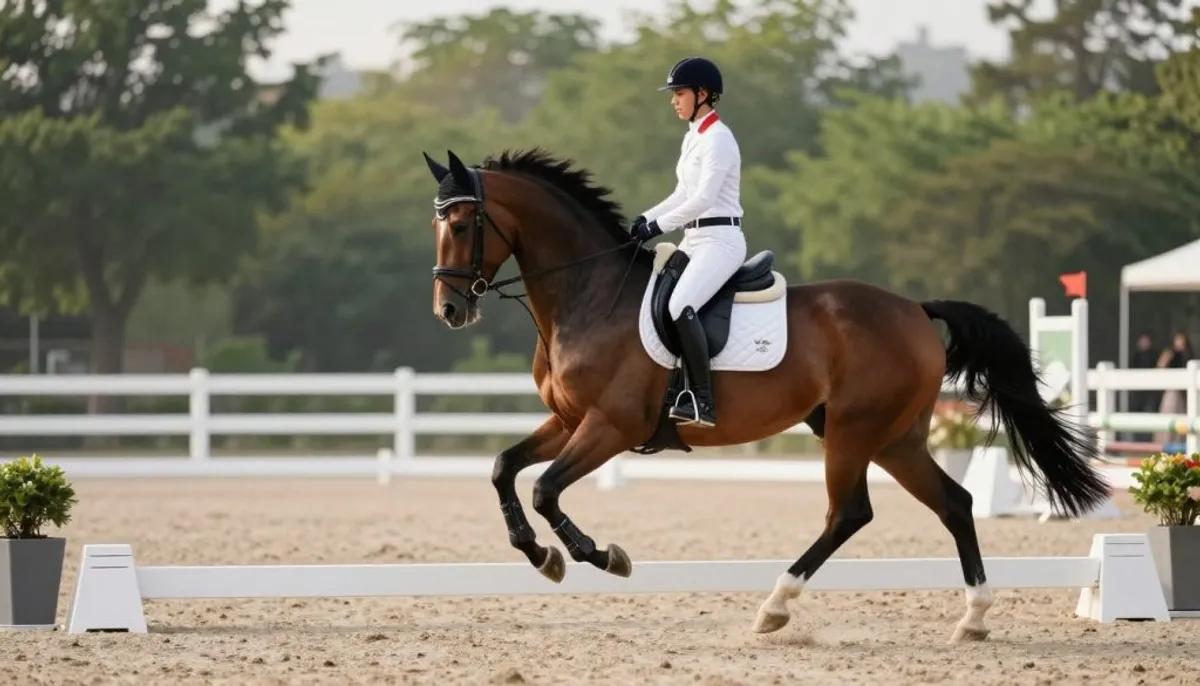
This guide offers a clear, step-by-step method. We discuss the quality of movements, the communication between horse and rider, and training routines to improve precision. You will discover practical training techniques that are easy to adopt even when time is short.
To stay guided, we follow a well-defined structure: the FFE Progression Scale from the French Equestrian Federation, revised in January 2020. This framework emphasizes the importance of progressing step by step while caring for the horse's mind and body. Serge Lecomte's advice in the FFE editorial stresses a smooth and harmonious partnership, aiming for the horse's well-being and cooperation.
Key Takeaways
- The horse training serves all disciplines, including show jumping.
- The priority remains the quality of gaits before more technical exercises.
- A clear routine improves control and precision in equestrianism.
- The FFE Progression Scale helps structure work without skipping steps.
- The classical training aims for a relaxed, attentive, and cooperative horse.
- The most effective training techniques are often the simplest, repeated calmly.
Understanding the Goal of Training and the Horse's Progression
Horse training is not meant to constrain. It seeks to educate clearly and fairly. The goal is to have a calm, forward, and straight partner. We want a relaxed, flexible horse that is eager to work and easy to guide with gentle commands.
In classical training, success lies in the small details of everyday life. We seek clear and stable gaits, constant contact without resistance, and a light head because the power comes from the back. This makes riding safer and free of unnecessary stress.
Equine learning goes better when we proceed step by step. We build foundations before adding exercises: we start with rhythm, then relaxation, and finally precision. This method prevents lessons from becoming too difficult and keeps the horse motivated.
From the horse “calm, forward, and straight” to the confident and attentive athlete
We start with a horse that moves in a regulated manner, turns without imbalance, and listens to its rider. Only a slight pressure from the leg and a soft hand are needed to guide.
Once the horse responds well, it becomes more confident. It can then focus better, making its movements smoother. This prepares it to perform better, whether in competition or during training.
The three phases of training: building foundations, developing impulsion, perfecting balance
| Phase | Priority | What we aim to feel | Signs we can advance |
|---|---|---|---|
| 1) Building Foundations | Correcting gaits, flexibility, quality of contact | Regular cadence, relaxed back, soft and symmetrical contact | Simple transitions without struggle, stable direction, available horse |
| 2) Developing Impulsion | More activity while maintaining foundations and straightness | Energy that “pushes” forward without rushing | Tonic but calm horse, quick responses, clean paths |
| 3) Perfecting Balance | Propulsion + straightness, towards more collection | Lighter forehand, maintaining balance on curves | More expressive movements, without loss of rhythm or resistance |
In classical training, these steps reinforce each other. Even with the desire for more expression, we must always protect regularity and contact. Otherwise, energy becomes uncontrolled speed.
Why return to the fundamentals in case of resistance, difficulty, or disorder
In the face of resistance such as a hard mouth or imbalance, we need to simplify. Returning to the basics helps restore order: rhythm, relaxation, then contact. This approach is often more effective than trying a harder exercise.
Working this way respects the horse's learning process. It makes training more accessible for both horse and rider. This leads to more consistent performance, based on simple and reliable responses.
The FFE Progression Scale: the roadmap for classical training
In France, the FFE Progression Scale (January 2020) is a guide in equestrianism. Riders, instructors, trainers, and judges use the same language. They rely on this scale to evaluate training sessions.
It offers a hierarchy of priorities through six key points. In training, we do not follow the steps one by one without going back. We constantly adjust, as each aspect is linked to the others. This helps make training more understandable and fair, avoiding tension.
Gait Correction: Rhythm, Natural Activity, Cadence/Tempo
In training, the horse's walk is essential in every session. A well-known challenge is to avoid asking too much while the gait deteriorates. If the quality of the gait decreases, everything else becomes less stable, even with a good path.
The FFE identifies three elements to monitor.
| Factor | What we seek | Frequent warning signs | Simple action track |
|---|---|---|---|
| Rhythm | Regular times: walk at 4 equal times, trot at 2 equal times, canter at 3 times with a clear projection phase. | Lateralized steps, broken canter, irregular trot. | Return to a comfortable gait, favor large curves, make simple transitions. |
| Natural Activity | Stable energy, sufficient to maintain the gait without rushing. | A horse that rushes, loses balance, or leans its shoulders. | Vary between straight lines and curves, alternate starts and pauses, test the response to the leg. |
| Cadence / Tempo | A regular rhythm, reminiscent of music, neither too fast nor too slow. | Sudden accelerations or unexpected slowdowns, especially before an exercise. | Count the tempo over 20 m, then play with the amplitude without changing it. |
Flexibility and Relaxation: Mental and Physical Indivisible
Flexibility is not just about the neck. It also includes the back and breathing. A relaxed horse understands better, and it prevents the rider from tensing up.
The goal is to achieve a relaxation that persists: a relaxed jaw, smooth transitions, easy flexion. When the mind is calm, the body relaxes, making riding smoother.
Quality of Contact: Trusting, Stable, Symmetrical, and Soft Relationship
Contact should guide without forcing. It is optimal when energy flows from the back to a firm hand. It seeks a soft connection, equal on both reins, without pulling.
Good contact is indicated by a relaxed neck and a calm mouth. If the contact becomes hard, we must quickly review the gait and relaxation.
Impulsion, Straightness, Collection: Building Performance without Rushing
Impulsion represents the power of the hindquarters with control, not just speed. Being straight means the horse is well positioned between the legs and reins. These principles facilitate collection while preserving balance.
Following this guide, we progress logically: we build the foundations, develop, then refine. Thus, equestrianism progresses without taking shortcuts that could harm performance and well-being.
Rider's Posture: Safety, Efficiency, and Well-being of the Pair
In equestrianism, posture is not just a matter of style. It plays a key role in balance, stability, and quick reactions, especially in unforeseen situations. It also affects the horse's comfort, thereby improving the quality of training.
According to a 2022 FFE study, 68% of riders suffering from back pain or having difficulty progressing linked these problems to poor posture. This is an aspect that is easy to check and often simple to improve with good advice.
Why does the riding position directly influence communication and progression?
A neutral and balanced posture facilitates communication with the horse. It allows for easier guidance of the animal without forcing. Conversely, a tense or crooked posture can create confusion: the horse may then behave unpredictably.
If the rider leans, it inevitably alters their direction without them realizing it. This disrupts the horse's balance, reduces the quality of movements, and the accuracy of training techniques. The effects are visible during changes of direction, in curves, and straightness.
Common Errors: Arched Back/Rounded Back, Raised Shoulders, Looking Down
- Hyperlordosis (arched back): center of gravity shifted backward, tension in the lower back, unstable legs.
- Rounded Back: difficult breathing, stiff pelvis, inconsistent handhold.
- Raised Shoulders: stretched arms, tight reins, tense or resistant horse.
- Shoulders Forward: weight on the horse's shoulders, less fluid executions.
- Looking Down: closed posture, difficulties maintaining alignment.
- “Chair” Legs (too far forward) or too far back: imbalance and imprecise commands.
Alignment of Shoulders-Hips-Heels: Simple Markers to Check in Every Session
Align your shoulders, hips, and heels. This will make your posture more stable and help your horse stay aligned. Keep your shoulders relaxed and look far ahead for better seating.
| Quick Marker | What You Feel | What the Horse Often Shows |
|---|---|---|
| Shoulders-Hips-Heels Aligned | Comfortable position, well-placed legs | Regular movements, easy direction |
| Legs Too Far Forward | Back compensates, difficulty in rising at the trot | Unbalanced horse, slow executions |
| Raised Shoulders | Stretched arms, tense hands | Uncertain contact, rigid horse's head |
| Looking Far Ahead | Open chest, better balance | Precise course, responsive horse |
Soft Hands and Mobile Pelvis: Foundations for Finer and Less Fatiguing Riding
Avoid tensing your hands or breaking your wrists. This disrupts your horse. Have flexible fingers, straight wrists, and slightly bent elbows for better contact.
The pelvis acts as a shock absorber. If it is rigid, the trot and canter are less fluid. A soft pelvis helps to move with the horse, making training clearer and less tiring.
To improve, feedback is very beneficial: using a mirror, filming yourself, or getting feedback from a trainer can help a lot. This allows you to spot and correct small errors like pressing too hard on a stirrup, an advanced shoulder, or a tight hand. Thus, your relationship with your horse will become increasingly precise and harmonious.
Horse Training: Foundations of Horse-Rider Communication and Clear Aids
In horse training, progressing often means speaking the same language. When we give clear indications, the horse understands us better. This makes learning calmer and more effective.
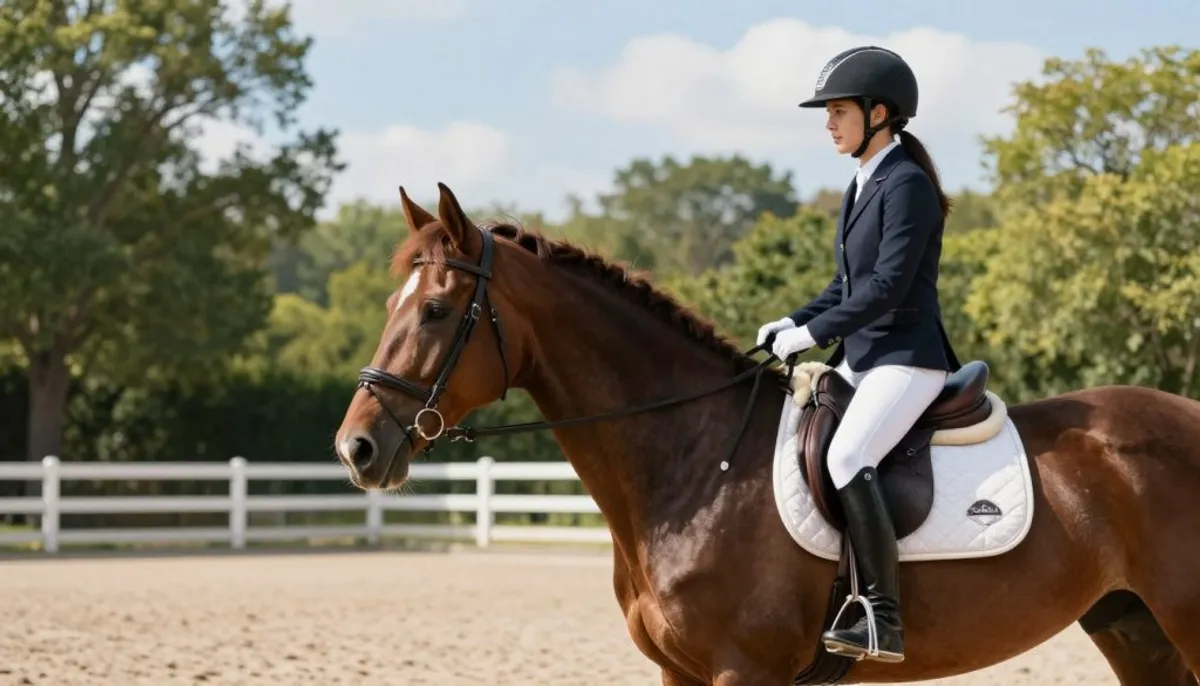
The best ways to train are not always the most complicated. Being clear about what we ask is essential. This helps the horse respond without feeling threatened.
Agreement of Aids: Legs, Hands, Seat, and Eyes in Service of Understanding
The legs motivate the horse, the hands direct, the seat stabilizes, and the eyes orient. Harmonizing all these aids avoids confusing the horse. This reduces its stress and improves your communication.
To be clearer, ask a question, wait for the answer, then release. When the horse responds well, soften the pressure. This allows for a dynamic and respectful exchange.
Permeability: Achieving Reactivity without Resistance, in Transitions and Movements
The FFE wants horses to react well without resisting. Even for leisure or competition, understanding this makes learning more solid. It is important even in the simplest exercises.
| Situation | Clear Aids | Sign of Good Response | Immediate Adjustment |
|---|---|---|---|
| Transition Walk-Trot | Lengthen, short legs, stable hands | Clear start, regular cadence | Lightly release fingers, follow with the pelvis |
| Transition Trot-Walk | Breathe out, straighten the torso, close the seat | Return to walk without “falling” forward | Give a little in front, keep legs in contact |
| On a Circle | Look on the curve, inside leg at the girth, outside rein framing | Shoulder in place, stable bend | Lighten the inside hand, reinforce the outside leg if needed |
The Role of Breathing: Lengthen, Release, Improve Relaxation
Breathing helps especially when working intensely. Deeply inhaling helps to straighten up, which often stabilizes the horse. Then, exhaling allows for relaxation; Camille Judet-Chéret finds that it is a good way to relax after a good response.
A simple exercise: sitting, straight, inhale through the nose and inflate the abdomen, then exhale slowly. This prepares well before mounting and avoids tension. These details help make training more precise.
Preparing an Effective Session: Relaxation, Routine, and Groundwork
Preparing a successful session starts before the first request. Having a simple routine is beneficial, as it calms the horse and helps the rider focus. Before performing technical movements, the horse's body must be ready to move correctly.
Progressive Relaxation: Preserve Regularity Before Increasing Demands
The goal of relaxation is to maintain correct locomotion. It involves keeping a stable rhythm, with a confident walk and regular trot. If the gait weakens, we reduce the difficulty.
It is advisable to start with straight lines, then wide curves. Next, consider tighter transitions. This approach gently prepares the horse without stressing it.
Groundwork: Establish Calm, Attention, Mobility, and Respect for Aids
Groundwork, although brief, is crucial for establishing a serene work framework. It is the ideal time to check the horse's reactions to different requests. This control helps limit the horse's resistance once mounted.
Some basic techniques are sufficient to ensure good preparation. This involves, for example, backing the horse up, then sending it forward. This contributes to a better reaction to the rider's aids.
Ground Exercises for the Rider: Core Strength, Proprioception, Flexibility of the Pelvis
A well-positioned rider facilitates the horse's relaxation. A few minutes of ground exercises can significantly improve your comfort in the saddle. For effective training, it is essential to have a strong torso and a flexible pelvis.
- Core Strength: plank on elbows or hands, 10 to 20 seconds, then rest, 2 to 3 times. Goal: stabilize the spine and pelvis.
- Flexibility: butterfly stretch, forward lunge, hamstring stretch, about 20 seconds per posture, slow breathing.
- Proprioception: balance on one foot, arms extended, then close your eyes for a few seconds; controlled step up/down.
- Self-Massage: ball under the arch; roller on thighs and back to release tension.
| Moment of Session | Priority Objective | Concrete Examples | What to Monitor |
|---|---|---|---|
| Start | Calm and get started | Hand walking, stop-start, straight walking | Breathing, attention, energetic steps |
| Mounted Relaxation | Regularity and relaxation | Large circle, straight lines, slight variations in amplitude | Constant rhythm, back loosening, stable contact |
| Technical Phase | Apply training techniques | Transitions, precise paths, beginning of simple lateral work | Unchanged gait quality, light responses |
| Cool Down | Recovery and comfort | Easy extended trot, long reins walk, marching | Gaits stretching out, soft neck, overall relaxation |
Correcting Gaits: Regularity, Cadence, and Balance Daily
Correcting a gait in equestrianism makes the horse more reliable every day. Regularity is more important than a fleeting spectacular effect. A stable horse conserves its body and learns better.
Differentiating Rhythm and Cadence: Avoiding Rushing, Slowing Down, and Irregularities
Rhythm represents the order of gaits: 4 in walk, 2 in trot, 3 in canter. Rhythm errors, such as an unsteady walk or interrupted canter, are problematic.
Cadence is the frequency at which the horse places its feet. It must be just right, without speeding up or holding back. The goal is to have natural, energetic activity without excessive speed.
Stability on Straight Lines, Curves, Corners, and Circles: Keeping Locomotion a Priority
Stability is evident on a straight line. On a circle or in a corner, it is more complicated: the horse may lean or slow down. The goal is to remain stable, even in difficult passages.
A good marker at the trot is to maintain the same cadence in a straight line and on a circle. We seek a constant bounce, regular contact, and clear transitions.
Amplitude Variations: Asking for More Stride without Increasing Cadence
A good extension results from a larger stride, thanks to the engagement of the hindquarters. Ask properly: for example, three beautiful strides, then return to normal. Then, you can extend.
A tool like Equisense Motion S can help you track cadence. It is a good way to observe your progress and refine your technique.
Golden Rule: No Exercise is Useful if Gait Quality Deteriorates
If rhythm is lost or the gait becomes disorganized, the exercise is pointless. Return to the basics: a clear and stable gait. This improves performance over sessions.
| Control Point | What You Are Looking For | Warning Signs | Simple Adjustment |
|---|---|---|---|
| Rhythm | Clear and regular times (walk 4, trot 2, canter 3) | Lateralized walk, broken canter, irregularity | Return to an easy line, transitions walk–trot, then restart |
| Cadence / Tempo | Stable frequency, without acceleration | The horse “trots”, rushes, or freezes | Alternate between circle and straight line while maintaining the same feeling of placement |
| Natural Activity | Energy that pushes from the back, without extra speed | Horse that runs, opens up, or becomes unsteady | Close transitions, then a few calm strides forward |
| Balance on Curves and Corners | Guided shoulders, horse “in the path” without falling | Horse that leans, cuts the corner, or lays down on the circle | Reduce the diameter, then enlarge, while keeping locomotion a priority |
| Amplitude Variation | Larger stride, same cadence | Acceleration, loss of bounce, unstable contact | Ask for 3 quality strides, return, repeat after a pause |
Flexibility and Relaxation: Building an Available and Willing Horse
Flexibility and relaxation are key in classical training, according to the FFE. They contribute to creating a calm, available, and willing horse. With these qualities, the rhythm is clear, movements are free, and effort seems easy.
To obtain a flexible and relaxed horse, all qualities are worked on together. If the back tenses, the gait shortens. Mental tension makes contact rough, losing impulsion. Conversely, a relaxed horse moves better and responds positively, marking progress in its education.
Good communication between the horse and rider starts with the rider's posture. A balanced position with relaxed shoulders indicates to the horse that it can relax. But a tight grip or a rigid leg can unintentionally create tension.
Breathing correctly can help overcome these tensions. Camille Judet-Chéret emphasizes the importance of breathing well to lengthen and relax. Long exhalation can make impulsion smoother and more consistent, avoiding excessive effort.
| Session Marker | What You Feel | Simple Adjustment | Desired Effect |
|---|---|---|---|
| On a 15 m Circle | The horse “falls” on one shoulder, irregular trajectory | Straighten your torso, look at the exit of the circle, present inside leg | Lateral balance, rib flexibility, better availability |
| Yielding to the Leg at Walk | The horse freezes or speeds up to avoid the side | Ask little, then release; keep a stable tempo | Reactivity without rushing, useful base for classical training |
| Trot Transitions | High neck, heavy mouth, uneven contact | Exhale, slow your pelvis, soften hands | Softer contact, better horse-rider communication |
| 12 m Circle at Trot | Loss of cadence, short strides | Return to 15 m, restore rhythm, then reduce again | Flexibility without breaking gait, respectful progression |
Circle exercises and response to the leg are concrete tests. If the horse remains cadenced without tensing, it is a good sign. Alternating between curves, straight lines, and transitions, each session makes training smoother.
Quality of Contact: Achieving a Stable and Respectful Connection
In horse training, the quality of contact is essential. It is necessary to avoid any resistance and tension, favoring a clear link. Classical training aims for a trusting and regular relationship with the horse. This makes it more receptive.
Communication between the horse and rider relies on simple aids. This avoids forcing and creating conflict.
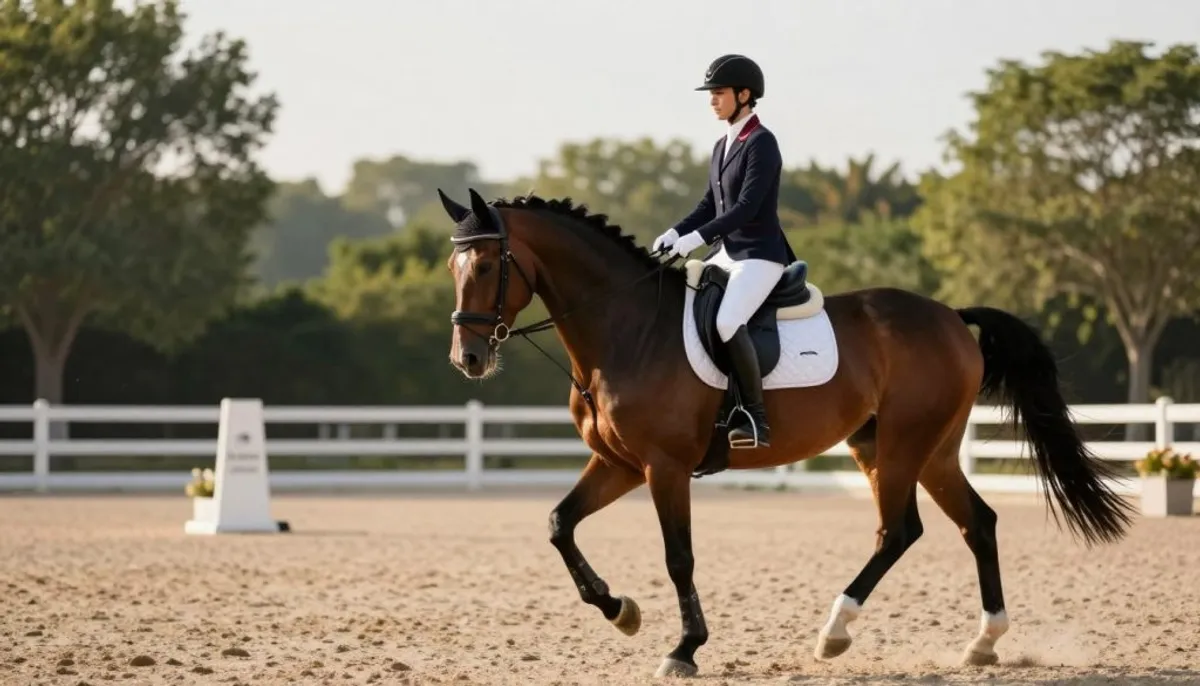
Good contact starts with proper hand positioning. Tight fists or rigid fingers send a negative message unintentionally. But flexible elbows, straight wrists, and soft fingers create a better connection.
Soft and Symmetrical Contact: Energy from the Hindquarters Transmitted to the Hand
A soft contact starts with the work of the hindquarters. They push, the back moves, and energy reaches the hands. In training, the contact is received rather than forced. Simple transitions help maintain this energy without rushing.
A good indicator of success is having two reins of equal length and a relaxed neck. If one rein becomes heavy, we need to adjust the straightness and impulsion. Thus, communication remains clear for the horse.
Visual and Sensory Markers: Muzzle Slightly Ahead of the Vertical, Relaxed Mouth
To check, we look for a muzzle slightly ahead, a relaxed mouth. And a neck that naturally widens as it accelerates. When successful, the horse maintains its balance and flexibility. The contact adjusts without becoming rigid.
Cadence and fluidity of movements are essential. If the contact disrupts rhythm, we need to simplify. In training, good contact should not hinder movements.
Common Errors: Horse Behind the Hand, Below the Vertical, Too Firm Contact, “Broken” Neck
A horse behind the hand may seem light, but the contact is unstable. Too firm contact may indicate a problem. In every situation, the key is to add energy before reducing pressure.
A broken neck indicates poor alignment. To correct, we use large movements, constant contact, and precise transitions. This stabilizes communication between the horse and rider over time.
| Observed Signal | Sensation in the Reins | Effect on the Gait | Immediate Adjustment |
|---|---|---|---|
| Muzzle Ahead of the Vertical | Present, elastic contact, without pulling | Stable cadence, back lifting | Keep elbows soft, yield in small touches |
| Horse Behind the Hand | “Empty” reins, blurry connection | Less bounce, less clear transitions | Re-energize with the legs, advance on a rein that supports |
| Too Firm Contact | Heavy reins, forehand settling | Risk of rushing or collapsing | Multiply half-halts, redo a transition while maintaining activity |
| “Broken” Neck | Uneven contact, hand “carrying” | Stiff back, fragile straightness | Open the frame, return to a wide circle, seek a free neck |
Training Exercises to Gain Control and Precision in Equestrianism
The exercises come from flat training, also used for jumping. They improve the course, stability, and quality of canter in equestrianism. We start by seeking regularity, then the precision of movements.
This method ensures good mobility and strengthens performance in equestrianism. It also helps master complex movements, such as the Spanish Walk.
Trot Circle, Diagonal, Doubling, Yielding to the Leg: Fluidity, Flexibility, Reactivity
Start by trotting on a 12-meter circle. Maintain an even and dynamic trot, keeping the same speed.
Continue with a short diagonal, aiming to lengthen the strides. Your goal is a straight and clear diagonal. Use ground poles to guide your gaze.
Then, double and perform a yielding to the leg without changing direction. If you are to the right, continue that way. The horse should remain straight and bouncy.
- Hips aligned with shoulders, the latter forward.
- A slight outside bend is acceptable, without strong curvature.
- Alternate both hands for a feeling of fluidity.
Curved Line at Canter and Counter-Canter: Balance, Control, and Precise Path
At canter, draw a curve to the centerline. The goal? Maintain a uniform canter without changing leads.
Use your inside leg and outside rein to direct. Stay straight and use light leg pressures to stimulate the horse.
15 m Circle at Canter, Diagonal, Transition to Trot: Straightness and Clear Transitions
Make a 15 m circle at canter, followed by a diagonal. In the center, transition to trot without hastening the cadence.
A tip: take a deep breath before changing gait. This aims to achieve a harmonious and straight trot from the start.
Doubling in Length and Stop: Straightness on Two Reins and Consistency of Gait
Start with a dynamic trot then double. Use your legs to correct the trajectory if necessary.
Then, stop while remaining straight, without slowing down abruptly. This precision perfects training techniques and strengthens skills before advanced maneuvers like the Spanish Walk.
| Sequence | Main Objective | Success Points to Aim For | Common Error to Avoid |
|---|---|---|---|
| 12 m Circle + Diagonal + Doubling + Yielding | Flexibility and clear responses to legs | Regular trot, straight diagonal, amplitude extension, parallel yielding | Accelerating cadence, yielding with hips ahead |
| Curved Line at Canter (Quarter → Center) | Control of canter and precise path | Stable cadence, horse in balance, same lead maintained | Horse crossing over or changing leads |
| 15 m Circle + Diagonal + Canter-Trot Transition | Straightness and clear transitions | Smooth transition, maintained impulsion, immediate quality trot | Abrupt transition, horse drifting |
| Doubling + Stop | Straightness on two reins | Straight trajectory, constant cadence, square stop | Too active hands, horse falling on shoulder |
Straightness, Impulsion, and Collection: Improving Equestrian Performance without Forcing
Logic and calm are crucial in classical training, especially at higher levels. To improve equestrian performance, one must advance in balance, not just by speeding up. Training utilizes straightness, good impulsion, and gradual collection.
For effective training, think simple. If rhythm, contact, or relaxation are lost, it is a signal. Return to simpler exercises for a few minutes before resuming. This approach preserves the horse's back and ensures smooth transitions.
Straightness: Stabilizing the Horse “Between Two Reins and Two Legs”
Straightness means keeping your horse straight, guided by the reins and legs, even without a visible path. Practice this on diagonals, doubling, and exiting corners. Aim for a precise trajectory, without allowing the shoulders to deviate.
During transitions, avoid letting the horse float. If the horse misaligns, first use the legs, then stabilize with a soft hand. The hands frame, but it is the legs that define the path.
Impulsion: Activity of the Hindquarters without Rushing, the Engine of Lightness
Impulsion does not mean hurrying. The important thing is to keep the horse active, tonic, but without unnecessary acceleration. It is not speed that counts, but the steady force of each movement.
A good indicator to test this is maintaining lightness and direction during a trot-walk-trot transition. If the horse becomes rigid, make a simpler transition before trying again with less intensity.
Collection: Developing the Power of Reach while Respecting Progressivity
Collection comes after mastering straightness and impulsion. It is not about forcing the head position but reinforcing the power from behind. Alternate between short exercise sequences and resting moments for the horse.
Focus on light movement, a relaxed neck, and a calm mouth. If energy decreases, the exercise is either premature or too long. Favor a few precise steps rather than prolonged struggle.
Avoiding “Spectacular” Too Soon: Preserving Back, Contact, Ease of Transitions
Seeking impressive training can be detrimental if cadence is lost, contact becomes hard, or the back tenses. It is important to maintain clear and fluid transitions. Do not rush.
In respecting the tradition of training, observe the horse's breathing, the stability of the reins, and the ease of returning to a straight line. If something is missing, simplify and rebuild.
| Key Point | Sign that it’s Right | Warning Sign | Immediate Adjustment |
|---|---|---|---|
| Straightness on a Diagonal | Shoulders and hips on the same line, equal reins | Horse deviating or falling on a shoulder | Inside leg at the girth, outside rein stable, short transition to recenter |
| Impulsion at Trot | Regular cadence, back “carrying”, easy transitions | Rushing, steps shortening, heavy hand | Reduce amplitude, return to a circle, redo trot-walk-trot gently |
| Beginning of Collection | “Seated” strides, free neck, soft contact | Broken neck, horse behind the hand, tension | Release, move forward on a simple line, collect over 3 to 5 strides max |
| Transitions (Trot-Canter, Canter-Trot) | Straight horse, clear departure, return without loss of balance | Horse opening, crossing over, or leaning | Prepare with a light half-halt, better align, restart with an easier transition |
Equipment and Comfort: Choosing High-Quality Gear for Fair Work
In horse training, having the right equipment is important. It helps make riding more stable and gentle. If the horse feels good, it is easier to communicate with it, especially when moving from one movement to another.
Comfort as a Lever for Equine Learning: Limiting Tensions and Pressure Points
A comfortable horse learns better because it is less tense. A poorly fitting saddle can injure the horse in various places. This can hinder the horse and make it less relaxed.
Always pay attention to sitting straight on the horse. Even a good saddle cannot help if one is unbalanced. But if we choose our equipment well, it helps distribute weight better. Thus, we maintain constant contact with the horse, which is necessary for effective work.
Focus on La Sellerie Française: High-Quality Products, Made in France, Unique, Custom or Limited Edition
La Sellerie Française offers top-quality equipment made by French artisans. It provides unique items, custom-made and in limited series. This quality attracts riders looking for precision without overdoing it.
The products from La Sellerie Française have beautiful finishes and are well-fitted. With them, the rider feels more stable, the horse is more comfortable, and the communication between them is clearer.
Manufacturing from A to Z in France: A Requirement Beyond Made in France and Origin France Labels
The brand is committed to manufacturing all its products in France. It wants to ensure perfect traceability and control of the process. This guarantees riders that everything is consistent: quality, controls, choice of materials.
| Point to Check | What You Feel in Riding | Possible Impact on Work |
|---|---|---|
| Saddle Stability at Walk and Trot | Less slipping, freer pelvis | Better consistency of aids, useful in horse training |
| Distribution of Pressure on Panels | More available horse, back loosening | Less defensiveness, equine learning more fluid |
| Position of Stirrups and Overall Balance | Legs falling better, calmer shoulders | Clearer requests, horse-rider communication more stable |
| Quality of Leather and Finishes (Stitching, Blocks, Flaps) | Safer contact, finer sensations | Increased precision in paths and transitions in riding |
To progress well, one must consider their position, check that everything is well adjusted, and listen to their horse. High-quality equipment helps achieve precise and regular movements.
Conclusion
Horse training progresses well with a simple and followed method. The FFE Progression Scale guides us. We start by working on rhythm and cadence, then flexibility and contact. After that, we focus on impulsion, straightness, and finally, collection. This approach secures each step of training.
In the face of resistance, one should not force harder or complicate things. One must return to the basics: a stable walk, a calm and attentive horse, and give clearer instructions. It is often through simplicity and patience that we succeed best in training.
A good posture and knowing how to breathe are essential for the horse-rider pair. Sitting straight, relaxing the hips, and having soft hands help a lot. Exercises like circles and changes of direction improve control and precision. This is true in training and in show jumping.
Overall well-being matters greatly: a comfortable horse, a stable rider, and the right equipment. Quality gear reduces stress on the horse and aids learning. For lasting performance, La Sellerie Française offers equipment made in France, from start to finish.
FAQ
Why is horse training a useful foundation, even in show jumping?
Because in an obstacle course, the action mainly takes place on the ground. It is often said: 90% on the ground and 10% in the air. Training reinforces balance, straightness, and the quality of canter. It also allows for better control and security of movements.
What is the goal of training according to the FFE?
According to the French Equestrian Federation, training aims to educate the horse harmoniously. This transforms it into a confident and attentive athlete. A well-trained horse is calm, flexible, and cooperative. The goal is to achieve perfect harmony without any resistance.
What manifestations are expected from a well-trained horse (FFE)?
We expect the horse to walk correctly, have quality contact without resistance, and lightness above all. Its movements should be fluid and harmonious. It should seem comfortable in all circumstances.
What are the three phases of FFE progression and their order?
The FFE defines three key stages. The first is building foundations, including understanding and trust. Next comes developing impulsion while keeping the foundations solid. The last stage is perfecting balance. It is important not to rush these steps.
What to do in case of resistance, difficulty, or disorder during a session?
The FFE method recommends returning to the basics. Avoid adding complexity or forcing. Check locomotion and contact, then rebuild the exercise step by step.
What is the purpose of the FFE Progression Scale (updated January 2020)?
It is a guide for step-by-step horse learning. It helps riders, trainers, and instructors follow a common method. The FFE indicates that this tool is also aligned with the FEI's evaluation principles.
Why are the points of the scale said to be interdependent?
The different elements of the scale are connected. For example, good contact may depend on rhythm and relaxation. If straightness is not mastered, balance and impulsion can be affected. Everything is based on logical progression.
What does “Gait Correction” mean and why is it a priority in every session?
For the FFE, walking well is essential and touches everything. It goes beyond the course itself. Ignoring the quality of movement for immediate gain hinders progress.
What is the difference between rhythm, cadence/tempo, and natural activity (FFE)?
Rhythm concerns the order of movements. Cadence is the frequency of steps, which should be regular. Natural activity is the sufficient energy to move at a good pace, without haste.
Why is a rhythm error considered serious (FFE)?
Because it harms the foundation of locomotion. Problems like irregular walk or choppy trot affect all work. If rhythm weakens, overall quality decreases.
How to maintain proper activity on curves, volte, and two-track work?
The FFE emphasizes maintaining activity regardless of the path. It is essential to avoid letting activity become excessive speed. If necessary, simplify the course to regain a regular gait.
What constitutes a successful extension at trot, without rushing?
A good extension increases the size of strides without accelerating. It is essential to prioritize the quality of strides rather than their number. If cadence accelerates, the exercise loses effectiveness.
What is the golden rule if the quality of gait deteriorates?
According to the FFE, if the gait deteriorates, it is useless to continue. One must return to a basic gait and rebuild methodically.
How does the rider's posture influence safety, well-being, and equestrian performance?
A good posture is crucial for balance and reaction in the saddle. It facilitates clear communication, improving safety and performance.
What does the FFE 2022 study say about posture and pain?
The study reveals that 68% of riders with pain link it to poor posture. This highlights the importance of good body technique and proper preparation.
What position errors in the saddle are most common?
Commonly encountered are the arched or rounded back, and contracted shoulders. Poorly positioned legs make aids less precise.
What simple markers to check before working?
Aim for shoulder-hip-heel alignment. Keep shoulders relaxed and look far ahead. These markers improve balance and aids.
Why do tense hands disrupt the horse?
Tight hands send confusing signals, making the horse nervous or unresponsive. Aim for a soft and precise rein hold.
What role does the pelvis play in riding and classical training?
A mobile pelvis facilitates movement and reduces tension. This allows for better execution of training techniques.
How to use feedback to correct posture?
A mirror, an observer, or a video can reveal imbalances. Adjusting your weight quickly improves straightness and comfort.
What does “permeability to aids” mean (FFE)?
This means the horse reacts well and without stress to the rider's requests. This goal is crucial for good communication and harmonious work.
How does breathing help horse-rider communication?
Deeply inhaling helps the rider straighten up and balance the horse. Exhaling after a request relaxes and allows for better flow.
What simple breathing exercise to do before mounting?
Sitting and straight, inhale through the nose and inflate the abdomen. Exhale slowly. This prepares for better posture in the saddle.
Why is progressive relaxation decisive in a work routine?
The FFE insists on gentle progression, without rushing rhythm and regularity. This preserves the horse's mental and physical well-being.
What is the purpose of groundwork in horse training?
Groundwork promotes calm, attention, and respect for aids. It then makes mounted work smoother and more effective.
What ground exercises can help the rider better hold their position in the saddle?
Exercises like planks strengthen the core. Working on pelvis flexibility helps with sitting trot. Proprioception improves balance, useful in jumping.
How to check that cadence remains stable between straight line and circle?
Cadence should remain regular, without rushing or slowing down, on circles as well as in a straight line. Adjust if necessary.
Can a tool like Equisense Motion S help track work?
Yes, Equisense Motion S can show the regularity of cadence, complementing the feel and advice from a trainer.
How to achieve lasting flexibility and relaxation?
With correct gaits, balanced posture, and progressive requests. This promotes fluid contact and a responsive horse.
What is quality contact, “soft and symmetrical”?
It is a constant and tension-free contact. Energy flows naturally from the horse to the rider. The contact remains balanced on both sides.
What visual markers help judge respectful contact?
Look for an open angle between the head and neck, a relaxed mouth, and a balanced hold. The contact must remain soft.
What common errors deteriorate contact?
A horse too folded or pressing too much loses freedom. A bad back or irregular cadence indicates a problem to correct.
What trot exercise helps gain fluidity, flexibility, and reactivity?
Alternating between circles and diagonals improves the trot. Keep the horse straight and active. Quality takes precedence over the quantity of strides.
What points to check on the yielding to the leg in this exercise?
Ensure the horse remains straight and bouncy. Avoid any change in cadence. Simplify if necessary and retry.
How to work on canter control with a curved line and counter-canter?
A curved path followed by a counter-canter helps maintain cadence and balance. The horse must remain straight and attentive.
How to successfully transition from canter to trot while keeping impulsion?
In a circle, decrease the size then request the transition. It should be direct but gentle. The following trot should be of quality.
A simple tip to improve transitions through breathing?
Inhale before the transition and exhale after to relax. This makes requests clearer and helps with relaxation.
How to work on straightness with “doubling in length + stop”?
Keep the horse well aligned, with a stable cadence. Use your legs before your hands to correct any imbalance.
Why is straightness a key point for equestrian performance?
A crooked horse loses balance and impulsion. Good straightness facilitates everything, from training to show jumping.
How to define impulsion without confusing it with speed?
Impulsion comes from the energy of the hindquarters, creating bounce and lightness. Speed alone is not enough. Look for a natural and consistent rhythm.
When to talk about collection, and how to avoid rushing the steps?
Collection comes after establishing solid foundations. If problems arise, return to the fundamental basics.
Should we seek “spectacular” movements too early, like the Spanish Walk?
No. Seeking effect without solidly established foundations can be harmful. The beauty of movement should come from a solid foundation.
How does equipment influence comfort and equine learning?
Good equipment reduces stress and improves work quality. The rider's position is essential, but equipment also plays a role.
Why can an asymmetrical rider create pressure on the back and withers?
Poor posture can unbalance the horse. This affects their movement and can lead to resistance. Correcting one’s posture is often necessary.
What does La Sellerie Française offer for high-quality equipment?
La Sellerie Française (https://laselleriefrancaise.com) offers luxury equipment, custom-made or in limited edition. Made in France, they are designed for comfort and efficiency.
What does “manufacturing from A to Z in France” mean for La Sellerie Française?
Everything is made in France, from design to finishing. This ensures superior quality and finish, according to the brand.
How to integrate these principles into a simple routine, week after week?
Prioritize gait correction. Integrate flexibility, contact, and impulsion before aiming for collection. Alternate between mounted and ground work, and take care of your posture and breathing.