
In horseback riding, protecting your head is crucial. Wearing a helmet is not optional; it is essential for safety. It protects us during falls, kicks, or slips. No matter the activity – whether it's a ride, in the arena, training, or competition, the helmet is a vital part of our equipment.
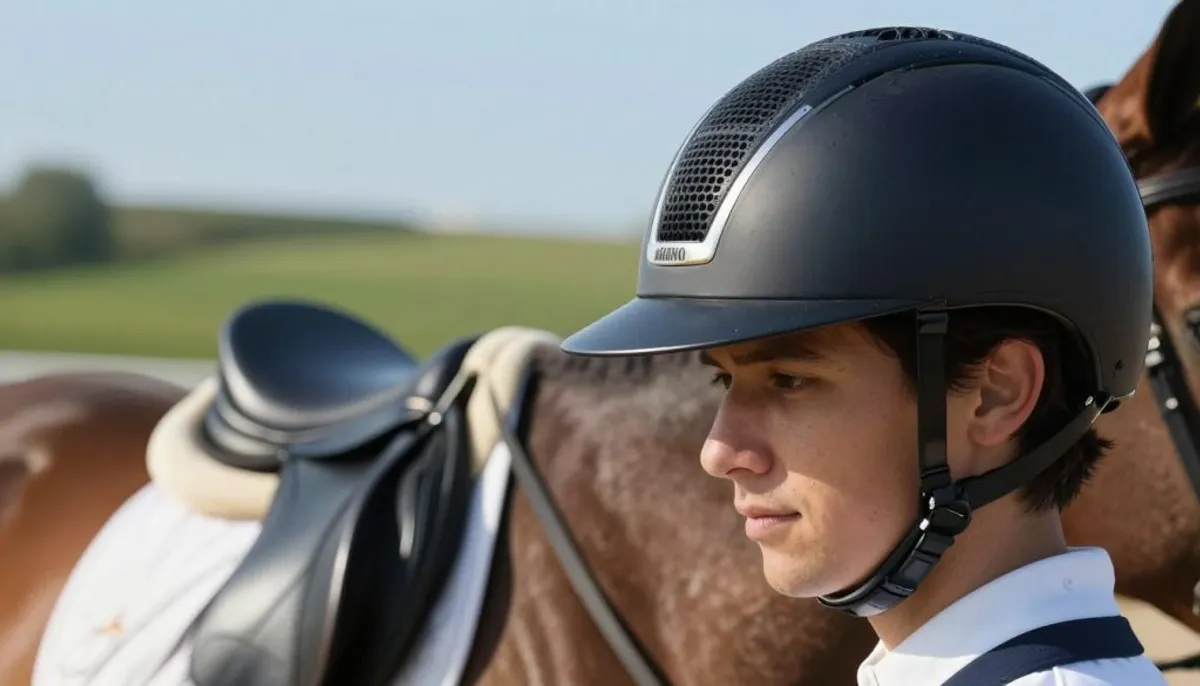
The good news is that safety now rhymes with comfort and style. Modern models offer better ventilation, are lighter, and provide precise adjustments. They are also visually appealing. Thus, a contemporary helmet is stable, comfortable, and practical for everyday use.
We will then examine the criteria for choosing a good helmet: safety standards, size, shape, comfort, ventilation, adjustability, style, brands, budget, and when to replace it after an impact. For those seeking exclusivity in France, La Sellerie Française offers high-end helmets, made in France by local artisans.
Key Takeaways
- The riding helmet is a pillar of rider safety, regardless of the level.
- A equestrian helmet must remain stable, well-fitted, and comfortable; otherwise, it will be worn less.
- Needs change depending on the activity: riding, arena, training, or competition.
- Safety standards and fit take precedence over style, even if both can coexist.
- Ventilation, weight, and interior are key points of modern equestrian equipment.
- After an impact, a riding helmet must be checked and often replaced.
Why the helmet is essential for rider safety
When riding, anything can happen very quickly. An unexpected obstacle or noise can change everything. Thus, wearing a helmet is not just a matter of level but of preparing for the unforeseen. It is as important as ensuring that your strap is securely fastened.
Choosing your riding equipment can seem complicated. You have to consider size, shape, comfort, and style. However, one thing is certain: the head must be the best protected. A suitable helmet can really reduce risks during a fall.
Horseback riding accidents can happen even to experts, without warning. A horse could stumble or be startled by something. At those moments, it is better to rely on a good helmet than on good luck.
The helmet is crucial among equestrian equipment. It is designed to minimize impacts and keep the head safe. A good helmet must stay in place, even when moving or getting up quickly.
Risks change depending on where you ride. On a trail, there are natural obstacles and surprises. In the arena, you must be cautious of other riders and their movements.
During training or competitions, the challenges are greater. Jumps, turns, and speed require more protection. The helmet is indispensable, especially in events like cross-country, which can be very risky.
| Situation | Common Risk | What the equestrian helmet provides |
|---|---|---|
| Outdoor ride | Uneven ground, branches, veering when a vehicle passes | Protection in case of a fall on hard ground, stable hold despite movements |
| Arena / riding school | Collision, loss of balance on a turn, fall at an obstacle | Shock absorption, consistent coverage of the cranial area |
| Intensive training | Fatigue, trajectory errors, higher pace | Comfort that helps keep it in place, enhanced rider safety over time |
| Eventing (cross-country) | Fixed obstacle, frontal or lateral impact, speed | Riding helmet suited to the constraints, reducing the effects of a violent impact |
Helmet standards in France: what to check before buying
Before choosing a helmet, take the time to check the label. In France, standards for riding helmets indicate whether the product is safe. It is a simple gesture that helps protect riders.
CE EN 1384 and VG1 01.040 2014-12 standards: what they serve
The CE EN 1384 and VG1 01.040 2014-12 standards ensure that the helmet provides adequate protection in case of an accident. They require precise testing: against impacts, penetration, and to verify that the helmet stays securely in place. For some helmets, there are also additional standards like ASTM F1163-15.
Make sure that the helmet or its manual mentions these standards. Without them, you cannot be sure of its protection.
Key certification requirements: rigid shell, inner shell, stability, and absorption
The criteria for the VG1 01.040 standard are often stricter than those for older helmets. They include a solid outer shell, an inner shell for better shock absorption, and improved stability. The goal is to reduce the risk of serious injury for the rider.
| Checked Point | What it means in daily use | What to look for before purchase |
|---|---|---|
| Impact absorption | Reduces the violence of the impact during a fall | Presence of a recognized standard (CE EN 1384 or VG1 01.040 2014-12) |
| Stability on the head | Prevents the helmet from rotating or slipping back at critical moments | Uniform adjustment, no “pressure point” on the forehead |
| Shell resistance | Protects against objects, hooves, or hard ground | Shell without cracks, clean finish, no deformation |
| Chin strap system | Keeps the helmet in place when moving | Neat straps, strong buckles, easy adjustment |
Attachment points and retention: 3, 4, or 5-point systems to limit helmet movement
A good helmet should not move. The 3, 4, or 5-point attachment systems help with this. It’s a small but important detail for safety and comfort.
Try this test: fasten the chin strap and move your head gently. If the helmet moves, it is not well-fitted, even if the standards are met.
Soft visor and prohibition of chin straps: understanding the evolution of rules
The rules have changed to reduce risks during an impact. Helmets must have a soft visor or no visor at all for certain sports. Chin straps are prohibited as they can cause injuries.
The important thing is to choose a helmet that meets the standards, fits well, and is designed to protect without causing other injuries. These three points are essential for safety.
How to choose a good helmet: size, shape, and perfect fit
Choosing a helmet starts with measuring and trying it on. It should stay in place, without being tight, and feel natural on the head. Finding the perfect size can depend on small details.
Measuring your head circumference correctly (above the eyebrows and ears)
Use a soft measuring tape to measure above the eyebrows and ears. Note the measurement, then compare it with the manufacturer's size guide. Each brand can vary, even for the same measurement.
Too big vs too small helmet: risks to protection and comfort
A helmet that is too big can move, which is problematic. In case of a fall, it offers less protection. On the other hand, a helmet that is too small can cause headaches.
Round or oval shape: adapting the equestrian helmet to the skull morphology
The shape of the helmet is as crucial as its size. There are round helmets and others that are oval. Find one that fits perfectly, without pressure or tilting back.
| Point to check | Good sign during fitting | Alert signal |
|---|---|---|
| Stability without chin strap | The helmet stays in place when shaking the head gently | It slides on the forehead or turns easily |
| Comfort on the forehead | Light and even pressure, without discomfort | Pressure point, quick pain, marked redness |
| Internal shape | Homogeneous contact on temples and occiput | “Empty” areas on one side, feeling of tilting |
| Adjustment range | Knob/pads that refine the fit on multiple notches | Adjustment at maximum from the start, too short a margin |
Chin strap: adjustments and checks to keep a helmet stable in the saddle
The helmet must fit well, even without the chin strap. However, it is essential when riding. Adjust it so that it is just under the chin, without being too tight. Make sure you can fit two fingers underneath it.
Some manufacturers offer size and adjustment options for more flexibility. This is especially useful if you are between two sizes or wear a bonnet. Keep the recommended size in mind, and confirm by looking at yourself and moving.
Riding helmet: comfort criteria not to overlook
A helmet that you don't feel once on horseback is ideal. During a long session, comfort is crucial, just like for boots or gloves. If you feel good, you think less about taking it off.
Weight and balance: avoiding fatigue and neck tension during long sessions
Weight is important, but balance is just as crucial. A well-balanced helmet reduces unnecessary movements and decreases tension in the neck. Lightweight models, like the Uvex Suxxeed Active, weigh less than 400 g, which is great for staying stable.
Try moving your head to test the balance. If the helmet tilts, your neck will feel it. A good adjustment of the chin strap is essential but should not correct a poor balance.
Padded interior: soft, hypoallergenic materials and even support
Comfortable padding is essential when it's hot. Choose soft foam to avoid pressure on the forehead and temples. People with sensitive skin should opt for hypoallergenic materials.
Some high-end models, like the Kask Kooki, also offer great freshness. This is particularly appreciated during competitions.
Liners and foams: the benefit of removable, washable, and sometimes interchangeable elements
Washable liners are great for hygiene, especially in hot weather or if you ride often. Being able to wash the lining keeps the helmet fresh and odor-free. If the liners cannot be removed, a disinfectant spray for helmets is a good solution.
Adjustable foams are convenient for a perfect fit. They are ideal if your head size changes or for a custom adjustment. This avoids tightening too much.
| Criterion to check | What you should feel | What to monitor during use | Concrete example |
|---|---|---|---|
| Weight + balance | Stable helmet, without tilting forward | Less fatigue and neck tension during long sessions | Uvex Suxxeed Active: lightweight approach (often mentioned under 400 g depending on versions) |
| Padded interior | Even pressure, no hard point on the forehead | Fewer irritations, better tolerance to perspiration | Kask Kooki: interior focused on comfort and soft feel |
| Washable liners | Easy to remove and replace lining | Simpler hygiene, limited odors, lasting comfort | Removable liners: regular washing + air drying |
| Interchangeable foams | Finer adjustment without tightening the chin strap | Better retention over time, adapting to needs | Set of foams of different thicknesses according to ranges |
Helmet ventilation: breathability, heat management, and perspiration
When it’s hot, a well-ventilated helmet makes riding more enjoyable. Air circulates, reducing heat and perspiration. This is essential for comfort during long rides.
Ventilation is also crucial in winter when you warm up quickly. A good airflow prevents moisture from lingering, making the inside of the helmet more comfortable. This helps us stay focused without having to constantly remove our helmet.
Why ventilation makes a difference
On a ride, especially at a walk and trot under the sun, good ventilation is appreciated. The effect is even more pronounced in jumping or dressage, during intense efforts. A well-ventilated helmet prevents feelings of suffocation and overheating.
A less humid helmet stays in place and requires less adjustment of the chin strap. This may seem like a detail, but it greatly improves long-term comfort.
Air inlets and outlets: what really works
The best helmets have a good separation between air inlets and outlets. Air enters from the front or sides, circulates inside, and then exits from the back. This structure prevents overheating without causing uncomfortable drafts.
Some helmets offer discreet ventilation, protecting against bad weather. The Kask Kooki, for example, subtly integrates ventilation without compromising style or protection.
Examples of designs that promote breathability
The Uvex Suxxeed Active is recognized for its good airflow. It limits perspiration, even during intense efforts. The technical choices of a ventilated helmet make a difference from the first use.
Other brands, like the Kep Cromo 2.0 and its “Air Control System,” rely on grids and air adjustments. These elements improve ventilation while maintaining a harmonious appearance. The goal remains the same: more comfort without adding weight to the helmet.
| Design | What you feel in the saddle | What to pay attention to |
|---|---|---|
| Internal air channels + rear outlets | Heat better evacuated, helmet more “dry” despite perspiration | Check that the openings do not create pressure points |
| Two lateral ventilation zones (e.g., Uvex Suxxeed Active) | Ventilation of the riding helmet regular, pleasant during sustained effort | Test with your hairstyle (bun, net) to maintain good circulation |
| Grids and flow control (e.g., Kep Cromo 2.0) | More stable breathability, less “enclosed” head feeling | Maintain the grids to avoid dust and obstruction |
| Very classic velvet helmets | Traditional look, but ventilated helmet sometimes more limited | To anticipate according to the season and intensity, to preserve comfort of the riding helmet |
Adjustable helmets: knobs, pads, and evolving systems for secure retention
The details of an adjustable helmet make a big difference when riding. With a good fit, the helmet remains stable, regardless of the pace. This helps in addition to the chin strap and attachment points that limit movement.
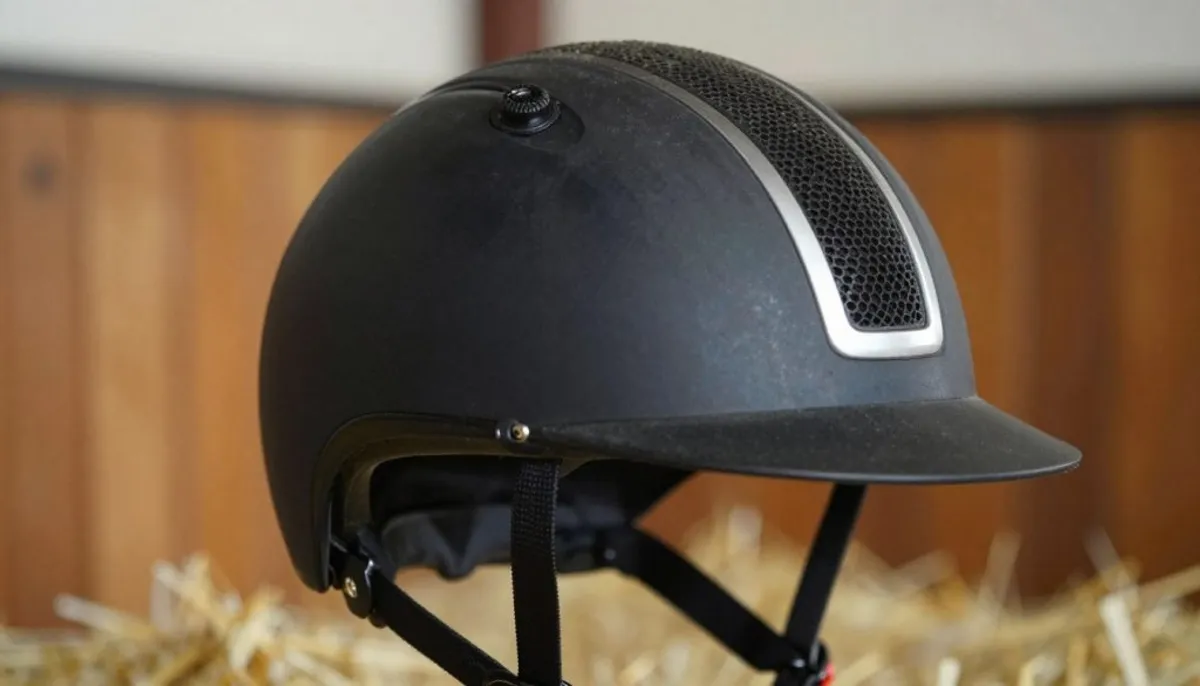
Rear knob adjustment: quick, precise, and practical
The rear knob quickly adjusts the helmet, even when wearing gloves. It’s perfect for beginners looking for a simple adjustment. The “100” helmet from Decathlon uses this knob for more comfort from the start.
Pads and fine adjustments: adjusting the helmet to the millimeter according to brands
Some helmets come with pads for precise adjustment. They fill the space without tightening, at the forehead or on the sides. Antarès provides a set of pads for perfect and lasting support.
Memory foam liners and multiple sizes: an evolving solution, especially for young riders
A memory foam liner adapts better to the head. The Samshield XJ has a breathable, removable, and washable liner. It is available in several sizes. Samshield offers two types of liner: closed for better stability and open for more ventilation.
| Adjustment system | What it serves | What you feel | Examples of brands/models | Point of caution |
|---|---|---|---|---|
| rear knob | Quickly and precisely adjust the head circumference | Clear adjustment, easy to redo before mounting | Decathlon “100” | Do not compensate for a poor size by tightening too much |
| pads | Refine the fit by zones (forehead, sides, nape) | More even pressure, fewer pressure points | Antarès (pad set) | Check that the helmet remains stable when shaking the head gently |
| memory foam liner | Molds to the shape and improves comfort | More “settled” contact, better retention over time | Samshield XJ | Maintain and replace if the liner compresses or deforms |
| Multi-size liners | Adapt the same helmet to various shapes and changes | More personalized feel, useful for young riders | Samshield XJ (multiple sizes, open/closed versions) | Choose the right combination of shell + liner, without play at the back |
Beginner helmets and children's helmets: safety, lightness, and ease of use
When starting horseback riding, you want to be comfortable and do things simply. A good helmet should be easy to put on, without squeezing, and stay securely in place, regardless of the pace. This is essential for developing good reflexes while staying safe.
Choosing an adjustable helmet is practical. You need to adjust it, fasten the chin strap, and ensure it doesn’t move. A small head movement is enough to test it. This avoids problems once in the saddle.
Starting calmly: opt for a comfortable and easy-to-adjust helmet
Leisure helmets, like the Casco Choice or Choplin Meyrik, provide good support while being lightweight. It is important that they do not tilt or squeeze too much. The chin strap should be adjusted without causing discomfort.
- Find the right size and check comfort around the head.
- Adjust the knob for a good fit without discomfort.
- The chin strap should stay in place without moving.
Children vs adults: similar standards but with lighter models for children
Children's helmets must meet the same safety standards as those for adults. A lightweight model is preferable for children. It allows them to wear it better and get tired less quickly. Models like the Riding World child Hepi or the Casco child Nori are appreciated for their ease of use.
Points of caution: pay attention to growth, frequent use, and stability
Children's heads grow quickly. It is good to have adjustable pads. For frequent use, a washable interior and good ventilation are important, especially in summer.
Stability is key. If the helmet moves, it protects less effectively. With an adjustable model, the helmet should fit well, even after several rounds.
| Model | Audience | Indicative price | Useful points for daily use |
|---|---|---|---|
| Casco Choice | Adult / teen | €95.00 | Simple adjustment, stable hold, good choice for beginner riding helmet |
| Choplin Meyrik | Adult | €79.90 | Accessible comfort, quick handling, good compromise for regular outings |
| Riding World child Hepi | Child | €49.90 | Soft budget, club use, easy adjustments for children's riding helmet |
| Casco child Nori | Child | €89.90 | Careful support, lasting comfort, good choice if the child rides often |
Style and aesthetics: reconciling elegant equestrian helmet and protection
The equestrian helmet is now both protective and a beautiful accessory. It is designed to combine style without hindering vision or comfort. The goal is to feel good and stay focused while riding.
Finishes and coatings: matte, shiny, velvet, alcantara, polycarbonate
Matte helmets are sober and modern. Shiny ones attract light. Some add velvet or alcantara for a more luxurious look.
The polycarbonate shell is popular for its resistance. Details like rhinestones add character. To remain chic, opt for simple finishes.
Customization: colors, details, grids, visors, and configurable elements according to ranges
Customizing a helmet goes beyond choosing a color. On the Kep Cromo 2.0, you can even change the shell or visor. There is also an app for safety in case of an accident.
At Kask, the Dogma and Starlady ranges offer options via a configurator. Antarès provides a careful selection of materials and visors. You will thus obtain a helmet in harmony with your equipment.
| Brand / model | Customization options | What it changes in style |
|---|---|---|
| Kep Cromo 2.0 | Shell, frontal area, visor, harness, grids, grid button, logo, liner | Highly modular look, from sober to more pronounced, with matte and shiny finishes easy to harmonize |
| Kask Dogma / Starlady | Shell, grid contours, logo, air vent, chin strap, size | Elegant and balanced rendering, ideal if looking for a revisited classic style |
| Antarès | Shell, leather, topstitching, headband, strap, choice of visors | Very visible “saddle” signature, perfect for a refined and personalized ensemble |
Golden rule: never sacrifice rider safety for looks
Style comes after safety. Ensure that the helmet does not move and is comfortable. Fit and safety are the priority, before customization and styles.
Equestrian helmet brands: benchmarks for comparing models on the market
Choosing a equestrian helmet depends on how you use it, the shape of your head, and the desired quality. The differences between a standard helmet and a more luxurious model are evident in comfort, ventilation, and available options.
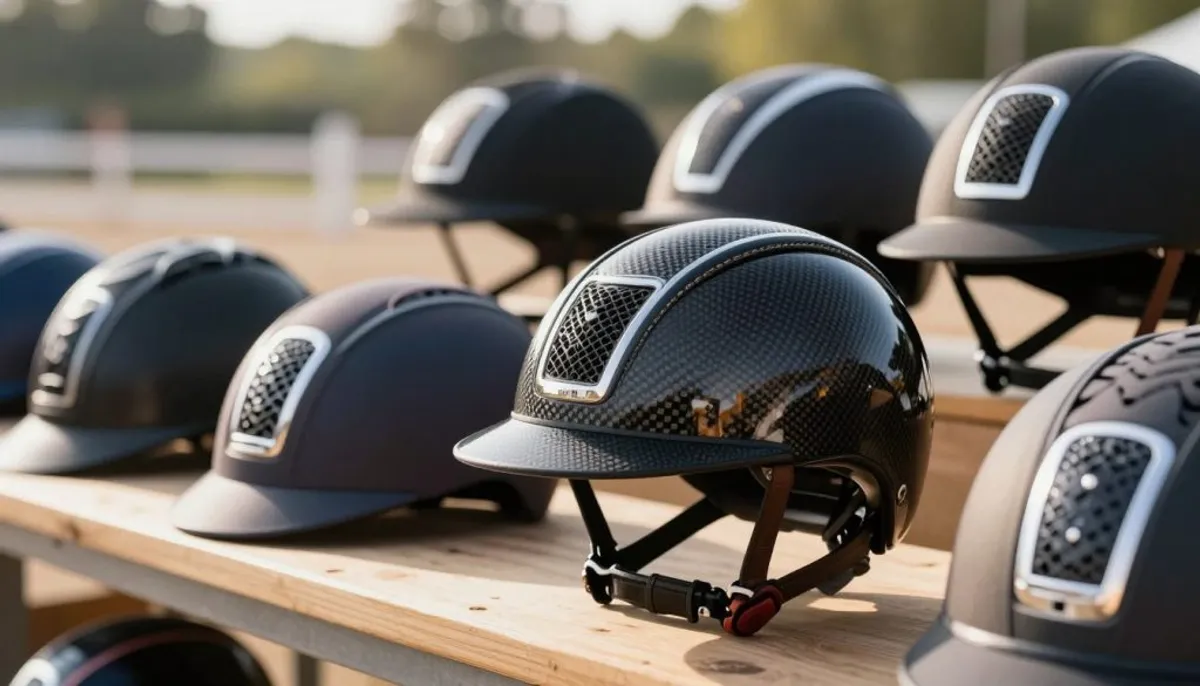
Standard helmets
Standard helmets are easy to find, both in stores and online, without having to wait long. They offer a modern look and are technical enough for training, arena, or rides.
The Uvex Suxxeed Active has a polycarbonate shell, good shock absorption, and a knob for easy adjustment. It can weigh less than 400 g. Its interior can be washed and is designed to be comfortable, even with a bun.
Focus on common features
Focus on weight, comfort of the foam, and ventilation. A removable and washable interior is practical for staying clean, especially in summer or if worn a lot.
The HKM Carbon Professional has a lining that can be removed, washed, or changed, several sizes available, and a knob for precise adjustment. The Kask Kooki combines polycarbonate and injected inner shell for optimal comfort and has a ventilation system suitable for climate changes.
Customizable helmets
A customizable helmet allows you to choose your look and adapt it to your needs. With accessories like configurators, grids, or interchangeable visors, you can change your style while keeping an effective helmet.
The Kep Cromo 2.0 offers many customization options, including for ventilation. The Kask Dogma and Starlady models are appreciated for their configurator and good shock absorption. Antarès offers, with its models like the Référence, Galaxy, and Premium, included pads and adjustable visors for tailored comfort.
After-sales service and revision
After-sales service is as important as price. An impact on a helmet may not be visible. Some manufacturers check the condition of helmets in their workshops after an accident.
Samshield offers the possibility to send the helmet for inspection and ensure it is still safe. Before buying, it is advisable to check if you can easily find spare parts, such as liners or foams.
| Model / brand | Type | Strengths | To check before purchase |
|---|---|---|---|
| Uvex Suxxeed Active | standard equestrian helmet | Announced weight < 400 g, adjustment knob, washable interior, ventilation with lateral zones, rear cutout for bun | Compatibility with your head shape, chin strap stability, liner maintenance |
| HKM Carbon Professional | standard equestrian helmet | Ventilation through openings, removable washable/changeable lining, 3 shell sizes, precise adjustment via knob | Choice of shell size, availability of replacement linings |
| Kask Kooki | standard equestrian helmet | Polycarbonate shell + injected interior, breathable antibacterial padding, separate air inlets/outlets | Exact configuration (inner foam sometimes needs to be purchased separately), feel of the visor depending on use |
| Kep Cromo 2.0 | customizable helmet | Advanced customization of elements, grid options, ventilation system, configuration via app | Delays and chosen options, maintenance of removable parts, budget for additional elements |
| Kask Dogma / Starlady | customizable helmet | Configurator, discreet ventilation, multi-layer internal structure, weight around 500 g depending on range | Balance on the nape, compatibility with bun, availability of parts |
| Antarès Référence / Galaxy / Premium | customizable helmet | Included pad sets, soft visors, certifications indicated with CE marking and SEI certification depending on models | Choice of pads, fine adjustment, checking the standard displayed on the helmet |
| Samshield (workshop service) | equestrian helmet after-sales service | Possibility to return after a fall or impact for diagnosis, approach focused on safety control | Return procedure, delays, conditions after impact |
Price, materials, and durability: understanding the gaps and maintaining your equestrian helmet
The prices of riding helmets vary greatly, even for models with similar standards. This difference often comes from the quality of assembly, comfort, and materials used. These aspects affect the helmet's sturdiness and longevity.
Why prices vary
The quality of manufacturing greatly influences the price. This includes quality control, finishes, and gadgets like the visor. A cheaper helmet may be compliant and functional, but it risks degrading faster if poorly stored or treated carelessly.
High-end products often include manual labor and more attentive monitoring. In France, this quality of manufacturing is highly sought after to ensure durability across seasons. Prestige brands, such as La Sellerie Française, offer this level of quality.
Entry-level, mid-range, high-end: useful benchmarks
Prices vary according to finishes, ventilation, and the quality of internal foams. Here are some price ranges to help you.
| Range | Price benchmark for riding helmet | What you most often get | Points to watch |
|---|---|---|---|
| Entry-level | About €50 | Helmet meeting standards, simple adjustment, leisure use | Faster wear of foams, finishes sensitive to shocks and scratches |
| Mid-range | About €120–200 | Better comfort, more effective ventilation, often removable liners | Check the fit well: a “almost good” helmet moves in the saddle |
| High-end | About €300–800 | Advanced finishes, strict quality control, premium options, sometimes made in France | Choose according to your actual practice, not just the look |
Technical materials: gaining in strength and lightness
The materials used often affect the price. For example, carbon kevlar offers lightness and strength. This is useful for long sessions or in eventing, where protection without unnecessary weight is essential.
A good example is the Samshield XJ, made of carbon fiber. Its interior is designed to absorb shocks effectively. This technology costs more but ensures better durability and performance over time.
When to replace your helmet
You need to change your helmet after an impact or fall, even if the exterior seems intact. Heat, UV rays, and humidity can also damage the helmet without visible signs.
A removable liner makes maintenance easier: just wash it and let it dry. If the liner is not removable, cleaning with a special sports disinfectant is recommended. These care tips help keep the helmet in good condition and avoid repeated expenses.
Conclusion
Choosing a riding helmet requires following a precise method, not making a random choice. You should start by checking the helmet standards. These standards, such as CE EN 1384 or VG1 01.040 2014-12, must be indicated on the label.
It is important to find a helmet that fits your size. The shape of the helmet must also match the shape of your head for a perfect fit.
Safety while riding depends a lot on the proper fit of the helmet. The chin strap must be well adjusted. The attachment points must prevent the helmet from moving on your head. If the helmet slips when you shake your head, it is not suitable for riding.
Comfort is crucial for wearing the helmet. A properly distributed weight, a soft interior, and hypoallergenic materials make wearing it more pleasant. Washable liners and good ventilation are essential for staying focused in the saddle. Style is less of a priority than safety.
In case of a fall, the helmet must be replaced, even if it seems intact. Pay attention to the foam and avoid exposing the helmet to direct sunlight. It should not be left in a hot car or out in the rain either. For those looking for quality helmets in France, La Sellerie Française offers high-end models. You will find unique pieces, made to measure or in limited editions, created by talented French artisans.
FAQ
Why is the riding helmet considered the most important equipment?
It protects the head during a fall or accident. This is true on a ride, in the arena, during training, or in competition. Horseback riding sometimes holds surprises. No one is immune, even experienced riders. Therefore, the helmet is essential for safety.
Is the helmet really essential even for a simple horseback ride?
Absolutely. Risks change, but the helmet is always necessary. Outdoors, an unexpected obstacle can cause a fall. Safety does not depend on the level of experience but on the context.
What riding helmet standards should be checked in France before buying?
A good helmet must meet safety standards, such as CE EN 1384 or VG1 01.040 2014-12. These standards guarantee quality benchmarks. Always check the compliance label before purchasing.
What do the CE EN 1384 and VG1 01.040 2014-12 standards actually test?
These standards check how a helmet withstands impacts. They ensure that it remains stable and can protect during a fall. A certified helmet reduces the risk of injuries.
What are the common requirements for VG1 certification?
VG1 requires a solid construction with a rigid shell and inner shell. It also aims to enhance protection against impacts. This helps in choosing a safe helmet.
What do the 3, 4, or 5-point attachment systems on an equestrian helmet do?
These systems help to better secure the helmet. They keep it in place during movements. A precise adjustment improves safety.
Why are we talking about soft visors and the prohibition of chin straps?
The rules are evolving to limit risks. Visors must be soft, and chin straps are prohibited. This helps prevent injuries.
Can a helmet display other standards in addition to CE EN 1384 or VG1?
Yes. Some models mention other standards like ASTM F1163-15. The important thing is to comply with a recognized standard and have a perfect fit.
How do you measure your head circumference to choose the right riding helmet size?
Use a measuring tape around your head, above the eyebrows and ears. Note the measurement in cm and follow the manufacturer's size guide. Sizes vary by brand.
What are the risks of a helmet that is too big or too small?
A helmet that is too big can move and reduce protection. A helmet that is too small can cause discomfort and headaches. The risk of injury increases in both cases.
How to properly test the fit when trying it on?
Ensure that the helmet is not too tight but also does not move. It should stay in place, especially with the chin strap attached. If the helmet shifts, the size is not right.
What is the importance of the shape (round or oval) in a riding helmet?
The shape is crucial. A poorly fitting helmet can move or cause pain. Choose according to the shape of your head for optimal comfort.
How to properly adjust the chin strap for secure retention?
Adjust the chin strap so that it is comfortable without compressing. A good adjustment prevents the helmet from tilting. Everything must be well-fitted for maximum safety.
Why is comfort a decisive criterion for choosing a good helmet?
A comfortable helmet is easier to wear regularly. It can reduce fatigue and irritations. “I always wear it” becomes easy with a pleasant helmet.
What weight should you aim for to limit fatigue and neck tension?
Aim for a lightweight helmet, around 400 g, to reduce fatigue and tension. Even though weight is not the only criterion, it is important.
What interior details should be prioritized for comfort and skin?
Look for soft and breathable padding. Materials like those of the Kask Kooki limit irritations. A good fit eliminates pressure points.
Why are removable liners and foams so practical?
They facilitate maintenance and increase the helmet's lifespan. If the foams are not removable, suitable disinfectants exist.
What is a ventilation helmet and how to recognize effective ventilation?
Good ventilation reduces perspiration and heat. Look for well-designed air inlets and outlets. This makes wearing the helmet more pleasant in summer.
Do you have concrete examples of well-ventilated helmets?
The Uvex Suxxeed Active offers excellent ventilation. The Kep Cromo 2.0 and Kask Kooki are also good. They ensure good airflow.
Do very classic helmets (like velvet) ventilate less?
Some classic models may ventilate less. Breathability is essential if you ride often or in hot weather.
How is an adjustable helmet with a rear knob useful?
The knob allows for quick and precise adjustment. It’s practical and reassuring, especially for beginners. A good adjustment makes the helmet more protective.
What do pads (shims) and fine adjustments serve?
They provide a precise fit. Antarès provides a set of pads for a custom fit. This improves retention and comfort.
Are memory foam liners useful or just marketing?
They are useful if well-fitted. The Samshield XJ offers a memory foam liner. This allows for a personalized fit.
What helmet would you recommend for starting horseback riding?
Choose a simple and adjustable model, with a rear knob. Safety, size, and a good fit are crucial.
Do children's and adult helmets follow the same safety standards?
Yes, but for children, a lightweight helmet is more comfortable. Stability remains essential at any age.
What specific points of caution for children (growth and use)?
Growth requires adjustments. Opt for evolving helmets. If the use is frequent, also choose a ventilated and comfortable helmet.
What price benchmarks exist for beginner and children's helmets?
There are accessible options like the Riding World child Hepi at €49.90. Always check the standards and fit.
What finishes and materials can be found on a modern riding helmet?
You will find velvet, alcantara, and other materials. Modern helmets combine aesthetics and safety.
Which helmets offer advanced customization?
The Kep Cromo 2.0 and Kask Dogma are highly customizable. Antarès also offers many options. Safety remains central, even with customization.
Can you choose a helmet for its look above all?
Safety should always come before style. Ensure that the standards and fit are correct before thinking about design.
Which equestrian helmet brands can be mentioned to compare “standard” models?
Uvex, HKM, and Kask offer options with good design and advanced technicality. For example, the HKM Carbon Professional focuses on good ventilation and optimal comfort.
What characteristics to look for when comparing two helmets at the same price?
Compare the standard, stability, and comfort. Check for the presence of a washable liner and the effectiveness of ventilation.
What is the value of a high-end helmet in terms of certifications and finish?
Luxury helmets focus on the quality of materials and assembly. Some Antarès models offer excellent certifications and superior comfort.
Is there an after-sales service or revision after a fall for an equestrian helmet?
Yes. After an impact, some brands, like Samshield, offer a diagnosis. However, it is often recommended to replace the helmet.
Why do the prices of riding helmets vary so much?
Differences come from the quality of manufacturing and materials. Even with a tight budget, never sacrifice safety.
What budget benchmarks exist for a riding helmet?
Prices range from €50 for entry-level to €300-800 for high-end. Quality often reflects in the price.
Do technical materials like carbon or kevlar really change the game?
Yes, they can make the helmet lighter and more resistant. Some models are specifically designed for intensive use.
When should you replace your helmet after a fall?
Replace your helmet after a significant impact to stay protected. Internal damage may not be visible.
Can wear, heat, and UV rays degrade a helmet without impact?
Yes, these elements can weaken materials. Regular maintenance, such as replacing worn foams, prolongs the life of the helmet.
How to maintain the hygiene of a riding helmet daily?
A removable liner is ideal. Otherwise, use suitable disinfectants and let it dry away from heat sources for better hygiene.
Where to find premium equestrian equipment made from A to Z in France?
La Sellerie Française (https://laselleriefrancaise.com) offers high-end equipment, made by French artisans. It’s perfect for those seeking quality and durability.