
Choosing a good riding pad can truly transform a riding session. It’s not just a decorative item. It protects the horse's back, ensures better stability, and improves teamwork between the rider and their horse. With the right pad, you feel the difference right from the start.
The pad is placed between the saddle and the horse's back. It is crucial, according to Ecogold. It impacts support, comfort, and safety. A well-fitted pad reduces the risks of slipping and discomfort for both the horse and the rider.
We will explore how to choose a pad according to the discipline practiced. It is important to think about reducing pressure and friction. It is also essential to choose a pad that dries quickly and allows the skin to breathe. You will discover the essential materials and customization options that reflect the rider's style on a daily basis.
If you are looking for the best in France, La Sellerie Française is a must. They offer unique luxury pieces, made to measure or in limited editions. Everything is made in France by carefully selected artisans. The quality goes far beyond a simple logo.
Key Points
- The riding pad is a piece of comfort and safety, not just an accessory.
- The saddle pad influences stability and contact with the saddle.
- A good choice enhances horse comfort and limits the risk of irritation.
- Each discipline imposes specific needs in cut, support, and breathability.
- The selection of materials affects moisture, hold, and durability.
- In France, La Sellerie Française offers a premium, artisanal approach, 100% made in France.
Why the saddle pad is essential for the comfort of the horse and rider
The saddle pad creates an important link between the leather and the skin. It absorbs moisture, reduces friction, and keeps the saddle in place on the back.
This simple layer is crucial. It aids in both the protection of the horse and the rider's feel. With better contact, the commands are clearer, without interference.
At Ecogold, we know that the pad is essential for comfort during exertion. It prevents discomfort due to sweat during long training sessions.
A direct link between you, the saddle, and the horse's back
A good pad balances pressure and reduces tension points. It ensures a stable seat, which is important during trot and gallop.
The horse feels freer. The rider perceives their saddle as more fixed. This harmony enhances performance without forcing the saddle readjustment.
Rider position stability and more effective communication
Without folds or slipping, the rider maintains their position. A well-designed pad offers safety and allows for better communication with the horse.
You gain precision and fluidity. The stability of the saddle is no longer a concern but an asset.
An investment as important as the saddle
Choosing the saddle is crucial, but the saddle pad is just as important. A good pad protects the equipment and the horse's skin in the long run.
Models like those from Ecogold optimize protection, thermal regulation, and support. They ensure the horse's well-being, essential for performance.
| Point to check | What you observe while riding | Desired effect |
|---|---|---|
| Cut and clearance of the withers | The pad remains clear, does not "pull" forward | Comfort for the horse's back and breathing in the sensitive area |
| Hold and contact surface | Less slipping at mounting and dismounting | More consistent saddle stability, clearer aids |
| Moisture management | Less soaked back, faster drying after exertion | Protection for the saddle and horse's skin less irritated |
| Pressure distribution | More regular sweat marks, fewer dry areas | Better training tolerance and more stable equestrian performance |
Riding pad: how to choose the right model according to your practice
Choosing a riding pad is about thinking of its work first. The type of riding determines the shape, thickness, and material of the pad. The goal? To protect the horse's back, absorb moisture, and ensure good hold under the saddle.
Start with the idea discipline → constraint → need for a clear selection. This saves you from buying pretty but impractical items, especially during intense training.
| Practice | What matters most | What you look for in the pad | Details to check in the tack shop |
|---|---|---|---|
| Jumping | Stability on landing, control of slipping | anti-slip jumping pad, stable contact area, good heat dissipation | Surface that grips without “sticking”, channel that clears the withers, flat seams |
| Dressage | Shoulder freedom, consistency of placement | dressing pad with a long cut, balance under the saddle, constant saddle support | Cut suitable for the flaps, good clearance of the withers, breathable fabric |
| Western / trail riding | Long-lasting comfort, cushioning, and sweat management | western pad designed for endurance, pressure distribution, proper drying | Thickness consistent with the tree, hold of the pad at a long walk, reinforced areas |
Jumping: priority on anti-slip and stability
In jumping, the pad must stay in place under the saddle, even in action. An anti-slip pad prevents movement. This is crucial, especially for wide or very active horses. The feel of the fabric is also important: avoid overly smooth materials.
For this, choose pads specifically designed for safety. Ecogold offers the Secure pad, known for being anti-slip and comfortable. It helps keep the saddle secure, perfect for those seeking increased stability while jumping.
Dressage: shoulder freedom, suitable cut, and support
In dressage, the length of the pad is essential. A pad that is too short can ride up and hinder movement. Opt for a long model that follows movements well and stays in place.
Ecogold Canada offers technical dressage pads, like the Calmatech range. These products ensure good pad hold and comfort under the saddle while leaving space for the withers.
Western and trail riding: long-lasting comfort and cushioning
On long rides, look for a pad that offers good cushioning and effective heat management. A good western pad is suitable for various activities, from training to competition or even trail riding. It should provide maximum comfort for the horse.
To choose well, think about the use: how long, on what terrain, and how often. FG Pro Shop offers high-quality pads from major manufacturers. A good riding pad makes training more enjoyable and protects the horse's back.
Saddle protection: avoiding friction, pressure points, and slipping
A good pad does much more than simply beautify. It protects the horse's back, improves contact, and ensures a smooth ride. With an appropriate pad, the horse is more comfortable, and the rider remains stable, without constant adjustments.
Signs alert us on the ground: ruffled hair, hot spots, and uneven sweating. They often indicate the need to adjust the equipment or find a better-fitting pad.
Reducing pressure zones and preventing irritations
Pressure zones form when weight concentrates on a small surface. This can be due to an unevenly thick pad, uncomfortable seams, or poor-quality padding. These zones can irritate over time, especially behind the shoulder and along the withers.
We seek equal tension, soft edges, and a shape that complements the back. The goal is to distribute pressure, allow the muscle to move, and reduce friction.
Keeping the saddle in place for safer practice
Saddle slipping is a safety issue. It alters the rider's posture and makes the seat unstable. Special pads improve grip without compromising comfort.
With a good pad, the rider's movements are more precise. This offers better control, whether in jumping or on a difficult horse.
The importance of a breathable pad for the back
A breathable pad helps regulate heat and moisture better. Sweat accumulation can damage the skin, even under a well-fitted saddle. A ventilated textile keeps the horse dry more effectively.
To better understand, let’s compare types of pads:
| Observed criterion | Breathable pad | Less breathable pad |
|---|---|---|
| Moisture management | Faster evacuation, more uniform wet areas | Sweat accumulation, irregular marks under the saddle |
| Comfort at the back | “Free” back sensation, fabric that remains more stable | Fabric that sticks, more frequent friction |
| Risk of pressure points | Less excess related to moisture, more consistent support | Folds and heavy areas that reinforce pressure points |
| Effect on safety while riding | Better hold felt when the pad stays dry and in place | Facilitated slipping when the fabric becomes heavy and deforms |
Secure™ anti-slip pad: stability, breathability, and quick drying
A Secure™ anti-slip pad from Ecogold changes everything during jumping. It promises clear stability without making the whole thing heavy. It helps maintain clear contact and improve performance by increasing the pace.
Ergonomic design with ultra-thin flaps for better positioning
Thanks to its ergonomic cut and thin flaps, it avoids thickness under the legs. This allows for a more natural and stable position. This feeling of stability facilitates precise action without effort.
During training, the Secure™ Ecogold prevents slipping. The saddle stays well in place, enhancing the safety and performance of the duo.
Breathable and hypoallergenic anti-slip textile, without neoprene
The anti-slip textile is designed to be gripping and flexible. It is breathable and hypoallergenic, without neoprene, to avoid overheating the horse's back. The goal is to provide good hold without irritating the skin.
Breathability is crucial during intense exercises. A breathable pad ensures a comfortable back and keeps the saddle stable without making it rigid.
Hexagonal structure type “rays” to keep the textile away from the skin and dry faster
The hexagonal structure creates space between the textile and the skin. This improves air circulation and speeds up drying. The horse dries faster, even after intense effort.
This design also aims for great durability. Ecogold pads are ethically made in Montreal. They combine performance and comfort for daily use.
| Key point | What it brings to the horse | What it changes for the rider |
|---|---|---|
| Adhesion of the anti-slip pad | Less slipping and friction related to saddle movements | More consistent stability, calmer aids in approach |
| Ultra-thin flaps | Less thickness under the saddle, clearer contact | Leg closer, more stable and readable position |
| Breathability of the textile | Moisture management and a “lighter” back sensation | More available horse, better consistency in performance |
| “Ray” structure | Air circulation, quick drying after effort | Fewer breaks related to moisture, smoother session |
| Secure™ Ecogold, designed and manufactured in Montreal | Finish designed for intensive use and back comfort | Reliable material in work, consistency and stability over time |
The saddle cushion and cushioning solutions: when and why to use them
A saddle cushion perfectly complements a good pad. It is ideal for improving contact and protecting the horse's back. This involves adding comfort where the saddle and pad are insufficient.
We think of it especially in cases of intensive work. This includes frequent sessions, a horse changing musculature, or a sensitive back. This is common, whether in a club or a private stable. Good equipment makes the horse more comfortable and the session smoother.
Stability is essential. If the saddle moves, the pressure on the horse's back increases. A quality cushion allows for better distribution of this pressure. This is crucial during prolonged exercises or if the horse has a particular back.
Cushioning should not be exaggerated. Too much thickness disrupts balance. The goal is to provide precise support without hindering movement. Thus, the position remains stable, and the horse moves freely.
| Situation | What you are looking for | Expected effect on the horse's comfort | Point of vigilance |
|---|---|---|---|
| Intensive work (multiple sessions per week) | More consistent cushioning under the saddle | Less back fatigue, better tolerance to effort | Monitor warming up and moisture if the material breathes little |
| Sensitive or recovering horse (reactive back) | Support distribution, softer support | More comfortable contact, less resistance to girthing | Check saddle fit: a cushion does not correct an ill-fitting saddle |
| Horse evolving (muscle building, weight loss or gain) | Stability and adaptation during the transition | More homogeneous pressures over the weeks | Reassess regularly, especially at the withers and behind the shoulder |
| Rider sitting for long periods (dressage, outdoors) | Cushioning targeted and saddle hold | Fewer sensitive areas after the ride | Avoid stacking a pad + cushion that is too thick |
The trick is to think “pad + cushion” as a unique set. You need to look for a combination that works well together. This ensures stability and comfort for the horse, without compromise.
The materials that make a difference: technical cotton, mesh, sheepskin pads
The material of a saddle pad is very important. It affects comfort, positioning under the saddle, and how it feels on the back. Choosing the right material can reduce the sensation of heat and humidity after exertion.
Choosing between technical cotton, mesh, or softer materials has a clear purpose. We want to keep the horse dry, limit friction, and ensure good ventilation. Technical materials are truly useful here.
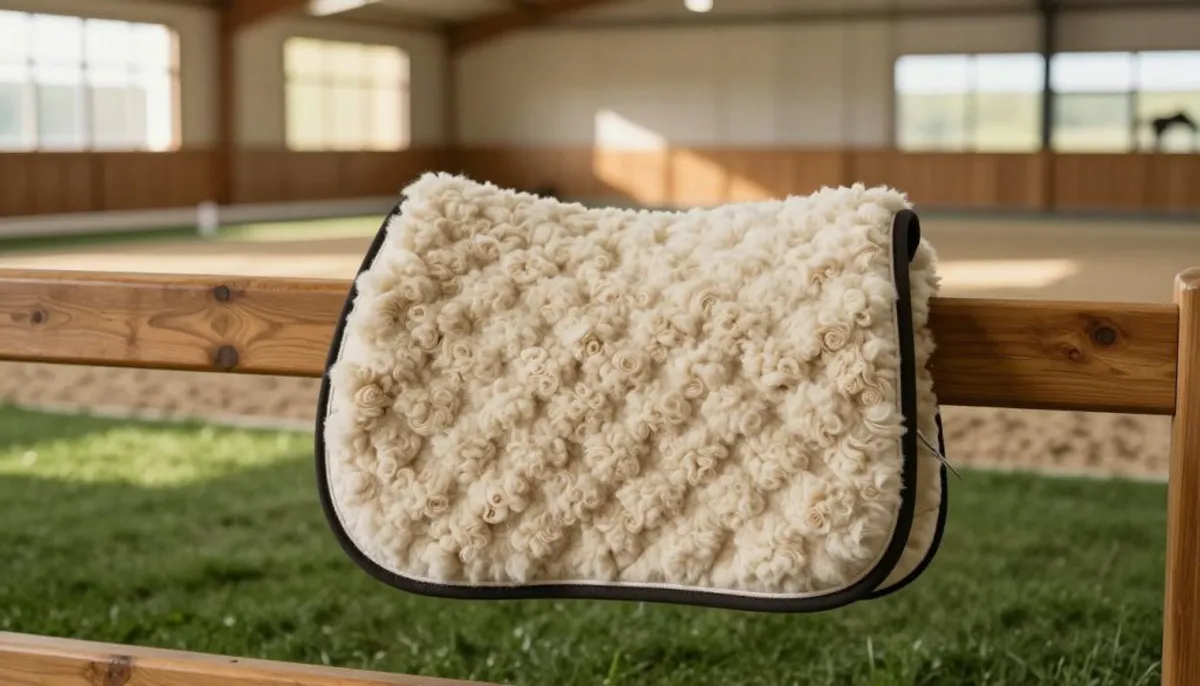
Sheepskin pad: comfort, softness, and friction management
The sheepskin pad is known for its softness. It creates a natural cushion that protects against friction, ideal for sensitive skin. It offers superior stability and flexibility with regular use.
Regular maintenance is necessary for it to remain effective. A clean sheepskin retains its softness and continues to protect. It can also provide welcome warmth depending on the season, but care must be taken during intense training.
Technical materials: breathability, moisture wicking, and durability
Technical materials aim for better ventilation and sweat elimination. They may include special structures that create air spaces, keeping the fabric away from the skin. This speeds up drying and reduces the feeling of stickiness.
Some brands like Ecogold offer hypoallergenic and neoprene-free fabrics that remain anti-slip. This is interesting for sensitive horses or for maintaining good hold with a soft touch.
Criteria to compare: thickness, density, maintenance, and season
| Criterion | What it changes on the back | Simple marker to check |
|---|---|---|
| Thickness | More cushioning, but can affect saddle balance if too thick | The pad should remain flat once in place, without folds under the flaps |
| Density | Offers better pressure distribution and lasts longer | Should return to its original shape after being compressed, without sagging |
| Breathability | Less moisture, for a more comfortable back during and after exercise | Look for a breathable lining (mesh or hexagonal structure) and quick-drying areas |
| Maintenance | Important for hygiene, stability, and longevity of the pad | Check if washing and drying are simple and if seams remain intact |
| Season | Choice of material according to temperature and activity | Summer favors technical materials; winter requires more comfort |
When choosing, rely on touch but also on the appearance after exercise. A good pad shows less moisture, even distribution, and a back that seems “free.” Sheepskin pads help against friction, while technical materials offer better ventilation for more intense training.
Saddle pads by discipline: dressage, jumping, western
Choosing a saddle pad for your horse requires thought. You must consider the cut, thickness, and hold. All of this varies depending on the discipline practiced. But the goal is always to protect the horse's back while keeping the saddle well in place.
To simplify your choice, here are tips focused on use and comfort in the saddle.
Dressage pad: long cut, stability, and elegance
In dressage, appearance matters a lot. We look for a cut that stays well in place under the saddle. The dressing pad must perfectly fit the shape of the saddle, without creating folds and allowing good breathing at the withers.
The dressage saddle pad from Ecogold Canada / Calmatech is highly appreciated. Its stability and superior quality are remarkable. Thanks to this, the horse presents an impeccable appearance and the contact is more consistent during exercises.
Jumping: freedom of movement and anti-slip support
In jumping events, movement and safety are paramount. It is important to have a pad that prevents the saddle from slipping. This is especially true in tight turns and during landings after a jump.
The Secure model from Ecogold has been designed with an anti-slip fabric. It ensures horse comfort and rider safety. The right fit around the withers and the shape allowing for shoulder movement freedom are crucial to avoid slipping.
Western: versatility from training to competition and trail riding
The western saddle pad must be adaptable. Whether for training, competition, or trail riding, it should always maximize horse comfort. It should also distribute pressure well on the horse's back.
The western pads at FG Pro Shop are of high quality. Made by renowned brands, they stay well in place, even on varied terrain. They also offer the necessary flexibility under the saddle.
| Discipline | What the pad should do | Cut and key areas | To watch before buying |
|---|---|---|---|
| Dressage | Stabilize the saddle, care for presentation, limit folds | Long cut, straight line, good clearance of the withers | Finish, hold during washing, balance of the pad under the flaps |
| Jumping | Encourage amplitude, improve anti-slip support, secure position | More clearance in front, shoulder freedom, stable contact area | Anti-slip surface, breathability, absence of hard points |
| Western | Distribute pressure over time, remain stable on varied terrain | Format suitable for the western saddle, good coverage and cushioning | Useful thickness without excess, heat management, practical drying |
Riding accessories and equestrian equipment: creating a harmonious set
To create a harmonious set, start by choosing a comfortable saddle pad. Around that, add the riding accessories that go well together. It is important that they do not restrict the horse's movement or stability.
Matching pad, bonnet, wraps, and rider's outfit
First, choose your saddle pad. Its color, shape, and thickness will set the style. Ensure that the bonnet and wraps match, with a similar detail. If you keep the colors simple, your rider style will be clearer.
For equestrian equipment, also think about materials. Choose breathable textiles to reduce heat. A lining that dries quickly makes the equipment easier to use every day. This ensures better cleanliness and improved performance during training.
Function vs style: finding the right balance according to your goals
Style is important, but functionality takes precedence. The essential thing is to maintain a good position on the saddle. Opt for an anti-slip and breathable pad. Products like those from Ecogold offer good stability without adding unnecessary thickness.
- Function: stability, moisture management, less friction.
- Style: uniform colors, neat finishes, subtle details.
- Performance: lasting comfort, quick drying, consistent sensations.
Choosing according to the intensity of work and frequency of use
If you ride regularly, choose equipment that is easy to maintain. Accessories that dry quickly and retain their shape are more durable. For intensive training, prefer high-performance equipment: anti-slip, breathable, and that does not retain moisture.
| Rhythm | Choice for the saddle pad | Preferred riding accessories | Effect on performance |
|---|---|---|---|
| Leisure 1–2 times/week | Suitable cut, moderate thickness, correct drying | Simple bonnet, easy-to-put-on wraps, sober colors | Stable comfort, light routine, easy recovery |
| Regular work 3–5 times/week | Breathable, good hold, anti-slip surface | Breathable wraps, easy-to-clean protections, all matching | Regular sensations, less slipping, more consistency |
| Intensive and competitions | Anti-slip, quick drying, temperature control | Coordinated riding accessories, high-performance textiles, beautiful finish | Increased reliability, protected horse's back, assured elegance |
Customized saddle pad: unique style, made to measure, and high-end finishes
A customized saddle pad beautifies and provides comfort. You choose its design, material, and durable details. These choices may seem simple, but they make all the difference to the discerning eye.
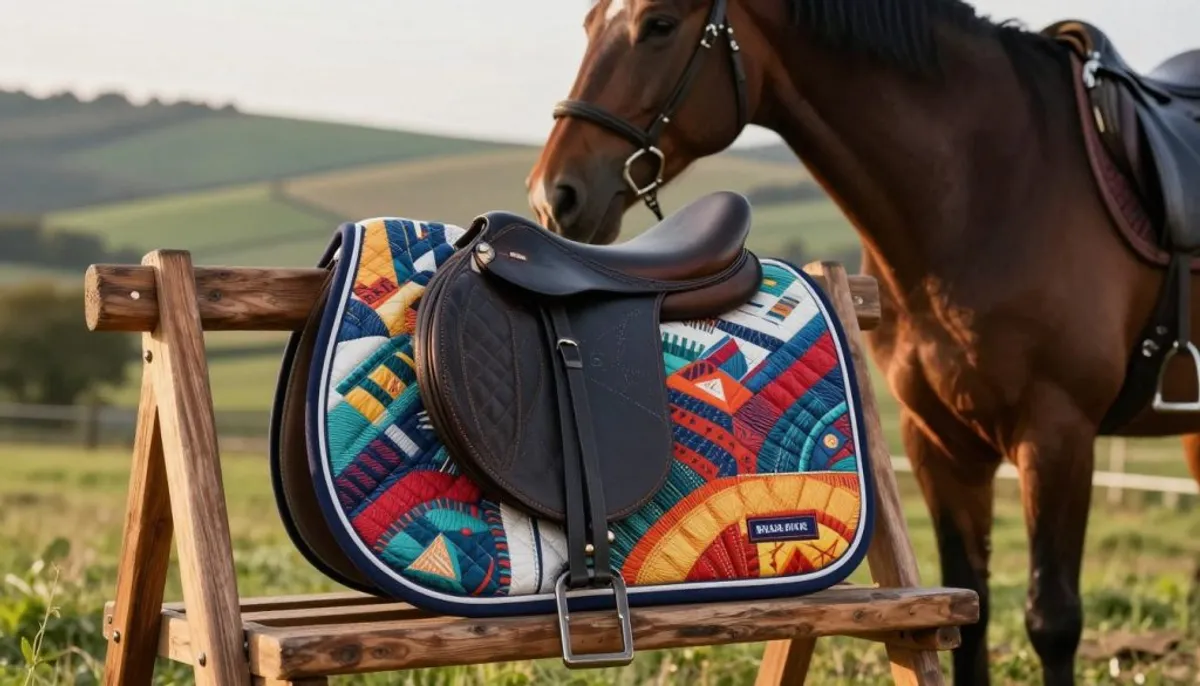
Customization: colors, piping, embroidery, and details
Start by choosing a color, then a piping. Add a subtle embroidery and beautiful quilting, and everything becomes harmonious. High-end models maintain their shape well, avoiding the “soft pad” look.
- Colors: matched to the horse's coat or the outfit
- Piping: fine contrast or tone on tone, depending on the style
- Embroidery: initials, stable logo, subtle pattern
- Finishes: regular seams, clean edges, stable cut
Limited edition vs custom: advantages depending on your need
A limited edition appeals for its exclusivity without a long wait. Designs come directly from the workshop, ready to be worn. The custom option, on the other hand, focuses on the perfect fit. It’s ideal if your saddle or horse has specific needs.
| Criterion | Limited edition | Custom |
|---|---|---|
| Objective | Distinctive style, guided and harmonized choice | Precise fit, finishes chosen to the millimeter |
| Lead time | More immediate depending on stock | Longer, time for manufacturing and validation |
| Design freedom | Defined palette, exclusive combinations | Wider options for colors, piping, embroidery, and details |
| Use | Ideal for renewing a stable look | Ideal if you seek a unique and tailored outcome |
Focus France: La Sellerie Française and the requirement for A to Z manufacturing in France
If you are looking for 100% French, La Sellerie Française stands out. It relies on the expertise of local artisans for unique creations. Their approach guarantees traceability, quality, and impeccable finishes.
Their saddle pads remain beautiful, stable, and comfortable in use. The quality of manufacturing ensures impeccable style, without hindering the horse.
Conclusion
A good riding pad changes the game on a daily basis. It protects the back and prevents slipping. This allows the rider to stay in place, emphasizes Ecogold. Over time, this pad becomes essential for comfort and precision.
To protect your saddle, choose simply. Opt for an anti-slip fabric that breathes and is gentle on the skin, without neoprene. A hexagonal design allows for quick drying, keeping the horse's back clean and healthy, explains Ecogold.
Make this purchase a wise decision. A durable pad is a good investment, just like the saddle, especially for those who ride often. Moreover, choosing the right riding accessories adds to the aesthetics and comfort, without exaggeration.
If you are looking for a high-end look, consider a custom saddle pad. La Sellerie Française offers limited editions or made-to-order items, entirely manufactured in France. This guarantees you a unique style while remaining effective.
FAQ
Is a riding pad really something more than just an aesthetic accessory?
Absolutely. The riding pad increases comfort and safety. It sits under the saddle and on the horse's back. It connects the rider to their mount for better control.
Why is it said that the pad is as important as the saddle?
Because it serves as an interface. It helps with stability and horse comfort. The pad is a crucial investment for performance and safety, just like the saddle.
How does a good pad improve the rider's stability?
Its design prevents the saddle from moving. This secures the rider's position. It makes communication with the horse more precise.
Which riding pad should I choose for jumping?
For jumping, you need a non-slip pad that keeps the saddle in place. The Secure™ pad from Ecogold is ideal and very comfortable.
Which saddle pad should I prioritize in dressage?
In dressage, choose a suitable, elegant, and stable pad. The dressing pads from Ecogold are special and keep the saddle in place.
And for western or trail riding, what should I aim for?
For western, comfort and cushioning are essential. The western pads from FG Pro Shop are perfect for everything from training to trail riding.
How does saddle protection act against friction and pressure points?
Good saddle protection reduces pressure and irritations. The goal is to comfort the horse's back and ensure safety.
Does saddle slipping often come from the pad?
Yes, especially if the pad slips or compresses. Some are made to prevent this. They keep the saddle in place for more safety.
Why is breathability so important under the saddle?
A good pad controls moisture. It keeps the horse dry and comfortable. The best pads allow for quick drying.
What distinguishes the Secure™ anti-slip pad from Ecogold?
The Secure™ pad is special for jumping. It prevents slipping and is ergonomic. It also secures the rider.
How can ultra-thin flaps help with positioning?
The thin flaps reduce thickness under the leg. On the Secure™, they help stabilize the position. This also improves communication.
Can a textile be anti-slip without being harsh on the skin?
Yes. Ecogold has created an anti-slip, breathable, and hypoallergenic fabric. It is sturdy yet gentle on the skin.
What is the purpose of the hexagonal “ray” structure advertised on some pads?
This beehive-type structure improves air around the skin. The goal is to dry the horse quickly.
Are Ecogold pads made responsibly?
Yes, Ecogold manufactures its pads in a responsible manner in Montreal.
When to add a saddle cushion in addition to the pad?
A saddle cushion is added for more comfort and stability. Ideal during intensive sessions or for sensitive horses. It better balances the saddle.
How to choose between materials: technical cotton, mesh, sheepskin pads?
Think about what you need: breathability and durability. A sheepskin pad is soft and manages friction. It all depends on your horse and your activity.
Is the sheepskin pad suitable for sensitive horses?
Yes, it offers comfort and minimizes irritations. But it needs to be cleaned regularly and adjusted well under the saddle.
What criteria to compare before buying a saddle pad?
Consider thickness, density, and ease of cleaning. Check that it suits the season. The important thing is comfort and stability.
What is the difference between a dressage pad and a jumping pad?
The dressing pad has a long and elegant shape. For jumping, we look for freedom and anti-slip support.
Are western pads reserved for western riding?
No. FG Pro Shop states that western saddle pads are suitable for all activities. They provide maximum comfort.
How to compose a coherent set of riding accessories?
Match the pad, bonnet, wraps, and outfit. The riding accessories should harmonize in colors and quality, without forgetting the function of the pad.
How to arbitrate between style and function on a pad?
Start with function: support, ventilation, drying, and comfort. Then, choose colors and finishes to your taste, without sacrificing performance.
How to choose according to the intensity of work and frequency of use?
If you ride often, lean towards high-performance pads. Choose an anti-slip, airy model that dries quickly. This protects the horse's back.
What does a customized saddle pad allow?
A customized saddle pad reveals your style. Choose your colors, patterns, and details. This adds charm without neglecting fit and shape.
Limited edition or custom: how to choose?
The limited edition offers unique pieces available quickly. The custom option guarantees perfection for your specific needs.
Where to find a premium pad made in France with true artisanal quality?
A: La Sellerie Française (https://laselleriefrancaise.com) offers exceptional pads, customizable and made by French artisans. Everything is produced in France for superior quality.