
Western riding is appreciated for its comfort and unique style. In France, it is practiced in various ways such as trail riding or reining. Many start with western riding lessons. Afterwards, they participate in workshops to improve their technique.
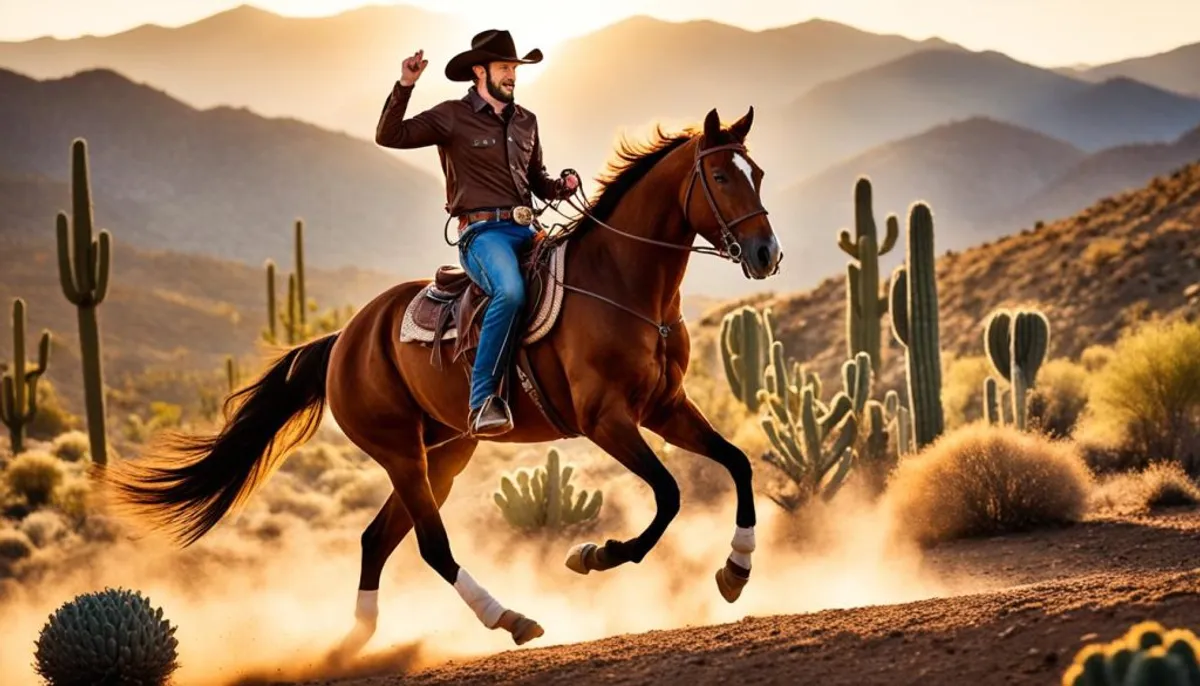
The "western" style is not just about the breed of horse. It mainly depends on the equipment. It doesn't matter if you ride a Quarter Horse or a Paint Horse. What matters are the saddles, bridles, and accessories that create the look.
The original cowboys sought reliable and comfortable gear for the horse. Aesthetics came second. Today, we still prioritize sturdy leather, simple designs, and a rustic look. This reminds us of the vast American plains.
We will differentiate the necessary from the superfluous. We will discuss the basics of riding, how to choose a saddle, a pad, and a girth. We will also cover bridles, side-pulls, reins, bits, and protections. And of course, the clothing and tack available in France.
Key points to remember
- Western riding combines technique, comfort, and safety.
- The "western" look mainly depends on the equipment.
- Western riding lessons and workshops help refine technique.
- Choosing a good saddle, pad, and girth is crucial for the horse's well-being.
- Bridles, reins, and bits should be selected based on the rider and the horse.
- In France, artisans and specialized shops offer everything needed, from leisure to competition.
Understanding the world of western riding and its origins
In France, western riding is appreciated for its simplicity. It aims for comfort, trust, and intense communication with the horse. Its unique approach has formed away from traditional arenas, following the daily life of cowboys.
When we mention western cavalry, the image of the Wild West often appears. But the heart of this discipline lies in its practical aspect. Born from concrete needs, it prioritizes measured gestures, effective organization, and durable equipment.
A horseback riding discipline inspired by the work of cowboys
Cowboys spent hours on horseback, busy sorting cattle. Therefore, western riding aims for efficiency while preserving the horse. It seeks to be light in aids but stable, suitable for long days.
It favors calm horses, ready to work. Emphasis is placed on serene behavior, fluid changes, and constant movement. The distinctive style develops as a complement to these foundations.
Key differences with English riding: philosophy, equipment, sensations
The main difference lies in the approach. English riding favors direct contact, in a more sporty framework. Western riding prefers a gentler approach, seeking to maintain the horse's balance and rhythm.
| Comparison Point | Western Riding | English Riding |
|---|---|---|
| Historical Purpose | Ranch work, endurance, efficiency | Traditional school, sport, and performance |
| Contact in the reins | Often lighter, seeking autonomy | More present, guided setup |
| Notable Equipment | Wrap-around saddle, horn, specific reins | Closer saddle, flaps, thinner stirrups |
| Sensation in the saddle | “Seated” position, stability, long-term comfort | More vertical position, fine precision of contact |
An instructor helps learners understand the basics. They show how to adjust their riding. This prevents confusion between different styles.
Between sport and lifestyle: codes, traditions, and atmosphere in the stable
The western cavalry creates a special atmosphere in the stable. Routines and preparations are essential, with particular attention to leather. The spirit is primarily friendly, even if details matter.
Dressing codes and disciplines vary, from trail to reining. To familiarize oneself, it is enough to observe and ask questions. An instructor can explain etiquette, the use of reins, and mutual respect.
People are attracted to this discipline that combines practice and identity. Western riding remains true to its origins while allowing for enjoyment. We seek to both ride and share a certain state of mind.
Western riding: the technical basics to master
In western riding, the goal is clear: stable, comfortable, and precise in its requests. This approach stems from a long-standing riding tradition. The horse must remain calm and receptive. It is important to have solid foundations before exploring speed or style.
Riding with comfort and stability: position, seat, and balance
The position encourages relaxation: relaxed shoulders, gaze far ahead, relaxed legs. Sitting “deeply,” one follows the horse's movement with their pelvis. This posture promotes balance, even on uneven terrain.
Western riding lessons emphasize breathing and rhythm. Transitions should be fluid, with minimal hand movement. On horseback, the subtler you are, the better the horse understands.
Managing the reins: open reins, closed reins, and Romal reins
The choice of reins greatly influences technique in western riding. Each type offers a unique feel and requires a certain technique with the hands. The best choice depends on the activity: arena, outdoors, or one-handed work.
| Type of reins | Common usage | Strengths | Point of attention |
|---|---|---|---|
| Open reins | Daily work in the arena, learning | Independent right/left actions, easy to adjust | Requires calm hands to avoid “pulling” continuously |
| Closed reins (Trail) | Outdoors, riding, hiking | Less risk of dropping a rein, simple grip | Watch out for excess length that can hinder if not folded properly |
| Romal reins | One-handed driving, more “finished” work | More stable hand, suitable for increased precision | The slap requires discipline, avoid unnecessary movements |
Precision of aids according to the horse and rider's level
In western riding, the precision of aids comes with experience. A novice horse needs simple and consistent signals. For a more experienced horse, subtler cues are sufficient, especially with a steady rhythm.
In advanced lessons, equipment and the intensity of actions are adjusted according to need. The important thing is to ask little, release quickly, and reward at the right moment. This method is what makes western riding effective, without using force.
Choosing a suitable western saddle: comfort, durability, and adjustment
The western saddle is not just an accessory. It is made for long-lasting work, with durable leather. That is why it is preferred in western tack in France, for its reliability and ease of use.
Characteristics of a western saddle: long seat, wide stirrups, horn
The western saddle is recognized by its long seat, which helps maintain stability. Its wide stirrups, made of leather, distribute pressure well and allow the legs to relax. The horn, which comes from the lasso, is a distinctive feature, even without practicing roping.
These elements are as important as style. They influence the feel, especially during long sessions, whether outdoors or with cattle.
Why the fit must be perfect: absence of adjustable padding
The main thing is the fit. In western saddles, you cannot adjust with padding like in English saddles. The tree must fit perfectly from the start, without creating pressure or hard spots, while respecting the horse's back.
A thick western pad can increase comfort. But, it only corrects slight defects. If the saddle is not well adjusted, the pad cannot fix everything.
When to seek a professional's opinion to avoid fit issues
If the horse changes or if you change disciplines, seeking a professional's opinion avoids mistakes. A “saddle fitter,” a saddler, or a good western tack can check the saddle's balance. This is also useful for second-hand purchases, as two saddles of the same size may not fit the same way.
For a good choice in western equipment, follow a simple method: observe, test, then confirm with the help of an expert. This check is often more important than the saddle's aesthetics.
| Point to check | What to look for on the horse | Indicator of a poor choice | Useful action |
|---|---|---|---|
| Freedom at the withers | Clear clearance, no direct contact when static and at a walk | Rubbing hair, discomfort at the neck, dry “V” marks | Check the height of the tree and the thickness of the pad, then re-test |
| Shoulder and forehand | Free shoulder, equal stride, not shorter | Horse that shortens, stumbles, or refuses to move forward | Check the width of the tree and the placement of the saddle |
| Contact along the length | Regular support, no “bridge” area | Hot spots, localized marks, sensitivity to brushing | Request a reading of the pad's imprints after the session |
| Saddle balance | Flat seat, centered rider, stable stirrups | Rider tilted forward/backward, legs that swing | Compare several models in western tack and film at a walk/trot |
| Lateral stability | Saddle that doesn't roll, even in turns | Slipping sensation, need to re-girth often | Review girth, rigging, and saddle/pad fit |
Western pad and back protection: cushioning, sweating, and stability
In western riding, the pad is essential, not just an accessory. It relieves the horse's back and stabilizes the saddle, as the latter does not have adjustable padding. This is an important choice from the beginning.
The pad aims to distribute pressure under the saddle. This is crucial during sudden stops, fast starts, and long distances. It also keeps the saddle in good condition by absorbing the horse's sweat. This prevents the leather from becoming hard and marked.
Sheepskin or imitation fur pads are highly valued for their comfort. They adapt well to the horse's back. Felt is also appreciated for its durability and ability to keep the saddle in place. Neoprene rubber offers good cushioning, especially for horses with sensitive backs, but care must be taken to ensure the pad is well-ventilated.
If your saddle is not perfectly adjusted, a pad with inserts may be the solution. With adjustable pockets, you can easily modify the thickness at the front or back. This allows for personalized adjustment without difficulty, ideal for following the horse's changing shape.
For daily training, a pad of 2 to 3 cm thickness is often used. This ensures comfort and stability. In competition, a thinner pad is common, often decorated with a blanket. It is important that the pad and blanket extend at least 5 cm beyond each side of the saddle, for optimal look and protection.
| Usage in western riding | Common thickness | Frequent materials | Points to check |
|---|---|---|---|
| Daily training | 2 to 3 cm | Felt, sheepskin, imitation fur | Pressure distribution, stability, extending 5 cm on each side |
| Competition | 1/2 to 3/4 inches | Thin pad + decorative blanket, dense felt | Freedom at the withers, clear silhouette, clean set for leather |
| Fit correction (temporary) | Variable with inserts | Pad with pockets + inserts, felt, neoprene rubber | Left/right symmetry, absence of excess thickness, breathability |
Taking care of your pad and saddle is important. Regular brushing, air drying, and checking worn areas are recommended. These small gestures maintain your western riding equipment and ensure the horse's comfort.
Western girth: length, shape, and materials to limit friction and pressure
When practicing western riding, the girth is essential. It ensures the horse's comfort and the saddle's stability. A good girth should distribute pressure, allow the horse to breathe, and prevent friction. This is crucial for the horse's well-being, especially during long rides, whether in the arena or outdoors.
For an effective girth, it should not be too tight. An unsuitable girth can cause irritation, discomfort for the horse, or even create muscle problems. It is important to adjust the girth properly before each use, as sweat and the horse's movements can shift it.
Controlling length: ring marker and loop placement
A girth should neither be too long nor too short. A good marker is the ring, placed about 15 cm from the loop. This ensures that the loops stay in place, without riding up under the saddle flap.
Ensure that the loops do not touch a sensitive area of the horse, especially near the elbow. In western riding, we tighten gradually: adjust, let the horse walk a bit, then check. This protects the horse and keeps the saddle in place.
Useful shapes according to morphology: anatomical, asymmetrical, half-moon
Some horses do well with a straight girth, but not all. If the horse tends to slide the girth forward, an anatomical shape can help. Asymmetrical or half-moon shapes can also prevent the saddle from moving.
By observing the horse at a walk, you can see if the girth moves or if its hair lies oddly. These signs often indicate a girth shape problem. Choosing the right shape is essential for good western equipment, like the pad.
Choosing the material: sheepskin, felt, neoprene rubber, leather
The material of the girth influences grip, warmth, and maintenance. Sheepskin is soft but requires frequent washing. Felt and neoprene rubber are good against irritations, but they need to be cleaned and dried well.
Leather is classic in western riding because it is durable and easy to maintain. However, it must be well adjusted to avoid marks on the horse's skin. Regardless of the choice, always check that everything is in good condition before using the girth.
| Material | Strengths | What to watch for | Common usage in France |
|---|---|---|---|
| Sheepskin | Soft contact, helps reduce friction, good comfort on sensitive skins | Rigorous maintenance, complete drying, avoid matted hair | Sensitive horses, light to moderate work |
| Felt | Good stability, breathable, sweat absorption | Must remain clean, risk of sand accumulation | Regular work, seeking breathability |
| Neoprene rubber | Grip, easy to rinse, limits slipping | Possible warmth, check for irritations and dried salt | Outdoors, active sessions, round horses |
| Leather | Durability, traditional look, simple maintenance | Precise adjustment, softening, buckles to check | Traditional tack, versatile use |
Practical accessories: buckle protectors and points of vigilance in use
Buckle protectors are small but very useful. They prevent the buckles from touching the horse's skin directly. This is a detail that finishes off the equipment well, especially for sensitive horses.
After each use, a quick check can prevent problems. Broken hairs, hot areas, or visible marks should be checked. In the world of western riding, these small gestures are important for the horse's well-being. A well-chosen, clean, and correctly placed girth makes riding more enjoyable for everyone.
Western bridles, side-pulls, and reins: finding the right option
In western riding, choosing the right bridle and reins is crucial. This influences the clarity of signals given to the horse. Good equipment is precise and comfortable. There are many styles, from the simplest to the most decorated. All aim to ensure clarity, comfort, and safety for the rider and the horse.
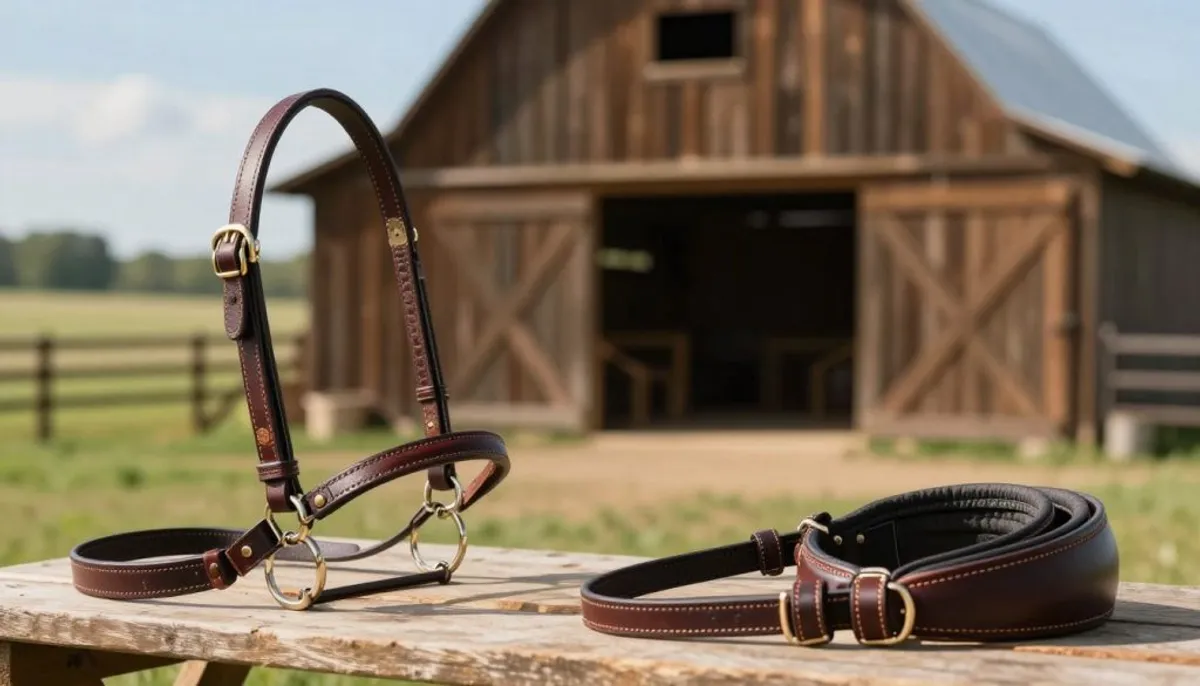
Particularities: no noseband on “classic” western bridles
“Classic” western bridles are distinguished by the absence of a noseband. This feature allows for finer communication between the hand and the bit. If a noseband is added, it is often for training or guiding a young horse.
Styles of headstalls: straight/V, knotted, one-ear, two-ear
There are different styles of browbands: straight, V-shaped, or knotted for a traditional look. The one-ear and two-ear headstalls are minimalist and elegant. However, they require the use of a bit for better stability.
Riding without a bit: understanding the action of the side-pull and the importance of the noseband
The side-pull acts by pressure on the nose thanks to a noseband. This makes instructions to the horse clear and simple. The width of the noseband adjusts the pressure: a thin noseband focuses the action, while a wide one diffuses it. A well-fitted piece of equipment is essential for the horse's comfort.
Pairing the right reins: open for everyday use, closed for outdoor, Romal for one-handed
Open reins are ideal for daily use. They are simple to adjust. Closed reins are preferred for outdoor rides, as they prevent losing a rein. Romal reins allow for one-handed riding, typical of western riding.
| Option | What the horse feels | To prioritize in practice | Point of vigilance |
|---|---|---|---|
| “Classic” western bridle (without noseband) | Aids centered on the mouth, clear contact if the adjustment is right | Precise work, horse already educated to western riding codes | Adjustment of the headstall and bit: avoid any tension on the corners of the mouth |
| One-ear / two-ear headstall | Stability linked to the bit, light sensation on the head | Clean look, western discipline, calm horse at mounting | To be used with a bit; check that the headstall does not slip |
| Western side-pull (without bit) | Pressure on the nose, clear response to open reins | Education, gentle recovery, sensitive horses in the mouth | Noseband width: thin = more concentrated action; wide = better distributed pressure |
| Open / closed reins (Trail) / Romal | Varies according to hand position: more direct, more “secure,” or more settled | Open for daily use, closed outdoors, Romal for one-handed | Proper length: too long = vague, too short = hard hand |
Western bits: snaffle, Billy Allen, and shank bits
In western riding, a bit is not chosen randomly. We examine the structure of the horse's mouth, its sensitivity, and how it responds to hand signals. The goal is to achieve a light and consistent response, whether in training or competition.
Western snaffle: operation and common profiles
The western snaffle works by direct pressure, without using leverage. It comes in single or double jointed versions to better distribute pressure on the horse's tongue. This type of equipment is favored for beginner horses, as it allows for gradual learning.
The diameter of the mouthpiece greatly influences the horse's feel. A thin mouthpiece is more “present” while a thick mouthpiece requires a more accommodating mouth. In this discipline, it is crucial to have clear and unambiguous aids.
The Billy Allen bit: central roller, chewing, and limiting the “nutcracker” effect
The Billy Allen is a type of snaffle that incorporates a mobile central roller. This detail promotes chewing and helps the horse relax. Moreover, this design reduces the risk of the “nutcracker” effect often associated with double-jointed bits.
It is perfect for those seeking the qualities of a snaffle while improving stability. It proves useful with horses that lean on the bit or play a lot with their tongue.
Shank bits (lever effect): influence of the length and shape of the shanks
Shank bits use a leverage effect to act. The hand transmits instructions via the shanks, curb chain, and angle of contact. The longer the shanks, the more pronounced the effect. The shape of the shanks can also influence the speed of response.
This type of bit can be combined with different mouthpieces, such as snaffles or Billy Allen. In competition, the choice of bit should correspond to the experience level of the horse-rider pair to ensure smooth and precise transitions.
Essential adjustment point: limited overhang on each side of the mouthpiece
A precise adjustment prevents many problems. The bit should not extend more than 0.5 cm on each side of the mouth to avoid pinching. It should also not be too tight to avoid pressure points.
| Type of bit | Main action | Horse/rider profile | Point to watch during adjustment |
|---|---|---|---|
| Western snaffle | Direct pressure, simple cues | Beginning work, basics, developing hand | Proper width, free rings without pinching |
| Billy Allen | Direct pressure with roller, aids chewing | Horse that contracts, needs stability | Centered roller, clean corners after the session |
| Shank bits | Leverage via shanks and curb chain, more technical action | Advanced pair, established codes, seeking finesse | Length of shanks, curb chain adjusted without excess |
Testing the bit during a trial can be very helpful. We seek to achieve a calm mouth, a supple neck, and a straight path. In western riding, these small details matter, especially during stressful competitions.
Accessories and protection: boots, halters, and useful daily equipment
In western riding, accessories are a key complement to the saddle and bridle. They vary according to the horse, the intensity of training, and the use – such as for trail rides or competitions. Good equipment primarily aims to protect the horse while remaining comfortable for it.
In western cavalry, the adjustment of equipment is done gradually. We monitor the condition of the skin, limbs, and the horse's sweating to keep only what is essential. The horse's well-being is our ongoing primary objective.
Boots become important in demanding training with rapid movements. For techniques like spins and sliding stops, they protect against injuries. They should be firm but allow the tendon to breathe properly.
A “western” halter is distinguished by its width, offering more stability. It is practical for grooming, transport, and breaks between training sessions. For blankets, it is crucial that they do not hinder shoulder movements and avoid any pressure on the withers, especially in well-muscled horses.
| Accessory | When it becomes useful | Point to check |
|---|---|---|
| Protective boots | Handling work, sharp transitions, spins, sliding stops | Firm adjustment, no rotation, clean and dry lining |
| Western halter | Grooming, stable break, transport, tying in the trailer | Width at the cheek, soft seams, hardware that does not pinch |
| Stable or drying blanket | After exertion, cool weather, clipped horse, recovery | Shoulder freedom, protected withers, well-placed straps |
| Transport protection | Regular trips, horse that moves a lot in the trailer | Proper height, simple closure, no folds at the pastern |
A good western riding equipment relies on a selective choice of a few quality items. In this discipline, we prefer materials that are easy to maintain and easily adjustable. An uncomfortable accessory can ruin a training session.
- Try the equipment at home before using it in competition.
- Ensure everything is well adjusted after each cleaning.
- Regularly inspect points where the horse could be injured.
Western riding clothing and tack in France: style, safety, and craftsmanship
In France, the western style is defined by comfort, safety, and love of detail. The outfits are not just beautiful; they tell a story. They also adapt to current riding practices. To make the right choices, an instructor can guide you on what will suit best, depending on the discipline and the horse.
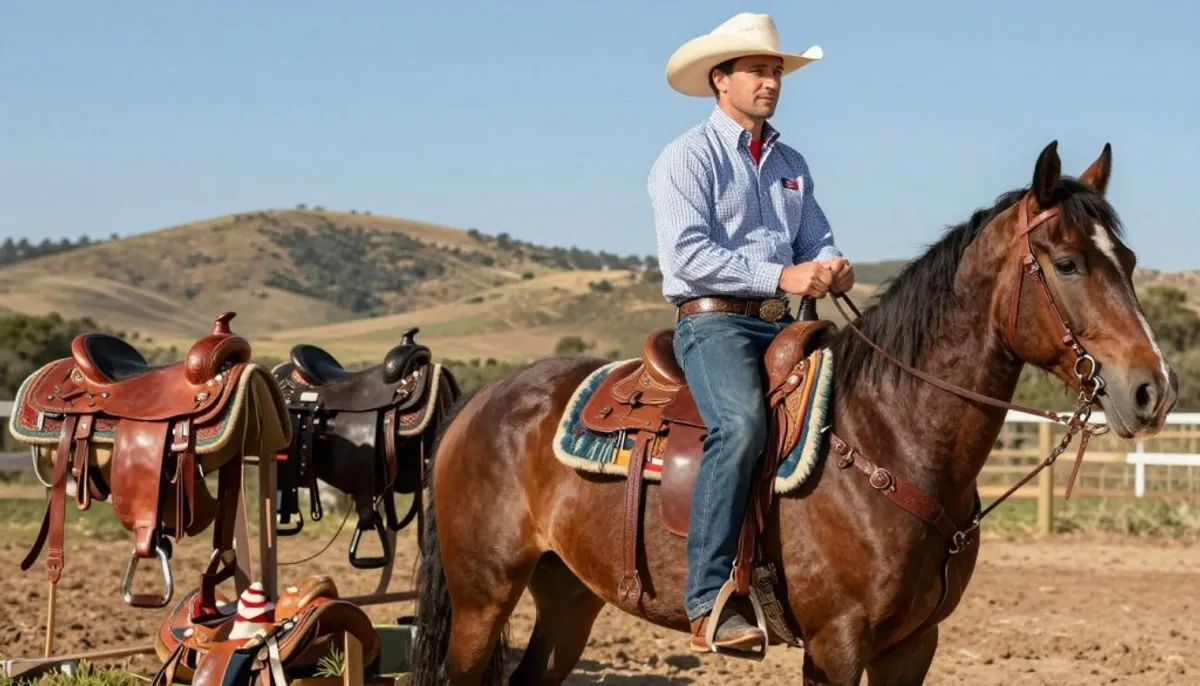
Rider's outfit: “workwear” heritage (jeans, hat) and modern trends
Western riding outfits come from workwear: sturdy jeans, boots, and a hat to protect from sun and rain. Today, riders prefer to keep this style but with more comfort and ventilation.
There is also a more sporty style today, with fitted cuts and technical fabrics. The important thing is to be able to move freely and stay clean on the horse.
Competition outfit: polished look, consistent with the discipline and regulations
The outfit for competitions is prepared with care, just like the horse's training. It must be elegant, coordinated, and comply with the rules.
An instructor can help understand what is expected: color, cut, accessories. This avoids fashion faux pas on the important day.
Western tack and leather art: the role of saddlers and the interest in custom-made
Western tack is not limited to aesthetics. Artisans work meticulously to ensure each piece is perfect for its use.
Choosing custom-made allows for better fitting, more stable sensations, and durable products. You can personalize with details like the type of leather or unique patterns.
Focus France: La Sellerie Française, high-end pieces made from A to Z in France
La Sellerie Française offers high quality, made entirely in France, in limited series or custom-made. The manufacturing is local, for those seeking quality and traceability.
This approach appeals to those who want durable products and support French craftsmanship.
Where to equip: online shops, shows, events, and directories of professionals
Many start their search online, then go see in shows or events. Testing in person is useful.
The website france-western.fr helps find experts and stay informed about the western world. You can find specialists in customization, equipment, and equine nutrition.
| Need | Option in France | What you check on-site | What to ask before buying |
|---|---|---|---|
| Western riding clothing for training | Online shops + fitting at events | Comfort in the saddle, shoulder freedom, seam integrity | Exchange policy, size guide, textile maintenance |
| Outfit for western riding competition | Shows, specialized stands, customization workshops | Color harmony, finishes, “clean” appearance | Event regulations, allowed accessories, preparation time |
| Western tack focused on durability | Saddlers/craftsmen, limited series | Leather quality, consistency of stitching, buckle strength | Warranty, repair options, leather care advice |
| Custom-made and fine adjustments | Referenced French workshops + support | Choice of leathers, finishing options, ergonomics | Measurement taking, deadlines, follow-up, recommendations from a western riding instructor |
Conclusion
Western riding is a blend of style and utility. The equipment tends to be practical, comfortable, and durable to match the cowboy spirit. Today, this tradition is seen in both trail riding and competition, for pleasure or sport.
Comfort and safety are essential. A good western saddle must fit perfectly. A professional can help you make the right choice. The pad is crucial for cushioning, pressure management, and sweating. For training, a 2–3 cm pad is common, while in competition, a blanket is often used.
Choose your girth wisely, keeping the ring 15 cm from the loop. It should have the right shape and be made from an appropriate material. Use buckle protectors to avoid friction. Classic bridles do not have a noseband, unlike side-pulls which require one. As for the bit, ensure it extends no more than 0.5 cm on each side of the mouth.
In France, continuing to learn and connect is crucial. Western riding lessons and workshops refine your techniques and help you choose the ideal equipment. To find gear, professional catalogs, events, and craftsmanship are invaluable. Custom-made is also an option, with high-end products available at La Sellerie Française, entirely made in France.
FAQ
Does the "western" appearance of the horse come from the breed or the equipment?
The style comes from western riding equipment. Elements like the saddle, bridle, and reins create this look. This applies to different types of horses like Quarter Horses or Appaloosas. Cowboys aimed for practicality and comfort above all, and aesthetics came afterwards.
What is the origin of western riding and why is it referred to as "ranch work"?
It originates from the needs of cowboys. They sought efficiency and comfort during long hours with durable equipment. That is why the style is rustic and functional, even for leisure or competition.
What are the major differences with English riding?
Western riding is the American equivalent of English riding but differs in its philosophy. The equipment and the priority on comfort, stability, and efficiency mark this difference. Technique and choice of tack are influenced by this.
What technical basics should be mastered to be stable and comfortable?
In western riding, one should aim for a stable seat, relaxed legs, and a calm hand. These techniques aim for the comfort of both the horse and rider in the long term, every day.
What types of reins are used in western riding?
There are three common types. Open reins are usual for everyday use. Closed reins (Trail) are preferred for outdoor rides as they slip less. Romal reins are used for one-handed riding.
How to choose reins according to practice (arena, outdoors, show)?
For training, open reins are recommended. If you are trail riding, prefer closed Trail reins. Romal reins are suitable for certain shows, provided you have the right level.
Can you ride without a bit in western riding, and in what cases?
Yes, it is possible with a western side-pull. This allows for control with a noseband. The choice depends on the horse and rider. It is good to start with a western riding instructor.
Side-pull: is it better to have a thin or wide noseband?
A thin noseband acts more locally. A wide noseband distributes pressure and can be more comfortable. The choice depends on the horse's sensitivity and the rider's precision.
What is the purpose of the horn on a western saddle?
Originally, the horn was used to hook the lasso. Today, it identifies the western saddle, even if its use varies by discipline. It should not be used as a support for the rider.
What are the characteristics of a western saddle compared to an English saddle?
The western saddle has a long seat, wide stirrups, and is made to last. Unlike English saddles, it is not easily adjustable. It must fit well from the start.
Why must the fit of a western saddle be impeccable?
This is important because it must fit the horse's back well. Without possible adjustment, a poor fit can cause problems. A bad fit can create pressure and friction.
Can a pad correct a poorly fitted western saddle?
A pad can improve comfort, but it does not adjust a poorly fitted saddle. It is better to have a well-fitted saddle and then choose the pad.
What thickness of pad to choose for training and competition?
For training, a thickness of 2 to 3 cm is common. In competition, a thinner pad is often used. The choice also varies according to the discipline and the horse's comfort.
What materials of pads are most recommended?
Choose a material that is comfortable and stable. Sheepskin pads are appreciated for comfort. Felt and neoprene rubber are also popular.
What size of pad/blanket is needed for a western saddle?
The pad and blanket should extend at least 5 cm beyond each side of the saddle. This helps protect and stabilize the saddle.
Are there pads with inserts to refine the fit?
Yes, some pads have adjustable inserts. This can help for specific horses but does not replace a good saddle.
How to check the length of the western girth?
Look at the ring about 15 cm from the loop. Also, ensure that the loops do not bother the horse.
What shape of girth to choose according to the horse's morphology?
Choose a girth suitable for the shape of the belly and elbows. A girth can be anatomical or asymmetrical. A straight girth does not fit all horses.
What material of girth to prefer to limit irritations?
Sheepskin, felt, and neoprene rubber are soft but require careful maintenance. Leather is durable but must fit well to avoid friction.
What is the purpose of a buckle protector on a western girth?
It protects the horse from the buckles. This is a small addition that improves comfort, especially for sensitive horses.
Why do “classic” western bridles not have a noseband?
In western riding, bridles without a noseband are common. They are more for training and some young horses. The choice is based on the goals.
What styles of western bridles are most commonly found?
There are bridles with different browbands, and “one-ear” or “two-ear” headstalls. The latter are simple, often without decorations.
Can “one-ear” or “two-ear” bridles be used without a bit?
These headstalls require a bit. To ride without a bit, a side-pull or similar system is needed.
What bits are most common in western riding, and how to choose?
Different bits meet the needs of the horse and rider. The snaffle is simple, sometimes double-jointed. The Billy Allen has a roller that helps the horse. Shank bits provide a leverage effect.
What adjustment is essential for the size of a western bit?
The bit should not extend more than 0.5 cm on each side. A poor adjustment can bother the horse.
What is the purpose of boots in western riding?
They protect the horse's legs during specific movements. The type varies according to the discipline and the level of exercise.
What other “western” equipment is useful in daily life?
There are western-style halters and blankets. The important thing is comfort and use before style.
What to wear for western riding in France: jeans, hat, modern style?
The typical outfit comes from cowboy clothing. Jeans and hats are classics. A more sporty style is also popular. Comfort is essential, regardless of the choice.
In competition, what is the difference between “traditional” attire and show attire?
For competitions, the appearance must be neat and suited to the discipline. Show attire places more emphasis on details and harmony while remaining true to the western spirit.
Why consult a professional to choose a western saddle?
A professional can avoid costly choices and preserve the horse's back. They offer support for progress, through lessons or workshops.
What is the role of saddlers in western tack in France?
Specialized artisans work leather for its durability. Custom-made adapts perfectly to each need, with quality finishes.
Where to find high-end western tack made in France?
La Sellerie Française https://laselleriefrancaise.com offers luxury items. They are unique or produced in limited series, all made in France.
Where to equip in France for western riding (shops, events, directories)?
You can buy online or at specialized events. france-western.fr helps find experts in western gear. There are Horse Design, King S Valley Shop, and Carol’Horse for new and customized equipment.
How to progress quickly and safely in western riding?
Good guidance from a western riding instructor is crucial. Lessons and workshops help refine technique and choice of equipment. One must adapt to the horse and rider.