
In France, horses enrich our daily lives, from the countryside to the racetracks. They are present at the club, on rides, and at major competitions. This article offers you an exciting look into the world of horses and equines.
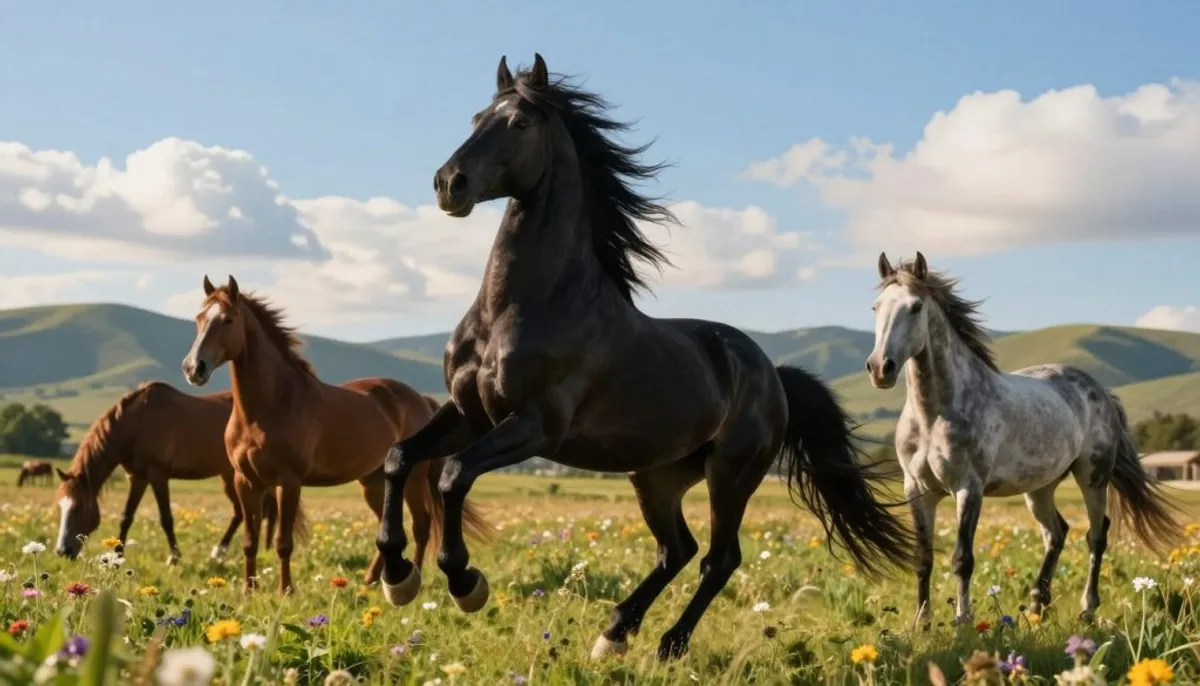
This text will introduce you to the ancient charm of horses. You will learn to recognize the different types of equines and their specialties. The goal is simple: to guide you towards a practice that suits you, in an atmosphere that you enjoy.
We will explore club riding in France, highlighting the importance of safety. We will then discuss daily care: feeding, hoof care, health. We will also talk about breeding and finally, the importance of good saddlery.
If you are looking to deepen your knowledge, a book published by Gründ in 1977 by the French Book Club might interest you. It is recommended as being in "very good condition": 192 pages filled with maps, index, and photos, weighing approximately 1.4 kg. References: ASIN B000XUIT6E, ISBN-10 270000194X, ISBN-13 978-2700001945, in French.
Key Points
- Horses and equines play a crucial role in French culture.
- Equines represent a large family with specific needs.
- Knowing the breeds and their disciplines helps make the right choice.
- Starting with a club is reassuring and safe.
- Caring for your horse is essential, just like equestrian technique.
- Good saddlery and proper equipment enhance the comfort of all.
Why Horses Have Fascinated for Centuries in France
Horses are everywhere in France, in the fields and in our memories. They symbolize freedom, elegance, and patience. This image is ingrained in our culture.
The maps and photos in Gründ (1977) show how regions and climate influence riding. This explains the diversity of equestrian practices. And why riding varies from one place to another.
Mounted Animals at the Heart of Rural and Sporting Traditions
In the countryside, horses were essential to festivities and agricultural work. This tradition continues, even with the arrival of machines. It also persists in equestrian clubs.
In sports, riding follows strict rules regarding attire and respect for the horse. The pleasure of riding is as important as winning.
The Human-Horse Bond: Intelligence, Sensitivity, and Cooperation
Understanding a horse begins with observing its body. This attention prevents mistakes, especially for beginners. The rider's calm attitude is crucial.
Trust between the rider and the horse is built on the ground and then in the saddle. Progress comes with the accuracy of rewards and consistency. This makes riding safer and more enjoyable.
- Observe before acting: posture, gaze, distance
- Keep aids simple: move forward, slow down, turn
- Finish on a success, even small
Leisure, Sport, and Work Horses: Complementary Roles
Horses in France have multiple roles. They can be used for leisure, teaching, or competition. It is important to understand what each activity requires.
The workhorse is useful in the forest or for vineyards. It combines riding and manual labor. The sport horse seeks to excel, with specific training.
| Role | Objective | Most Common Setting in France | What This Requires from the Rider |
|---|---|---|---|
| Leisure | Outings, relaxation, discovery | Club, boarding, guided rides | Regularity, safety, pace management |
| Sport | Technique and performance | Competition stable, official competitions | Precision of aids, preparation, recovery |
| Work | Pulling, everyday utility | Forest, vineyards, carriage driving, local tourism | Patience, clarity of commands, respect for effort |
Horses and Major Families of Equines
It is easy to confuse horses, donkeys, and ponies when starting out. They do not have the same size or behaviors. Knowing how to differentiate them can help choose the best activity, whether in a club or in nature.
Horses, Ponies, Donkeys, and Hybrids: Understanding the Differences
Size is the first clue. In France, an animal under 1.48 m at the withers is often a pony. But horses are generally larger. They can be used in sports, for leisure, or for driving.
Donkeys have long ears and a unique voice. They think calmly before acting, which may seem like stubbornness. Mules and hinnies are crosses between donkeys and horses. They combine endurance and strength, but their care is similar to that of horses.
| Family | Simple Marker | Common Strength Sought | Daily Care to Monitor |
|---|---|---|---|
| Horse | Variable build, often over 1.48 m | Versatility (leisure, sport, work) | Stress management and need for regular movement |
| Pony | Often 1.48 m or less, compact format | Hardiness and maneuverability | Tendency to gain weight if grass is rich |
| Donkey | Long ears, cautious, careful approach | Sobriety, carrying, hiking | Regular hoof care and prevention of laminitis |
| Hybrid (mule, hinny) | Intermediate silhouette, often hard foot | Endurance and surefootedness in varied terrain | Consistent training and well-fitted equipment |
Common Characteristics of Equines: Behavior and Needs
All equines primarily need to eat forage. Clean water and daily movement are essential. They should also live with others to avoid boredom. A shelter protects them from rain and wind, improving their lives.
Foot care is crucial for horses, ponies, and donkeys. It is necessary to check the trimming, sole, and horn. Regular care such as vaccinations, dental care, deworming, and monitoring droppings is fundamental.
An illustrated guide can be very helpful to avoid getting lost. Publishing houses like Gründ offer books with photos, an index, and a clear structure. These books can be 192 pages long, with maps and markers to better understand equines.
Body Language to Know for Better Interaction
The horse's body speaks before the lunge line. A low neck, calm breathing, and moving ears indicate a relaxed animal. But a high head or a swishing tail often indicates stress.
It is essential to see the horse as a whole, not just one sign. A resting foot may indicate relaxation, but also check the eyes and breathing. A horse backing up may just be asking for more space.
- Comfort: slow blinks, soft lips, light pressure on the halter.
- Discomfort: pinned ears, flared nostrils, jerky movements.
- Attention: ears fixed on a noise, tense neck, sudden stop.
Horse Breeds: Diversity, Morphologies, and Aptitudes
In France, horse breeds are recognized by their shape: neck, back, and legs. These characteristics are important. They influence comfort and movement. To make a good choice, it is useful to link the horse's shape to its use: riding, jumping, work, or hiking.
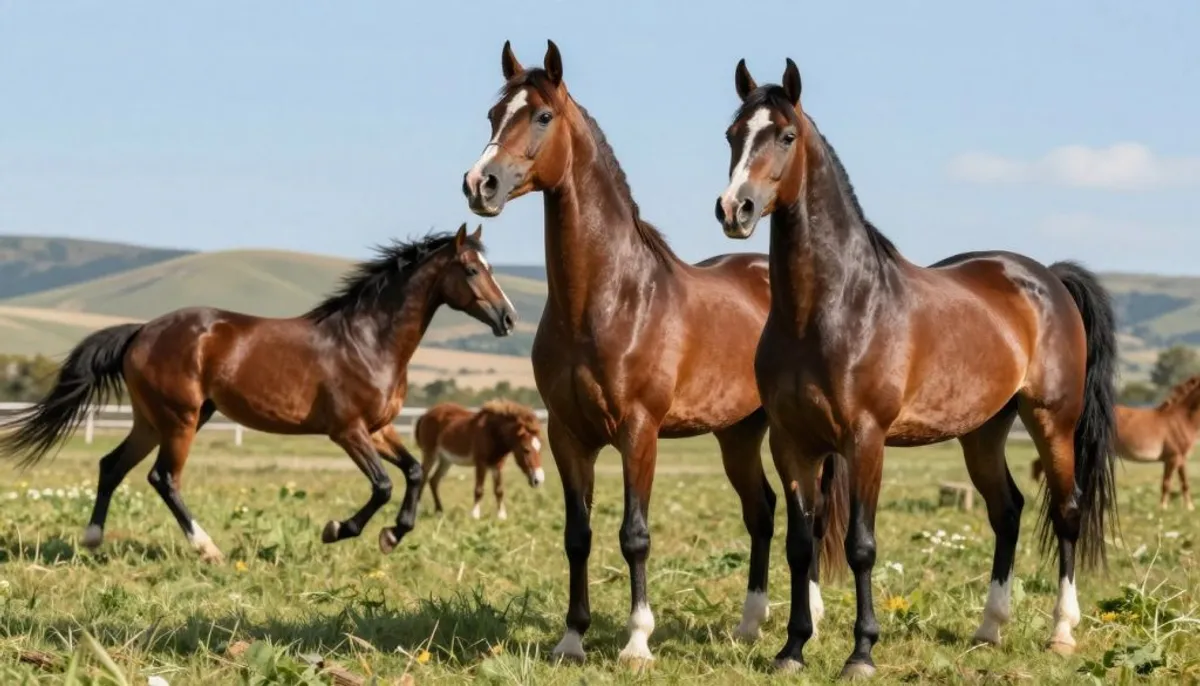
It is also important to consider the temperament and hardiness of the horse. Horses that require less energy do not work like those that are very active. This distinction avoids surprises, especially if you ride often on different terrains.
Saddle Horses: Agility, Comfort, and Versatility
Saddle horses are made to be comfortable and flexible. They can be found everywhere: clubs, competitions, and rides. Their back and gaits make balance and control easier.
The Selle Français is well-known in France for jumping, or the Anglo-Arab for its spirit. Depending on needs, different qualities will be sought: a sensitive mouth, long strides, or a smooth movement. For enjoying riding, liking to change scenery is a plus.
Draft Horses: Power, Temperament, and Uses
Draft horses are recognizable by their size, width, and strength. They are well-suited for pulling, logging, or even tourism. Their gait is steady, and often, they have a calm temperament, which is reassuring.
Some breeds are very famous, like the Breton or the Percheron. They require regular attention: hoof care, weight monitoring, and effort management. For riding, some draft horses are ridden, ensuring the saddle is adapted and progress is made gradually.
Criteria for Choosing a Breed Based on Your Riding Project
Choosing a horse is not based on an image. It depends on your experience, the time to dedicate, and the available facilities. For outdoor activities, the horse must be safe and calm, as well as well-proportioned.
| Project | What to Look for in Horses | Points of Caution | Useful Marker in Riding |
|---|---|---|---|
| Riding and Hiking | Endurance, steady pace, stable mind | Hooves, carrying back, weight management | Regular outings, simple transitions, long reins |
| Jumping | Reactivity, balanced canter, respect for the bar | Osteopathic follow-up, hoof quality, recovery | Gymnastics, ground poles, cadence |
| Dressage | Flexibility, balance, availability | Patience in work, back musculature | Rhythm, bending, gradualness |
| Driving | Pulling, calmness, straightforwardness | Fitting harness, shoulders, sensitive skin | Voice training, straight lines, sudden stop |
To compare breeds without confusion, paperwork remains useful at the stable. A Gründ book from 1977, with maps and photos, helps identify origins and main categories. Then, the best is to observe horses in action, and if possible, try them out on several occasions.
Riding: Disciplines, Learning, and Safety
Riding offers several specialties, each with its own learning pace. In the arena, precision is crucial; outside, one must be comfortable and know how to observe. With calm and trained horses, starting out is easier, especially in clubs where one is well-supervised.
| Discipline | What You Learn | Recommended Progression | Key Safety Points |
|---|---|---|---|
| Initiation | Mounting, stopping, turning, managing pace | Short and regular sessions | Helmet, adjusted stirrups, distance between horses |
| Dressage | Position, straightness, balance, fine aids | Patient work, clear markers | Checked equipment, relaxed horse, instructor's instructions |
| Jumping | Approaches, cadence, trajectories, landing | Ground poles then small jumps | Protective gear, spacing, speed control |
| Cross | Reading the terrain, natural obstacles, commitment | Solid base in the arena before going outside | Vest, reconnaissance, priority and pace rules |
| Endurance | Effort management, recovery, rhythm | Progressive outings and fitness tracking | Hydration, breaks, heat and terrain awareness |
| Outdoor Riding | Trust, direction, autonomy on rides | Simple routes then varied ones | Group instructions, visibility, calmness in unforeseen situations |
| Driving | Driving, voice, harness adjustments, maneuverability | Supervised learning, slow gestures | Control of harnessing, clear areas, emergency stop |
| Ground Work | Respect, lunge line, mobilization, communication | Short sessions, specific goals | Gloves, space, attention to horse postures |
One often begins riding with ground work. This serves to establish a relationship of trust. Afterward, one learns to position correctly, use legs and hands, and maintain balance. Progress should be made step by step.
The regularity of lessons in a riding club is important. It is better to have one session each week than a long break followed by an intense resumption. Setting achievable goals helps to remain calm and confident. Thus, riding becomes a sport where expectations are clear, for both the rider and the horse.
To avoid accidents, respecting certain rules is essential. Wearing a helmet is mandatory. Equipment should also be checked before mounting. In the arena, it is important to maintain a safe distance between horses, announce movements, and follow the direction of traffic.
Knowing how to manage emotions is crucial. If a horse becomes stressed, the rider must remain calm and simplify requests. In case of trouble, it is wise to slow down, return to a walk, and seek advice from the instructor.
When purchasing riding equipment, choosing reliable suppliers is recommended. For online purchases, paying attention to descriptions and return options is important. This caution is essential to ensure safety, which often depends on small details.
Equestrian Clubs: How to Choose the Right Structure in France
There are many choices for equestrian clubs in France. Some are in the countryside, others near cities or focused on sports. To progress well in riding, it is important to visit clubs during lessons. This allows you to see if the atmosphere, welcome, and care for the horses suit you.
Supervision, Horses, and Levels: Points to Check
A good club should be transparent about the qualifications of instructors, the number of riders per lesson, and safety measures. Instructions should be clear, corrections made calmly, and beginners should receive attention. Too many riders in a group can slow your progress.
Take the time to see the school horses. Well-maintained and logically used horses are less fatigued and have fewer health problems. It is good to ask how horses are chosen for each rider, if progress is monitored, and what equipment is recommended.
- Group sizes announced and respected
- Safety briefing before mounting and procedures in case of a fall
- Monitoring of rider-horse pairs, especially in beginner classes
Atmosphere, Facilities, and Saddleries on Site
The atmosphere of a club is as important as technical teaching. A place where everyone greets each other and explains care gestures to horses fosters faster learning. Respect for horses is visible in small details like clean water, quiet areas, and clear instructions.
Ensure that facilities, such as the arena and indoor riding hall, are of good quality. Being able to go outside, for example in the forest, makes riding more interesting and helps build confidence. The saddleries should be well-organized, ventilated, and the equipment regularly checked.
- Grooming areas that are sheltered and well-lit
- Clean storage area, locks, labeling
- Useful displays: emergency numbers, evacuation plan, arena rules
Budget, Licenses, and Regularity: Building a Sustainable Practice
The cost of a riding club includes more than just lesson prices. Also consider the license, membership, equipment, and sometimes courses or transport. To manage your budget well over the year, do your calculations monthly. This avoids giving up after unexpected expenses.
Some opt for second-hand equipment to save money. It is reassuring to buy with protected payment and clear fees. For example, Label Emmaüs offers a good model with secure payment via Hipay, 3D Secure protocols, and SSL, and accessible customer service. It is a cooperative that reinvests all its income, supports employment through integration contracts, and finances training.
| Item to Anticipate | What to Check | Practical Marker to Track Your Riding |
|---|---|---|
| Lessons in equestrian clubs | Actual duration, group size, make-up lessons, weather | Note the cost per session and the number of sessions per month |
| License and Membership | What it includes: insurance, access to facilities, events | Spread over 12 months to compare two plans |
| Equipment (purchase or second-hand) | Compliant helmet, boots, mini-chaps, gloves, maintenance | Plan a "gear month" and avoid emergency purchases |
| Transport and Extras | Fuel, competitions, courses, individual sessions | Set a monthly envelope and stick to it for 3 months |
| Label Emmaüs Fee Schedule (updated August 18, 2025) | Basket Amount | Service Fee |
| Service Fee | 0–10 € | 0.59 € |
| Service Fee | 10–30 € | 1.19 € |
| Service Fee | 30–50 € | 2.49 € |
| Service Fee | 50–100 € | 3.49 € |
| Service Fee | 100–500 € | 4.49 € |
| Service Fee | 500 € and above | 4.99 € |
Being consistent is very important for progressing in riding. Two sessions per month are pleasant, but for real progress, a stable rhythm is better. When you visit clubs, ask what frequency they recommend for your level. Their response will show their seriousness and respect for the horses.
Horse Care: Feeding, Health, and Daily Well-Being
Caring for horses means adopting a daily routine. A stable routine makes it easier to detect changes in the horse. This applies to all equines, big or small.
Feeding: Forage, Water, Supplements, and Common Mistakes
Good feeding starts with quality forage and always available water. Supplements depend on the horse's age, work, and health.
Common mistakes include excess concentrates or sudden changes in diet. Introduce new foods gradually to avoid digestive issues.
| Point to Check | Good Reflex | Common Mistake | Possible Effect |
|---|---|---|---|
| Forage | Quality hay, fibers present at every meal | Dusty hay or too small a ration | Coughing, stress, slowed transit |
| Water | Clean trough, check morning and evening | Neglecting hydration after transport | Dehydration, fatigue, dry droppings |
| Concentrates | Adjusted to work, divided if needed | Over-concentrated "to maintain condition" | Excitement, weight gain, digestive issues |
| Transitions | Gradual change over 7 to 10 days | Change overnight | Discomfort, diarrhea, decreased appetite |
Hygiene and Maintenance: Grooming, Hooves, Deworming, and Monitoring
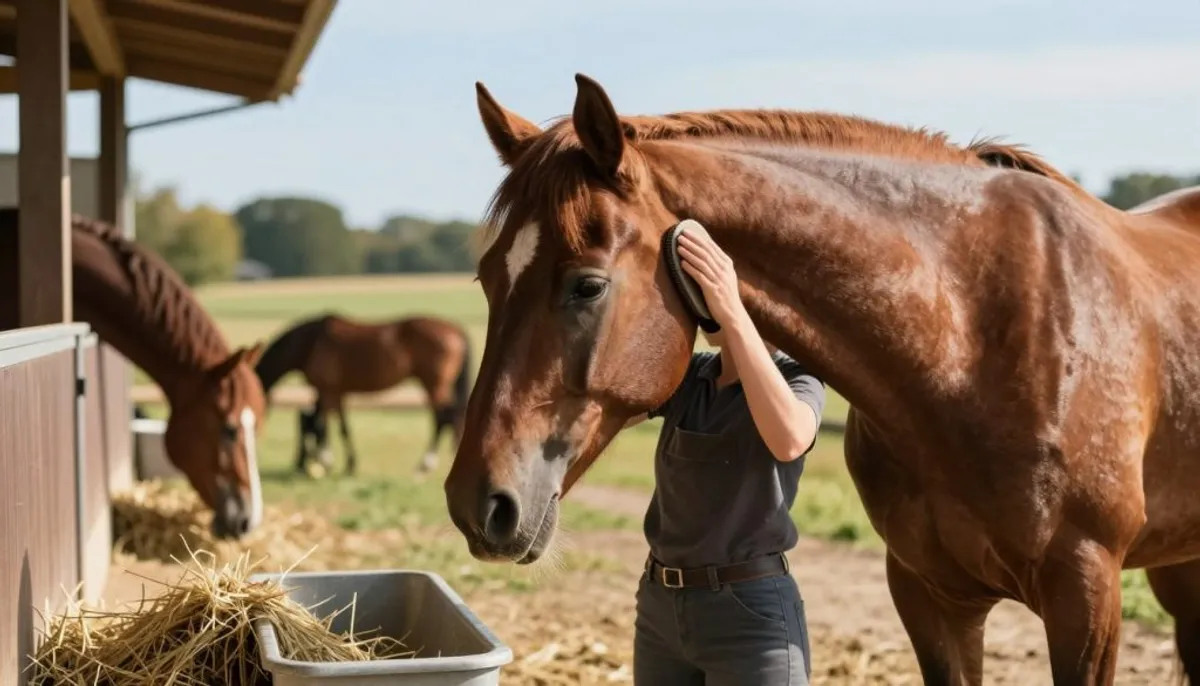
Grooming helps remove mud and check the condition of the skin. It is the moment to ensure everything is fine under the saddle. This care reduces the risk of injury.
The horse's hooves should be inspected daily. Ensure there are no stones or bad odors. Hoof and dental care is crucial for overall health.
Decisions regarding blankets are based on the weather. Do not overprotect the horse. A horse too covered may feel cold once the blanket is removed.
Prevention: Warning Signs and When to Call the Veterinarian
It is important to know what is normal for your horse. Unusual behavior can indicate a problem, such as colic. If the horse is limping, appears tired, or coughs at rest, quick action is needed.
In case of doubt, describe the symptoms precisely: temperature, breathing, color of mucous membranes. Many owners use a notebook with an index and photos for visual tracking. A guide from Gründ (1977, 192 pages) offers useful checklists for daily care.
Horse Breeding: Principles, Selection, and Responsibilities
Horse breeding aims for a specific goal: sport, leisure, or work. This choice impacts everything, from work to the attention needed. In France, being consistent and patient is essential for success.
Horses are selected based on their appearance, posture, movement, and temperament. Breeds can indicate their aptitude, but each horse is unique. Observing a horse daily gives good insights into its character.
Horse reproduction requires organization: monitoring cycles, selecting the male, health checks, and managing births. Veterinarians are essential for planning, vaccinating, and managing emergencies. Breeding centers and breed associations offer help and information to properly follow each animal.
The well-being of horses is not just about a nice pasture. They need clean water, good hay, shelter, and companionship. Horses that are alone or have little interaction learn less well and are more stressed.
Caring for a horse requires time, money, and good organization of space. It is important to think early about socializing the young horse through gentle actions. Gradually learning to accept the rider will help it physically and mentally.
| Decision Point | What to Check | Direct Impact on Horses |
|---|---|---|
| Breeding Goal | Sport, leisure, draft, level of demand and outlets | Education program, growth rate, type of valorization |
| Choice of Breeders | Conformation, health, performance, temperament, genealogy | Quality of limbs, mental balance, ease of work |
| Infrastructure | Safe fencing, foaling areas, quarantine, access to farrier | Fewer injuries, better recovery, easier monitoring |
| Traceability | Identification, notebook, health monitoring, sales with complete documents | Trust in purchase, clear history, better protection for the foal |
| Future of Foals | Serious network, contracts, placement plan, long-term budget | Less overproduction, more stable transitions, better-managed lives |
It is important to anticipate the future of foals for a solid ethics. Choosing reliable partners and being realistic about demand helps the breeder and the horses. Choosing a horse breed should help achieve a solid project, not follow a trend.
Responsible purchases, such as second-hand equipment, reduce costs and waste. The model Label Emmaüs, a SCIC-SA where 100% of revenues are reinvested and 1/3 of employees are in integration, shows how the solidarity economy can support responsible breeding management.
Saddleries and Equipment: Quality, Comfort, and French Know-How
In saddleries, distinguishing between an impulse purchase and a practical purchase is essential. In riding, safety is the first priority, followed by comfort and durability. These criteria ensure the well-being of horses, avoiding discomfort caused by inadequate equipment.
Rider and Horse Equipment: Essentials to Prepare
For the rider, a compliant helmet is mandatory. Boots or shoes, mini-chaps, and gloves should be added for a better grip. Depending on the activity, a protective vest can be an asset, especially outdoors or during jumping.
For the horse, it is crucial to start with a well-fitted halter or bridle. A clean saddle pad and an appropriate girth are also necessary. Depending on the discipline, additional protections like boots or bell boots may be added, and a blanket if needed. A simple maintenance kit is also essential.
- Priority 1: helmet, adjustment, overall condition of equipment.
- Priority 2: comfort (breathable saddle pad, stable girth, gloves).
- Priority 3: useful options depending on riding (protection, blanket, vest).
| Need | For the Rider | For Horses | Control Point in Saddleries |
|---|---|---|---|
| Safety | Compliant helmet, vest according to practice | Protections adapted to the discipline | Sizes, straps, closures, wear |
| Comfort | Boots/shoes, mini-chaps, gloves | Saddle pad, girth, well-adjusted bridle | Pressure points, stability, breathability of textiles |
| Maintenance | Technical clothing easy to wash | Brushes, hoof pick, leather care | Ease of cleaning, replaceable parts |
How to Choose a Suitable Saddle: Morphology, Discipline, Adjustments
A well-fitted saddle respects the horse's shape: withers, back, and shoulders. If it is too narrow, it can cause injury; if too wide, it moves. This can create discomfort and affect performance.
The type of riding is also crucial. Jumping, dressage, or endurance require different supports. Properly adjusting the saddle makes all the difference. Trying the saddle, then having a professional check can prevent problems.
Focus on Craftsmanship: La Sellerie Française and High-End Made in France
La Sellerie Française is known for its premium quality and French craftsmanship. It offers unique products, custom-made or in limited editions. Everything is made in France by talented artisans. Their work stands out for the quality of leathers, stitching, and finishes, designed to last.
Their approach aims for performance as well as comfort. Good leather adapts well, stays in place, and retains its shape. For riding, this means better contact with the horse. It also allows the horse to be more responsive, thanks to equipment that supports its movements.
Conclusion
In France, history and landscapes contribute to the magic of horses. They have helped in the fields, then in sports and leisure. This fascination also comes from the daily bond based on listening, gentleness, and trust. Understanding horses means learning to respect them better.
The different breeds present unique shapes and personalities, ranging from saddle horses to draft horses. Riding improves when safety comes before speed. This includes good equipment, following simple rules, and having good supervision. A good equestrian club offers a place for everyone, with appropriate horses and regular training.
The well-being of horses is essential. It is important to ensure they have good forage, water, hoof care, and to be attentive to the first signs of problems. Breeding also requires great attention, as it involves many years of care and selection. For more information, the Gründ book (1977) (ASIN B000XUIT6E, ISBN-13 978-2700001945, 192 pages, with maps, index, and photos) provides valuable insights into horses and their world.
To progress, take the time to observe and train before regularly engaging in riding. Choose durable and quality equipment, and always check that it is well-fitted. For this, trusted spaces like Label Emmaüs (customer service 9 am–5 pm, Mon-Fri; payment Hipay, 3D Secure, SSL; service fees indicated, updated August 18, 2025) are recommended. And for those seeking the best, La Sellerie Française offers excellent equipment made in France, for both horses and riders.
FAQ
Why do horses fascinate so much in France?
They have always been part of French culture. They are seen in leisure, competitions, and celebrations. Their breeding passes knowledge down through generations.
What role do mounted animals play in French daily life?
They are at the heart of many outdoor activities and clubs. People ride, engage in equestrian tourism, and more, creating connections. Even without practical purpose, this enriches social life.
How does the human-horse bond change practice?
It makes learning and safety better. Knowing how to communicate and cooperate with the horse makes everything more enjoyable. Respect for these animals is essential, especially for novices.
Sport horse, leisure horse, and work horse: should one choose a side?
No, each role enriches the other. A horse can adapt and learn according to activities. In France, the function of horses has evolved without conflict.
What is the difference between horses and ponies?
Size differs with a threshold around 1.48 m. Ponies, being more robust, are popular for learning. Horses offer great diversity depending on their breeds.
What specific traits do donkeys have compared to horses?
Donkeys are cautious and assess risk differently. They require patience and consistency in care. They are unique, not just smaller versions of horses.
Mule and hinny: what exactly are they?
They are animals resulting from crosses between horses and donkeys. A mule comes from a donkey and a mare, while a hinny comes from a horse and a jenny. Each hybrid is unique.
What needs are common to all equines?
They need good food, water, movement, and companionship. They should also have shelter and regular care. These elements are fundamental for their well-being.
How to quickly read a horse's body language?
Observe its posture, ears, and eyes. A relaxed horse moves freely, while a nervous horse may tense up. These signs help adjust your approach.
How does an illustrated book help better understand horses?
It facilitates comparison of shapes and spotting signals. Useful for recognizing types of equines and their history. Gründ published a very comprehensive one in 1977.
How to navigate the diversity of horse breeds?
First, identify the major categories: saddle, draft, or intermediate. Then look at morphology and temperament. This helps choose according to your needs: sport, leisure, work.
What is the difference between saddle horses and draft horses?
Saddle horses are versatile and agile. Draft horses are strong and calm, perfect for driving. These two categories sometimes meet in new disciplines.
What criteria to use when choosing a breed or type of horse?
Consider your experience, goals, budget, and available facilities. Also think about the horse's character and your time. Documented resources that help compare are useful.
What are the most common riding disciplines in France?
Initiation, dressage, jumping, and endurance are widely practiced. Each discipline has its learning pace. The best is to test and then specialize over time.
What are the typical steps to learn to ride safely?
Start by understanding the horse's behavior, then learn posture and commands. Being consistent and well-supervised helps a lot.
What safety rules are essential when riding?
Always wear a helmet, check equipment, and maintain a good distance between horses. The horse's condition and good preparation are key to avoiding risks.
How to choose an equestrian club suited to your level?
Look for qualified instructors with good pedagogy. The organization of lessons and the well-being of horses are important. A good club takes the time to explain and adapt lessons.
Which club facilities matter most in daily life?
Well-kept facilities and clean storage are essential. Having saddleries on site is an asset. The state of the equipment reveals the seriousness of the club.
How to estimate your monthly riding budget for sustainability?
Add up the costs of lessons, membership, and equipment, then divide by month. Allow a little extra for unexpected expenses. This helps stay motivated without surprises.
How to recognize a reassuring online purchasing framework for equestrian equipment?
Look for accessible customer service and secure payment methods. For example, Label Emmaüs guarantees safety and transparency when purchasing online.
What should one know about Label Emmaüs if they want to buy more responsibly?
A: Label Emmaüs reinvests in employment and trains those distanced from work. It is a sustainable choice for thoughtful purchases.
How to properly feed a horse daily?
Choose good forage, ensure access to water, and adjust the ration. Be attentive to rapid dietary changes and hydration.
What simple horse care routine to adopt?
Groom the horse regularly, monitor its hooves, and follow the farrier's advice. Veterinary checks and proper adjustment of blankets are crucial.
What warning signs should prompt a call to the veterinarian?
In case of colic, lameness, or respiratory issues, act quickly. A good guide can help spot these concerning signs.
What are the fundamentals of horse breeding in France?
The goal is often related to sport, leisure, or other tasks. It requires constant attention and a caring approach from the start. Education and monitoring are key.
What ethical responsibilities accompany breeding?
It is important to think about the future of the animals and avoid overproduction. All aspects, from cost to ethics, need careful planning.
What equipment is essential to start riding?
The rider needs a helmet, appropriate shoes, and other safety gear. For the horse, prepare the essentials for riding and care. Safety should always come first.
How to choose a saddle that fits the horse's morphology?
The saddle should not hinder the horse and adapt to several criteria. A good fit is crucial for the animal's well-being.
Why prioritize quality saddlery for the rider-horse pair?
Good equipment protects, aids in practice, and lasts long. It contributes to the comfort and safety of all.
What does La Sellerie Française offer and how is it different?
A: La Sellerie Française (https://laselleriefrancaise.com) sells exclusive and made in France items. These are quality products, made by experienced artisans. They support French excellence.
RelatedRelated articles
- 18 Mar 2026·21 min readNatural Care for Horses – Ultimate GuideGeneral
 Taking care of horses is a daily practice. This includes watching, touching, smelling, and noting changes. A good horse care guide does not promise the impossible. Instead, it teaches how to perform regular gestures suited to each horse and season. O...