
Riding an Icelandic horse is a unique experience. This small horse, strong and gentle, is known for its kindness. It makes riding easy, even for beginners.
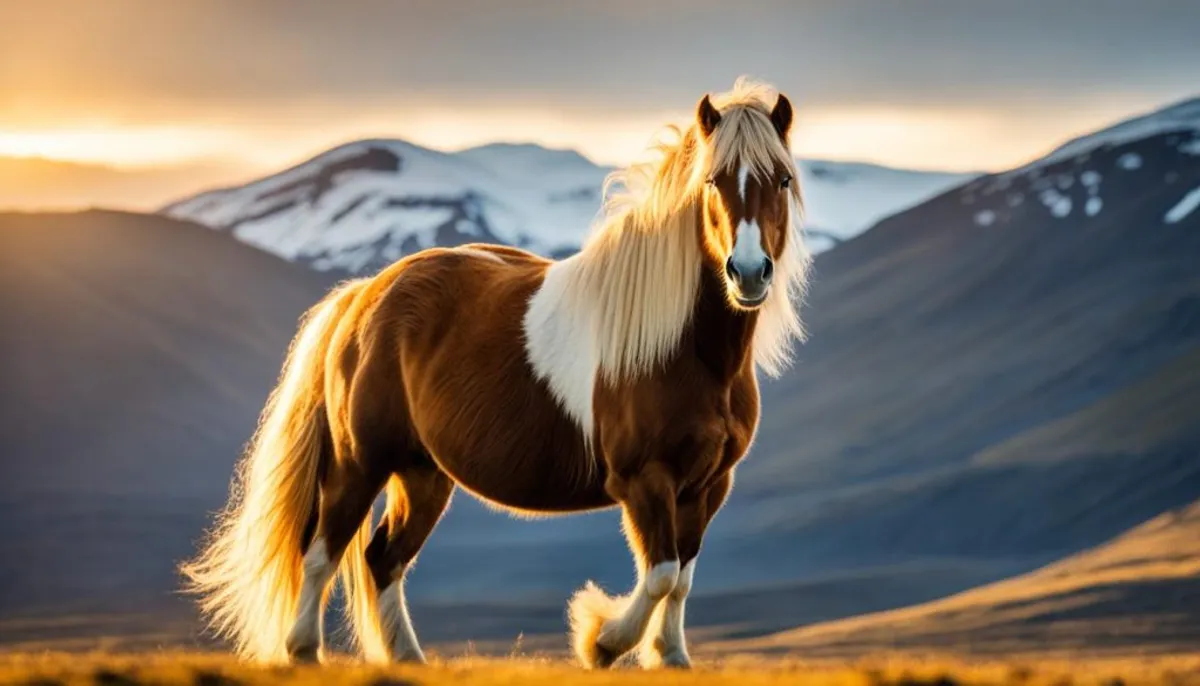
In Iceland, the landscape adds to the adventure. Black lava fields, green hills, and fresh air make every ride exceptional. From Reykjavík, nature is easily accessible, making the call for horseback riding irresistible.
We will explore why the Icelandic horse is so loved in France. We will discuss its temperament, comfort, and its five unique gaits. You will learn everything to prepare for your horseback riding adventure in Iceland: duration, guidance, equipment, breeding, and even the sporting aspects.
Key Points
- The Icelandic horse is known for its kindness and reassuring nature.
- The landscapes near Reykjavík combine lava fields and green hills.
- A horseback ride in Iceland is easy to prepare, with simple logistics.
- The Icelandic horse is distinguished by its 5 gaits, including the famous tölt.
- The comfort of riding explains a large part of its success.
- Breeding and local culture are as important as the ride.
Why the Icelandic horse fascinates riders in France
In France, the Icelandic horse captivates from the first encounter. One is charmed during a trial session, then returns seeking the peace it provides. It is stable and always ready to work, even if one lacks much experience.
A friendly and reassuring temperament, ideal for beginners and experienced riders
The Icelandic horse stands out for its gentle nature and easy contact with humans. For novices, its good humor helps to relax and learn. Experienced riders find in it a reliable ally to refine their technique.
This type of horse is highly appreciated by trainers. It allows for clear learning: gentle starts, precise rhythm changes. The Icelandic horse remains calm even outdoors, an asset when things change quickly.
A comfortable ride appreciated for leisure riding and trekking
For those seeking leisure and well-being in the saddle, the Icelandic horse is perfect. With it, our body remains relaxed and at ease. On a trek, this comfort is even more appreciated: one can admire the landscape while maintaining good posture.
Depending on the group, the ride can be leisurely or a bit faster. Regardless of the pace, the Icelandic horse gives us confidence. This encourages exploration without stress.
A companion suited for family riding, from child to adult
Sharing is what matters with the Icelandic horse. In a family, everyone can enjoy it: first a child, then an adult. This simplifies group outings and makes them more enjoyable.
People also love the routine it creates: preparing the horse, grooming it, then heading out for a ride. When everyone returns happy, one understands the appeal of this animal.
| What riders seek | What the Icelandic horse often provides | What this changes in leisure riding and horseback trekking |
|---|---|---|
| A horse that instills confidence | A friendly, attentive, and unflappable temperament | More serene starts, a more relaxed rider, outings labeled as “easy” |
| Comfort over time | A stable ride and gentle sensations | Less fatigue, better posture, more enjoyment over several kilometers |
| A modifiable pace | An ability to remain consistent at a walk and keep up with a group | Slow and steady rides possible, with an option for a faster pace |
| A “family” horse | Characteristics of the Icelandic horse centered on kindness and versatility | A practice shared across generations, from the riding school to horseback trekking |
Icelandic horse: an iconic and endearing breed
In France, the Icelandic horse evokes vast expanses and natural riding. It is chosen for the pleasure it brings. One then discovers that progressing pleases it.
A recognizable and versatile Icelandic horse breed
Recognizable by its stature and mane, the Icelandic horse is confident on a ride. It moves calmly, adapting its pace to varied terrains. Its calm yet lively mind appeals to riders.
It is relaxed during leisure outings and precise in the arena. It changes gaits easily, showing constant attention. Its adaptability reassures those seeking a companion for adventure and work.
What makes it unique in the eyes of enthusiasts worldwide
Riders see the Icelandic horse as a natural and cooperative partner. Easy to direct, it loves to exert itself and conserves its energy. This harmony creates a special bond between the horse and its rider.
It also impresses with its resilience and effort management. It engages in activities without losing its will. For many, it is both a horse of the heart and of practice.
The pleasure of “new sensations” in the saddle thanks to the gaits
The Icelandic gaits mark a turning point for many riders. They offer five gaits instead of the usual three. This diversity makes movement more dynamic and variable, enhancing comfort.
Experiencing these gaits encourages improved communication with the horse. One learns to manage speeds with precision, bringing more serenity to the overall experience. Thus, practice becomes a pleasure to discover gradually.
| What we seek | What we feel in the saddle | What we can work on |
|---|---|---|
| Calm horse outdoors | A sure step, a regular cadence, few surprises | Direction, balance, simple transitions on paths |
| Comfort and variety | Discovery of the Icelandic gaits, sensation of gliding and rhythm | Stability, impulse management, return to calm |
| Technical progression | A horse that responds without tensing up | Speed adjustments, precision of aids, continuity in the five gaits |
History of the Icelandic horse and equestrian culture in Iceland
In Iceland, the horse is everywhere, in farms and on roads. Its history unfolds through landscapes and travel tales. For the French, discovering Iceland on horseback offers a unique experience.
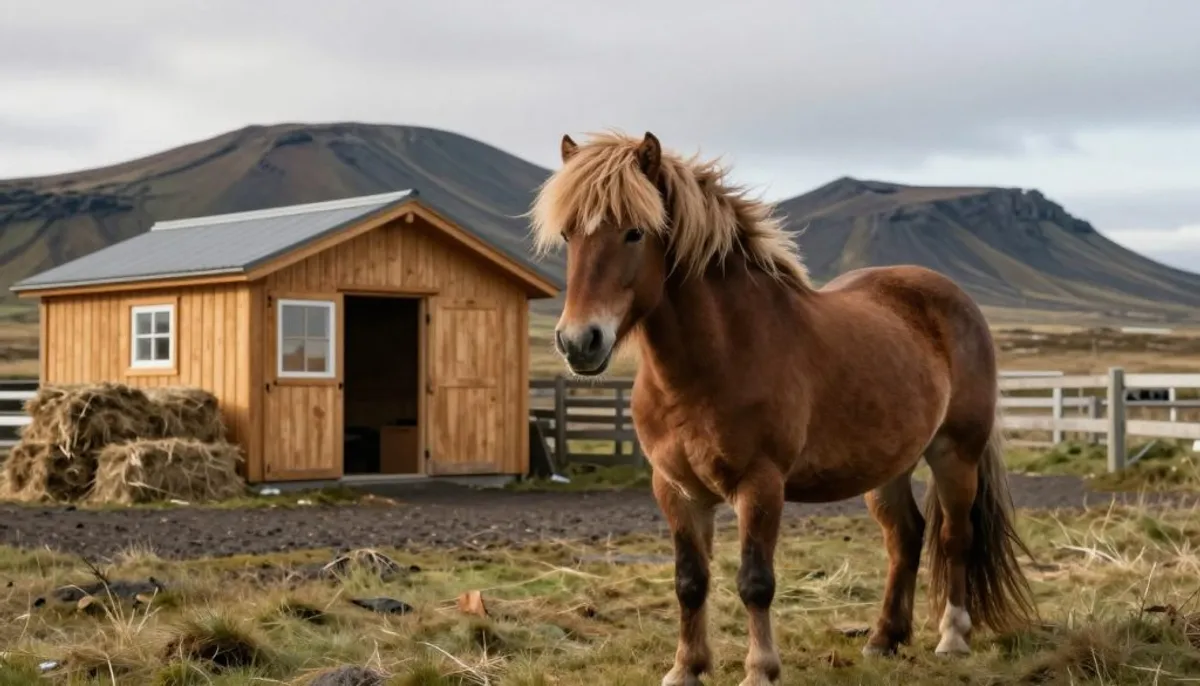
An emblematic horse linked to Icelandic landscapes and lifestyle
The Icelandic equestrian culture is fully appreciated by traversing natural terrains. Crossing lava fields recalls the youth and life of the Icelandic soil. Shortly after, the landscape transforms, revealing green hills.
The Icelandic horse is much more than a leisure activity. It is a reliable companion, suited to the climate and long journeys. Its endurance enriches its history, balancing utility and local pride.
Between tradition and equestrian tourism near Reykjavik
Equestrian practice is accessible from Reykjavík. A short drive easily leads to the stables. Equestrian tourism in Reykjavik offers outings suitable for everyone. Beginners and experienced riders can explore on horseback without fear.
The experience continues well after the ride. Hot drinks and relaxation moments with the horses are offered at the stables. This allows for photos and appreciation of the Icelandic equestrian culture, based on sharing and contact.
| What we experience on site | What it brings to the journey | Concrete detail |
|---|---|---|
| Volcanic landscapes | A “terrain” reading of the history of the Icelandic horse | Passages over ancient lava fields, black soils, and minerals |
| Countryside close to the city | Equestrian tourism in Reykjavik is easy to fit into a schedule | Departure from Reykjavík, quick access to the stables by car |
| Welcome at the stables | A lively glimpse of the Icelandic equestrian culture | Hot drinks, free time, photos, and interaction with the horses |
Characteristics of the Icelandic horse: morphology, temperament, and hardiness
The Icelandic horse strikes with its compact build, strong neck, and short legs. Its robust feet help it remain stable on various terrains, such as forests or near rivers. In France, its manageable size is highly appreciated as it instills confidence in riders, whether mounting or stopping.
Mentally, the Icelandic is known for its gentleness and friendly attitude. It enjoys contact, is attentive and reassuring, which is very valuable for outdoor rides. Trainers love it because it makes learning easy and peaceful.
The Icelandic horse is naturally hardy, capable of facing the elements without losing motivation. However, this does not mean it does not require care. This endurance contributes to making rides more enjoyable and safe.
This horse easily adapts to different activities. It can offer a peaceful ride or a more exciting experience for experienced riders. It depends on the relationship between the rider and the horse. The goal is always to ensure constant comfort with a stable attitude.
| Aspect | What we often observe | What it changes in riding |
|---|---|---|
| Morphology | Strong back, compact body, solid feet | Stability on paths, better ease in uneven passages |
| Mental profile | Gentle, attentive temperament, close to humans | Less stress in groups, easier management of starts and stops |
| Hardiness | Endurance, sobriety, resistance to changing conditions | Easy outings over moderate durations, constant pace without forcing |
| Versatility | Clear responses to aids, modifiable energy | Peaceful or more active rides, depending on the level and goal of the day |
With such a foundation, the Icelandic horse offers a unique experience in the saddle. This is due to its special gaits: the Icelandic gaits. They make the time spent together unforgettable.
The Icelandic gaits and the five gaits in the saddle
Riding an Icelandic horse offers a unique experience in equestrianism, valuing rhythm and direction. The different Icelandic gaits adapt to the terrain, the horse's energy, and the rider's level. One benefits from increased comfort and better precision in applying aids.
Understanding the 5 gaits and what they change for the rider
The five gaits bring a new dimension to the rider's feeling. They impact the sensation in the pelvis, the handling of the reins, and stability. Riding an Icelandic horse is like discovering a new palette of colors to paint the landscape of the ride. It teaches the rider to feel balance rather than force it.
To start, simply understanding these gaits is essential:
- Walk: calm, ideal for adjusting direction and relaxation.
- Trot: more energetic, practical for working on impulse and straightness.
- Canter: engaging, requires a good frame and a responsive horse.
- Tölt: fluid, uninterrupted, appreciated for its comfort.
- Amble: fast and demanding, to be used in specific conditions.
The Tölt: a comfortable gait to work on with guidance
The Tölt is particularly enjoyable because it allows for a stable position. Many find this gait pleasant for long journeys or on tracks. However, without proper mastery, the gait can be lost if the horse accelerates too much or becomes unbalanced.
An instructor can guide the rider to maintain the right rhythm. The goal is to master acceleration without losing the rhythm, then to slow down without unbalancing the horse. Thus, the Icelandic gaits become clearer, and the rider feels more confident.
Refining the mastery of gaits on a training track, in guided autonomy
The training track allows one to focus on their feelings away from external stress. One practices transitions, posture, and consistency while paying attention to the horse's breathing. In guided autonomy, everyone progresses at their own pace, guided by clear instructions.
| Objective on the track | What the rider does | What it brings to the five gaits |
|---|---|---|
| Rhythm stability | Breathes, sets a tempo, keeps hands calm | More precise transitions, smoother gaits |
| Balance and direction | Looks far, uses legs slightly, keeps the torso upright | Less deviation, better-controlled trajectories |
| Quality of the Tölt | Slows down before the request, relaxes once correct | Stabilized tölt, better comfort |
| Energy management | Varies between active walk and pauses, briefly asks and then rewards | More responsive horse, better control of gaits |
On an Icelandic horse, these practices clarify the five gaits without excessive effort. They allow for refining the adjustment of aids and better enjoying the Icelandic gaits, in the arena or in the great outdoors.
Icelandic breeding: selection, well-being, and the know-how of breeders
In Iceland, seeing horses live freely in herds helps us understand their breeding. They live outdoors, braving the wind, on different types of terrain. This experience transforms our view, revealing not just a horse but also a breeding culture, a lifestyle, and simple daily relationships.
Meeting Icelandic breeders and understanding their approach
Icelandic breeders observe their horses closely: their behavior outdoors, their reaction to new things, their ease of being approached. They value mental balance as much as physical appearance. This creates calm horses, both in nature and in competition.
Talking with them can greatly assist a French rider considering importing a horse from Iceland. These conversations provide insights into the horse's education, its follow-up, and what one can expect from it based on its age and level.
The link between selection, kindness, and trust in horseback riding
A key point emphasized by trainers is the selection of easy and pleasant horses. This kindness positively influences the riding experience, especially when the horse remains calm in the face of surprises.
Trust also arises from gradual training: acceptance of the rider, maintaining a gentle contact, and following a clear direction. With the Icelandic horse, this approach reassures beginners and offers experts a solid foundation to perfect their techniques.
What riders and instructors often seek in this breed
In France, the Icelandic horse is sought after for its comfort, reliability outdoors, and ability to suit all family members. Its versatility is a major asset, allowing it to excel in both leisure rides and flat work, and to progress towards an increasingly mastered tölt.
| Frequent expectations | What we often observe in the Icelandic horse breed | Points to check before importing Icelandic horses |
|---|---|---|
| Comfort over time | Soft gaits, stable saddle, reduced rider fatigue on treks | Quality of the walk, balance, adaptation to the saddle and rider's weight |
| Regularity outdoors | A horse that is forward-going, focused, capable of transitioning between paces | Habituation to vehicles, group management, response to voice commands |
| Technical progression | Modifiable cadence, tölt work possible with guidance | Level of training, clarity of aids, flexibility of back and neck |
| “Family” use | Simple handling, calm temperament, good tolerance for mistakes | History of handling, respect on foot, reactions to mounting |
The balance between well-being, careful selection, and education is what makes Icelandic breeding so special. This is why many riders quickly fall under the charm of these horses. Then they consider importing them to France, to experience this beautiful adventure every day.
Trekking and equestrian tourism: riding between lava fields and hills
For a stress-free horseback ride in Iceland, organization is simple. One starts in Reykjavík and quickly moves away. In no time, the landscape changes and the air becomes fresh.
Itineraries close to Reykjavik with a journey of about 20 minutes to the stables
The journey begins with a short transfer, of about 20 minutes, offering beautiful views. Upon arriving at the stables, we prepare and meet our Icelandic horses. The guides explain the basics before we set off.
This option is ideal for those who want to discover both the city and nature. One feels far away, while everything is nearby.
Easy and accessible outings: about 1.5 to 2 hours of riding (activity ~4 hours in total)
The guided ride lasts 1.5 to 2 hours. In total, the activity lasts about 4 hours. The level is easy, perfect for a family outing. Children from 7 years old can participate.
The landscapes are magnificent: lava fields, black soil, then green hills. The wind and light change quickly. These contrasts make the ride unique.
An experience all year round, designed for both novices and experienced riders
Groups often include beginners and advanced riders. Everyone progresses at their own pace, guided by the instructors. Riding an Icelandic horse is a unique sensation, even on volcanic terrain.
The end is friendly: we return to the stables for a coffee, tea, or hot chocolate break. It is a pleasant moment that concludes the experience. We remember the warm welcome and the beautiful landscapes.
| Step | Indicative duration | What we experience | Level |
|---|---|---|---|
| Departure from Reykjavík | Few minutes | Quick briefing and setup for the transfer | Easy |
| Transfer to the stables | About 20 minutes | Scenic drive, exiting the urban area | Easy |
| Ground preparation | 20 to 40 minutes | Meeting the Icelandic horse, adjustments, instructions | Accessible for beginners |
| Guided ride | 1.5 to 2 hours | Lava fields, paths, green hills, modifiable pace | Easy to intermediate |
| Return and break at the stables | 15 to 30 minutes | Free coffee/tea/hot chocolate, relaxed debrief | Easy |
Equipment, safety, and preparation: succeeding in your outing in Iceland
In Iceland, one must be ready for any weather change. It is important to have good equipment. This includes items suitable for walking on volcanic paths or in wet grass. Good equipment makes the experience more enjoyable. For riders, being comfortable is crucial to follow movements without tension.
Equipment often included at the stables: helmet, boots, rain gear/warm clothing
The stables often lend necessary gear such as riding helmets, rubber boots, and rain gear or a warm outfit. This helps if you don't want to carry too much luggage. Additionally, it avoids issues of choosing the wrong size or forgetting something important depending on the season.
Before leaving, check what the stable offers and what it does not. Weather conditions like wind and rain can be exhausting. Properly protecting oneself makes a big difference in the long run.
Practical tips to prepare: warm layers, waterproof gear, gloves, sturdy shoes, water bottle
Wear several layers of clothing to be ready for any weather change. Start with thermal underwear, add a fleece, and finish with a waterproof jacket. This allows for easy adaptation. Don’t forget a hat, gloves, and a light scarf to protect against the cold.
- Waterproof and breathable jacket and pants if possible
- Sturdy shoes or boots suitable for wet ground
- Water bottle, light snack
- Phone or camera, well-stowed
This equipment increases safety during rides, especially on uneven ground. It also helps you stay fit to better enjoy the experience.
On-site organization: safes for valuables and lockers (no backpacks)
Generally, one avoids riding with a backpack. This prevents any discomfort during the ride. The stables often provide safes and lockers for your personal belongings.
If you are looking for quality gear, La Sellerie Française offers leather items and handmade saddlery accessories from France. You can find what you need without having to buy on-site.
| Item | Objective on Icelandic terrain | Practical tip before departure |
|---|---|---|
| Riding helmet (often lent) | Enhance equestrian trekking safety in case of a gust or deviation | Check the fit: chin strap tight, hair tied back |
| Rubber boots (often lent) | Keep feet dry in wet grass and mud | Bring thick socks to avoid chafing |
| Waterproof jacket + pants | Block wind and rain, stay focused in the saddle | Choose clothing that does not make noise while moving |
| Gloves + hat | Protect extremities, maintain a stable hand on the reins | Choose gloves that retain grip even when wet |
| Water bottle + snack | Avoid fatigue during the outing | Compact size, easy to leave in a locker without a backpack |
Guidance and experience on site: guides, groups, and rider comfort
From the moment of arrival, the atmosphere is welcoming. Equestrian guides in Iceland are well-trained, patient, and provide clear instructions. They speak English, Scandinavian, and German, which is convenient for those coming from France.
The outing is organized to be enjoyable for everyone. A group for horseback riding can have up to 20 people. They pay attention to maintaining appropriate distances and transitioning smoothly from one activity to another. This keeps a stable pace, which is safer and more fun.
Depending on their skills, participants can be divided into sub-groups. Those with more experience can go for a faster trot. Others may prefer a leisurely walk. Each rider is given a horse that matches their size and skills to ensure their comfort.
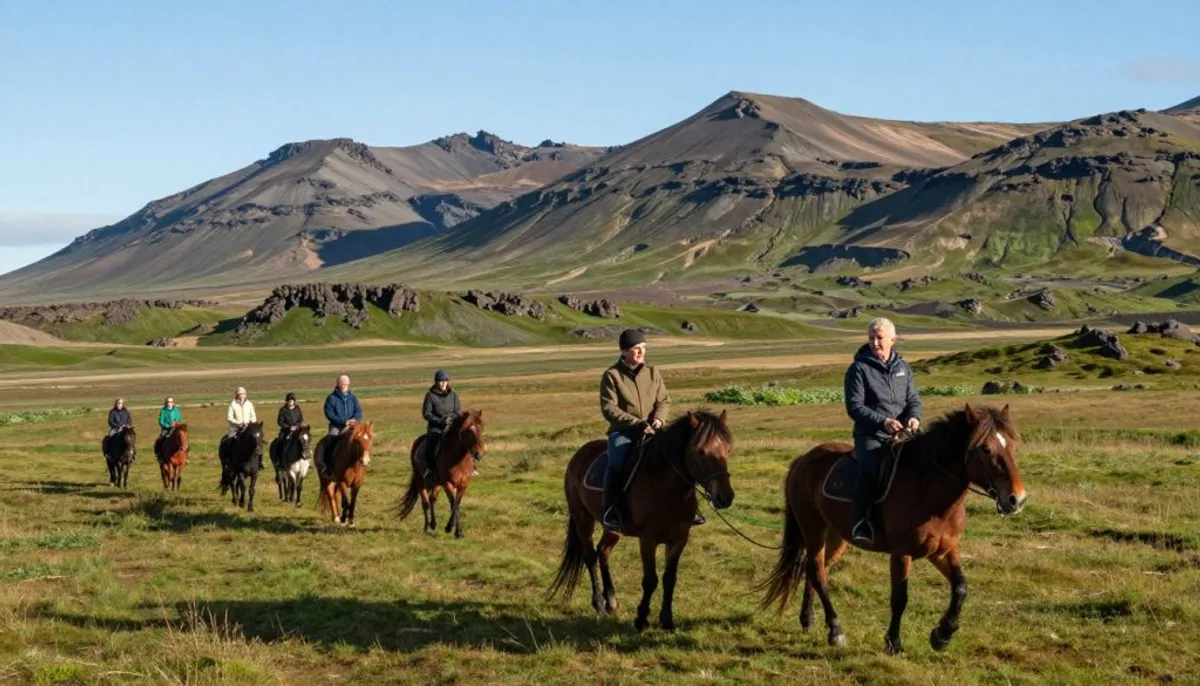
Comfort does not stop once dismounted. At the stable, one often finds all necessary equipment like a helmet, boots, and raincoat. This is very useful, especially when the weather changes quickly. After finishing, one can relax with a hot drink before leaving.
Booking for equestrian tourism is simplified thanks to practical services. Immediate confirmation and 24/7 assistance make everything less stressful. Some travelers also find benefits in joining the VIP Club of Guide to Iceland, offering priority service and discounts.
| Experience point | What it changes on the ground | What to pay attention to |
|---|---|---|
| Equestrian guides Iceland (announced languages) | Instructions understood, better management of pace and distances | Check the language at the time of booking if you are comfortable especially in French |
| Horse riding group (up to 20 riders) | Friendly outing, regular cadence, enhanced safety in line | Indicate your level to be placed correctly in the group |
| Sub-groups by level | Adapted gaits, less fatigue, more confidence in the saddle | State whether you want a relaxed or more sporty pace right from the briefing |
| Provided equipment + weather | Less load to carry, better protection against rain and wind | Still prepare gloves and warm layers for the upper body |
| Booking services (confirmation, assistance, benefits) | Simpler planning, support in case of changes, possible gains | Check the schedule, meeting point, and conditions before departure |
Competitions of the Icelandic horse and sports practice beyond trekking
After a ride, some riders want to go further. They seek to be more precise and better control their mount while looking for stronger sensations. Competitions of the Icelandic horse offer this without losing the friendliness inherent to this breed.
On the track, the Icelandic gaits become a true challenge. Riders work to achieve a regular cadence, good posture, and follow a precise line. This work is organized in stages, with clear and measurable objectives.
From leisure to performance: when gaits become a technical goal
Turning to sport means paying attention to details. One adjusts their position, balance, and how to respond to aids. Changes of gait become specific exercises, not just a means of moving from point A to point B.
This method also appeals in France as it structures practice. It allows for progression without stressing the horse. Training becomes more varied, even in small spaces.
Learning to “accelerate” and channel the Tölt with adapted teaching
The Tölt, appreciated for its comfort, requires precision. Accelerating means seeking a steady force while keeping a relaxed neck and well-placed back.
Good guidance consists of simple exercises: first in a straight line, then in circles, before returning to a walk. This reinforces stability and serenity. The dialogue between the rider and their horse then becomes smoother.
The role of facilities and instructors to progress with confidence
Dedicated sports facilities maintain a friendly atmosphere. They offer practical sessions and moments of sharing. The instructor works on specific aspects: rhythm, use of hands and legs, the way to breathe.
Progression occurs in three phases: guided, semi-autonomous, and finally autonomous with advice. This process is reassuring, especially for those aiming for Icelandic horse competitions. It also helps define a clear project, whether for leisure, technical improvement, or competition.
| Rider's objective | Focus on the track | Key point to monitor | Desired outcome |
|---|---|---|---|
| Discover the Icelandic gaits | Transitions walk–trot–canter, seeking regularity | Stable position and simple aids | Understand the horse's reactions and gain comfort |
| Stabilize the Tölt | Cadence, straightness, amplitude variations | Energy without rushing | A fluid gait, easy to maintain |
| Prepare for Icelandic horse competitions | Figures, precision, stress management | Constant rhythm and quality of transitions | Sharper presentation and better reading by judges |
| Build a project in France | Training plan, choice of guidance, frequency of sessions | Fit between horse–rider–objective | Decide calmly on an import of Icelandic horses |
Conclusion
The Icelandic horse is loved for its friendly character and trustworthiness. In France, it is appreciated for its robustness and stable spirit. It is easy to bond with it, perfect for equestrian leisure, alone or with family.
It offers true comfort when ridden, thanks to its five unique gaits. Icelandic breeding has focused on quality of movement and ease of riding. Above all, the Tölt makes rides more enjoyable, with fewer jolts and more fun.
Horseback treks in Iceland are simple adventures. Near Reykjavík, excursions traverse landscapes of lava and hills. These outings last between 1.5 and 2 hours, in an activity of ~4 hours, available all year round. Experienced guides lead the groups and often provide necessary equipment.
Before leaving, it is important to dress well, take a raincoat, sturdy shoes, and a water bottle. Following the rules is essential for a worry-free experience. Consider investing in quality equipment from La Sellerie Française, made in France. With an Icelandic horse, new adventures await you, whether for trekking, gait training, or more technical practices.
FAQ
What makes the Icelandic horse so “special” for a trek in Iceland?
The Icelandic horse is truly kind and friendly. It is easy to feel confident with it, especially outdoors. Its 5 unique gaits offer exceptional experiences. Imagine crossing lava fields and green hills near Reykjavík.
Is the Icelandic horse suitable for beginners?
Absolutely. It is an activity suitable for both beginners and more advanced riders. These horses are calm and gentle, making the experience enjoyable and safe.
Why is there talk of great riding comfort with this breed?
Riders often say they feel very good on an Icelandic horse. This feeling is due to its friendly behavior. The Tölt, with its smoothness, adds to the comfort of riding.
Is the Icelandic horse suitable for family riding?
Yes, it is perfect for families. It can carry children and adults, making the experience intergenerational. Organizers ensure that the horse and pace are adapted to each rider.
What do the landscapes look like during a ride near Reykjavík?
The rides explore ancient lava fields and countryside with beautiful hills. It is a lovely way to discover Icelandic nature on horseback.
Where does an excursion depart from and how long does it last?
Excursions depart from Reykjavík, about 20 minutes by car from the stables. A ride typically lasts from 1.5 to 2 hours, with a total duration of about 4 hours including transport and time spent at the stables.
Can one choose a “calm” or more dynamic pace during the ride?
Of course. Organizers often offer leisurely rides to enjoy the views. For those who wish, there are faster options, in small groups, for more comfort and safety.
What are the Icelandic gaits and why are there 5 gaits?
The Icelandic horse is unique with its five gaits. This changes the experience of speed and movement. People love these new sensations, whether for leisure or more technical uses.
What is the Tölt and why is it so sought after?
The Tölt is a special gait that seems to glide, very pleasant. Instructors on site can show you how to master this gait. For advanced riders, it is even possible to accelerate while remaining in control.
Can one train the gaits on a training track?
Some stables offer sessions on a track to discover the 5 gaits. You can practice independently while benefiting from advice to improve your experience.
What does “Icelandic breeding” mean and why do we meet Icelandic breeders during a trip?
Meeting Icelandic breeders allows you to discover the unique culture of the island surrounding breeding. It is an enriching experience that strengthens the bond with these exceptional horses.
What are the most cited characteristics of the Icelandic horse (temperament and hardiness)?
Their gentle temperament, friendly nature, and ability to reassure are highly valued. Their robustness is also a remarkable characteristic, inherited from their history and outdoor lifestyle.
Is the activity accessible to children, and from what age?
One can start from 7 years old, depending on the organizer. The outings are designed to be simple and safe. It is a great family activity thanks to the versatility of the Icelandic horse.
What equipment is generally provided during outings?
The stables often lend helmets, rubber boots, and clothing suitable for the Icelandic climate. Everything is designed for your comfort and safety.
What should one bring to manage Icelandic weather well?
Wear several warm layers, a hat, gloves, and a scarf. Have a waterproof jacket and pants. Don’t forget sturdy shoes, a water bottle, and, if you wish, something to take photos.
Can one ride with a backpack during the ride?
No, for safety and comfort reasons. Safes are available for your personal items.
How does the guidance work (guides, languages, group size)?
Guides are well-trained and speak several languages, including English and Scandinavian. Groups can have up to 20 people, with adjustments based on each person's level.
Is there a friendly moment after the ride?
Yes, it is customary. You can stay a bit at the stables to relax and chat. Hot drinks are offered, and it’s a good time to take photos.
Are excursions available year-round and easy to integrate into a trip?
Offers are available year-round and easily fit into any trip. Booking and organization are simplified for visitors.
Are there competitions for Icelandic horses and sports practice beyond trekking?
Yes, beyond treks, there are competitions that highlight the precision of gaits, like the Tölt. It is an opportunity to improve in a sporting context.
How does one transition from leisure to a more sporty objective with the gaits?
With good instructors, one learns to master speeds and enjoy the process. It becomes even more enjoyable when working on the Tölt and other gaits.
Why do some riders consider importing Icelandic horses after a trip?
After a wonderful experience, some want to continue practicing regularly. Importing an Icelandic horse can be an option for those looking to combine comfort and performance at home.
Where to find durable and high-quality equipment for horseback riding?
For quality gear, La Sellerie Française (https://laselleriefrancaise.com) offers premium items. Everything is made in France, with custom or limited edition options, made by local artisans.
RelatedRelated articles
- 10 Mar 2026·19 min readLocation of the Facteur Cheval PalaceGeneral
 Are you wondering where the Palais du Facteur Cheval is located? It's easy to find. It's in France, in the beautiful region of Auvergne-Rhône-Alpes, specifically in Hauterives Drôme. Finding the ideal palace is quite simple thanks to its location. It...