
In France, active stables are becoming an interesting solution. They address how to house a horse while respecting its essential needs. And this, without complicating the life of the team. This system combines groups of animals, freedom of movement, and technology to ensure the well-being of horses while facilitating management.
The concept is still not widespread, but it is gaining ground. Studies show between 14 and 16 active stable projects, either under construction or already operational. These numbers indicate that the idea is taking root in France, although it remains a minority.
The main attraction? A stable that ensures the total well-being of horses. Thanks to automation, the organization of key spaces, and simplified maintenance, some report up to 70% time saved. This mainly concerns feeding and cleaning if the stable is well thought out.
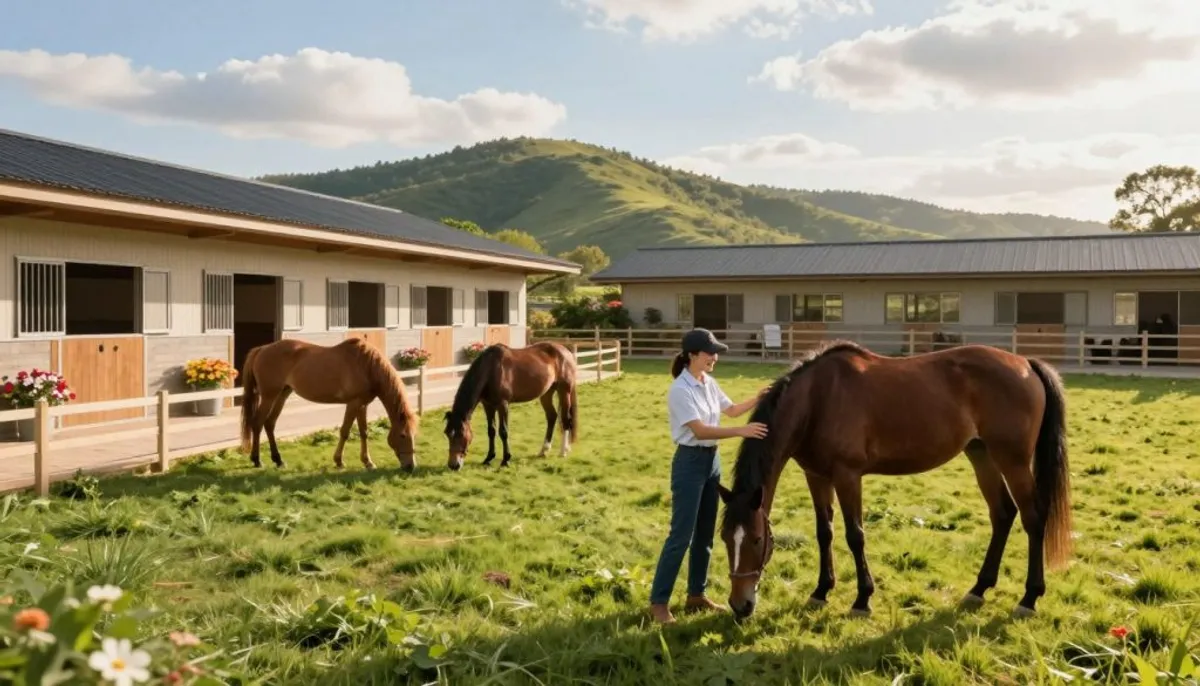
In France, the sector is also organizing. The Chambers of Agriculture of Charente and Drôme are interested in this model. The Equine Network in Nouvelle-Aquitaine and Horse Stop in Malissard share their experiences. They provide useful data and techniques for those managing these stables.
This article will explain how active stables are changing daily management. We will discuss the necessary surface area, flooring, areas of interest, how to manage the herd, and budgetary aspects. The idea is to combine respect for horses, appropriate feeding, and free movement while remaining realistic about daily management.
Key Takeaways
- The active stable aims for equine well-being while improving management comfort.
- The model remains a minority in France, with estimates of around 20 to 30 structures.
- ECOVEGETAL and SCHAUER are mentioned in field counts (14 to 16 projects built/ongoing).
- Actors such as the Chambers of Agriculture (Charente, Drôme) and the Equine Network in Nouvelle-Aquitaine share useful benchmarks.
- The well-being stable often relies on automation, mechanization, and thoughtfully planned circulation.
- Active riding seeks a balance between the natural needs of the horse and operational efficiency.
Understanding the concept of active stables and its origin
The active stable is increasingly discussed. It offers a lively environment for horses without complications. It is based on a clear idea: allowing the horse to move, choose, and interact. In a dynamically designed riding center, this makes the atmosphere much more pleasant as the herd creates a point of reference.
A housing mode invented by a German agronomist to improve equine well-being
A German agronomist created this concept 15 years ago. He aimed to improve the well-being of horses and simplify management. His goal was to do better, not to do more, by creating a space similar to a course.
The active stable uses a stabilized floor connected to various points of interest: water, feeding areas, shelters, and places to rest. Horses can move freely, making management clearer thanks to well-defined routines.
Why this model better meets the natural behaviors of horses than individual boxes
The individual box greatly limits horses. They move little and eat quickly, often up to three times a day. This facilitates logistics but does not meet the natural needs of horses. They need to walk, observe, and live in groups.
| Key Point | Individual Box | Active Stable |
|---|---|---|
| Social Life | Limited contacts, often through partitions | Herd, regular interactions, and social codes |
| Movement | Little walking outside planned outings | Daily circulation between areas and reference points |
| Feeding | Concentrated rations, fixed schedules | Better-distributed access, finer flow management |
| Work Environment | Many repetitive actions in the same place | Organized course, targeted maintenance of key areas |
A concept still little known in France, but developing
In France, the active stable is not very well known in the Southeast, noted Patrick Déaux. However, it is becoming known through technical days and demonstrations by Horse Stop and the Chamber of Agriculture of Drôme. These events showcase the innovative side of housing, according to Patrick Déaux.
Projects exist in Haute-Savoie, near Lyon, and in Deauville. In Eure (27), a project in Buret is underway for this summer. For riding centers, this growing popularity opens up new possibilities while simplifying daily life and improving the well-being of horses.
Active stable: the fundamental needs of the horse at the center
An active stable makes the horse's life more natural. It uses knowledge about horse behavior to plan space and time. The goal is to meet the essential needs of the horse in a practical and observable way.
The well-being stable offers the horse choices. It can move, rest, eat, or interact at will. This helps the horse to be more receptive and relaxed for riding.
Social life in a herd and interactions among peers
Horses like to be in groups. An active stable promotes constant contact among them. They can wash each other, nap together, or play before settling down.
Managing cohabitation is crucial. Affinities and access to resources are monitored. A well-being stable takes care of these aspects to ensure the tranquility and stability of the group.
Feeding spread throughout the day: a horse that eats over a long time frame
Horses need to eat for long periods, often at least 16 hours a day. An active stable ensures constant access to forage for healthy digestion and constant activity.
Feeding is monitored and adjusted according to needs. A balance is sought between the freedom to eat and portion control. This helps prevent overweight in some horses.
| Observed Point | Organization in Active Stable | Desired Effect on the Fundamental Needs of the Horse |
|---|---|---|
| Access to Forage | Distributed over a wide time frame | Long ingestion time, regular occupation, more stable rhythm |
| Concentrates | Adjustable quantities according to profile, with monitoring | Better-dosed energy, prevention of excess, weight management |
| Feeding Competition | Multiple zones and access designed to limit pressure | Less tension, better exchanges, calmer herd atmosphere |
Daily movements stimulated by separate points of interest
The movement of horses comes naturally. They move to drink, eat, or rest. They walk several times a day, according to their needs, without stress.
This activity is essential for their well-being. They remain curious and fit, thanks to an environment designed for them. This creates a solid foundation for active riding.
Essential layouts for a functional well-being stable
A good layout of an active stable is recognized because everything seems fluid. Horses circulate, eat, drink, and rest without problems. The aim is to have a clear, solid, and easy-to-clean space, even in winter. Choosing the right floor and intelligently placing points of interest simplifies daily life.
Stabilized surface and smooth circulation between key areas
A stabilized surface is essential. It prevents mud, keeps horses clean, and secures their movements. This surface connects different areas without creating bottlenecks.
Having wide corridors and double-secured entrances avoids disputes. Horses move easily, stop, and resume their path without stress. Well-draining floors prevent water from stagnating, thus protecting the terrain.
Points of interest: feeding, drinking, “dormitory” shelter, rolling and playing areas
The different points of interest encourage activity. Separating where horses eat, drink, and sleep promotes their movements. This also distributes their activities throughout the day.
The feeding area can vary depending on the project. It can be a common space or have personalized distributions. The use of automatic feeders ensures a regular routine. Spaces are created for horses to play or roll safely.
When weather permits, access to pastures expands living space. This access can be free or controlled, such as with sorting gates, to stay in phase with the rest of the stable.
Choosing durable and draining floors: stabilization slabs, sandy areas, rubber mats
Diversifying floor types is beneficial. Sandy areas provide comfort, rubber mats are practical for long standing periods, and stabilization slabs are suitable for frequent passages. This choice protects the floors and ensures good circulation, even in rainy weather.
In France, companies like ECOVEGETAL recommend this method. Although more expensive to purchase than a classic floor, it has the advantage of a homogeneous terrain that does not degrade in the rain. Water infiltrates, reducing mud and facilitating cleaning, making maintenance much simpler.
| Area | Recommended Floor | Why it’s Useful | Routine Maintenance |
|---|---|---|---|
| Passageways and intersections | stabilization slabs + draining floors | Uniform floor, rain infiltration, stable circulation | Light scraping, mechanizable collection, control of inputs |
| Around the feeding racks | rubber mats + stabilized surface | Less slipping, standing comfort, area that stays clean | Daily collection, occasional rinsing, leveling if needed |
| Waterers | stabilized surface + stabilization slabs | Limits puddles, protects surroundings, reduces trampling | Cleaning surroundings, checking drainage, local dredging |
| “Dormitory” shelter | stabilized surface + sandy areas | Rest comfort, drier ground, calm atmosphere | Removal of droppings, aeration of sand, occasional addition |
| Rolling and playing | sandy areas | Rolling possible without abrasion, natural cushioning | Raking, removing dug areas, sand supplement |
Automation and individualization of feeding: the heart of active riding
In an active stable, we do more than just give hay. We seek to follow a routine while meeting the specific needs of each horse. This helps keep the herd active while caring for each animal.
Feeding automates can provide several meals a day, in measured quantities. Hay is accessible in racks or distributed on demand. This depends on the installation and the desired level of control. Automation also manages concentrates and minerals, avoiding excesses.
For personalized rations without isolating the horse, identification is essential. A collar with a transponder, connected to software, is often used. There are also bracelets detected by antennas, teaching the horse to lower its head to access its food.
The parameters include the type of food, the quantity, and the access time. This approach prevents ration theft and reduces tensions. The devices are safe and designed to avoid injuries, thanks to their elastic elements.
The selective sorting gates manage horses' access to different areas based on their needs. This helps keep the stable organized, avoiding clustering and distributing horses evenly in the spaces.
There are simpler methods to personalize feeding. Sliding cornadis allow for direct human control, without electronics. Even though hay nets are not essential, they can help regulate consumption for some horses.
| Feeding Solution | Identification | What it Brings to Daily Life | Points of Attention in Active Stable |
|---|---|---|---|
| Horse feeding automate for concentrates and minerals | Collar + transponder, computerized settings | Fractionated distribution, precise dosing, less competition at feeding | Maintenance, adjustments to be made according to body condition and work |
| Automates with identification by bracelet (e.g., ECOVEGETAL) | Bracelet above the fetlock + low side antennas | Access validated at entry, control of access time, orientation towards an exit area | Learning phase, vigilance on bracelet adjustment and habituation |
| Free access feeding racks | Without identification | Easy to manage, encourages occupation and digestion over long periods | Monitoring of dominance, management of horses at risk of overconsumption |
| Sliding cornadis for individualized meals | Visual recognition by the team, gentle restraint | Simple alternative for a custom ration, good control of intakes | Human time, organization of passages, consistency with active riding |
| Selective sorting gates to manage access | Often coupled with identification (collar or bracelet) | Modulated access to pastures, creation of recovery zones, smoother circulation | Flow adjustments, avoiding bottlenecks, observing interactions |
Active stable vs paddock paradise: differences, complementarities, and model choice
Between active stables and paddock paradise, the idea is similar: to offer a living environment better suited to the horse. This includes the organization of spaces, access to resources, and their circulation. In a stable designed for well-being, details like distance, flooring, and routine are crucial.
What both systems have in common regarding fundamental needs
Both approaches aim for a more natural daily life for the horse, such as living in a group. They can move freely and choose where to rest. Their comfort relies on quality shelters, available water, and peaceful management of movements.
In a well-being stable, we keep an eye on group dynamics and conflicts. These observations allow for necessary adjustments. This is where the comparison between active stables and paddock paradise becomes interesting.
Corridors, surface, dynamic rotational grazing: the specifics of paddock paradise
The paddock paradise uses long corridors over large areas. This encourages horses to move. The floors and the width of the passages are important, especially in winter.
When the grass grows, dynamic rotational grazing is beneficial. Areas are opened and closed in rotation to avoid overgrazing. This approach requires a good understanding of the terrain.
Automation and custom rations: the distinctive advantage of the active stable
Automation in an active stable facilitates feeding. With distributors and access controls, meals can be better managed. This simplifies the dietary monitoring of horses with varying needs.
The big advantage is the ability to adjust the ration for each horse. This is useful for controlling weight or for special diets. This method ensures precise management while maintaining a natural framework.
Possible hybrid solutions depending on the herd, budget, and terrain
It is often possible to combine the two models. For example, by keeping a paddock paradise layout with selective access. Or by integrating rotational grazing if the parcels allow it.
The ideal choice depends on several factors such as terrain and the needs of the horses. Each group of horses has its specifics. Regardless of the decision, the goal remains to create a coherent and safe environment.
| Point of Comparison | paddock paradise | active stable | To Consider for a Well-Being Stable |
|---|---|---|---|
| Space Organization | Corridors and loops to stretch movements | Connected areas, circulation designed around automates | Width of passages, blind spots, resting areas |
| Grass Management | Often associated with dynamic rotational grazing | Possible if access to parcels and practical fencing | Rotation schedule, soil condition, load-bearing capacity |
| Feeding | Individualization more difficult without dedicated equipment | Custom rations facilitated by gates and distribution | Feeding competition, access time, monitoring |
| Material Investment | More focused on fencing, floors, shelters, points of interest | More focused on automation and access management | Initial budget, maintenance, availability of parts |
| Adapted Terrain Profile | Interesting when there is space to trace long | Often relevant even on more compact surfaces | Drainage, stabilization, access for machinery, muddy areas |
Surface, herd size, and horse profiles: criteria for a dynamic riding center
An effective riding center needs a few key elements: sufficient space, good organization, and well-matched horses. These aspects become particularly important when the weather changes or more people visit.
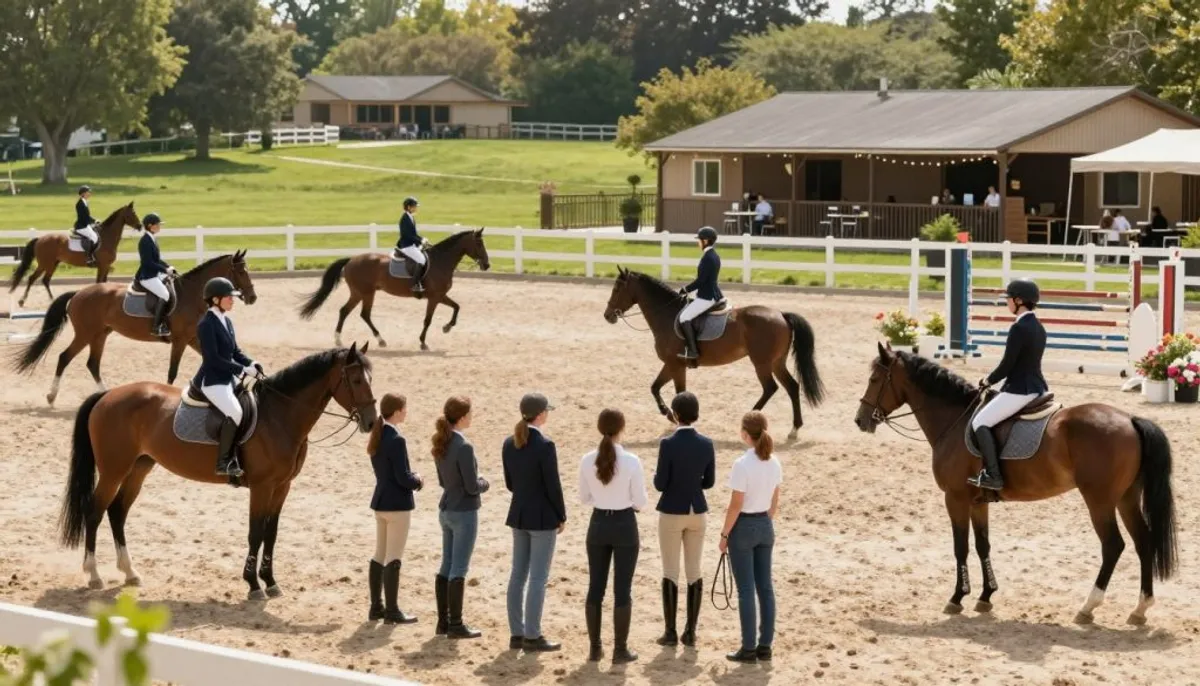
Recommended minimum surface: practical benchmarks (e.g., 100 m² per horse excluding layouts)
For harmonious group living, it is recommended to have at least 100 m² per horse. This does not include spaces occupied by equipment or green areas.
Some stables have 50 horses on a space of 5,000 m². This model aims to use space efficiently, even when the terrain is less solid.
Group Size: one herd or several, up to large groups depending on context
Choosing the size of a herd depends on several factors, such as layout and the desired level of tranquility. Some riding centers opt for multiple small groups to reduce tensions.
It is possible to have a herd of up to 40 horses if conditions allow. Regardless of the number, it is good to have a flexible organization with specific gates and areas to manage the group.
Pony/Horse Compatibility: adjustments to passages and fencing
Mixing ponies and horses requires some adjustments. For a pony under 1.30 m, the passages must be adapted so it does not get stuck.
Consideration must also be given to young animals. A foal must be able to accompany its mother without risk. In a well-organized stable, these adjustments improve the movement of all.
Special Cases: commercial horses, more delicate integration, and rapid rotation
Commercial horses present a unique challenge due to their frequent rotation. This can increase stress and require more attention.
To maintain tranquility, it is best to seek a balance between the different horse profiles. Good organization facilitates management and reduces risks during group changes.
| Point to Decide | Practical Benchmark | What it Changes on the Ground |
|---|---|---|
| Living Surface | 100 m² per horse, excluding buildings and automated areas | Fewer conflicts at key points, better circulation, more durable ground |
| Stabilized Sizing | Observed example: 50 horses for 5,000 m² stabilized | Useful areas even in winter, simpler maintenance, reliable access to resources |
| Group Organization | Herd size modifiable, feedback up to 40 horses depending on context | Operational flexibility, adaptation to the activity level of a dynamically designed riding center |
| Pony/Horse Mix | Adjustments if pony < 1.30 m: passages, fencing, access points | Fewer blockages, better mother-foal follow-up, enhanced safety |
| Rapid Rotation Horses | Commercial horses: more delicate integration | More monitoring, frequent adjustments, need for temporary pens and lots |
Daily Organization, Cleaning, and Workload in an Active Stable
Active stables rely on simple and regular actions. They are better organized when everything is clear and clean. This brings comfort to the horses and the team.
Common Duties: collection of droppings, maintenance of stabilized areas, monitoring
The day often begins with the collection of droppings. This is done where the horses spend the most time. Then, we clean the stabilized areas and check around the waterers and shelters.
Keeping an eye on the horses is essential: we monitor their movement, appetite, and interactions. Staying attentive helps avoid problems. Generally, these tasks take about 3 hours a day, varying according to weather and herd size.
Design to Facilitate Dredging: Limit Angles, Accessibility of Areas, Mechanization
Good planning can make all the difference. Having fewer angles and wide passages helps a lot. Choosing the right floor and planning adequate logistics (as recommended by ECOVEGETAL) makes mechanical cleaning easier. This saves time and effort.
Cases like that of Brigitte Benoist (Equi’libre 40) show the importance of adjustments. For example, buying more durable slabs helps keep surfaces healthy year-round. This avoids muddy areas in winter.
| Organization Point | What Helps Daily | Effect on Workload |
|---|---|---|
| Paths and Stabilized Areas | Fewer puddles, less mud, clear routes | Reduces stable cleaning time after rain |
| Rubber Mats | Regular surface, maintenance with scraper or sweeper | Allows for mechanized dredging in targeted areas |
| Angles and Corners | Rounded paths, direct access | Fewer manual finishes, quicker rounds |
| Herd Monitoring | Routine passage, observation at fixed times | Avoids delays in care and unforeseen events |
Optimized Supply: Place Elements Along Fences to Feed from Outside
Organizing supply along the fences saves time. Thus, everything fills up without entering the living space. This also makes care safer when horses are active.
This method stabilizes the operation of stables, even on busy days. It simplifies work and allows for focus on observation and care without overloading the team.
Health, Behavior, and Adaptation of Horses: Feedback in France
In an active stable, the first days help understand how everything works. If the horse has already lived outside with others, it adapts quickly. But for those coming from a box, it takes longer, and they need trust.
The automatic concentrate distributor is often a challenge. Equi’libre 40 explains that learning happens gradually. Brigitte Benoist says it allows the horse to see the automate as something simple.
Brigitte Benoist, from Equi’libre 40, sees an improvement in the well-being of horses after 5 years. She notices that horses are more relaxed, regardless of their age or past. This follow-up also shows that they are calmer in common areas.
Horses seem to be doing better, both physically and mentally. Issues like stomach aches are less common, and horses move more easily. At the same time, signs of discomfort and repetitive behaviors decrease.
There is a common concern about “automates and stereotypies.” Some studies show problems near distributors. But some managers say these problems do not always stem from the active stable. They add that a few horses already had these behaviors.
Biosafety remains essential and requires organization. Keeping vaccinations and deworming up to date is crucial. It is important to pay attention to new horses, especially when diseases are circulating. Observing horses daily helps not to miss anything.
Care management is crucial. If a problem is not contagious, a special box can be used to limit movements while allowing the horse to see others. If the problem is contagious, placing a few boxes away can protect the herd.
It is rare for horses not to adapt, but it happens. For those who have spent a lot of time in boxes, like 23 years, adaptation takes time. Patience and respect for their rhythm are necessary.
Integrating a new horse requires preparation. Many stables use a special box for 15 days to 3 weeks before starting controlled outings. With a large group, adaptation often goes better due to more social space and less tension.
| Observed Situation | What Helps in Active Stable | Often Mentioned Duration | Well-Being Vigilance |
|---|---|---|---|
| Horse already used to group life | Gradual access to areas, stable reference points, simple routine | Few days to 2 weeks | Monitor access to water and hay, avoid social overload |
| Horse coming from an individual box | Gradual introductions, breaks in integration box, supervised outings | 15 days to 3 weeks | Observe horse behavior at night and in narrow passages |
| Learning the automatic concentrate distributor | Guided passages, short sessions, repetitions, calm atmosphere | 1 to 10 days depending on the horse | Limit static waiting near the automate to reduce tensions |
| Horse already carrying stereotypies | More movement, more interactions, access to spread-out forage | Variable evolution over several weeks | Note triggering moments, adjust access and density |
-
Monitoring simple things like appetite allows for changes to be seen without complicating matters.
-
Clear rules from the start help protect the herd while maintaining a good dynamic.
-
Progressing slowly helps reduce stress and supports the well-being of horses, even the most sensitive.
Costs, Profitability, and Economic Model in France
In France, the cost of setting up a stable varies. It depends on whether the land is ready, access to machinery, water networks, and existing buildings. The use of automated technologies, leveling the ground, and the type of floor chosen are also important. To stay organized, some calculate based on the “cost per place” and the reduction of necessary work.
The profitability of a stable does not depend on a single factor. It comes from well-chosen expenses, efficient organization, and an offer that meets local demand. The goal is to create a solid system, not just to accumulate expensive equipment.
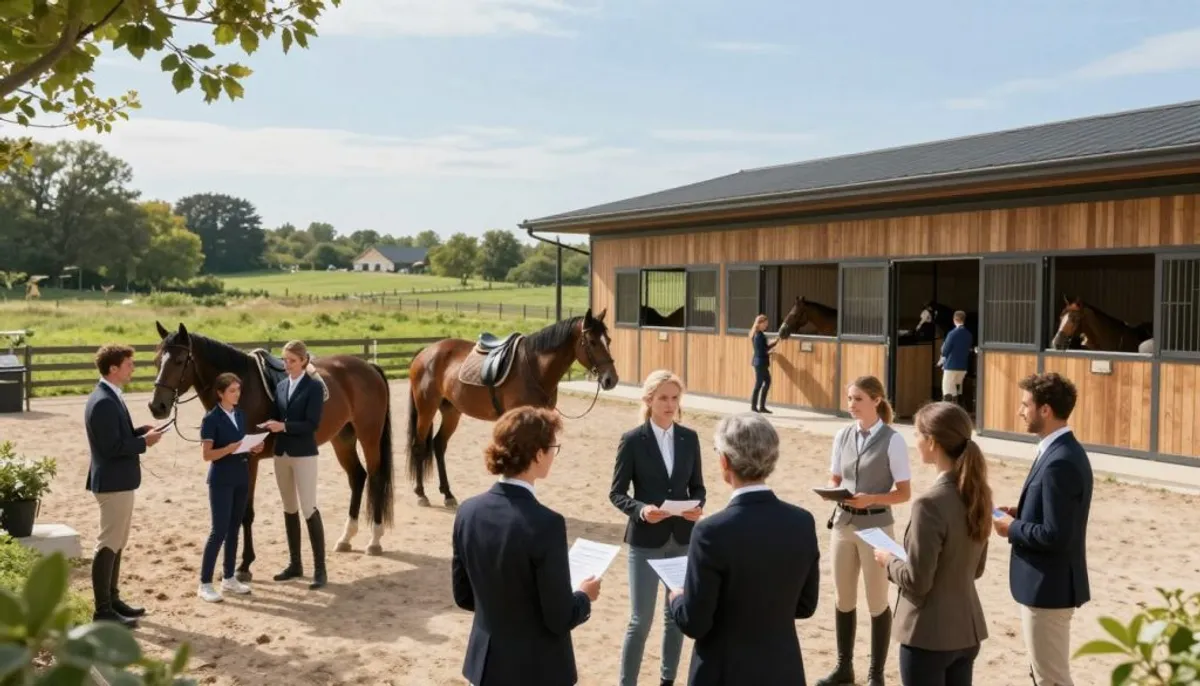
Observed Magnitudes: Investment per Place and Variables (automates, earthworks, floors)
Investment in automation is estimated between 3,000 and 4,000 € per horse, including transport and installation. This is based on field feedback. These are visible costs, but there are also less obvious expenses like stabilizing the ground, draining, setting up fences, gates, creating shelter areas, and improving circulation.
Regarding earthworks and floors, the cost is often cited between 20 and 35 €/m² by professionals, depending on materials and intended use. For a medium-sized project (about 50 horses with 5,000 m² developed), costs can reach around 5,000 € per place. This varies greatly depending on the basic project and specific needs.
| Item | Magnitude | What Affects the Bill | Impact on Operation |
|---|---|---|---|
| Investment in automates | 3,000 to 4,000 € / horse | Number of stations, individual settings, installation, after-sales service, protections | Regular rations, monitoring, fewer daily manipulations |
| Earthworks and floors | 20 to 35 € / m² | Nature of the terrain, drainage, slabs, sandy areas, access for machinery | Less mud, secure circulation, durability of layouts |
| Cost per place (observed benchmark) | ~ 5,000 € / place | Share of self-construction, stabilized surfaces, fencing, shelters | Calculation base for horse boarding and sizing |
Examples of Budgets and Structures: Projects Around 20 Horses, Costs, and Main Items
Patrick Déaux mentioned a budget of 80,000 € for a project of 20 horses, excluding construction. This amounts to 4,000 € per horse. Equi’libre 40 indicated a budget of 120,000 € for 20 horses, doing the work themselves over a year.
Labor has a significant cost, even if it is not always visible on invoices. For better cost management, it is advisable to proceed step by step: first improve the floors and circulation, then add automation, and finally carry out the extension. This brings comfort from the start for a riding center.
Operational Gains: Reduction in Feeding/Cleaning Time and Reallocation Towards Horse Work
Improvements often allow for time savings, rather than directly reducing costs. Patrick Déaux, based on Pascal Frotiée's case, mentions a time gain of up to 70% for feeding and cleaning. This time is then used to work more with the horses. Several people from the Equine Network say they see benefits quickly, thanks to the reduction in workload.
This time gain allows for improved reception, horse care, and overall organization. For a dynamically designed riding center, knowing how to organize well is as crucial as the equipment itself.
Boarding and Pricing: Relevant Comparison with Box/Paddock Boarding with Similar Facilities
The most reliable method for defining horse boarding is to compare with similar offers in the region. It is necessary to look at the available facilities, then adjust based on the quality of the floors and the management of rations. Often, the price of boarding in an active stable is comparable to that of a box/paddock, if the equipment is similar. Location is the most influential factor.
To remain profitable without promising too much, it is important to balance prices, capacity, and necessary work. A pricing grid based on reality - quality of equipment, regularity of rations, comfort for owners - is clearer for everyone.
Varied Equestrian Activities and Rider Experience: Riding Workshops, Equestrian Coaching, Horse Rides
A dynamic riding center is more than just a place. It is where time and comfort meet through good organization. This allows for many activities without stressing the horses.
Creating a Recovery Area for the Cavalry: Managing Entries/Exits with Selection Gates
In France, some stables have created special recovery areas. Here, ponies rest between classes. Thanks to special gates, they go to an area close to the preparation places without disturbing others.
Next to the riding arena, this area helps with rest after exercise. The pony calms down, drinks, and then rejoins the others at the right time. Thus, even when many people come, the workshops go smoothly.
Building a “Dynamic Riding Center” Offer: Fun Equestrian Workshops and Active Riding Daily
A moving center makes life easier and horses happier. Relaxed horses are better for riding. This creates a good environment to learn to hold well and be precise.
During holidays, fun workshops attract many. With good organization, lessons and rides can be mixed. Rides become precious moments, without stress to leave.
Practical Organization for the Public: Accessibility, Time to Retrieve One's Horse, Simplified Routes
Some say that finding their horse is difficult. But often, even if the horse is far away, it takes little time. For example, crossing 2,000 m² only takes four minutes, even with barriers to open.
To welcome well, paths must be clear and access easy. By simplifying the journey between different areas, we avoid wasting time. Thus, we have more time for lessons or coaching.
Recommended Partnership: La Sellerie Française and High-End Equipment Made in France
La Sellerie Française prioritizes quality and longevity. It offers luxury equipment, made in France, either custom-made or in limited series. It promises entirely French manufacturing, with higher standards than usual certifications.
| Key Point | Choice of Organization | Benefit for the Rider | Impact on the Active Stable |
|---|---|---|---|
| Mount Management | Recovery area + selection gates | Horse ready faster, smoother circulation | Less disturbed herd, better-distributed flow |
| Educational Offer | Varied equestrian activities in the schedule | More diversity, visible progress | Regular use of spaces, stable rhythm |
| Supervision | Equestrian Coaching in short sessions | Simple objectives, immediate feedback | Less waiting, better rotation of areas |
| Club Highlight | Fun Equestrian Workshops during holidays | Group atmosphere, concrete learning | Predictable organization, better-managed horses |
| Outdoor | Planned Horse Rides by level | Confidence, pleasure, discovery of terrains | Horses more available thanks to daily movements |
| Equipment | La Sellerie Française: high-end parts, manufacturing from A to Z in France | Comfort, finish, durable material | Well-groomed image consistent with a dynamic riding center |
Conclusion
The active stable places the horse at the center of its concerns. It relies on a clear concept: living in community, eating regularly, and moving every day. This method promotes the horse's well-being through varied points of interest and well-designed flooring. It aims to keep the horse active and healthy, with less time spent without moving.
In France, the dilemma exists between choosing an active stable or a paddock paradise. The active stable prioritizes automation and personalized feeding. While the paddock paradise offers vast spaces and extended corridors, sometimes in rotation. Adopting a combination of both can be beneficial, depending on resources, available space, and the number of horses.
Successful experiences highlight certain essential points. It is recommended to have at least 100 m² per horse and to pay attention to the quality of the floors. Avoiding sharp angles can reduce stress and simplify maintenance. Effectively managing resources and integrating good biosafety practices is crucial for the well-being of horses.
Although the concept of active stables is still not widespread in France, with only 20 to 30 sites, it is progressing. Testimonials like that of Equi’libre 40 encourage, and companies like Horse Stop and ECOVEGETAL materialize these ideas. With the support of the Chambers of Agriculture and the Equine Network, well-being stables are developing, and active stables are part of a more sustainable approach.
FAQ
What is an active stable?
An active stable offers horses a space where they can move freely in a group. This method includes special areas like places to eat, drink, shelter, and roll. It aims for the well-being of horses with modern technology.
Where does the concept of active stables come from?
15 years ago, a German agronomist created this concept. He wanted to improve the lives of his horses and simplify his work.
Why does the active stable better meet natural needs than an individual box?
In a box, a horse is often alone, moves little, and eats at fixed times. The active stable promotes social life, continuous feeding, and more activity. This better corresponds to their natural needs.
Is the active stable widespread in France?
Although less common, there are between 20 and 30 active stables in France. Organizations like ECOVEGETAL and SCHAUER mention 14 to 16 structures. The concept is developing thanks to demonstration events.
Which French actors follow or support these projects?
Among the supporters are the Chamber of Agriculture, the Equine Network in Nouvelle-Aquitaine, and ECOVEGETAL. Horse Stop in Malissard and Equi’libre 40 also provide feedback.
What fundamental needs are targeted in an active stable?
The model prioritizes socialization, long-duration feeding, and movement. It tries to closely adhere to the natural behaviors of horses while remaining manageable and safe.
How does the active stable promote the social life of horses?
Horses live together, in constant contact. This enhances their emotional well-being and follows recommendations for a well-managed herd.
Why is it said that a horse should eat for at least 16 hours a day?
A horse naturally eats over a long period. The active stable allows for continuous access to hay and regulates, if necessary, other foods. This avoids short and divided meals.
Is an active stable necessarily “hay at will”?
Not always. The stable can offer hay in a controlled manner or individualize it through automated systems. This helps adjust the ration for each horse.
How does the layout encourage movement?
The places to drink, eat, sleep, and play are spaced out. This arrangement encourages horses to move regularly.
What layouts are essential for a functional well-being stable?
It is essential to have a stable surface to keep horses clean. Spacious areas and a well-thought-out layout for feeding and cleaning are also crucial.
What are the classic points of interest in an active stable?
Commonly found are places to feed, automatic food and water dispensers, a shelter, and areas to relax and play.
What floors should be favored in an active stable?
Varied surfaces are preferred: slabs for durability, sand for comfort, and rubber in sensitive areas. The goal is a well-drained and easy-to-clean floor.
Why are stabilization slabs often recommended?
According to ECOVEGETAL, slabs provide a draining, stable, and durable floor. This reduces mud and simplifies cleaning.
Can an active stable be opened on pastures?
Yes. Access to pastures complements the stabilized area well. Sorting gates allow for managing access and protecting the meadows.
How is automation the heart of active riding?
It helps personalize feeding and makes organization smoother. Concentrates and minerals are distributed optimally, facilitating work.
How are horses identified by the automates?
They wear a collar or bracelet with a transponder. This system recognizes each horse as it approaches to provide the correct feeding.
Do the automates increase the risk of injuries?
Few injuries are reported. The devices are designed to be safe for horses, with suitable protections.
Are there simpler solutions than automates to individualize feeding?
Yes. Adjustable cornadis are a less expensive alternative. They allow for more basic individualization of feeding.
Are hay nets essential in an active stable?
No, they are not mandatory. They can help slow down hay ingestion, but this depends on the horses.
What is the difference between an active stable and a paddock paradise?
Both promote a good life for horses. But the paddock paradise uses long corridors and vast areas. The active stable stands out for its advanced use of technology to personalize feeding.
Can a hybrid model be created between an active stable and a paddock paradise?
Yes. The two can be combined depending on the terrain and needs. For example, rotational grazing can be added to an active stable project.
What surface should be planned per horse?
At least 100 m² per horse is needed for good functioning. This does not count spaces for machinery and layouts.
Do you have an example of real sizing?
One example mentions 50 horses on 5,000 m². This gives an idea of the necessary space, but each project is unique.
Must there be only one herd?
No. It is possible to divide horses into several groups depending on space and management.
Can ponies and horses be mixed in an active stable?
Yes, but infrastructure adjustments are needed for all. This ensures safety and circulation for all animals.
Which horse profiles are less compatible with the active stable?
Commercial horses can be difficult to integrate due to their rapid rotation. Some horses accustomed to boxes may also need more time to adapt.
Is it necessary to separate geldings and mares?
It is not necessary to separate them systematically. The goal is to find a good group balance while managing spaces and access well.
What are the daily duties in an active stable?
Among the tasks are the collection of droppings and cleaning of slab areas. Expect about 3 hours a day for these activities.
How to design an active stable to facilitate mechanized cleaning?
It is advisable to have a good floor and suitable machines. Avoid sharp angles to facilitate the passage of cleaning equipment.
How to optimize the supply of forage and food?
Placing key elements along the outer fence facilitates supply. This saves time and simplifies logistics.
How long does it take for a horse to adapt to the automates?
This varies. A horse accustomed to the herd adapts quickly. Others need time to get used to it, especially with the concentrate distributor.
What feedback is there in France on adaptation and behavior?
According to Equi’libre 40, no adaptation difficulties have been noted in five years. Horses become calmer and healthier, with less stress.
What about stereotypies near the automates?
A study from IFCE has been discussed. But observations show that pre-existing stereotypies are not related to the automates. Careful management is key.
How to manage biosafety and the arrival of new horses?
As in any stable, vaccination and deworming are essential. Welcoming new horses often takes place via an integration box. This facilitates their incorporation into the herd.
What to plan for care, injuries, or contagious diseases?
For non-contagious issues, a paddock box maintains social contact. For contagious cases, plan isolation boxes away from the group.
How much does an active stable cost in France?
Prices vary with the land, earthworks, and automation. Expect about 3,000 to 4,000 € per horse for the automates. Earthworks cost between 20 and 35 €/m².
Are there examples of budgets for a project of around 20 horses?
For 20 horses, a budget can range between 80,000 € and 120,000 €. This depends on the work to be done and whether internal labor is counted.
Does the active stable really allow for time savings in daily life?
Yes. Feedback indicates significant time savings. This allows for more attention to monitoring and working with the horses.
How to set the price of boarding in an active stable?
It is advisable to compare with local box/paddock boarding offering similar services. The price tends to be similar, adjusted according to location.
What investments should be prioritized to avoid mistakes?
It is better to focus first on a good floor before adding automates. A modest but solid start is recommended.
Do selective sorting gates also help manage a club cavalry?
Yes. They help organize ponies for classes. Specific areas facilitate daily management.
Is it true that it takes a long time to retrieve one's horse in an active stable?
Not really. Even if the stable is large, locating and retrieving one's horse can be quick. Especially if the design is well thought out.
Can an active stable support a dynamic riding center and an active stable oriented towards leisure sports?
Yes, it frees up time for teaching and equestrian activities. It is ideal for a varied offer combining sport, leisure, and well-being.
Can the active stable be associated with a relaxation and well-being focused active stable offer?
Absolutely. It is often seen as enhancing the well-being and availability of horses. This improves their experience of group life.
What equipment do you recommend for riders and structures?
A: La Sellerie Française (https://laselleriefrancaise.com) offers premium equipment, made in France. It is a quality option for riders and stables.