
In equestrianism, seeking more sensations without losing comfort is essential. The bareback pad offers an ideal solution: it brings us closer to the horse than a traditional saddle. But it remains more stable and softer than a fully bareback ride. This suits both the needs of the heart and technical requirements.
This type of equipment allows us to better feel the horse's movements. We can more easily notice muscle tensions. This improves our way of adjusting our aids without tension. Over time, the connection with the horse becomes stronger, calmer, and more precise.
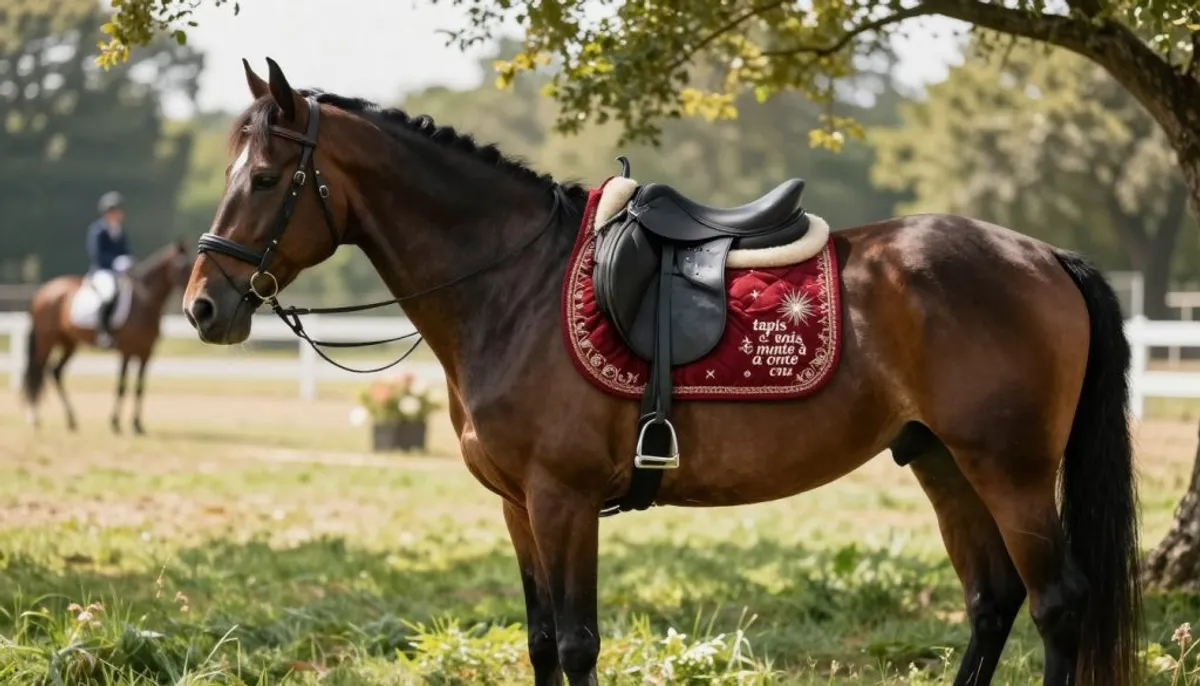
The horse also benefits from this equipment. A good bareback pad provides remarkable shoulder freedom. It also ensures better pressure distribution on the horse's back. This makes its back more capable of working, especially during short or medium sessions.
For the rider, the advantages are clear: balance improves and the seat becomes more independent. Some pads offer exceptional comfort, thanks to their synthetic shearling and high-density foam padding. This allows for cushioning while remaining in close contact with the horse.
Key Points to Remember
- The bareback pad strikes a balance between closeness and comfort in equestrianism.
- It helps to better feel the movements and muscle tensions of the horse.
- A good equestrian equipment improves pressure distribution and freedom of movement.
- The rider develops balance, core strength, and independent seating.
- Versions with synthetic shearling and high-density foam provide appreciated cushioning.
- The choice of bareback pad influences both the horse's well-being and the rider's progress.
Meta title and meta description to maximize clicks
On the internet, a few words can make all the difference. A good title captures attention. Then, a simple and clear description reassures on several points such as comfort, fit, and the type of materials used. This provides a good basis for comparing equestrian products.
What the reader should understand right away: it concerns the use, the level of comfort offered, and what it brings to the horse. Adding a clear promise motivates riders, whether for use in dressage or on trails.
Bareback Pad: Optimal Equestrian Comfort
Explore our bareback pads for an equestrian experience close to nature. They are of superior quality and meet the needs of the most demanding riders.
Choosing a saddle involves retaining specific terms related to the product. To maintain fluid communication, varying vocabulary around equestrianism is beneficial. It should always reinforce the idea of precision and safety.
- saddle: reference “purchase” and advice, from the search
- equestrian equipment: notion of quality, finishes, and durability
- equestrianism: practice, sensations, progress
- online saddle shop: availability, choice, quick comparison
| Element | What is read | What it suggests |
|---|---|---|
| Meta title | Bareback Pad: Optimal Equestrian Comfort | Identified product, clear intention, quick reading |
| Meta description | Natural experience, comfort, superior quality | Rider comfort + horse well-being, without jargon |
| Associated terms | saddle, equestrian equipment, equestrianism, online saddle shop | Purchase search, comparison, informed choice |
Why choose bareback riding for a finer connection with your horse
Riding without a saddle provides unique sensations. You feel the horse's movements better. This includes its rhythm and small imbalances. A good bareback pad ensures close contact. It also provides some comfort.
Working without a saddle does not eliminate the need for equestrian equipment. But it enriches training. It encourages us to listen and adjust better, rather than simply holding our position.
Feeling movements and muscle tensions for better communication
Feelings come through more directly without the saddle. You perceive more, like the push from the hind legs. Flexibility and tensions are felt earlier. This simplifies and clarifies our requests to the horse.
The bareback pad filters just enough. It stabilizes without blocking useful information. This allows for more precision, especially at the walk and trot. The horse's back can thus express itself clearly.
Developing mutual trust and quality aids
With a better position, riding becomes softer. The hands are calmer and the legs more stable. The aids are less intense, allowing the horse to relax better. It feels less unnecessary pressure.
Good equipment is crucial for this training. A well-fitted, non-slipping bareback pad provides safety. Short and regular sessions build trust.
Horse's freedom of movement and a more “natural” approach
Horses move more freely without a saddle. The shoulder and back express themselves fully. This also improves the rider's position. They learn to be stable without tensing up.
The choice of pad must be thoughtful: shape, thickness, stability. The idea is to let the horse be free. But, one must remain safe with the right equipment.
| What you observe | What it changes in riding | Point to check on a bareback pad |
|---|---|---|
| Back rising at the walk | Finer aids, better timing | Stable surface and regular contact |
| Tension on one side at the trot | Discreet corrections, more accurate trajectories | Cut that respects the line of the back |
| Horse stretching forward | Smoother cadence, lighter hand | Material that limits slipping |
| Rider tensing up | Breathing and pelvis need work | Simple, secure, well-positioned girthing |
bareback pad
The bareback pad is placed directly on the horse's back. It allows you to ride very close to the horse without discomfort. It also offers good grip and distributes pressure well. This pad helps find a stable position, which is important for feeling the horse's movements.
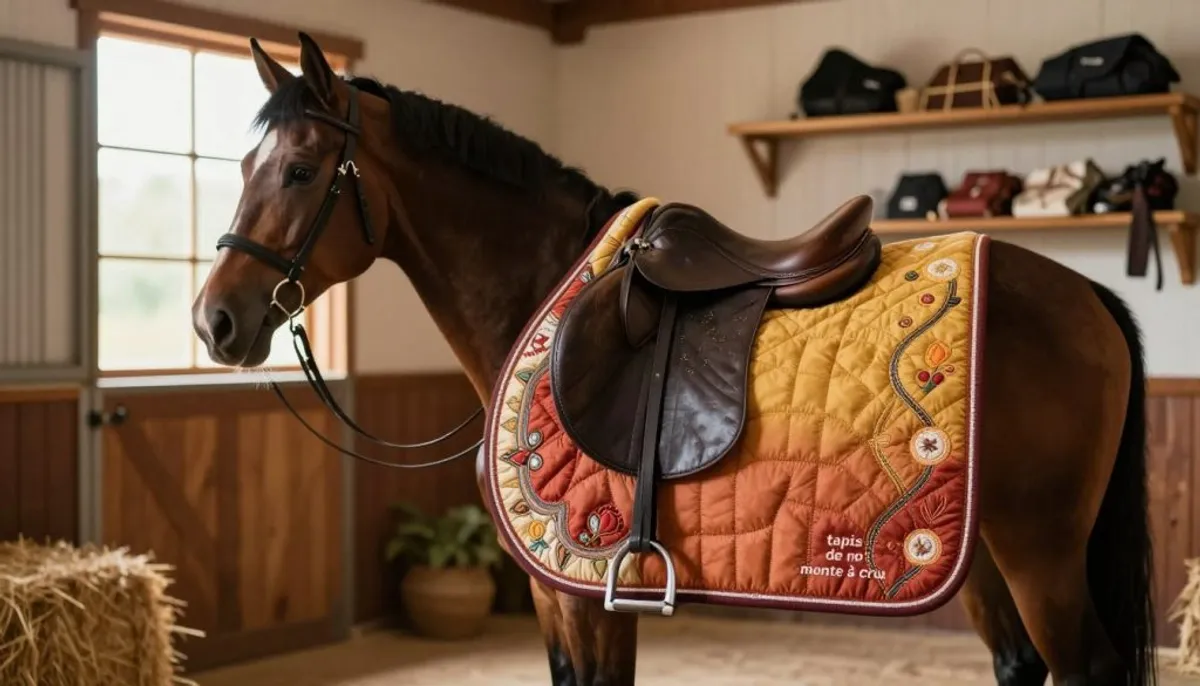
Definition and role in equestrian equipment
This pad can replace the contact one would have with a saddle. It provides additional comfort thanks to its padding and non-slip surface. Also, it allows the horse to move freely. The rider feels the movements better while being comfortable.
- Cushioning: reduces pressure points during movement.
- Grip: keeps the leg in place, even on wet hair.
- Stability: helps to stay in place, especially if the horse moves a lot.
Differences with a horse saddle and a classic saddle pad
A horse saddle has a rigid structure, with a support for the rider. It distributes weight but filters sensations. The bareback pad is flexible and follows the horse's back. This allows for better feeling of movement. That’s why choosing this pad requires maintaining your body well.
A saddle pad is designed to go under the saddle, not to ride directly on. It protects and stabilizes the saddle. The bareback pad, on the other hand, is made to be used alone. Some models even have a handle or rings for different uses.
| Compared point | bareback pad | horse saddle | saddle pad |
|---|---|---|---|
| Structure | Flexible, without a tree, close to the back | Rigid, tree + panels for bearing | Flexible, designed to go under the saddle |
| Main objective | Contact, stability, comfort in “close” riding | Carrying, weight distribution, framework for aids | Protection, absorption, maintenance under the saddle |
| “Autonomous” use | Yes, designed to be ridden as is | Yes, it’s the main element | No, depends on a saddle |
| Feelings | Very direct, helps with balance work | More filtered, more framed | Does not change the seat without the saddle |
For what uses: flat work, lungeing, trail rides
When working on the flat, this pad helps improve position and precision. During lungeing, it allows focusing on posture. For trail rides, it is perfect for combining safety and freedom of movement, especially if well chosen.
- Flat work: improves transitions and precision.
- Lungeing: helps find a good position and relax.
- Trail rides: ensures comfort and safety, suitable for the terrain.
Comfort and well-being of the horse: pressure distribution and anatomical cut
For a relaxed horse, contact must be simple and continuous. A well-thought-out bareback pad distributes pressure and conforms to the shape of the back. This is as important as the rest of the equestrian equipment.
When the distribution is uniform, the horse's back relaxes. Thus, it moves with more flexibility.
The withers cut is crucial. It relieves a sensitive area and reduces friction. This happens when the horse begins to move.
A precise fit ensures that the pad stays in place. It then conforms better to the horse's shape, even during intense training.
The choice of materials also influences the acceptance of the equipment. Suede is soft to the touch. It offers good grip.
nubuck leather creates a more “warm” contact, which is preferred in quiet sessions. Lamsvel, often chosen for its softness, reduces irritation in sensitive areas.
During a prolonged outing, it's important to quickly check for sweating and temperature. Some pads manage humidity and heat, which are important during long efforts. Properly matching the bareback pad, girth, and accessories limits pressure points that may arise.
| Criterion | What it brings to the horse | Point to check before purchase |
|---|---|---|
| Withers cut | Less friction, better shoulder freedom | The withers remain clear at the walk and trot |
| Anatomical cut | Stability, more regular support on the back | The pad conforms to the line of the back without “bridging” |
| Suede | Soft contact, good grip, immediate comfort | Easy to brush surface, well-flat seams |
| nubuck leather | Pleasant touch, durability | Proper maintenance to keep flexibility |
| Lamsvel | Softness, helps limit irritation | Regular thickness and homogeneous contact areas |
| Humidity / heat management | Drier back, more constant comfort | Breathable lining and quick drying after use |
Finally, checking the condition of the coat after the session is essential. Marks or a very damp area indicate a problem with the equipment. Adjusting the size, shape, or certain accessories can often improve comfort.
Rider comfort and stability: seating, balance, and technical progression
In equestrianism, using a bareback pad changes a lot. It allows for a more natural placement without a tree or flaps. This helps to follow the horse's movement and improve balance over time.
Improving balance and coordination without a rigid structure
With this pad, you feel the horse's movements better. The hips move with it and the shoulders stay straight. This allows for stable legs, even if the horse changes pace.
Riders often note better mobility of the pelvis, which becomes more stable. This is essential for progressing smoothly, especially with good equipment.
Independent seat: refining the dosage and timing of aids
When achieving an independent seat, aids are used better. You control the strength of the legs and the weight of the body, and the hand is softer. This improves transitions and departures in riding.
The bareback pad also helps stay centered and breathe correctly. This allows for quicker notice of tensions or imbalances. Thus, one can correct mistakes without delay.
Anti-slip solutions and “soft and plush” feel depending on models
Some pads have anti-slip surfaces and a shape that secures. Others offer a more comfortable feel thanks to synthetic shearling. This is very pleasant for long sessions.
| Key point | What you feel in the saddle | What a bareback pad can bring | Detail of equestrian equipment to check |
|---|---|---|---|
| Pelvis stability | Support guided by the tree | Stability built by the support | Shape, thickness, grip areas |
| Dosage of aids | Aids sometimes “amplified” by the structure | More direct timing, immediate corrections | Good hold on girthing, absence of folds |
| Rider comfort | Stiffer seat but very framed | Closer feel, sometimes more enveloping | Suede or synthetic shearling, flat seams |
| Initial safety | Flaps that stabilize the leg | Anti-slip models are more reassuring | Coating, handle as needed |
Choosing the right pad is done by feel but also by verification. It must stay well in place, without turning or causing discomfort. In the world of equestrianism, these small equipment details make a big difference.
Practical features that make a difference in equestrian equipment
Choosing a bareback pad requires attention to detail. These influence the sensation in the saddle, safety, and daily use. Often, these aspects decide at the time of purchase.
Holding handle
This handle is not just an accessory. Some Norton models, available at Equimai, offer a polypropylene holding handle. It is designed to provide secure support.
It can be either fixed or removable. This is very useful for stabilizing without pulling on the reins, thus protecting the horse. Having such a handle is a real advantage.
Adjustable stirrups and stirrups
Norton / Equimai pads have adjustable stirrups securely attached. This facilitates quick adjustment, suitable for various locations.
You can add western-style zinc stirrups. They provide greater support and reassurance, ideal for calm sessions. It is important to check these options before purchasing.
Girth and buckles
It is crucial to inspect the girthing system. For a “Comfort” pad, you find a long girthing with polypropylene straps. They stay in place and are easy to use.
Combined with a short padded cotton girth of 70 cm, and a chromed metal buckle, this system ensures precise adjustment. This set is essential for frequent use.
| Element | Practical detail | Usage interest |
|---|---|---|
| Handle | Polypropylene holding handle (fixed or removable) | Stable support point, more safety for starting and progressing |
| Stirrups | Adjustable stirrups on sturdy rings | Quick adjustment, more constant position in session |
| Stirrups | Western-style zinc stirrups (depending on models) | Wide support, more reassuring feel on varied terrain |
| Girth | Long girthing + counter-girths in polypropylene | Better hold, simple handling during grooming and mounting |
| Girth | Short padded cotton girth, 70 cm | Comfort on contact, progressive and stable tightening |
| Buckles | Chromed metal | Durability in use, more reliable adjustments over time |
Transport
For outings, a good transport system matters a lot. Some sets include a zippered transport bag. It allows traveling without dirtying your car.
This detail makes things much easier. A quality bag protects the pad and keeps the tack clean, even in wet weather.
Materials and durability: how to choose a pad made to last
A bareback pad should be pleasant from day one. But it must remain stable, flexible, and clean after several months. The key to durability is a good choice of materials: a solid outer surface, durable padding, and easy cleaning.
Thinking about the horse's comfort is crucial. Good equipment avoids pressure points and friction. This ensures constant comfort for the horse while simplifying daily maintenance.
Synthetic shearling, high-density foam, and padding: impacts on cushioning
Synthetic shearling is prized for its softness and durability. It remains comfortable, even after many uses. If your horse has sensitive skin, this helps reduce irritation.
Padding, with its high-density foam, plays an essential role. This foam retains its shape and distributes weight evenly. This means that cushioning remains constant, extending the lifespan of your pad while maintaining comfort.
Thickness and support: example of 30 mm high-density foam padding
The thickness of 30 mm foam padding is a mark of quality. It offers excellent cushioning and good support. This translates to a stable seat, without the uncomfortable effect of a cushion that shifts.
Here are some benchmarks for evaluating equestrian equipment.
| Element | What it changes on horseback | What it changes over time |
|---|---|---|
| Synthetic shearling | Soft contact, limits friction, helps comfort on sensitive skin | Better withstands washes, maintains a regular texture if well brushed |
| 30 mm high-density foam | Marked cushioning, firmer support, more stable pressure distribution | Less crushing, more durable shape, fewer “flat” areas |
| Outer in leather or resistant textiles | Better grip depending on the finish, more reassuring feel under the leg | Resists abrasion, ages better, maintains a neat appearance |
Daily maintenance: resistant textiles, leather, possible antibacterial properties
Easy-to-maintain equipment is essential. Resistant textiles clean quickly. For leather, simple cleaning followed by appropriate care prevents it from drying out or cracking.
Some pads offer antibacterial and temperature-regulating properties. These features keep the pad fresh and healthy. Thus, good equestrian equipment is one that lasts and is easy to maintain.
Customization and style: from personalized saddle pads to custom-made
Style is important, but comfort is essential. A personalized saddle pad makes the whole harmonious without weighing down the horse. In saddlery, we seek clean lines, colors that do not change, and materials that are easy to maintain.
Start with the colors of your equestrian gear for true harmony: the bridle, protections, bonnet, and girth. Adding a different colored border or a topstitch can suffice. Choose visible details in motion that do not hide the horse's color.
Another important aspect is the perfect fit. Models with removable inserts exist. They fit into special pockets. This allows you to change the level of comfort for the horse's back according to your needs without having to replace all the equipment.
| Option | For what need | What you adjust | To watch out for |
|---|---|---|---|
| Coordinated colors and finishes | Match with your accessories while remaining discreet | Visibility, contrast, sharpness of lines | Colors that are too bright can distract |
| Insertion pockets + removable inlays | Adjust comfort according to the horse and its activity | Comfort, support, sensation under the saddle | Too much thickness can cause pressure areas |
| Custom-made in saddlery | Horses with particular shapes, need for precision | Shape, weight distribution, placement of reinforcements | Time for realization and accurate measurements |
| Limited edition | A unique look with predefined specifications | Simple design and finishes | Less choice in shape compared to custom-made |
When to seek something unique? If the horse changes shape or for softer comfort without unwanted movement. Custom-made is also good for better cushioning while remaining elegant. For a distinctive aesthetic, limited editions are a good choice that combines style, durability, and harmony with your equipment.
A well-chosen saddle pad shines through its simplicity and attention to detail. It is this discreet elegance, characteristic of good saddlery equipment, that makes the whole elegant and resistant to daily use.
Where to buy in France: online saddlery and artisanal excellence
In France, riders want more than just a good price. They seek comfortable, durable equipment with traceability. A good online saddlery saves them time. It must offer precise information and impeccable quality.
Why choose La Sellerie Française for high-end equipment
La Sellerie Française offers high-level equestrian equipment. It provides carefully crafted products, with clean finishes and quality materials. These details matter a lot for the comfort of the rider and the horse.
Choosing an online saddlery is also a matter of trust. Having detailed product descriptions and easily understanding sizes and delivery policies helps. Advantages like free shipping from €99 or easy returns often motivate purchases.
Made in France from A to Z: beyond labels
The main asset is complete manufacturing in France. This assures customers greater clarity.
There is less uncertainty and a more transparent process from the choice of components to final assembly.
Unique, custom-made, or limited edition products made by French artisans
You can choose unique pieces, custom-made, or limited editions. This is ideal for personalized equipment.
The expertise of French artisans ensures quality finishes, without superfluous elements.
| What to expect from an online saddlery | What it changes in daily life |
|---|---|
| Simple traceability and manufacturing from A to Z in France | Better long-term trust and fewer surprises about the origin of parts |
| Premium choice in saddlery and regular finishes | More stable comfort, better wear management on equestrian equipment |
| Unique, custom-made, or limited edition options | More accurate adjustment, sharper sensation, equestrian equipment more consistent with practice |
| Delivery and returns explained straightforwardly | More serene ordering, simpler exchange if the size does not fit |
Useful link
https://laselleriefrancaise.com
Conclusion
The bareback pad changes everything in equestrianism. It brings us closer, making things simpler and more vibrant. It allows for fine contact while being comfortable. Depending on the models, there are handles, stirrups, girths, and transport bags.
This pad is very beneficial for the horse. It helps distribute pressure evenly and offers incredible freedom to the shoulders. Thanks to its special cut and breathable materials, it prevents overheating during long sessions.
For the rider, it is a revolution. Without the usual rigidity, we learn to better balance and coordinate our movements. This helps us achieve a more independent seat quickly, with reassuring comfort.
Before making a purchase, think carefully. A good bareback pad is made of durable materials, quality leather, and long-lasting foam. La Sellerie Française is the best for quality equipment made in France. Perfect for those looking for something unique or custom-made.
FAQ
What exactly is a bareback pad?
A bareback pad allows you to ride a horse without a rigid saddle. It offers comfort and a natural sensation while redistributing pressure evenly.
Why choose bareback riding to improve the rider/horse connection?
Riding without a saddle allows you to feel the horse's movements more finely. This strengthens the communication between the rider and the horse, enhancing their connection.
What are the benefits for the horse?
This promotes the horse's well-being while providing a more natural experience. Modern pads offer freedom of movement and good pressure distribution.
What are the benefits for the rider?
For the rider, these pads help improve balance and coordination. They encourage diligent work for better harmony of movements.
How is it different from a classic saddle pad?
A saddle pad is placed under a saddle for protection. The bareback pad, without a saddle, aims for a direct riding experience, improving sensation and control.
How is it different from a horse saddle?
The horse saddle provides a stable structure due to its tree. The bareback pad, without a tree, enhances the feel and balance but requires a suitable choice for each situation.
For what uses is a bareback pad most suitable?
It is ideal for flat work, lungeing, and trail rides. For increased safety, some models are specifically designed for outdoor comfort.
Is the withers cut important?
Yes. A good withers cut is crucial for the horse's comfort. It allows for better adaptation to its morphology.
What materials should be prioritized for comfort and breathability?
Prefer suede, nubuck leather, and lamsvel for their comfort and ability to regulate humidity. These materials also ensure good breathability during efforts.
Are there really “soft and plush” models?
Yes. Some pads offer exceptional comfort thanks to their high-quality padding. Their softness supports both the rider and the horse's back.
What thickness of foam provides good cushioning?
A 30 mm foam is often recommended for good cushioning and support. This is particularly helpful during extended sessions.
Does a bareback pad really help with independent seating?
Absolutely. It encourages the rider to adapt to the horse's natural movements, thereby improving their balance and coordination.
What solutions exist to limit slipping and reassure during progression?
Pads designed with more grip and stability help beginner riders. Materials, padding, and accessories like handles enhance this safety.
What is the purpose of the handle on a bareback pad?
The holding handle helps the rider stabilize, especially in case of surprises. It allows staying in the saddle without tensing up.
Can stirrups and stirrups be added to certain models?
Yes, depending on the models. Some allow adding stirrups and stirrups for more support. Check this option based on your needs.
How does girthing work on a “Comfort” model?
Some pads include complete girthing for better comfort. This involves a padded girth and quality buckles.
Is it practical for going on a trail ride?
Yes, especially with comfortable and stable models. Good cushioning and reliable girthing make trail rides more enjoyable.
Is the bareback pad easy to maintain?
Its maintenance varies according to materials but aims to remain simple. Antibacterial properties and good temperature management make these pads practical for daily use.
What do removable inlays and insertion pockets mean?
They allow adjusting support and cushioning according to needs. This is practical for adapting to each horse or situation.
Is customization useful for this type of equipment?
Yes, for aesthetic harmony with your equipment or for specific comfort. Customization can better meet your equestrian goals.
When to choose a unique piece, custom-made, or a limited edition?
If you are looking for precise adaptation or a high-quality product, opt for custom-made or a limited edition. This guarantees exclusivity and performance.
Where to buy a bareback pad in France?
For assured quality, prefer a reliable online saddlery. For a premium offer, La Sellerie Française offers unique products made in France.
Why choose La Sellerie Française for high-end equipment?
La Sellerie Française offers high-end products, entirely made in France. The quality and traceability of their products exceed usual labels.
What is the official link for La Sellerie Française?
What criteria to check before purchasing in saddlery?
Compare according to use, anatomical cut, and material quality. Ensure that the chosen options match your equestrian needs.