
The Hanoverian is powerful, elegant, and reliable. It is highly valued in the equestrian sports world. It is a German warmblood saddle horse originating from Hanover and Celle, in Lower Saxony.
In France, it is popular both in competitions and breeding. Its consistency and mental strength are admired.
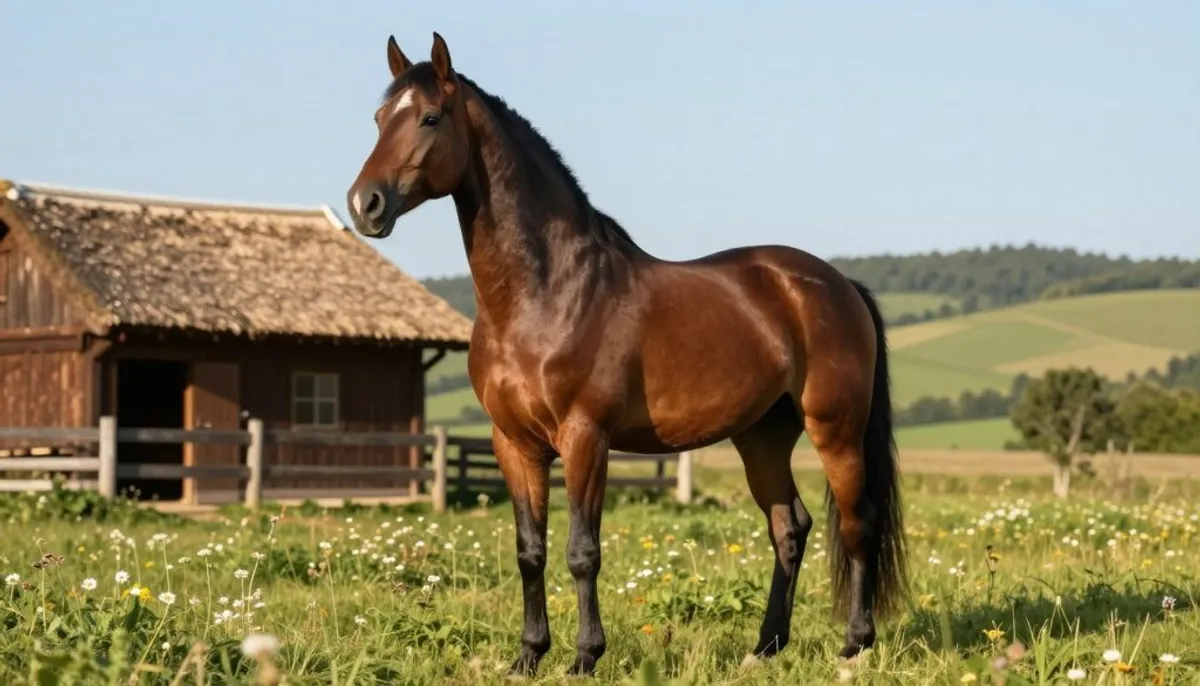
This guide explores why the Hanoverian is so respected. We will examine its appearance, movements, behavior, and breeding methods. These qualities make it exceptional in various competitions, such as dressage, show jumping, and eventing.
It also stands out in the WBFSH rankings, either on its own or by stud-book.
Regarding its physical characteristics, the Hanoverian often measures between 1.55 m and 1.73 m at the withers. Some may even exceed 1.80 m. Its weight generally varies between 500 and 600 kg, depending on its type and condition.
The common coat colors include bay, chestnut, black, and gray. More rarely, one can find white, isabella, or mouse. However, the true essence of a Hanoverian lies in its balance, mobility, and the rigorous selection practiced by breeders.
Key Points
-
Originating from Hanover/Celle, the Hanoverian is a German warmblood.
-
It particularly excels in dressage, show jumping, and eventing.
-
Its height often ranges from 1.55 m to 1.73 m, although some are taller.
-
Its weight generally hovers around 500 to 600 kg, depending on build and training level.
-
Common coats: bay, chestnut, black, gray. Less common: white, isabella, mouse.
-
The goal of Hanoverian breeding is to produce a modern, resilient, cooperative, and competitive horse, recognized in the WBFSH rankings.
Overview of the Hanoverian Breed and Its Uses
The Hanoverian breed horse is known for its sporty shape and calm demeanor. It is consistent in its work, making it perfect for those who ride frequently. In France, it is loved by riders of all levels.
When discussing breeding, one thinks of precise rules and rigorous selection. The Hanoverian stud-book helps keep track of origins and performances. This ensures consistent quality, even internationally.
German half-blood saddle horse breed: general profile
The Hanoverian is a German warmblood designed for sport. It combines strength, balance, and responsiveness. It aims for harmonious size and shape.
The Hanoverian standard emphasizes the importance of having good gaits and a solid structure. It must also move with ease, making it perfect for competition.
Preferred disciplines: dressage, show jumping, eventing, driving
In dressage, its movements and ability to concentrate are valued. For show jumping, its strength and agility are essential. Mentality plays a significant role in these sports.
Hanoverians also shine in eventing, especially with a bit more blood. For driving, they are appreciated for their consistent energy. This versatility makes them popular among enthusiasts.
International distribution: from Lower Saxony to the world (including France)
Originating from Lower Saxony, the Hanoverian has spread everywhere thanks to exports. It has been popular in the United States, Australia, and New Zealand since the 1970s. It can even be found in South Africa, adapted to various climates.
In France, its profile as a high-level sport horse is attractive. Buyers inquire about its origins and performances. This seriousness in selection ensures confidence for competitions.
| Use | Qualities often sought | What is frequently observed |
|---|---|---|
| Dressage | Large gaits, balance, ease of collection | Clean transitions, stable contact, steady progress |
| Show Jumping | Strength, respect, responsiveness to approach | Good take-off, careful trajectory, courage on lines |
| Eventing | Endurance, honesty, consistent mentality | More spirited subjects, effective gallop, proper recovery |
| Driving | Energy, traction, obedience to voice | Steady rhythm, precise direction, willing attitude |
Hanoverian
The Hanoverian is highly valued in equestrian sports. It meets riders' expectations well. It combines efficiency and comfort, making it exceptional.
In France, this mix of power and ease is greatly appreciated.
Why this breed has become a benchmark for modern sport horses
The Hanoverian is known for its work ethic and physique. It has a strong back, a good shoulder, and a powerful hindquarters. These characteristics allow the rider to work in harmony with the animal.
In competition, it does not shine by a single feat. Its reputation comes from demanding selection and rigorous monitoring. The Hanoverian stud-book has distinguished itself in the WBFSH, especially in dressage between 1990 and 2000.
This horse shows willingness, attentiveness, and calmness, even under pressure. With its supple movement, it is highly sought after.
What distinguishes it from other European warmbloods
Compared to other warmbloods, the Hanoverian offers a perfect balance between strength and elegance. It combines robustness and agility through careful crossbreeding. This combination is notable in its jumping style and transitions.
Its impact goes beyond the borders of Lower Saxony. It has enriched neighboring breeds such as the Oldenburg and the Westphalian. Thus, Hanoverian traits can be found in many pedigrees across Europe.
| Axis | What is often observed in the Hanoverian | Desired effect in sport | Point of attention when purchasing |
|---|---|---|---|
| Frame and balance | Athletic silhouette, strong back, natural balance | Stability, regularity of lines, ease in exercises | Check shoulder freedom and back flexibility at walk and trot |
| Locomotion | Elastic gaits, covering walk, rhythmic gallop | Expression in dressage, effort savings over time | Observe regularity and engagement, even on simple ground |
| Power | Solid hindquarters, strength, and consistency in effort | Jumping reserve, endurance in eventing and over multiple days | Control the quality of feet and growth management |
| Mentality | Cooperative temperament, controlled blood, “strong nerves” | Fewer attention faults, better focus in the ring | Evaluate reaction to the environment: trailer, noise, new space |
| Radiance | Hanoverian performances visible internationally, influence on Oldenburg and Westphalian | Access to well-followed lines, clear selection benchmarks | Request traceability information and results in aptitude tests |
History of the Hanoverian: origins, crossbreeding, and evolution
To understand the history of the Hanoverian, one must go back to Lower Saxony, near Hanover, in the 17th century. At that time, a local breed of robust and enduring horses was being developed. This breed was then crossed with Neapolitan, Oriental, and Iberian horses, bringing more refinement.
This mix gave the Hanoverian its recognized strength and elegance. Over time, Hanoverian breeders refined this breed. They sought to produce a versatile horse capable of adapting its role according to needs.
From military and agricultural needs to aristocratic driving horses
Initially, these horses had to meet military and agricultural demands. They needed to be reliable, strong for pulling, enduring, and easy to steer. Aristocrats also desired elegant and imposing driving horses.
In 1714, George Louis of Hanover became King of Great Britain as George I. Hanoverians then became prized for royal carriages. They were often light-colored, nicknamed Hanoverian creams, following a tradition of driving that lasted until George V.
The key role of the Celle Stud (founded in 1735)
George II founded the Celle Stud in 1735, not far from Hanover. This site became essential for the selection and rigorous management of breeds. It also introduced a central registry, crucial for tracking lineages.
Initially, the crossbreeding aimed to create a versatile horse. The Holsteiner was particularly influential, with contributions from Prussia, Italy, Spain, and Denmark. Later, in the 19th century, the introduction of Thoroughbreds lightened the breed.
Major influences: Holsteiner, Thoroughbred, Trakehner, Mecklenburg, Anglo-Arab, and Arabian
Crises, such as the Napoleonic wars, forced quick decisions. After these periods, Celle had to rebuild with fewer stallions. The Mecklenburg and Thoroughbred helped create a more dynamic type. This type remains solid, meeting farmers' needs.
In 1888, the “Hanoverian Blood Horse Stud Book” was created. This initiative by the Royal Agricultural Society improved lineage tracking. It also prepared the Hanoverian association to play a key role in managing origins.
Reorientation after World War II towards sports performance
Mechanization after 1945 reduced the need for horses for pulling. The Celle Stud and breeders had to adapt to this new market.
Selection now favors sports performance. Contributions from Trakehner, Thoroughbred, Anglo-Arab, and Arabian make the horses more athletic. These changes explain the Hanoverian's place in modern equestrian sports.
| Period | Main need | Crossbreeding and influences | Desired effect on type |
|---|---|---|---|
| 17th century | Army and agricultural work | Local mares, Neapolitan, Oriental, and Iberian contributions | Endurance, strength, maneuverability, more refined style |
| 1714–early 18th century | Prestigious driving | Hanoverian horses used for British royal carriages | Regular gait, presentation, uniformity in driving |
| 1735–late 18th century | Structured selection | Celle Stud, strong Holsteiner influence, varied European contributions | Versatility and controlled improvement of lineages |
| 19th century | Dual use (saddle + pulling) | Thoroughbred for lightening, revivals with Mecklenburg and Thoroughbred after crises | More blood and energy while maintaining bone and solidity |
| After 1945 | Sport and performance | Trakehner, Thoroughbred, Anglo-Arab, Arabian | Finer model, locomotion, responsiveness, athletic aptitude |
Hanoverian Characteristics: Height, Weight, and Accepted Coats
To identify a Hanoverian horse, one looks at its height, weight, and color. These elements are essential for understanding this breed. They help distinguish different families of horses.
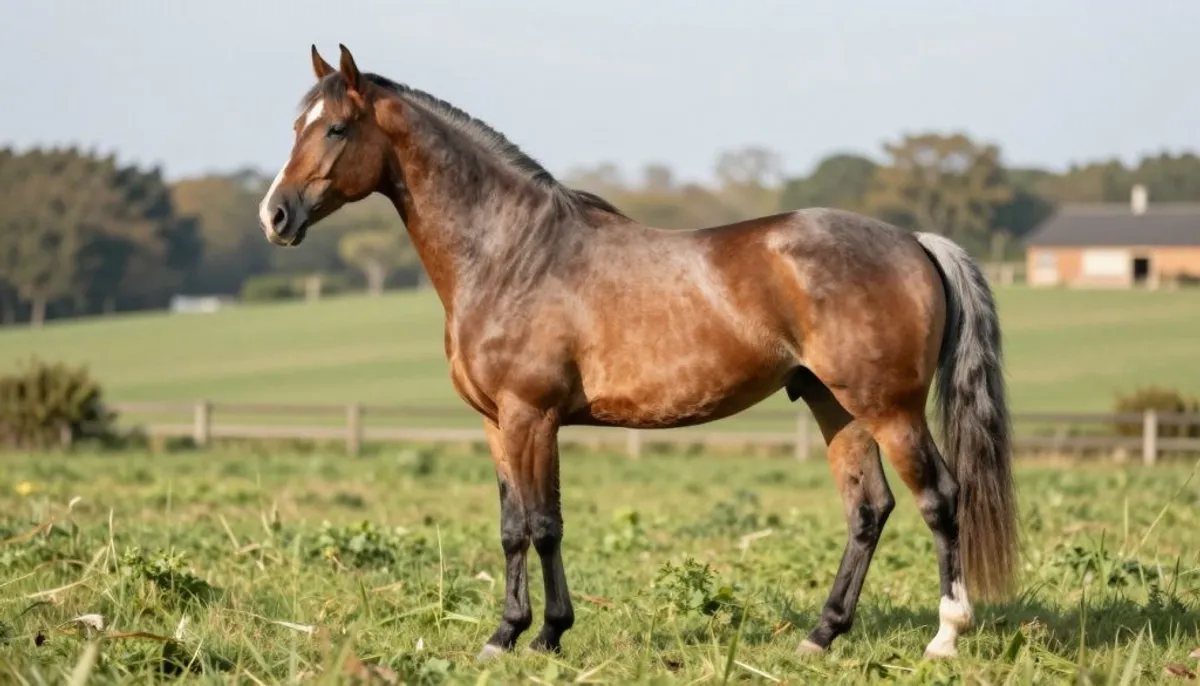
The height of an adult Hanoverian is often between 1.55 m and 1.73 m. On average, they measure 1.63 m. The tallest can reach or exceed 1.80 m, providing a different experience for the rider.
Their weight generally varies between 500 and 600 kg. This depends on their bone structure, condition, and activity level. Hanoverians combine strength and agility.
Mainly, colors such as bay, chestnut, black, and gray are found. White, isabella, and mouse are rarer. Bays and chestnuts are the most common among these horses.
White markings are common and accepted. White faces and socks are often seen. These signs help identify a Hanoverian, just like its main color.
| Criterion | Common reference | What this implies in daily life |
|---|---|---|
| Height at withers | 1.55 m to 1.73 m (average about 1.63 m) | Choice of saddle size, adapted jump height, impression of “cadence” more or less ample |
| Very tall subjects | Up to > 1.80 m for some individuals | More coverage at walk and gallop, but requires a rider comfortable with a large frame |
| Indicative weight | About 500 to 600 kg | Management of feeding, hooves, and physical condition, especially in sports work |
| Accepted coats | Bay, chestnut, black, gray; more rarely white, isabella, mouse | Useful visual reference, with no direct link to the expected sporting quality of a Hanoverian breed horse |
| White markings | Socks and white faces fairly common depending on lineages | Facilitates identification and highlights diversity while remaining within the Hanoverian standard |
Model and Morphology: An Athletic and Powerful Saddle Horse
At first glance, the Hanoverian displays its calm power. It shows perfect balance, ideal for carrying, pushing, and stability. Hanoverian breeders seek to produce sporty, agile horses without heaviness.
The Hanoverian standard guides breeders but also allows for some variety. Some are longer, others more compact, depending on their lineage and sporting purpose. The goal is always to have a solid structure, secure supports, and a great ability to gather.
Head and Expression
Their head, often delicate, is of medium size with a wide forehead. Their profile is mostly straight, sometimes slightly convex. Large, expressive eyes, a calm gaze, long ears, and wide nostrils are typical.
For Hanoverians, these traits are essential as they reveal their well-being and attentiveness. The influence of Thoroughbreds has refined their expression. This gives a more elegant appearance while maintaining their robustness.
Forehand
Their neck is long, graceful, and well-set, often high. The shoulders, strong and sloping, are well-muscled, promoting great movement and good freedom in front. The withers are prominent, a key element for saddle support.
This front of the Hanoverian allows for free movements without rigidity. Breeders seek a free shoulder, essential for both dressage and jumping. Thus, breeding focuses on utility, not just appearance.
Body
The Hanoverian's chest is wide and deep, indicating good lung capacity. The back is straight, of medium length, maintaining a clear silhouette. The girth area is well-defined, stabilizing the equipment.
No matter the lineage, the Hanoverian always has a solid structure. Its musculature, particularly on the back and croup, is distinct. These traits support balance in motion and long-term strength.
Hindquarters and Limbs
The hindquarters are robust with a wide and rounded croup, and a tail set high. The joints are strong and clear, with well-defined solid tendons. This structure supports the push and flexibility needed to maintain itself.
The feet, once considered weak, have been improved through selection. Nowadays, the goal is to have resilient, well-formed feet for regular work. The solidity of the limbs is paramount for Hanoverian breeding, as is their movement capacity.
| Area | Morphological references | Interest in sport |
|---|---|---|
| Head | Wide forehead, straight or slightly convex profile, large eyes, open nostrils | Easy breathing, more stable contact, often serene expression |
| Forehand | Long and well-attached neck, sloping shoulders, marked withers | Amplitude, balance, better shoulder freedom, and saddle stability |
| Body | Wide and deep chest, straight back, rectangular or compact frame depending on trends | Lift, endurance, cleaner transitions, and lasting posture |
| Hindquarters and limbs | Long and muscular croup, wide joints, resilient tendons, well-conformed feet | Push, propulsion, safer landing, regularity at work |
Temperament, Mentality, and Gaits: A Reliable Partner in Daily Life
The Hanoverian is known for its calm presence and availability. Its temperament makes it ideal for the stable and club as it is calm yet full of energy.
The personality of the Hanoverian horse is just as important as its physique. It is easy-going, learns quickly, and remains stable, even with changes around it.
Character: Kind, Docile, Sociable, Balanced, Willing
The Hanoverian is recognized for being kind and sociable. It enjoys human contact, easily adapts to routine, and is easy to handle.
However, it is not passive. Its joyful and willing nature requires a clear approach and varied challenges.
Desired Qualities: Courage, Cooperation, Desire to Learn, “Strong Nerves”
Courage and cooperation are highly valued in the Hanoverian. It strives to understand and responds well when guided tactfully.
Being emotionally stable is crucial for these horses. This quality makes them more confident, even in tumultuous or demanding environments.
Gaits: Covering Walk, Rhythmic Gallop, Elastic and Expressive Locomotion (an asset in dressage)
The gaits of the Hanoverian capture attention immediately. Its walk is ample and relaxed, perfect for marching.
Its gallop is well-rhythmed and flexible enough to be easily adjusted. Its elastic and expressive movement is a major asset in dressage, maintaining good impulsion.
| Observed Point | What is expected of a Hanoverian | Concrete impact at work |
|---|---|---|
| Sociability | Horse close to humans, respectful, easy to handle | Care, grooming, and loading are more serene, even with an amateur rider |
| Emotional Stability | Strong nerves and ability to stay attentive in a new place | Better session regularity, fewer flight reactions, faster mental recovery |
| Walk | Ample, flexible walk that covers ground | Cleaner transitions, smooth warm-up, useful base for contact work |
| Gallop | Rhythmic, balanced gallop with good back lift | Facilitates lines, adjustments, and supports Hanoverian performances over time |
Hanoverian Breeding: Selection Objectives and Quality Criteria
In France, the Hanoverian is seen as a high-level athlete. However, Hanoverian breeding aims for more. We seek a horse that is safe, pleasant to ride, and adapts well to sport and leisure. The Hanoverian standard is a clear guide. It allows for openness to modern qualities.
Selection is based on precise rules and regular checks. The Hanoverian stud-book is essential for knowing origins, performances, and lineage logic. On the ground, the Hanoverian association conducts annual visits. During these visits, foals are evaluated, their conformation examined, and their identification carried out.
Breeding priorities: performance is important, but it is not everything. Behavior, health, and functionality are also crucial. An ideal horse must be cooperative, calm in noise, and recover quickly after effort.
- Sport: balance, propulsion, and ease of learning.
- Temperament: cooperation, calmness, desire to progress.
- Health: clear locomotion, clean feet, consistent veterinary follow-up.
- Functionality: useful movements, strong back, manageable energy in daily life.
Tests and evaluations: choosing breeders is not just about their beauty. One must evaluate their conformation, gaits, and especially their gallop. A good gallop is key for balance in dressage and jumping. We also observe their behavior in handling and work, and their availability.
We test their ability in dressage and show jumping. The Hanoverian standard guides choices, but the objective is precise. We want a horse that evolves well without stress and faces challenges with ease.
Versatility: even if a lineage excels in dressage or jumping, judgments vary. This avoids specializing horses too early. We seek a balance, for horses capable of meeting riders' needs and evolving in their careers.
| Observed Criterion | What is sought | What is penalizing | Why it is decisive |
|---|---|---|---|
| Model and Conformation | Harmonious lines, dry limbs, regular feet | Marked conformation defects, weak feet | Reduces the risk of injury and improves sports longevity |
| Gaits | Ample walk, elastic trot, balanced gallop | Short gaits, flat gallop, stiffness | Conditions the quality of dressage and approach to jumps |
| Mentality | Calm, honesty, ability to learn | Stress, defensiveness, difficulty settling | Facilitates daily work, transport, and competition |
| Dressage Ability | Flexibility, balance, available back | Lack of connection, rigidity | Allows for clean progression towards technical exercises |
| Jumping Ability | Respect, trajectory, responsiveness without haste | Knocking down poles, lack of engagement, loss of rhythm | Secures the margin at obstacles and consistency in courses |
| Traceability | Origins and performances tracked in the Hanoverian stud-book | Incomplete data, irregular tracking | Helps reason crossbreeding and consolidate selection |
In conclusion, everything is clear: there are rules, tests, and a long-term vision. The Hanoverian stud-book, the breed standard, and the association's actions aim for the same goal. They wish to maintain a performing, healthy, and pleasant horse to live with. Versatility remains an essential quality.
Hanoverian Association, Hanoverian Stud-Book, and Lineage Traceability
To track a lineage, it is not enough to have a good eye. Rules, evidence, and data are needed. The Hanoverian association connects breeders, judges, and sports results.
The Hanoverian standard is based on objective criteria. Each step, from approval to performance, is documented.
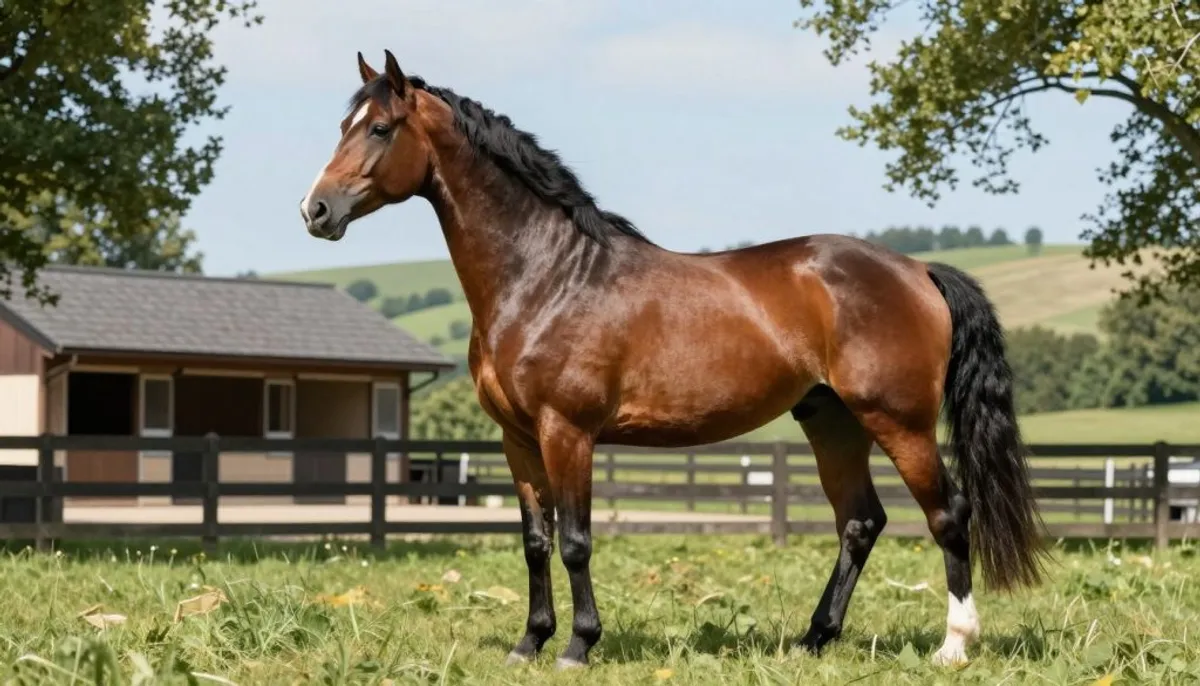
Hannoveraner Verband: managing the stud-book since 1922
The management of the Hanoverian stud-book evolved in the early 20th century. Between 1899 and 1922, the agricultural chamber took care of it. In 1922, the breeders' organization, the Hannoveraner Verband, took over.
This transition improved information collection, especially on performances. The goal is to connect pedigree, model, abilities, and results. This maintains the Hanoverian standard through clear criteria.
Organization and network: federation of clubs/breeders and performance data collection
The Hanoverian association relies on a network of about 50 local clubs. With over 10,000 members, it facilitates inspections and the sharing of advice.
Information on performances and results feeds the stud-book. This helps breeders, in France and elsewhere, choose sport horses.
| Reference | What it brings to traceability | Impact on the Hanoverian standard |
|---|---|---|
| 1899–1922: managed by the agricultural chamber | Administrative base, recording of origins and structured tracking | Common framework, but less oriented towards “sport data” |
| 1922: taken over by the Hannoveraner Verband | Centralization and unified method, clearer link between origin and results | More precise criteria, selection aligned with the use of sport horses |
| Network: ~50 clubs, >10,000 members | Regular information flow and field tracking | Homogeneity of evaluations and better reading of lineages |
Identification and tradition: the “H” brand (and modern debates about marking)
Identification was marked by the “H” brand, created under George II in 1735. The design of the H is unique, with two upper points representing horse heads.
In Germany, branding has been prohibited since 2012. Traceability now depends on modern identification while respecting the tradition of the stud-book.
Sales and selection: the importance of Verden in the breed ecosystem
Verden is essential for understanding selection and the market since 1949. These sales attract an international audience and showcase breeding trends.
Some horses sell for over €100,000. In 2003, a horse reached a record of €2.1 million. The average price at that time was €11,481.
The meetings in Verden show the real value of lineages. They prove what the Hanoverian stud-book guarantees in the long term.
Hanoverian Performances: Sports Results and Presence in Rankings
Equestrian sports often highlight Hanoverian horses. These horses are known for their power, balance, and ease of use. The history of Hanoverians is marked by their success in modern competition.
Hanoverians excel in both dressage and show jumping. They have a strong reputation as winners. Their consistently good performances are seen in the rankings year after year.
WBFSH: a breed regularly at the top in stud-book and individually
In the WBFSH rankings, Hanoverians are often at the top. They particularly distinguished themselves between 1990 and 2000.
The Hanoverian horse has won the Best of All Trophy six times. This shows that it excels in the three Olympic disciplines. This consistency highlights the versatility and quality of the Hanoverian as a sport horse.
Dressage: locomotion, power, and consistency at the highest level
The Hanoverian is appreciated in dressage for its suppleness and strength. These qualities perfectly meet the current demands of the sport.
The German team, including three Hanoverian geldings, won the 2008 Olympic Games. Furthermore, the Hanoverian dominated the World Championship for Sport Horses, achieving seven consecutive victories.
- Gigolo with Isabell Werth, a major figure in the great years.
- Satchmo, team gold at the 2008 Olympics and individual silver.
- Salinero, double Olympic champion in 2004 and 2008 with Anky van Grunsven.
These horses exemplify the balanced and powerful approach favored in Hanoverians to excel at the highest level.
Show Jumping: strength and respect, with iconic champions
Hanoverians stand out in show jumping for their strength and precision. They demonstrate their stability on large courses.
- Dollar Girl, winner of the World Cup in 1995 with Nick Skelton.
- Top Gun, team gold at the 1988 Olympics with Franke Sloothaak.
- Deister, three-time European champion with Paul Schockemöhle.
- For Pleasure, double Olympic champion and “Best Horse in the World” WBFSH 2003, ridden by Marcus Ehning and previously by Lars Nieberg.
- Shutterfly, a great winner with Meredith Michaels-Beerbaum, including the Aachen Grand Prix in 2005.
The Hanoverian stud-book ranked 5th in show jumping in 2013. This illustrates the depth of quality in the breed.
Eventing: more competitive “close to blood” (Thoroughbred contributions); examples of performing lineages
In eventing, the Hanoverian shines through a balanced mix with Thoroughbreds. This makes them faster and more enduring. Breeding has evolved to meet the needs of the sport.
The breeding of Friedrich Butt is a perfect example. He crosses Hanoverians with Thoroughbreds for more responsiveness. Butts Abraxxas and Butts Leon shone at the Beijing Olympics in 2008.
Another example is A Criminal Mind, champion at the Rolex Kentucky Three Day in 2001. These horses demonstrate how the Hanoverian can excel in eventing.
| Discipline | What is often found in the Hanoverian | Performance benchmarks cited | Notable examples |
|---|---|---|---|
| WBFSH (global) | Regularity in stud-book, presence in rankings | Frequent domination 1990–2000, 6 times Best of All Trophy | Hanoverian stud-book often at the top, all disciplines |
| Dressage | Elastic gaits, power, stable cadence | German team 2008: three geldings; 7 consecutive titles at WBCH (including 2013) | Gigolo, Satchmo, Salinero |
| Show Jumping | Strength, respect, balance on large courses | Stud-book: 3rd (2004), 4th (2008), 5th (2013) | For Pleasure, Shutterfly, Dollar Girl |
| Eventing | Best competitiveness “close to blood” thanks to Thoroughbred contributions | Team gold at the 2008 Olympics (Beijing) for two horses bred by Friedrich Butt | Butts Abraxxas, Butts Leon, A Criminal Mind |
Health, Veterinary Follow-Up, and Points of Caution in the Hanoverian
The health of the Hanoverian is built every day, from birth. Regular veterinary visits and attentive observation help keep the horses fit. This allows for adherence to the Hanoverian standard, especially for the young.
Maintaining this serious follow-up helps preserve the Hanoverian's sporting qualities: strength, balance, and suppleness. In France, special attention is given to feeding and exercise. This prevents overexertion of the horse.
Selection and Prevention: Reducing Hereditary Diseases through Breeding Policies
Selection policies in Hanoverian breeding reduce hereditary diseases. The goal is to avoid reproducing horses with risks while maintaining good genetic diversity. This also helps maintain good fertility.
The inbreeding coefficient is an important indicator. For the Hanoverian, it was about 0.06 in 2012. This helps us understand selection choices, but it is not the only factor in a horse's quality.
| Genetic Reference | Value | Practical reading for the breeder |
|---|---|---|
| Hanoverian | 0.06 | Desired balance between performance and diversity, with controlled pairings |
| Quarter Horse | 0.04 | Lower inbreeding, broad genetic base according to lineages |
| Mongolian Horse | 0.02 | Very high diversity, historically less “closed” population |
| Thoroughbred | 0.15 | Higher inbreeding, intense selection based on speed criteria |
Osteochondritis (OCD): Affected Joints, Impacts, and the Importance of Screening
Osteochondritis, or OCD, affects the bone and cartilage of young horses. The fetlocks, both front and back, are often affected. Less frequently, it concerns the hock or kneecap.
This can cause micro-fractures or fluid pockets. If untreated, it can lead to arthritis and affect the horse's career. OCD is linked to other issues such as navicular disease.
About 7 to 10% of Hanoverians have OCD in their knees and 12 to 24% in their fetlocks. Early screening, often through imaging, is crucial. This helps plan training and veterinary follow-up.
Managing the Sport Horse: Growth, Work, and Prevention of Joint Wear
Sport horses sometimes have to work despite joint pain. This can harm their career if not monitored. Good management considers their growth, especially for the large horses typical of Hanoverians.
It is important to control effort, vary terrains, and ensure good recovery. Attentive follow-up allows for early detection of problems. We monitor stiffness, irregular movement, or sensitivity to touch.
- Plan the increase in workload: progression in stages, with lighter weeks.
- Care for growth: stable ration, suitable minerals, body condition monitoring.
- Limit wear: alternating outdoor/flat/ground poles, long warm-up, cool-down.
- Track signs: note variations in locomotion and reactions after effort.
Equipment, Tack, and Comfort: Focus on La Sellerie Française
A well-equipped Hanoverian moves with more ease, especially when work becomes serious. The Hanoverian characteristics — prominent withers, powerful shoulders, often straight back — require simple attention: avoid pressure points and allow the body to breathe. For a sport horse, comfort is never a detail.
Choosing a Saddle Suitable for the Hanoverian Model (Back, Withers, Shoulders)
The saddle must clear the withers and follow the line of the back without bridging or tilting. On a Hanoverian, a well-chosen gullet and regular panels are needed to distribute the load well. The goal is perfect stability while allowing the shoulder to be free during jumps or speed changes.
If the adjustment is good, the horse's back remains supple. Its walk lengthens, and contact becomes easier. This shows respect for its Hanoverian traits, even if the horse is small.
Bridles and Accessories: Adjustment, Freedom of Movement, and Performance
The bridle must be adjusted but never too tight. A Hanoverian with its long neck needs space at the nape and throat. This allows it to move freely. Whether in dressage or jumping, it responds better without pressure.
Accessories should follow this same idea: a balanced girth, a well-placed saddle pad, and protective gear adjusted according to work. The idea is to have a clear routine that is easy to check each time.
La Sellerie Française: High-End Products, Made in France, Unique, Custom, or Limited Series
For those looking for high-end tack in France, La Sellerie Française offers unique pieces. They can be custom-made or in limited series, always with high-quality finishing. The advantage is clear: durable leather, strong stitching, and details designed to last.
This approach also combines aesthetics and functionality, important in competition and for daily use. On a Hanoverian, the right balance between style and comfort is felt from the first try.
Manufacturing from A to Z in France: A Requirement Beyond the Made in France Label and the Origine France Certification
La Sellerie Française emphasizes its fully French manufacturing, offering superior quality beyond what a simple label can promise. This approach goes beyond the Made in France label and the Origine France certification, highlighting the craftsmanship of the workshop and precise production control.
For Hanoverian horses, this represents a significant advantage: one obtains quality equipment. It follows the development of work while ensuring the horse's comfort.
Useful Link
https://laselleriefrancaise.com
Conclusion
The Hanoverian benefits from a long history and rigorous selection. Around Celle, breeding aims for three aspects: shape, gaits, and character. This has created a strong horse, supple in movement, with a good mentality for work.
In height, the Hanoverian varies between 1.55 m and 1.73 m, with most measuring around 1.63 m. Some may even exceed 1.80 m. They weigh between 500 and 600 kg. Their coat can be bay, chestnut, black, or gray, and sometimes white, isabella, or mouse. White markings are often seen, depending on the lineages.
Their excellence is visible in competitions, often well-ranked by the WBFSH. They particularly shine in dressage, show jumping, and eventing, especially if they are close to the “blood” type.
Good equipment is as crucial as genetics for a Hanoverian. It requires equipment suited to its morphology. La Sellerie Française offers fully manufactured equipment in France, designed to be comfortable and durable.
FAQ
What type of horse is the Hanoverian exactly?
The Hanoverian originates from Hanover, Germany. It is valued in sports for its strength, suppleness, and reliable character.
In which disciplines does the Hanoverian breed excel the most?
The Hanoverian excels in dressage and show jumping. It is also good in eventing and driving, thanks to its temperament.
What are the typical height and weight of an adult Hanoverian?
An adult Hanoverian often measures between 1.55 m and 1.73 m. Some even exceed 1.80 m. They weigh between 500 and 600 kg.
What coat colors are accepted by the Hanoverian standard?
Hanoverians are primarily bay, chestnut, black, and gray. Sometimes white, isabella, or mouse, according to the stud-book.
Are white markings common in Hanoverians?
Yes, socks and markings on the face are common and do not affect their sporting ability.
What morphological characteristics define the Hanoverian model?
The Hanoverian is athletic, with a long neck and muscular shoulders. Its body is strong, often rectangular, with solid limbs.
How can one recognize the typical head and expression of a Hanoverian?
Its head is elegant, with a wide forehead and large eyes. It has a calm and attentive gaze.
What is the mentality of the Hanoverian, and which audience does it suit?
The Hanoverian is kind, sociable, and has a good temperament. It is perfect for professionals and amateurs looking for a reliable partner.
What gaits contribute to the Hanoverian's reputation in dressage?
It is famous for its supple and effective gaits. Its walk is ample, and its gallop is rhythmic, ideal for dressage.
Why has the Hanoverian become a benchmark for modern sport horses?
Thanks to precise selection, it combines strength, movement, and good temperament. This contributes to its successes in competitions.
What distinguishes the Hanoverian from other European warmbloods?
It has a base of power with refinement for sport. This combination ensures good stability in competition.
What is the history of the Hanoverian, in a few key points?
It begins with local horses enriched by various contributions. The Celle Stud, founded in 1735, has been crucial for the breed.
What role does the Celle Stud play in Hanoverian breeding?
Founded in 1735, it plays a significant role in Hanoverian selection and dissemination. It symbolizes the history of the breed.
What crossbreeding has shaped the Hanoverian breed over time?
The Holsteiner, Thoroughbred, Trakehner, and others have influenced the breed. They have helped improve power, endurance, and movement.
How does selection work in the Hanoverian stud-book?
It is based on evaluations of model, gaits, and temperament. This guarantees the quality of the sport horse.
Who manages the Hanoverian stud-book today?
The Hannoveraner Verband has been handling the stud-book since 1922. They collect data and manage the traceability of horses.
What does the “H” brand mean for the Hanoverian?
It is a historical symbol, now a subject of debate. Since 2012, Germany has prohibited branding.
Why is Verden so important in the Hanoverian ecosystem?
Verden is essential for selection and sales. The auctions showcase the international value of the best Hanoverians.
Is the Hanoverian really well-ranked in the WBFSH?
Yes, it is often at the top of the rankings. This proves the quality of Hanoverian selection.
What are some examples of well-known Hanoverian champions in sports?
Gigolo, Satchmo, and Salinero in dressage; For Pleasure and Shutterfly in jumping. They showcase the strength of the breed.
Is the Hanoverian suitable for eventing?
Yes, especially with more Thoroughbred blood. Horses like Butts Abraxxas and Butts Leon are perfect examples.
What health points should be monitored in a sport Hanoverian horse?
Attention should be paid to growth, joints, and work. Good follow-up and appropriate training are key.
What is osteochondritis (OCD) in the Hanoverian, and which joints are affected?
OCD affects young horses at the fetlocks and sometimes at the hock. This can impact their movement and cause arthritis.
What is the prevalence of OCD in Hanoverians?
Between 7 to 10% for knees and 12 to 24% for fetlocks. Early screening is therefore important.
How does Hanoverian breeding address the prevention of genetic diseases?
The goal is to eliminate genetic diseases through careful selection. Genetic diversity is also monitored.
What saddle should be chosen for a Hanoverian, and why is adjustment so important?
A saddle suitable for the prominent withers and back of the Hanoverian is needed. A good adjustment improves comfort and performance.
What adjustments are important for bridles and accessories in the Hanoverian?
Ensuring good freedom of movement and stable action is crucial. This allows for better control and guidance of the horse.
What does La Sellerie Française offer to equip a sport horse like the Hanoverian?
La Sellerie Française (https://laselleriefrancaise.com) offers high-quality equipment, made in France. They are perfect for athletes like the Hanoverian.
What does “manufacturing from A to Z in France” mean for horse equipment?
This guarantees exceptional quality, with monitoring and durability. Everything is made in France for optimal quality.
Where can one find the official link to La Sellerie Française?
The useful link is https://laselleriefrancaise.com.
The “Hanoverian” and the “Hanoverian/hanoverienne”: which spelling to retain?
“Hanoverian” is used for the breed. Generally, it is most important to link the term to the breed and its standards.