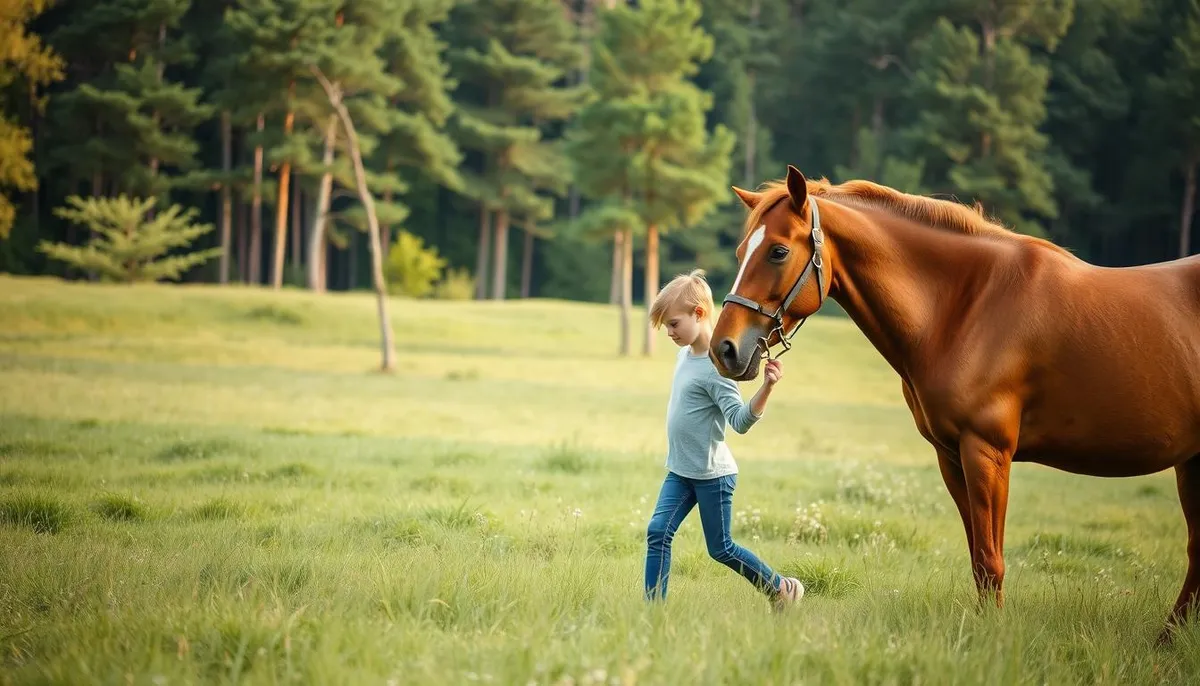
Equine therapy uses the horse to help people. It is a therapy where a professional and a horse help achieve specific goals. These goals range from physical and mental well-being to cognitive and social improvements. This approach is for everyone: children, adults, seniors, with or without disabilities.
Being near a horse brings a lot. The warmth and movement of the horse improve balance and coordination. This contact helps to relax, become more aware of one’s body, and improve non-verbal communication. The benefits of equine therapy touch on concentration, memory, emotional management, and self-confidence.
In France, equine therapy is offered in specialized centers and associations. Sessions may include a warm welcome, moments with the horse, breathing, relaxation, and games. This therapy dates back to ancient Greece but continues to evolve even today.

Key Points
- A horse therapy centered on the human-horse relationship and personalized goals.
- Physical and psychological benefits: balance, coordination, relaxation, and emotional management.
- Cognitive effects: attention, concentration, memory, and problem-solving.
- A practice in France supported by equine therapy centers and specialized associations.
- A safe environment led by trained medical-social professionals in ethology and psychology.
- Progressive sessions combining welcome, ground or mounted exercises, breathing, and games.
Definition and Approach of Horse Therapy
Horse therapy is the union between horse, therapist, and participant. It aims for well-being at all levels: physical, emotional, cognitive. Equine mediation is at the core, to better connect with one’s body and emotions, in safety.
What is Equine Therapy and How Does it Differ from Adapted Riding?
Equine therapy defines therapeutic goals. A professional guides, using equine mediation. They focus on posture and relationship for long-term benefits.
In comparison, adapted riding is more sports-oriented. It helps to ride with assistance, aiming for autonomy and safety. Both approaches support each other but aim at different objectives.
The Horse as a Therapeutic Mediator and Non-Judgmental Partner
Horses do not judge, offering tranquility and stability. Their movement helps the entire body, improving posture and coordination. The contact calms them and helps to feel aligned.
This interaction enhances self-awareness and confidence. It also strengthens the therapeutic relationship.
Target Audiences in France: Children, Adults, Seniors, People with Disabilities
The therapy is suitable for a wide audience: children to seniors, including those with disabilities. It helps those facing challenges like ASD or ADHD, anxiety, depression, and more.
In France, the approach is personalized for each individual. Sessions adapt to the needs and pace of the person, in a natural environment specific to equine therapy.
Benefits of Equine Therapy: Physical, Psychological, and Social Effects
When riding a horse, one experiences incredible things. The benefits of equine therapy are seen in our posture and breathing. We become calmer. It helps us feel better in our body and mind. The way we communicate without speaking becomes easier.
Improvement of Motor Skills, Balance, and Coordination
The horse moves in a special way that helps our balance and coordination. The warmth of the horse relaxes, and its movement strengthens our muscles. This makes us stronger.
It also helps our body move more easily. We become more agile. Children, adults, and seniors can all benefit.
Self-Confidence, Emotional Management, and Non-Verbal Communication
When we are near a horse, we learn to calm down. This reduces stress and anxiety. We also learn to understand ourselves better without talking.
This builds self-confidence. We learn to know ourselves better, to be empathetic, and to manage difficult moments. All of this makes us happier.
Attention, Concentration, Memory, and Problem-Solving
Activities with the horse improve attention and concentration. Repeating instructions enhances memory. This greatly helps our brain.
We learn to think quickly to adjust. This helps us stay calm and focused, even when it’s difficult.
Equine Therapy
The definition of equine therapy is a practice where the horse assists in care. This care method utilizes the relationship with the horse. It helps develop autonomy, communication, and motor skills. In France, it follows clear rules, with ethical values and action plans.
The equine mediation can be done either on foot or on horseback, depending on what the person is capable of and what they seek to improve. Those who practice it are well-versed in the medical field and the equine world. They also understand psychology, riding, and animal behavior studies. Sessions take place in calm and safe locations, designed for all ages and types of difficulties.
An equine therapy session begins with welcoming everyone, then defining goals. After that, exercises such as calm breathing, relaxation, movement, and play are performed. This practice uses the horse's warmth, heartbeat, and movements to help better manage emotions and adjust physically.
Ancient writings show that people used horses for healing since ancient Greece. Nowadays, in France, specialized centers and associations offer these services. They provide a pleasant environment for families and health professionals.
| Axes of Equine Mediation | Session Actions | Targeted Benefits | Therapeutic Framework Guidelines |
|---|---|---|---|
| Relationship with the horse | Observation, grooming, leading on foot | Trust, communication, joint attention | Therapeutic goals defined and reassessed |
| Movements and rhythms | Walk, transitions, assisted mounting | Balance, tone, sensory regulation | Secure protocols, controlled equipment |
| Emotional regulation | Breathing, relaxation, grounding | Stress management, calming, presence | Supervision by trained professionals in France |
| Transfer of learning | Games, role-playing, feedback | Autonomy, spatial awareness, initiative | Session traceability and informed consent |
Types of Practices: Hippotherapy, Therapeutic Vaulting, and Equine Mediation
In France, therapeutic frameworks are used to heal with horses. The goal is to help on motor, sensory, or emotional levels. This involves the horse, the person, and a specialized team.
Hippotherapy: Movements in Three Dimensions, Body Heat, and Rhythmic Pulses
Hippotherapy helps to relax through the warmth of the horse. The horse's movements also help awaken the body.
It improves balance and coordination. It is based on brain science and is always done in safety.
Therapeutic Vaulting: Balance, Tone, and Coordination
Vaulting involves performing controlled movements on a horse. It strengthens the body and aids coordination.
It also allows for better balance management and builds self-confidence. We progress gradually, paying attention to breathing properly.
Instructional Riding and Adapted Riding: Frameworks and Objectives
Instructional riding is about learning to communicate with the horse. Clear objectives are set, and everyone can help.
Adapted riding is more sports-oriented and may require special assistance. It also brings benefits, but in a different way depending on individual needs.
Flow of Equine Therapy Sessions and Therapeutic Objectives
Each equine therapy session follows a well-defined therapeutic protocol. This helps to see how we progress. Therapists set goals, ensure everything is safe, and can change the pace according to individual needs.
Welcome Time, Meeting the Horse, and Building Trust
The beginning of the session allows for discussion of what we hope to achieve and to remind of the safety rules. We approach the horse on foot to better understand it by observing its posture and breathing.
We meet the horse in different ways, such as grooming or riding, following the plan. This helps establish a trust bond and clarify the immediate goals of the therapy.
Exercises: Breathing, Relaxation, Games, and Role-Playing
Breathing exercises adapt to the horse's walk or trot, sometimes even with eyes closed. We use the horse's warmth and movements to relax.
Games help to focus and coordinate movements. They can be obstacle courses or stories. Role-playing improves listening, stress control, and communication.
Personalized Follow-Up, Progress Evaluation, and Safety
The therapeutic protocol evolves over time. We change activities and the way we do them. A brief assessment at the end of each session evaluates progress.
Safety is essential. It comes from a well-trained horse, an appropriate location, and good observation. Sessions follow regularly, focusing on the goals to be achieved.
| Step | Main Goal | Tools and Exercises | Indicators Monitored | Safety Points |
|---|---|---|---|---|
| Welcome | Clarify therapeutic objectives | Briefing, task selection | Motivation, attention | Equipment check, calm area |
| Meeting | Building Trust | Grooming, leading | Posture, contact, breath | Distances, horse signals |
| Work on Horseback | Regulation and Coordination | Breathing, relaxation, gaits | Balance, tone | Supervision, gait adjustments |
| Games/Scenarios | Social and Cognitive Skills | Obstacle courses, stories, instructions | Concentration, communication | Safe trajectories, stable equipment |
| Calm Down | Sensorial Integration | Guided breathing, stretching | Perceived heart rate, calming | Safe dismount, dedicated area |
| Debrief | Adjust the therapeutic protocol | Brief feedback, next plan | Observed progress | Traceability, appointment |
Equine Therapy for Children and Adults: Indications and Results
Equine therapy for children uses the horse to help focus and move. In autism spectrum disorders and ADHD, activities like guiding the horse, grooming, and navigating between cones are very helpful. This improves concentration and coordination.
The simple rules of the riding arena help with self-control. Additionally, not needing to speak to understand creates a safe space to connect.
In equine therapy for adults, anxiety, depression, and post-traumatic stress are addressed. Following the horse's rhythm while riding can be calming. It can also awaken bodily sensations, help manage emotions, and strengthen self-confidence with clear goals.
For those with disabilities and seniors, equine therapy aims to improve mobility, balance, and strength. Progressive activities like mounting and standing straight encourage memory and adaptation. Studies show that this reduces agitation and stress, increasing independence and personal control.
Care is chosen based on age, diagnosis, and individual goals. We observe, perform specific exercises, and evaluate regularly. This allows for clear visibility of improvements, such as better attention, coordination, or ease of interaction.
| Audience | Therapeutic Indications | Key Objectives | Observed Clinical Results | Examples of Exercises |
|---|---|---|---|---|
| Child | autism spectrum disorders, ADHD, learning disabilities | Sustained attention, coordination, social interaction | Less agitation, better focus, smoother movements | Leading on foot, horse care, cone courses |
| Adult | Anxiety, depression, post-traumatic stress | Emotional regulation, self-esteem, bodily grounding | Decreased stress, improved sleep, increased confidence | Rhythmic breathing at walk/trot, controlled mounts/desmounts |
| Seniors | Balance loss, isolation, mild memory issues | Proprioception, tone, cognitive stimulation | More stable walking, facilitated exchanges, regular breathing rhythm | Orientation exercises, stop transitions, gentle stretches |
| Disability | Motor, sensory, or psychological impairments | Functional mobility, communication, autonomy | Improved posture, better sensory tolerance, secure movements | Adapted sitting positions, guided lateral transitions, tactile mediation |
Choosing an Equine Therapy Practitioner and Centers in France
Choosing the right practitioner in equine therapy takes time. One must know what to look for. Centers are evolving in France, aiming for more professionalism. They focus on horse safety, accessibility, and their integration into rural areas.
Tip: Try a trial session. Observe the horse and the location. Note how they listen and respect the individual’s pace.
Role of the Equine Therapist: Dual Medical-Social and Equine Expertise
Practitioners in equine therapy often come from the medical-social sector, such as psychologists or nurses. They are well acquainted with horse behavior, how to conduct a session, and safety around horses.
Their role? Set goals, decide on exercises with the horse, observe reactions, and track progress. They also work with the family and health professionals.
Selection Criteria: Certification, Experience, Framework, and Safety
- A good training is crucial, including in psychology and ethology.
- They must have experience with various conditions, such as autism or disabilities.
- The location must be well-equipped, with calm and accessible facilities.
- The horses must be well-chosen, trained, and monitored by a veterinarian.
- Procedures, such as evaluations and safety, must be documented.
Choosing an equine therapist involves assessing their listening skills, objectives, and how they track progress. Request a detailed quote and an action plan.
Where to Practice in France: Specialized Centers, Associations, and Rural Structures
In France, there are equine therapy centers everywhere. Locations in the countryside provide a tranquil setting that aids therapeutic work.
Associations, hospitals, and private practices offer various programs. Prices vary. It is important to inquire about accessibility and collaborations.
| Type of Offer | Professional Profiles | Key Advantages | Points to Check |
|---|---|---|---|
| Specialized Center | Multidisciplinary team (psychologist, psychomotrician, educator) | Structured assessments, covered riding arena, enhanced equine safety | Availability, transparency of objectives, cost of assessments |
| Association | Certified equine therapist, trained volunteers | Moderate rates, local anchoring, links with schools and institutions | Quality of equipment, clinical supervision, insurance |
| Private Practice | Experienced equine therapy practitioner | Individualized follow-up, flexible hours, therapeutic continuity | Price, written roadmap, transport access |
| Rural Structures | Professionals trained in ethology and stable management | Calm, diverse terrains, sensory immersion | Accessibility for people with reduced mobility, seasonality, emergency protocols |
Equine Therapy Training, Costs, and Recommended Equipment
In France, equine therapy is based on solid principles and well-structured practice. It helps meet various needs while caring for the horse. Equipment and costs are also important to consider.
Training Path in France: Foundations of Psychology, Ethology, and Practice
The training path includes psychology, psychopathology, and how to support others. One learns to understand horse behavior and the basics of riding. This allows for appropriate action.
Practical training teaches how to organize sessions, prepare the horse, and manage safety. It shows how to adapt activities to different disabilities. Trainees learn to create a safe and stimulating space for both the horse and the patient.
Session Rates and Possible Financial Assistance by Structure
The prices of equine therapy sessions vary based on several factors. They depend on the location, the experience of professionals, and the duration of sessions. Private centers often have higher rates compared to some associations.
There are aids available to finance these sessions. Some insurances take these alternative practices into account. Therefore, it is essential to inquire well.
Equipment and Materials: La Sellerie Française, High-End Products 100% Made in France
The right equipment ensures safety and comfort. This includes saddles, pads, and other gear. Choosing well-fitted equipment is crucial to avoid injuries and maintain stability.
La Sellerie Française offers quality equipment made in France. They are durable, precise, and comfortable, meeting the needs of equine therapy sessions.
| Clinical Need | Key Equipment | Expected Benefit | Quality Benchmark |
|---|---|---|---|
| Trunk Stability | Vaulting surcingle with handles | Secure grip, balance work | Reinforced seams, full-grain leather |
| Pelvic Comfort | Shock-absorbing pad and suitable saddle | Pressure reduction, neutral posture | High-density foam, calibrated panels |
| Fine Guidance | Adjustable reins and halters | Clear signal, relaxed horse | Stainless steel fittings, precise adjustments |
| Therapeutic Games | Soft modules and cones | Motivation, spatial awareness | Non-toxic materials, non-slip |
| Protection | Gaiters and fetlock protectors | Shock prevention | Reliable closures, breathable lining |
Conclusion
In France, equine therapy is recognized as a legitimate therapeutic method. It uses the horse to assist on physical, emotional, and mental levels. Activities like hippotherapy and adapted riding create a nurturing environment.
Through it, people improve their motor skills, balance, and coordination. They also gain confidence and emotional management. This enhances attention, memory, and social skills.
The equine therapist plays a key role, thanks to their dual expertise in care and riding. They choose the right location and ensure everything is safe. Companies like La Sellerie Française provide quality equipment.
To get started, find a center near you and inquire about their qualifications. Define your objectives and how to measure your progress. Equine therapy in France is an option for everyone, bringing well-being and autonomy.
FAQ
What is equine therapy and how does it differ from adapted riding?
Equine therapy is a therapy conducted by a trained professional specifically in this field. Its goal is to achieve specific care objectives. In contrast, adapted riding is a sport designed for individuals requiring assistance without aiming for a specific therapeutic goal.
Why is the horse considered a non-judgmental therapeutic mediator?
Horses react without judging human emotions and behavior. Their contact soothes and stimulates. This helps to emotionally balance and strengthen self-confidence.
Who can benefit from horse therapy in France?
Everyone, from children to seniors, can benefit from this therapy. This includes various disorders and disabilities. Sessions are personalized to meet the specific needs of each individual.
What are the main benefits of equine therapy on the body?
It improves motor skills, balance, and coordination. The horse helps also to develop muscle strength and spatial awareness.
How does equine therapy strengthen self-esteem and emotional management?
Interacting with the horse helps to affirm oneself and communicate better. Successfully completing exercises reduces anxiety, which improves self-esteem.
Do the sessions improve attention, concentration, and memory?
Yes. Following instructions and adapting to new situations enhances concentration, memory, and problem-solving.
What does a typical equine therapy session consist of?
Sessions begin by setting goals. Then, there is interaction with the horse, followed by various exercises. Each session is adapted and regularly evaluated to ensure safe progression.
What is the difference between hippotherapy, therapeutic vaulting, and equine mediation?
Hippotherapy is based on the horse's movement to help physically and neurologically. Vaulting requires maintaining balance on the horse. Equine mediation encompasses all these therapeutic methods using the horse.
Does hippotherapy help with anxiety and post-traumatic stress?
Yes. Certain exercises with the horse have proven effective in reducing anxiety and improving stress management.
What does therapeutic vaulting bring?
Vaulting exercises improve balance, make the body more toned, and help focus the mind. This also strengthens self-confidence.
How do instructional riding and adapted riding differ?
Instructional riding aims to create a bond with the horse while learning to ride. Adapted riding, on the other hand, is more focused on sports while ensuring safety.
How does the welcome and trust-building process unfold at the beginning of a session?
A time is dedicated at the beginning to discuss expectations and rules. Approaching the horse gradually helps establish a climate of trust.
What exercises are used: breathing, relaxation, games?
Sessions include breathing and relaxation exercises, but also more dynamic activities. Everything is done to work the body and mind in a playful manner.
How is personalized follow-up and safety ensured?
Clear objectives, evaluations, and well-trained horses ensure the success of the sessions. Supervision by a qualified therapist guarantees safety.
Is equine therapy for children indicated for ASD and ADHD?
Yes. It helps to concentrate better, control movements, and interact socially. The horse makes these interactions easier and more natural.
What results are observed in adults?
Adults gain confidence, manage their emotions better, and may see their mobility improve. This positively affects their daily life.
How to choose an equine therapy practitioner in France?
Look for a professional with dual expertise and proven experience, as well as an appropriate and safe framework for sessions.
What selection criteria for a center or association?
Consider certifications and experience, the horses and their training, as well as the safety of the location and equipment.
Where to practice: specialized centers, associations, rural structures?
There are many options, from specialized centers to associations. Farms offer a natural setting, often more calming and conducive to concentration.
What training is required to become an equine therapist in France?
A comprehensive training that blends psychology, ethology, and equestrian practice, with a focus on safety and adaptation to specific needs is required.
How much do sessions cost and are there any aids available?
Prices vary, but there are associations offering reduced rates. Sometimes, financial assistance is available depending on the region.
What equipment do you recommend for sessions?
Specific equipment such as suitable saddles or other aids is recommended. La Sellerie Française offers quality materials made in France.
Is equine therapy suitable for seniors and people with sensory or motor disabilities?
Absolutely. It can be adapted for each person to help on physical, cognitive, and social levels, in a welcoming environment.
How to prepare for a first equine therapy session?
Come in appropriate attire, open to sharing your goals and fears. An initial dialogue with the practitioner is essential.