In France, equine therapy is gaining popularity as a comprehensive care option. It is more than just a simple outing in nature. With it, the horse is not just an animal; it becomes a health collaborator.
Therapy with horses is based on structured encounters. It involves a trio: a patient, a horse, and a qualified therapist. Each session is well-structured, with specific goals and personalized support. We progress together, building a unique relationship.
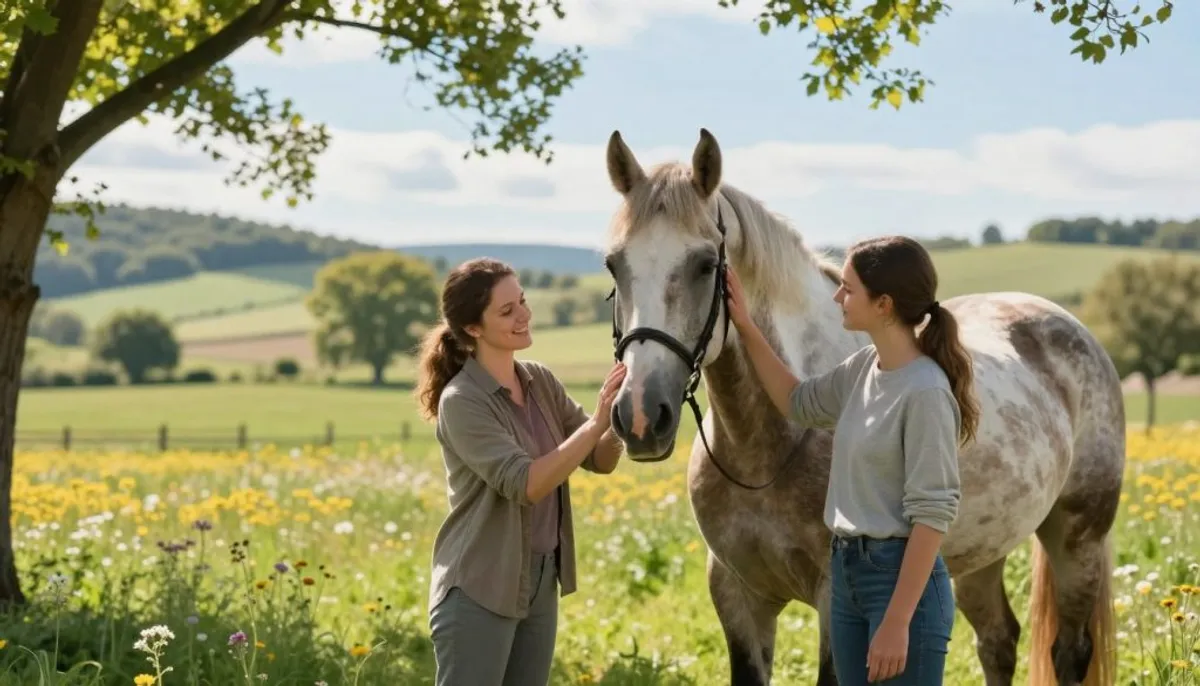
The charm of this approach lies in its duality. Contact with the horse is physically beneficial through movement and warmth. Mentally, it brings peace of mind, as it does not judge and communicates differently than through words.
This article explains the role of the horse as a mediator and shows the benefits of equine therapy on both physical and mental well-being. We will discover who it is aimed at and how the sessions take place, in centers or associations, in France.
Key Takeaways
-
Equine therapy is a unique type of care, different from recreational riding.
-
It is structured with objectives and monitoring for everyone's safety.
-
The horse plays a key role through its movement and way of communicating.
-
Benefits include physical, emotional, and social improvements.
-
Sessions are adapted to individuals, taking place on foot or on horseback.
-
Centers and associations in France offer various equine therapy programs.
What is Equine Therapy and Why is it Popular in France?
In France, many people are turning to therapy with horses. Being in nature, often in the countryside, helps to calm down and take deep breaths. Equine therapy is seen as a method that addresses both body and mind through the relationship maintained.
Definition: A Therapeutic Relationship Between the Patient, the Horse, and the Equine Therapist
Equine therapy is about working together: the patient, the horse, and the equine therapist. The therapist creates a safe environment, observes interactions, and then adapts activities. The goal is to focus on physical and emotional aspects, not just learning to ride.
The horse is a true support in these moments. It offers its presence, warmth, and reacts to the patient's actions. Depending on needs, sessions take place next to the horse, holding it by the lead, or even mounted.
The Horse as a Non-Judgmental Mediator: Non-Verbal Communication and Soothing
The horse does not judge. It reacts to our voice, our rhythm, our posture. This helps reflect on how we present ourselves without words.
Walking with the horse, grooming it, or just stopping and starting again can really calm. This routine is key in equine therapy.
Equine Therapy, Equine Mediation, Hippotherapy: Related Terms and Useful Nuances
These terms are similar but do not mean the same thing. Equine mediation focuses more on the relationship and emotions. Hippotherapy is more centered on the horse's movement, which is beneficial for the body.
To choose well, one must consider the type of session, the objectives, and how movement is used. Equine therapy can mix ground games and posture exercises. A hippotherapy session will be more focused on specific motor aspects.
| Approach | What is Most Worked On | Examples of Common Activities | When it is Often Sought |
|---|---|---|---|
| Equine Therapy | Overall therapeutic goals: body, emotions, relationship | Leading, guided grooming, adapted balance exercises, breathing | Need for a care framework with objectives and monitoring |
| Equine Mediation | Relationship, trust, communication, emotional regulation | Observation of the horse, ground games, simple courses, attention exercises | Relational difficulties, stress, need for a reassuring space |
| Hippotherapy | Motor dimension: tone, posture, coordination through the horse's movement | Walking work, rhythm variations, pelvis placements, postural adaptations | Rehabilitation or motor objectives with a focus on the body |
Equine Therapy: Key Principles and Therapeutic Objectives
Equine therapy creates a special bond: a person and a horse in a care environment. The horse acts as a mediator, offering a non-judgmental presence. It experiences the moment with us. This helps reconnect with oneself, soothes the mind, and strengthens confidence at one’s own pace.
Personalized Objectives: Physical, Emotional, Cognitive, and Social Well-Being
Each person has specific objectives based on their age, situation, and current needs. Among the goals are gaining autonomy, improving motor skills, or facilitating communication. Equine therapy also helps to concentrate better, remember things, and adapt easily.
On the emotional level, it helps manage stress and anxiety. Being with the horse and following a routine provides stability. Socially, it encourages listening, adapting to others, and teamwork.
Ground or Mounted Approach Based on Abilities and Needs
Ground activities include observing the horse, caring for it, and preparing it. These actions promote concentration, coordination, and self-confidence. They allow one to feel competent in concrete tasks.
One can also work mounted, with support to get on if necessary. This approach works on balance and posture gently. Professionals in equine therapy choose the most appropriate approach, always ensuring safety.
| Modality | What is Often Done | Skills Worked On | Points of Vigilance |
|---|---|---|---|
| On Foot | Observation, grooming, simple care, leading | Attention, planning, fine motor skills, confidence, communication | Safety distance, reading signals, checked equipment |
| On Horseback | Assisted mounting, walking, stopping, changing direction, guided breathing | Balance, tone, body schema, emotional regulation, grounding | Enhanced supervision, helmet, controlled girth, adapted pace |
Therapeutic Framework: Consent, Traceability, Reevaluation of Objectives
The therapeutic framework is crucial in equine therapy. Informed consent is sought before starting. The rules are clear. The location is chosen to be safe, well-equipped, and ready to welcome horses and people.
Each session is documented: activities, observations, and progress. This information helps to regularly adjust objectives for lasting impact. Thus, the benefits of equine therapy develop over time, thanks to solid professional training and ongoing ethical commitment.
Benefits of Equine Therapy on the Body
The horse offers physical benefits from the very first movements. Its regular rhythm facilitates concentration and organization of gestures. In France, the approach is simple, safe, and well-structured.
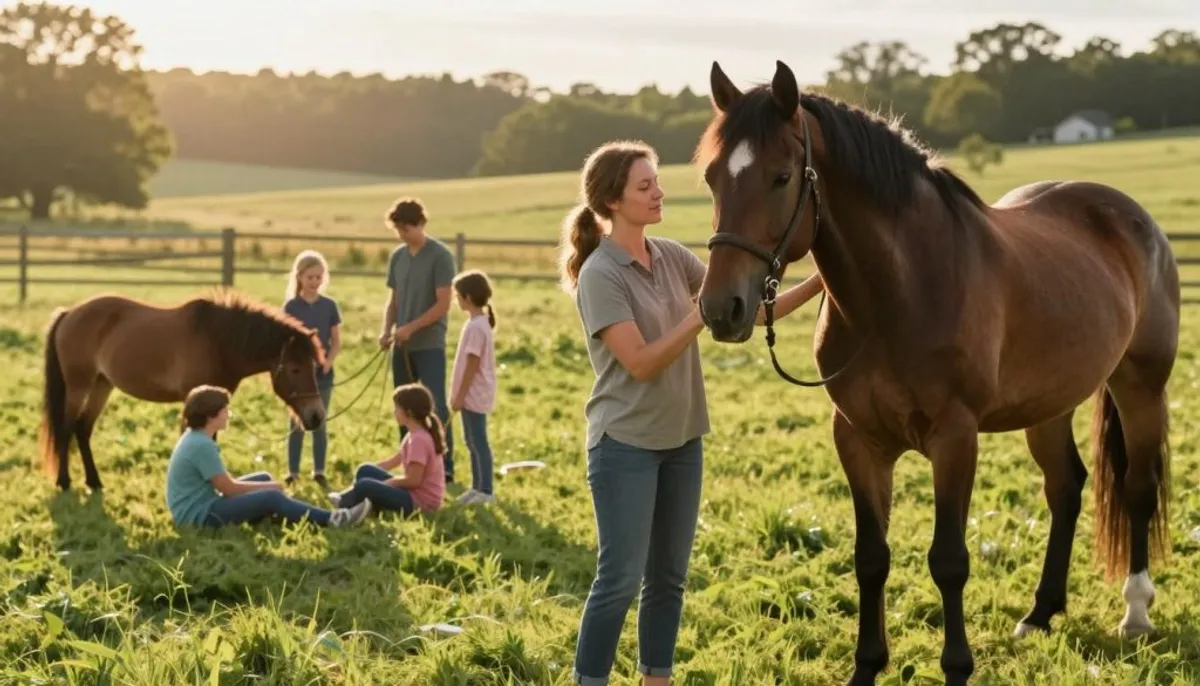
Walking is essential in equine therapy. It allows for small adjustments of the body without effort. Stops and starts help control stability.
Overall Motor Skills, Balance, and Coordination Through Horse Movements
The horse's movement is specific: lively, in 3D, and constant. This forces the body to adapt, stimulating motor skills. For example, we use leading, then a course with obstacles to improve coordination.
Transitions like walking-stopping-walking are common. They require anticipating, breathing, and starting again. These sequences help maintain balance, even when one gets distracted.
Muscle Strengthening, Posture, and Body Schema
The horse's warmth relaxes the body. This activates deep muscles more easily. Equine therapy also offers gentle stretches, ideal for older individuals.
Posture improves with small corrections. Alignment becomes clearer, specifying the body schema. In equine therapy, feedback is immediate: if one slouches, the movement is lost.
Proprioception, Praxies, and Dexterity Through Care and Material Manipulation
Caring for the horse improves proprioception. Grooming, cleaning hooves, or tidying promotes spatial organization. These tasks help plan, execute, and verify actions.
Using specific equipment improves dexterity. Adjusting a girth or holding a lead requires finesse and precision. These gestures, practiced in equine therapy, enrich daily skills.
| Physical Objective | Frequent Exercise | What the Body Learns | Point of Vigilance |
|---|---|---|---|
| Dynamic Balance | Transitions walk-stop, then resume walking | Trunk stability, pelvis adjustments, timing | Slow progression, pauses at fatigue |
| Overall Coordination | Course between cones while leading | Eye-body coordination, direction changes, rhythm | Safety distance and simple instructions |
| Posture | Guided sitting, hands on hips, calm breathing | Alignment, upper/lower body dissociation | Adapt according to pain and range |
| Proprioception | Grooming by zones, then tactile verification | Body landmarks, gesture precision, attention to contact | Respect for the horse, slow and regular gestures |
| Dexterity | Manipulating brushes, adjusting a halter, folding a mat | Grip, measured strength, fine coordination | Appropriate equipment, avoid sudden movements |
Psychological, Emotional, and Relational Benefits of Equine Therapy
Equine therapy acts as a mirror. The horse reacts to our posture, our breathing, and our intentions. We progress through simple steps, without striving to be the best.
We find calm through equine therapy. We also improve in how we speak and ask for help. This approach is beneficial even for adults seeking concrete support.
Self-Confidence and Self-Esteem: Progressing with a Living Partner
Working with a horse shows progress quickly. Successfully completing simple tasks together boosts our self-confidence. This is because our successes are visible and tangible.
The horse does not criticize. This relationship encourages us to try, to make mistakes, and to start again. This makes equine therapy reassuring and motivating.
Managing Emotions, Stress, and Anxiety: Breathing, Relaxation, and Horse Rhythms
The horse's rhythm helps us find our own. By attuning to it, we relax and reconnect with our bodies. This greatly helps to calm stress.
Learning to be patient with the horse helps us manage frustration. For adults, these lessons are valuable for regaining calm in stressful moments.
Non-Verbal Communication, Empathy, and Improvement of Social Interactions
Horses pick up subtle signals like our gestures or our tone. This teaches us to communicate clearly without tensing up and to adjust as needed.
This approach enhances our ability to pay attention to others, to understand, and to assert ourselves. The lessons learned in equine therapy then help in daily life, fostering healthier exchanges.
- Observing the horse's signs (ears, breath, weight) to better recognize one's own signals
- Naming a simple emotion, then translating it into action (stepping back, pausing, resuming)
- Practicing a short, stable instruction, and checking the response without rushing
| Objective Worked On | Frequent Exercise in Session | What the Person Trains | Simple Progress Indicator |
|---|---|---|---|
| Trust and Self-Esteem | Leading with stops and restarts | Decision-making, stability, sense of competence | More composed instructions, less hesitation |
| Stress and Anxiety | Breathing in sync with the walk, relaxation pauses | Self-soothing, body awareness, recovery | Longer breath, lower shoulders |
| Managing Frustration | Restarting a request with better timing | Patience, tolerance for mistakes, perseverance | Less irritation, chosen pauses |
| Non-Verbal Communication | Distance play and body orientation | Clarity, coherence, respect for boundaries | Horse more attentive, interactions smoother |
| Empathy and Social Bonding | Guided grooming and observation | Reading signals, gentleness, cooperation | More listening, more appropriate responses |
For Whom: Equine Therapy for Children, Adults, Seniors, and People with Disabilities
Equine therapy is open to all, offering a safe framework and personalized pace. One can stay on the ground, practice in an arena, or ride with assistance. Each program is adjusted to the person's needs by the practitioner.
Children: ASD, ADHD, Learning Disabilities, Relational Difficulties
In equine therapy, the horse is a reliable reference point. It is beneficial for children with disorders like ASD or ADHD, or problems at school. The sessions help them focus and follow simple instructions.
The sessions include structured activities like grooming, leading, and organized games. The practitioner pays attention to reactions, adjusts the space between them and the child, and ensures each new step is secure.
Adults: Anxiety, Depression, Post-Traumatic Stress, Quest for Bodily Grounding
Equine therapy is particularly sought after by those going through difficult times. It helps regulate emotions and reconnect with the body, in a non-performance-driven setting. The horse's presence provides a sense of security and helps live in the present moment.
Objectives are achieved step by step: feeling safe, learning to ask for help, establishing boundaries. Follow-up with a practitioner allows for clear reference points and measurable progress from one session to the next.
Seniors and People with Disabilities: Mobility, Autonomy, Cognitive Stimulation
For seniors, equine therapy contributes to maintaining mobility and balance. It helps combat loneliness. Specific activities stimulate memory and promote cognitive adaptation. The sessions are tailored to their needs, with breaks as necessary.
The approach with people with disabilities is described as gentle and non-intrusive. It aims to improve posture, movement safety, sensitivity, and communication. The environment is adapted to ensure safety, whether for children or adults.
| Audience | Frequent Objectives | Examples of Situations in Session | Points of Attention |
|---|---|---|---|
| Children | Focus, calming, social interactions | Grooming, guiding on foot, obstacle courses, structured games | Simple routines, short instructions, visual cues |
| Adults | Stress management, self-esteem, bodily grounding | Breathing while walking, conscious walking, graduated objectives | Progressiveness, sense of control, respect for boundaries |
| Seniors | Mobility, balance, cognitive stimulation, social connection | Transitions walk-stop, orientation, gentle stretches | Fatigue, fall prevention, regular breaks |
| Disability | Autonomy, communication, functional mobility | Adapted care, secure guiding, sensory work | Accessibility, adjusted equipment, enhanced security |
How a Session of Equine Therapy Works in Practice
We start by arriving and calming down. Then, we define specific actions with the horse. In France, this helps to feel safe. It also allows focusing on the day's objective. Equine therapy can be done on foot or mounted, paying attention to rhythm and comfort.
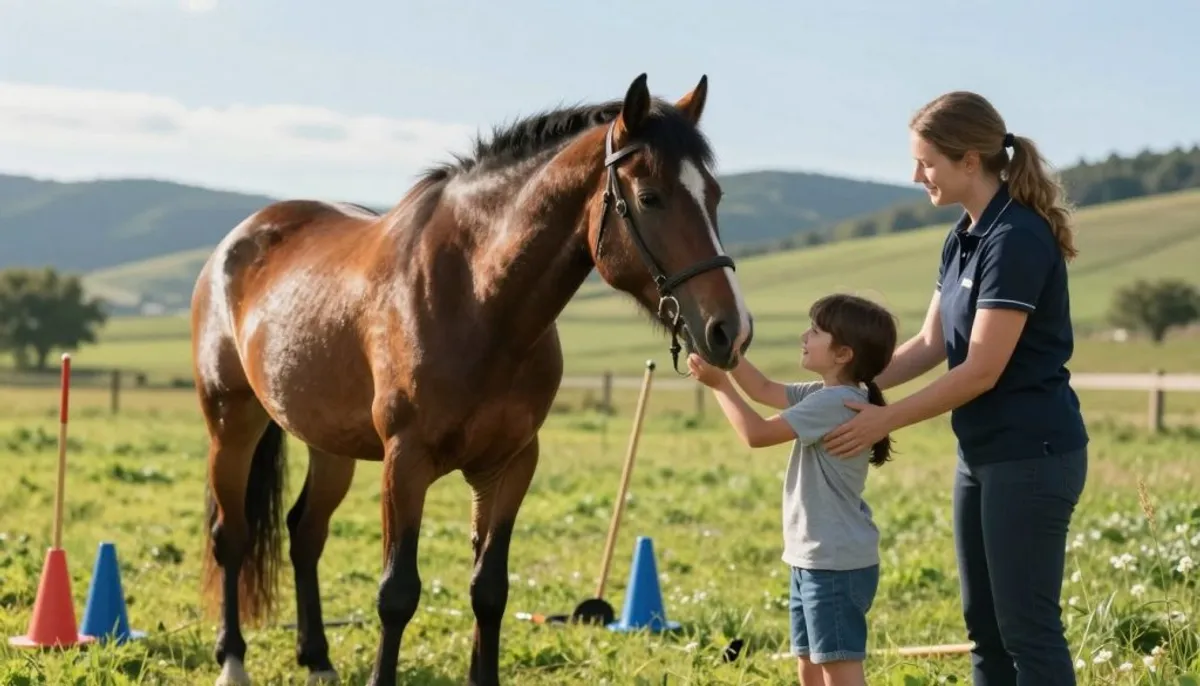
Welcoming and Building Trust: Everything starts in a peaceful place. We take a few minutes to talk. We specify what we want to achieve today, such as improving balance or managing stress. We remind safety rules and check the equipment.
This initial moment creates a framework for therapy with the horse. It allows adjusting the session according to mood or weather. The goal is to evolve step by step, without pressure.
Meeting the Horse: We usually approach it on foot. We observe how it stands, listens, and breathes. This gives us indications for establishing a solid relationship.
We can propose grooming it, walking with it, or even mounting with assistance. These actions reinforce attention, coordination, and confidence. Each action respects the rhythm of the person and the horse.
Therapeutic Exercises: The activities are varied but always very concrete. We can do breathing exercises while walking, relaxation. Some exercises are done with eyes closed, if safe.
Games, courses, and specific exercises help improve adaptation and listening. Equine therapy also includes elements like movement, the horse's warmth, or the touch of equipment. It aims for a balance: neither too simple nor too complex.
Calming Down and Follow-Up: We finish by slowing down, stretching, and tidying up the equipment. We take the time to reflect on what was easy or difficult. This moment of reflection is useful for remembering and planning the next session.
| Step | What Happens | What It Often Works On | Safety Points |
|---|---|---|---|
| Welcoming | Exchange, objectives of the day, equipment check | Reference points, motivation, clarity of instructions | Calm space, rules reminded, checked equipment |
| Meeting | Observation, grooming, leading, assisted mounting if planned | Attention, coordination, confidence, non-verbal communication | Distances, angles of approach, constant support |
| Exercises | Breathing, relaxation, games, courses, targeted tasks | Balance, stress management, adaptation, planning | Short instructions, rhythm of the horse respected, breaks |
| Calming Down | Slowing down, integrating, dismounting, mini-review | Self-regulation, memory of the experience, continuity | Safe dismount, clear closure, traceability |
The Main Approaches in France: Hippotherapy, Therapeutic Vaulting, and Equine Mediation
In France, there are several ways to work with the horse. They share clear goals in a safe place with precise guidance. Whether to gain strength, calm down, or improve relationships, the sessions are short and well-organized.
The horse, here, is not just a tool. It acts as a true intermediary. It brings its own responses and unique character. This is why the sessions are based on simple rules and a step-by-step evolution.
Hippotherapy: Three-Dimensional Movements, Body Heat, Soothing Rhythms
Hippotherapy takes advantage of the horse's natural movement, in 3D. Its warmth and regular movements often help to release tensions. This aims to improve well-being, balance, and coordination.
Sessions can start with help to mount the horse or with ground exercises. Some places in France offer this in a specialized way, with a precise action plan and personalized adjustments each time.
Therapeutic Vaulting: Balance, Tone, Coordination, and Confidence
Therapeutic vaulting focuses on controlled movements on the horse's back, usually while turning. This engages balance, strength, and precision of gestures. Breathing is a guide: it helps with positioning and staying focused.
Progress is made gradually, starting with basic exercises. For many, this boosts self-confidence, thanks to a progression that is easy to follow and secure.
Difference with Adapted Riding: Therapeutic Objectives vs. Sports Objectives
To distinguish the two, here are some key points. In equine therapy, there are specific well-being objectives to achieve, evaluated regularly. Good training in equine therapy is crucial to understand both the signals sent by the horse and the participant, while closely monitoring the evolution of sessions.
| Marker | Equine Therapy | Adapted Riding |
|---|---|---|
| Purpose | Individualized therapeutic objectives (posture, regulation, relationship) | Equestrian practice oriented towards technique, pleasure, and autonomy |
| Framework | Care project with observations, adjustments, and follow-up | Adapted learning session with simplified sports instructions |
| Role of the Horse | Therapeutic mediator: rhythm, contact, non-verbal interaction | Practice partner: aids, direction, balance in the saddle |
| Supervision | Trained professional + enhanced safety rules according to the audience | Adapted equestrian supervision, safety focused on riding |
Whether in equine therapy or adapted riding, the horse's intervention varies. This can be on foot, during grooming, leading, or in attention games. The choice depends on who participates, the location, and the objectives set at the beginning.
Choosing an Equine Therapy Practitioner and Center in France
Take the time to look closely at the place and how they work before deciding. In France, the quality of equine therapy relies on listening, clearly defined objectives, and daily safety.
Role of the Practitioner: Dual Medical-Social Competence and Knowledge of the Horse
The practitioner in equine therapy combines medical-social skills with a deep knowledge of the horse. They are capable of interpreting the signs of the patient and the animal without rushing.
Training in equine therapy combines theory and practice. It covers helping relationships, psychopathology, ethology, and session preparation. This solid foundation allows for setting objectives, choosing activities, and measuring progress.
Selection Criteria: Framework, Experience, Safety Protocols, Suitable Horses
It is important to know how the center defines its working framework. This includes objectives, evaluations, and their revision. A transparent approach reassures families and strengthens the bond with health professionals.
- Ability to adapt to diverse audiences and specific needs.
- Implementation of safety protocols, equipment checks, and well-defined calm areas.
- Rigorous selection of horses, regular veterinary follow-up, and respect for their well-being.
- Clarity on costs, support plan, and session follow-up.
| Point to Check | What Reassures | What Should Raise Alarm |
|---|---|---|
| Objectives and Follow-Up | Clear objectives, regular follow-ups | Lack of clarity, little follow-up |
| Safety | Clear instructions, safe equipment | Inconsistent rules, worn equipment |
| Horses | Calm, suitable, well-monitored horses | Stressed, overworked horses |
| Equipment | Adjustable, durable equipment | Inappropriate equipment |
| Organization | Fixed schedules, good reception | Uncertain planning, weak communication |
Where to Practice: Specialized Centers, Associations, Rural Structures, and Accessibility
Specialized centers and some associations offer good services. Prices may be more affordable at the latter. Private practices can offer more personalized follow-up, which is sometimes necessary.
In rural areas, tranquility aids immersion. However, it is essential to check accessibility for all and seasonal availability. To properly equip a place, La Sellerie Française is recommended for its quality equipment, made in France.
Conclusion
Equine therapy is developing in France as a unique care method. It creates a special bond between the patient, the horse, and the equine therapist. Their goals are well-defined and adapt over time.
It has real impacts on both physical and mental health. This therapy improves mobility, balance, and coordination. It also strengthens posture and body awareness. Additionally, it calms, boosts self-confidence, and helps better manage stress. All this is achieved through a way of communicating without words, but effectively.
Equine therapy sessions consist of several well-organized steps. It starts with welcoming, meeting the horse, exercises, followed by a calming moment and a review. It is crucial to ensure safety, monitor progress, and revisit set goals. Hence the importance of choosing a professional who knows horses well and how they react.
There are numerous equine therapy centers and associations in France, especially in the countryside, an ideal setting for relaxation. Before starting, it is wise to compare the environment, safety measures, and whether the horses are suitable. For a good experience, choosing quality equipment is also essential. La Sellerie Française offers high-quality horse products made in France.
FAQ
What is equine therapy, and how is it different from recreational riding?
Equine therapy combines a patient, a mediator horse, and a specialized therapist. It aims for the well-being of both body and mind in the long term. Recreational riding, on the other hand, focuses on pleasure and sports performance. However, it can also provide well-being.
Why is equine therapy so appealing in France today?
In France, it is recognized for its holistic approach. Contact with animals enhances self-confidence. Many centers and associations in rural areas offer a peaceful environment to recharge.
What are the basic principles of equine therapy?
At the heart of equine therapy is the relationship between the patient, the horse, and the therapist. This is followed by tailored goals in a safe place.
Each session follows a precise plan. This includes adapted exercises and a time for calm. Progress is monitored and objectives are reviewed regularly.
What is the role of the horse in equine therapy?
The horse provides a supportive space to express and manage emotions. It reacts to how we present ourselves without judgment. This helps develop concentration and manage emotions.
What do the warmth, movement, and rhythms of the horse bring?
Contact with the horse combines physical and emotional support. Their natural rhythm promotes relaxation. And the horse's movements stimulate coordination and balance, useful for readjusting physically and reducing stress.
Equine therapy, equine mediation, hippotherapy: what are the nuances?
Equine mediation prioritizes emotional connection and safety, often on the ground. Hippotherapy focuses on movement, warmth, and the horse's rhythm for physical objectives. Equine therapy encompasses a more general approach, targeting specific goals and ongoing support.
What are the physical benefits of equine therapy?
It improves motor skills, balance, and coordination. There is better posture and tone. Activities like grooming enhance movement precision.
What emotional and psychological benefits can be expected?
It helps better manage emotions and feel calm. Contact with the horse supports self-esteem. Activities also help express feelings and accept limits.
How does equine therapy help communication and social relationships?
It fosters non-verbal communication, essential for respect and attention. Contact with the horse enhances empathy and social skills. The horse's direct responses facilitate learning.
Is equine therapy for children suitable for ASD, ADHD, or learning disabilities?
Yes, it is beneficial for ASD, ADHD, and learning difficulties. Activities target concentration and reduce agitation. They include grooming and leading, among others.
What can adult equine therapy offer in cases of anxiety, depression, or post-traumatic stress?
It helps manage stress and regain confidence. Breathing and relaxation techniques support emotional control. Some people report lasting well-being and improved sleep.
Can seniors and people with disabilities participate?
Yes, the approach adjusts to everyone's needs. For seniors, it maintains mobility and stimulates the mind. For disabilities, it encourages autonomy and physical well-being in a safe and adapted environment.
Does an equine therapy session have to be on horseback?
No. Sessions can take place on the ground or on horseback. The type of activity depends on the need, diagnosis, and safety.
What does a concrete session look like in France?
A session begins with a review of the day's goals. It includes meeting the horse and therapeutic exercises. It ends with a relaxation moment and a review to adjust follow-ups.
What objectives can be worked on in equine therapy?
One can work on physical, cognitive, emotional, and social objectives. The plan is tailored to the person and constantly reevaluated.
What approaches are found in France: hippotherapy, therapeutic vaulting, equine mediation?
Hippotherapy focuses on the horse's movement. Therapeutic vaulting improves tone and confidence. Equine mediation facilitates emotional expression, often on the ground, while being structured.
What is the difference between equine therapy and adapted riding?
Equine therapy targets healing with personalized follow-up. Adapted riding is more oriented towards equestrian learning. Its main goal is different.
Who can be a practitioner in equine therapy in France?
A practitioner often combines medical-social training and equine therapy training. Knowledge of the horse and therapeutic techniques is key.
What does training in equine therapy include?
It includes theory (psychology, ethology) and practice (preparing the horse, choosing exercises). Risks are managed meticulously.
How to choose an equine therapy center or professional in France?
Look for an experienced professional, with clear objectives and safety measures. A good center explains its method and costs transparently.
Where to practice equine therapy in France?
It is possible in specialized centers, associations, or private practices. Choose a calm, accessible place suited to the season.
What equipment is used and why does quality matter?
Quality equipment ensures safety and comfort: saddles, reins, protections. La Sellerie Française (https://laselleriefrancaise.com) offers high-end equipment designed in France.