
The Franche Montagne horse or Freiberger comes from the Jura massif. It is the only horse breed native to Switzerland that still exists today. In France, it is loved for its simplicity, honesty, and closeness to humans.
It lies between the light draft horse and the saddle horse. Its supple gaits and calm temperament make it versatile. It is used for both driving and outdoor outings.
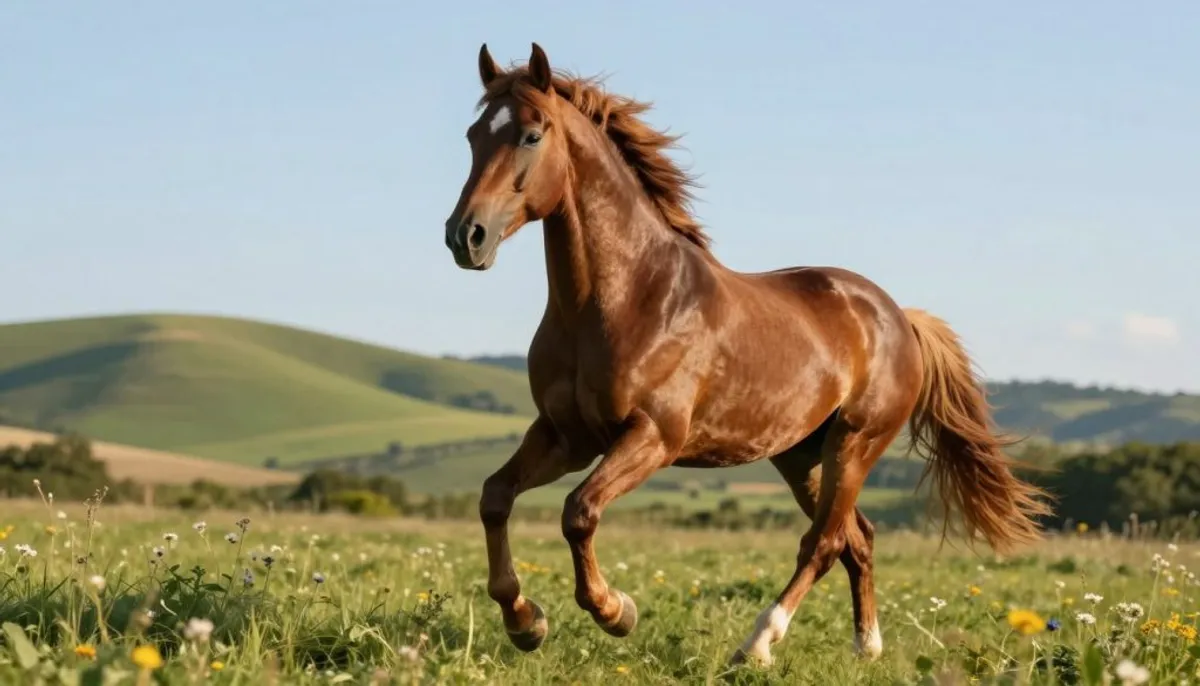
Some aspects distinguish it at first glance. It often measures between 1,50 m and 1,60 m, with a weight of 550 to 650 kg. Most of the time, its coat is bay or chestnut.
It has a medium-sized, elegant head with a gentle expression. Its straight profile contributes to its balance. This balance makes it unique, combining quiet strength and ease under the saddle.
We will discover its origins in the Jura, then the important moments of its history in the 19th and 20th centuries. We will study how the stud-book defined the breed. Then, we will examine its morphology, character, how it is used, its presence in France, and what to check before buying.
Key Points
- The Freiberger is the only horse breed of Swiss origin still present today.
- The Franche Montagne horse oscillates between light draft horse and saddle horse.
- The characteristics of the Franche Montagne horse include a height of 1,50 to 1,60 m.
- Its average weight is around 550 to 650 kg.
- The coat is most often bay or chestnut.
- The Franches-Montagnes type is renowned for its supple gaits and good character.
Overview of the Breed and Why It Charms in France
Since the beginning of the 21st century, the Franche Montagne breed has been highly valued in Switzerland. It is known even outside of Switzerland, especially in France since the late 20th century. It can also be found in Germany and Italy, loved by those who enjoy outdoor activities.
The reasons for its success? It is robust, calm, and easy to live with. Families want it because it is reassuring, even for beginners. It fears neither cold nor difficult terrain, which appeals to French riders.
It is very versatile, remaining the same regardless of the activity. Ideal for relaxing after work, improving skills, or escaping on weekends. In hiking, it maintains a steady pace and stays alert, allowing one to enjoy the views without worries.
It is also excellent for driving. It is chosen for its pulling abilities and during tourist trips in a caravan. It is also useful for specific tasks in challenging terrains.
Its appeal comes from its rarity as a light draft in Western Europe. With its strengths, it adapts to gentle riding, focused on diversity and excursions in nature. For many, it is the perfect choice for leisure, combining strength, comfort, and ease.
| What is Expected in France | What the Franche Montagne Horse Offers | Where This is Seen |
|---|---|---|
| Safety and calm to progress | Docile temperament, measured reactions, stable learning | Guided walks, first outdoor sessions, building confidence |
| A versatile horse for varied activities | Suitable for riding, leisure, and accessible sports exercises | Riding school, arena, small sporting outings, flat work |
| Comfort over time | Sure-footedness, endurance, hardiness, regular gaits | Hiking, rocky paths, varied terrain, long outings |
| A true aptitude for driving | Strong pulling, straightforwardness at a standstill, willingness to work | Driving solo or in pairs, caravan, equestrian tourism |
Jura Origins and Historical Cradle of the Franches-Montagnes
The Franche Montagne horse takes us back to the Swiss Jura, near the French border. This place, with its relief and climate, has created a unique, strong, and hardworking type of horse.
Their home is the district of Franches-Montagnes, next to the Doubs. This area has encouraged exchanges with neighboring breeders. This has forged the unique identity of these horses.
The District and Its Biotope
The district benefits from an environment of meadows and conifers. The terrain is high and open, requiring resilient horses.
This place imposes a simple way of life, with grass in summer and cold in winter. This makes the horses robust and suited to varied terrain.
From the Jura Horse to Early Breeding
Initially, these horses, very useful locally, were simply called Jura horses. The first breeding dates back to the 17th century, although little detail is known.
1619 is often mentioned as the year when the presence of robust local horses is attested. Some stories speak of vision problems related to humid regions.
Initially, these horses were rare and valuable, especially among nobles. Around 1620, they became more common, used for transport and messaging by the Montagnons.
Crossbreeding and Contributions that Built the Breed
The current breed comes from crossbreeding between local mares and selected stallions. The Anglo-Norman was important for improving size and movement.
It was also influenced by the Comtois horse, due to proximity to the Doubs. There are mixtures of Thoroughbred for speed, and Ardennais and Percheron for strength.
Some stories speak of Arab or Spanish roots, but this is controversial. According to the National Stud of Avenches, the breed as we know it was born around 1850.
| Reference | Location | What This Says About the Horse |
|---|---|---|
| Origin Plateau | district of Franches-Montagnes, Swiss Jura | Adaptation to altitude, cold, and demanding soils |
| Natural Environment | biotope of meadows and conifers | Hardiness, sobriety, endurance over long seasons |
| First Traces | 17th century | Local population described as robust, resilient, with a heavy head |
| Point of Evidence | 1619 | Attested presence of an indigenous horse, sometimes associated with marshy areas |
| Breeding and Gathering Hub | Saignelégier | Key place to observe the evolution of types and breeding practices |
| Contributions from crossbreeding | Jurassic plateaus and cross-border exchanges | Influences of Anglo-Norman, Comtois, Thoroughbred, Ardennais, Percheron according to needs |
Construction of the Breed in the 19th Century and Major Turning Points
In the 19th century, the characteristics of the Franche Montagne horse developed. They evolved through daily work and fairs. In 1817, the region had about 4,000 mares. This shows that breeding was already well established. Breeders wondered whether they should prioritize quantity or quality.
A Recognized Production: Numerous Mares and Utility Horses
The needs of buyers are varied. Farmers seek robust and reliable horses for agriculture.
Some want a light and fast horse for carriages. An ex-voto from 1850 shows the importance of the horse in the family. It reflects the pride of breeders.
The Impact of the Railroad and Changing Needs
The arrival of the railroad changed the needs. The horse was less used for long journeys. Horses intended for riding or driving became less common.
The market turned towards horses better suited for daily work. This raised the question of converting workhorses.
The Role of Authorities and the Importation of Breeders
Model and Gait Competitions have been organized since 1821. They aim to improve the quality of horses. After the Aarau exhibition in 1865, the canton of Bern reacted to improve breeding.
Between 1860 and 1890, breeders were imported to diversify the breeds. There was a desire to balance characteristics by introducing different types of blood.
| 19th Century Reference | What Changes in Breeding | Desired Effect on Type |
|---|---|---|
| 1817: approx. 4,000 mares recorded | Broad breeding base, selection mainly by use and robustness | Endurance, sure-footedness, regular pulling |
| Since 1821: model and gait competitions and premiums | Public evaluation of stallions and mares, health and gait criteria | Standardize abilities without losing hardiness |
| Around 1850: rise of the railroad | Decrease in horse transport, refocusing on local work | Strengthen pulling ability and profitability in agriculture |
| 1865: alert in Aarau | Mobilization of the canton of Bern and the Swiss Confederation | Enhance overall quality and regularity of models |
| 1860–1890: importation of breeders (Norfolk Breton, Thoroughbred, Anglo-Norman…) | Blood contributions for liveliness and gaits, with adjustments to maintain bone | Balance between strength, energy, and a more practical type |
Stud-book, Modern Selection, and Standardization of the Breed
To grasp the essence of the Franches-Montagnes horse, one must explore the stud-book and breeding decisions. These choices have evolved over time, despite sometimes lacking information. With harmonization and stricter rules, the standardization process has gradually developed.
In France, this system is appreciated for understanding pedigrees and comparing generations of horses.
The Founding Stallions and Influential Lines
Two major stallions, Vaillant and Imprévu, have marked history. Their descendants still define the lines of Franches-Montagnes horses today. This continuity is essential in selection, offering precise benchmarks for breeders.
Imprévu, of Anglo-Norman breed and dark bay color, was born in Caen in 1886 and was imported in 1889. Vaillant, born in 1891, is light bay and comes from a cross in his family. He is often associated with lines like "Anglo-Jura" or "Normand-Jura". There is also talk of Léo, a Thoroughbred who greatly influenced the breed, despite criticism of some of his descendants deemed too light.
Opening and Structuring of the Breeding Register
The stud-book of 1924 was a key moment. It aimed to improve traceability of origins and avoid inbreeding. However, gaps persisted, especially for some unawarded mares. The goal was to make genealogy clearer and more useful for all.
The Swiss National Stud of Avenches played an important role since its opening in 1901. Jura stallions were already present at that time. Breeding unions were founded, contributing to the structure of breeding before complete normalization. Before 1935, some French stallions were accepted as FM to strengthen the breed type, which later raised questions.
| Historical Reference | What Changes in Breeding | Effect on Standardization |
|---|---|---|
| 1901: Swiss National Stud Avenches | Centralization of breeders, more regular monitoring | Better harmonized model and faster decisions |
| stud-book 1924 | Traceability of origins and common framework | More reliable comparison of Franches-Montagnes lines |
| After 1947 | Encouraged meat orientation, then rebalancing | Gradual return to a more versatile horse |
| Early 1990s | Last contributions with half-blood Swiss for gaits | Refinement of the saddle model without losing the rustic base |
Closure of the Genealogical Book and Focus on Purity
The closure of the stud-book in 1997 marked a turning point. From January 1, no new outside blood has been accepted. The goal was to maintain the purity of the breed. That same year, the FSFM took responsibility for its preservation and promotion in Switzerland.
Modern selection is based on precise criteria such as temperament, health, and abilities in riding and driving. These criteria aim to select reliable and easy horses for daily life. In France, these aspects help buyers understand what they are looking for, beyond aesthetics.
Franche Montagne Horse: Morphology, Size, and "Light Draft" Model
The Franche Montagne horse is seen as a light draft, reactive yet solid. It displays perfect balance, with strong bones and well-attached limbs. Its purpose is to be versatile, following the idea of a useful and pleasant horse to ride.
A Medium-Lined Horse, Between Draft and Saddle
The standard describes a medium-lined model: a compact but light body, with a stable back. This shape allows it to pull without tiring quickly while moving with ease. For many, it is ideal for leisure riding or pulling.
Selection in the 20th century improved the horse, making its appearance more harmonious. The challenge was to maintain good bone structure while being more practical. This compromise marks the identity of the light draft in this breed.
Average Size and Weight
The height of a Franche Montagne ranges between 1.50 and 1,60 m at the withers. Its weight generally varies from 550 to 650 kg, changing according to several factors. This range ensures a good balance between carrying capacity and pulling ability.
In the 19th century, these horses averaged between 1.50 m and 1.54 m. Some exceeded 1.60 m. But over time, the height has stabilized to current standards.
Typical Head and Expression
The head of the Franches-Montagnes is medium-sized, well-defined, with a gentle expression. It features a straight profile, giving a balanced and distinguished look. This appearance is simple and full of character.
This type of head pairs well with a well-structured front, comfortable for pulling or riding. This harmony is ideal for daily work, offering behavior that is easy to interpret. It is a crucial aspect of its appearance and utility.
| Morphological Reference | What is Often Observed | Interest in Use |
|---|---|---|
| Type | light draft, medium-lined model | Versatility: driving, hiking, work, leisure sports |
| Height | Franche Montagne horse height: 1,50 to 1,60 m | Good compromise between maneuverability and pulling capacity |
| Weight | Franche Montagne horse weight: 550 to 650 kg | Stability, carrying capacity, and endurance for daily use |
| Head | Franches-Montagnes head, gentle expression, straight profile | Comfort in contact, breed identity, and overall harmony |
| Breeding Orientation | "Dual Purpose" Horse: pulling + saddle horse | A model designed to adapt to the needs of a family and a stable |
Coat, White Markings, and Competition Presentation
The coats of the Franche Montagne horse are appreciated for their simplicity and uniformity. The most common colors are bay and chestnut. These shades can vary, becoming warmer depending on the season and coat condition.
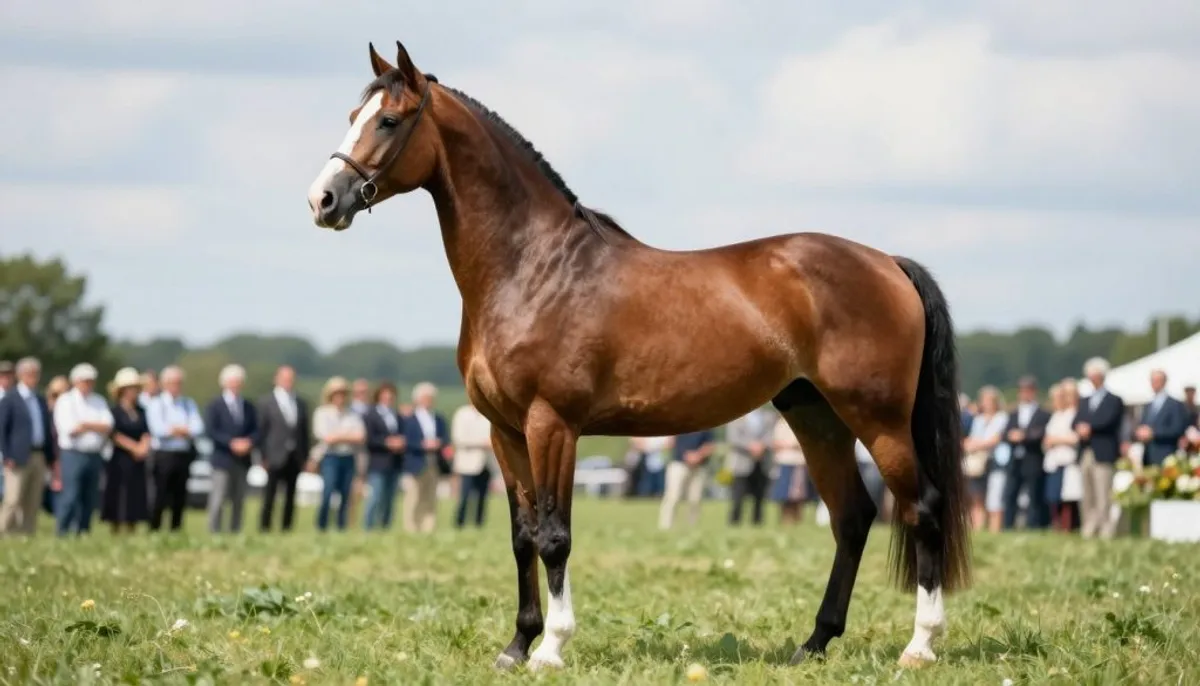
White markings play an important role in the eyes of judges and the public. They often include a distinct blaze on the head and stockings on the legs. However, these markings do not affect the horse's skills.
At the beginning of the 19th century, breeders were not selective about the color of horses. Different colors coexisted, including greys. However, around 1855, the bay coat became more popular for its uniform appearance in exhibitions.
The goal in model and gait competitions is clear. One must present a well-proportioned, calm horse with precise movements. A clean coat, a well-defined blaze, or balanced stockings can enhance the horse's appearance. This is especially true at the walk and trot.
Competitions for model and gaits began in 1821. They encourage certain practices: grooming the coat, cleaning the feet, and presenting the horse simply. This allows for better appreciation of movement, whether the horse is bay or chestnut.
| Observed Point | What is Common | What the Judge Looks to See |
|---|---|---|
| Coat Color | bay, chestnut | Uniformity of coat, absence of dull areas, healthy appearance |
| Head Marking | blaze fine to wide | Readable expression, head presented straight, clean and well-defined marking |
| Leg Markings | stockings short to mid-cannon | Dry legs, clear conformation, well-maintained feet, and overall symmetry |
| Presentation | Horse clipped or not, black mane, chestnut or washed | A simple presentation that does not obscure the model or gaits |
| Performance in the Ring | Active walk, regular trot, calm transitions | Impulse, back flexibility, stable cadence, and relaxed attitude |
Temperament, Hardiness, and Abilities: A Reliable Family Horse
The Franche Montagne horse is appreciated for its simplicity of life. It is said to be both docile and full of energy, with a straightforward way of communicating and a strong desire to progress.
It is perfect for families. It easily transitions from one activity to another. On mountain walks, it remains calm, observes, thinks, and acts wisely.
The selection of this breed has always aimed to achieve a stable temperament. Tests assess health, ability to be driven and ridden while maintaining a good disposition and respect.
In their pastures, these horses show natural curiosity and sociability. Their life in the mountains makes them strong and ready to face the whims of weather and terrain.
The Franche Montagne horse does not need much to live well. It stays healthy with a simple diet of hay and grass.
It is reliable on all types of terrain. Its sure-footedness is particularly appreciated in hiking, especially on demanding routes.
There are several types of Franches-Montagnes, offering different experiences whether under saddle or on the ground. Some are sturdier, while others are more elegant and light.
Some horses are elegant and have lighter gaits. This variety comes from breeding choices. The introduction of half-blood stallions has produced sportier horses while maintaining the original balance.
| Profile in the Breed | What is Noticed Daily | Practical Advantages | Contexts Where It Shines |
|---|---|---|---|
| Robust Model | Strong frame, composed attitude, regular response | Easy pulling, endurance, stability, good hardiness | Driving, utility work, long mountain outings |
| More Elegant Model | Lighter gaits, finer responsiveness, more bounce | Versatility, comfort under saddle, highlighted in leisure | Sporty hiking, basic dressage, varied outings |
| Intermediate Type (Most Common) | Overall balance, stable temperament, good availability | Family horse that is easy, sure-footed, quick to adapt | Walks, outdoors, introduction to driving and riding |
Disciplines and Uses: Driving, Hiking, Sport, and Work
The Franches-Montagnes is a versatile horse and pleasant to have. It is perfect for sport and everyday life thanks to its stable character, smooth movements, and calmness in noisy places. These qualities explain why it excels in driving, but also under saddle, at work, and for other demanding tasks.
Driving, a Preferred Domain
In France, in many stables, this horse excels in driving. It is ideal for walks, caravan excursions, and family outings. Its open nature and ability to instill confidence are appreciated. In competition, its calmness helps to be more precise, even under pressure.
Its regular pace and energetic walk make driving enjoyable, whether on road or path. With good training, it quickly masters changes in pace and direction. Thus, driving becomes an accessible sport while retaining the reassuring aspect of this breed.
Saddle and Sporty Leisure
Under saddle, it meets expectations for hiking, being reliable and resilient. It is also skilled in TREC, requiring control, intelligence, and good terrain management. Western riding suits it well too, thanks to its calmness and willingness.
Since 1965, the introduction of half-blood has improved its skills for riding while maintaining its sturdiness. In dressage, it excels in the basics, offering a solid posture without tension. It also enjoys jumping, as long as it is approached gently and progressively.
Utility Work: Forest, Agriculture, and Logging
The Franches-Montagnes still plays an important role in agriculture, useful for specific tasks and light pulling. For logging, it maneuvers skillfully while reducing ecological impact. Where machines create large passages, it passes more discreetly, which is better for the forest.
It supports the forestry economy, especially in wet or difficult areas. In forestry work, finesse and patience are as critical as strength. In these cases, it becomes a valuable tool, not just a symbol.
Historical and Current Role in the Swiss Army
The Swiss army used these horses, especially during World War I, for various tasks. Their use intensified during World War II, being useful to the army and agriculture. They were renowned for their reliability and endurance.
Today, the army still uses them, but in small numbers. They are mainly employed for pulling in the Alps, where the terrain is challenging. In these alpine terrains, the Franches-Montagnes remains discreet but effective.
| Use | What is Sought | Advantage of the Franches-Montagnes | Typical Setting |
|---|---|---|---|
| Franches-Montagnes Driving | Regularity, attentiveness, safety | Stable driving horse, smooth pulling | Walks, caravan, driving solo or in pairs |
| Driving Competition | Precision, stress management, impulse | Cool temperament, sharp transitions | Manoeuvrability, marathon, presentation |
| Hiking and TREC | Sure-footedness, endurance, straightforwardness | Serenity outdoors, adaptability | Varied paths, orientation, PTV |
| Forestry Work and Logging | Reduced impact, finesse of passage | Useful pulling without degrading soils | Sensitive plots, slopes, narrow access |
| Swiss Army and Transport Troops | Autonomy, robustness, reliability | Adapted for pulling in alpine terrain | Rugged alpine terrain, logistical missions |
Breeding, Distribution in France, and Key Points for Choosing Wisely
The history of breeding the Franche Montagne horse begins in Switzerland, especially in Avenches at the National Stud. This horse became known in France in the 2000s, thanks to driving and hiking. Italy and Germany have also been interested in this breed for a long time.
The stud-book recorded 3,415 mares in 1930. There were already many horses in the Jura in the 19th and early 20th centuries. After a decline, interest in these horses has increased again thanks to leisure activities.
Where the Herd is Concentrated
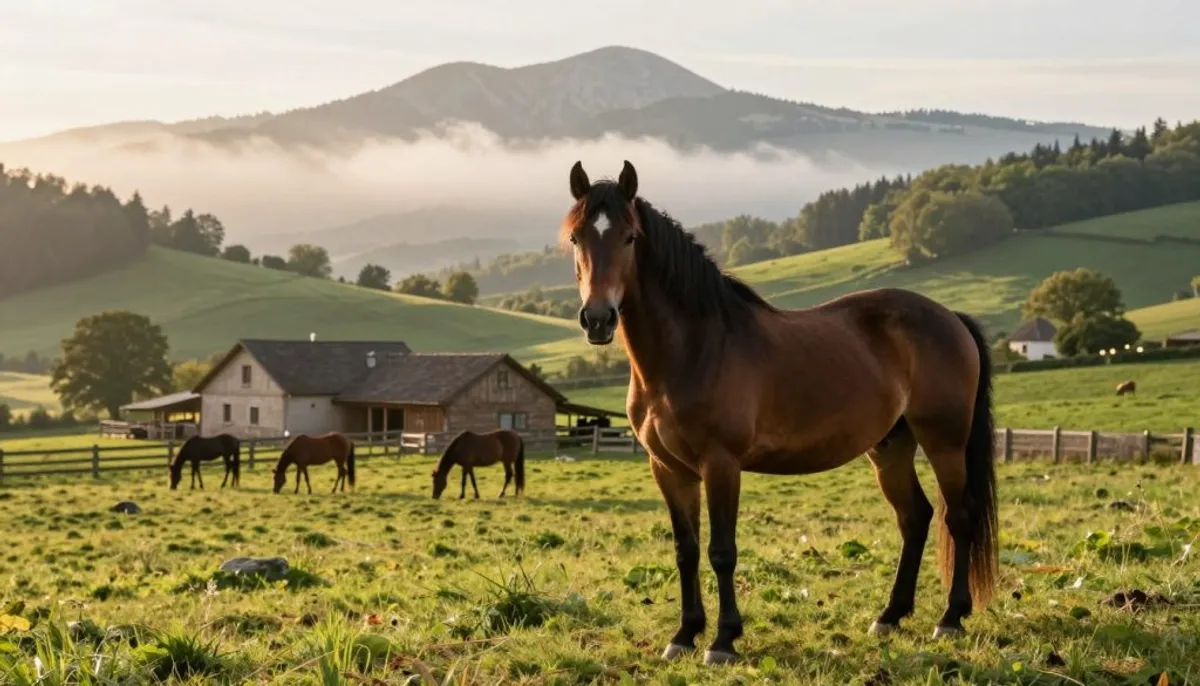
Most horses are born in Switzerland, near Avenches. In France, there are scattered farms focused on an all-terrain horse. This influences the choice depending on the type of horse you are looking for.
Preserving Origins and Diversity
Genetic diversity is crucial. The breed experienced crossbreeding with lighter breeds in the 20th century. The Alsatian stallion had a significant impact in the 1970s and 1980s. After 1997, there are few horses without external blood.
Since 2003, ProSpecieRara has been helping to preserve pure lines. They ensure that horses have no more than 2% foreign blood. Their action has increased the number of identified horses, focusing on genetic diversity.
What to Check on the Model
The standards for the Franche Montagne horse ensure no risk of surprises. They define an average horse, between draft and saddle, with a good model and beautiful gaits. The height ranges between 1.50 and 1.60 m, and the weight between 550 and 650 kg. They have an elegant head and a gentle gaze.
The stud-book is a good indicator, as are the tests and the horse's history. Its behavior is also evaluated: easy to handle, calm, and good in transport.
Sale, Price, and Budget to Consider
Before buying a Franche Montagne horse, define its future use. Ask for its genealogy, skills, and type. The price varies according to age, training, and health.
Plan a budget for equipment, which varies according to the activity. La Sellerie Française is renowned for its quality products made in France, including custom pieces.
| Point to Check | What This Changes | Simple Question to Ask |
|---|---|---|
| Registration in the stud-book | Traceability, consistency of type, selection tracking | "Is the horse registered and with what papers?" |
| Base Horses and 2% Foreign Blood Percentage | Reference for those seeking a lineage closer to the original | "Is the percentage of foreign blood documented?" |
| Standards of the Franche Montagne Horse | Choice between versatility, light pulling, and comfort under saddle | "Do the model and gaits match my use?" |
| Mental Health | Safety, ease in daily life, athletic longevity | "How does it behave alone, outdoors, and in a group?" |
| Budget for Riding Equipment | Comfort, injury prevention, performance in driving or under saddle | "Should I plan for a harness, a saddle, or both?" |
Conclusion
The Franche Montagne horse comes from the Swiss Jura. It is known for its solidity, reliability, and enjoyment in riding. It has a good temperament, is robust, and has good gaits. This makes it unique.
This horse has an interesting history. The crossbreeding of the 19th century created its foundations. Then, in 1924, its breeding took a precise direction in Avenches. Even after the arrival of motor vehicles, this breed adapted. The program of 2003 emphasizes the importance of maintaining a great genetic diversity.
In France, since the 2000s, more people have shown interest in these horses. They seek a reliable companion for everyday life. It is crucial to think carefully about the desired use before making a choice. One must also consider the breed standards, origins, and whether the horse suits the rider.
One should not forget the importance of good equipment. Proper gear and regular maintenance limit problems. French saddlery workshops offer good support for choosing. With good preparation, the Franche Montagne horse shows its full value: a friend you can rely on, adaptable and durable.
FAQ
Is the Franches-Montagnes (Freiberger) really the only horse breed from Switzerland still in existence?
Yes. The Franches-Montagnes, also known as Freiberger, is the last horse breed native to Switzerland. It plays a significant role in Swiss riding. Its popularity also extends to France.
What are the key characteristics of the Franche Montagne horse?
The main traits of the Franche Montagne horse are its versatility and spirit. It is considered a light draft. Its movements are fluid, and its character is remarkable. People love it for its reliability and practicality in daily life.
What size and weight for an adult Franches-Montagnes?
An adult measures between 1.50 and 1.60 m at the withers and weighs 550 to 650 kg. These measurements explain why it is good both for driving and riding.
How can one recognize the typical head and expression of the breed?
The standard describes a medium-sized, refined, well-defined head with a gentle gaze and a straight profile. Historical crossbreeding has improved aspects like the lightness of the head and the length of the neck while maintaining the solidity of the skeleton.
What coat color does a Franches-Montagnes have, and what white markings are common?
The coat color is generally bay or chestnut. A white blaze on the forehead and white markings on the legs are often found. The mane can be black, chestnut, or sometimes light. The bay coat has been highly valued since the 19th century.
Where is the cradle of the breed, and why is this biotope so important?
The cradle is located in the district of Franches-Montagnes, in the canton of Jura, near the French border. The meadows and coniferous forests provide an ideal habitat for these robust horses, which live outdoors.
Since when has documented breeding been discussed in the Franches-Montagnes?
It is difficult to date precisely, but traces can be found as early as the early 17th century. A key moment is in 1619, with a population described as robust. At that time, there were also mentions of vision problems related to humid areas.
Who used these horses in the 17th century in the Jura?
Before 1600, horses were rare and expensive. Around 1620, horses served postal services. The farmers of the Jura, called “Montagnons”, used them for work in the mountains.
From what crossbreeding does the modern Franches-Montagnes come?
The Franches-Montagnes comes from crossbreeding between Jura mares and various stallions, including the Anglo-Norman. The exchange with the Comtois horse, beyond the Doubs, influenced the breed in the 18th and 19th centuries.
Are some hypotheses of origins (Arab, Spanish, Northern European) reliable?
Initially, there were thoughts of Arab, Spanish, or Northern European ancestors. But today, these ideas are contested. Experts prefer to rely on known crossbreeding and selection made over time.
Why is the 19th century a key period for the breed?
In the 19th century, there was a high demand for horses for work. In 1817, there were nearly 4,000 mares in the district. Breeders in the Jura were renowned for their robust horses, useful in agriculture and for the army.
What effect did the railroad have on the evolution of the Franches-Montagnes?
Around 1850, trains began to replace horses for transport. This changed the demand, which then turned towards agricultural horses. Ultimately, motorization threatened the breed, but it found its place in the leisure world in the 20th century.
What role did Swiss authorities play in selection and quality?
Since 1821, competitions for the best horses encouraged quality selection. After 1865, the region of Bern and all of Switzerland invested more, notably by importing good breeders.
Which breeders have marked the recent history of the breed?
A: Vaillant and Imprévu are two important lines from the late 19th century. Imprévu, born in Caen in 1886 and imported in 1889, is an Anglo-Norman. Vaillant, born in Saignelégier in 1891, contributed to forming the Anglo-Jura type.
What is the purpose of the stud-book, and when was it created?
The stud-book, created in 1924, helps track origins and manage breeding to avoid inbreeding. Its opening responded to the need to know the lines, especially for unawarded mares.
Why is it said that the stud-book has been "closed" since 1997?
Since 1997, the stud-book has not accepted any outside contributions. This allows for maintaining a pure and stable breed, thanks to the work of the FSFM (Swiss Federation for the Breeding of Franches-Montagnes).
What are the breed standards of the Franche Montagne horse to check?
The criteria include a height of 1.50–1.60 m, a weight of 550–650 kg, and an elegant head. They seek a docile and safe character. Tests on temperament, health, and work abilities are also important.
Why is the Franches-Montagnes considered a rare light draft in Western Europe?
It is unique because it combines the qualities of a light draft and a saddle horse. This particularity makes it attractive for those seeking a versatile horse, especially for outdoor activities.
Is the Franches-Montagnes suitable for beginners and family riding?
Yes, its safe and docile character makes it ideal for beginners and family riding. Its selection promotes a stable and reliable temperament.
Which disciplines are best suited for the Franches-Montagnes?
It excels mainly in driving, for leisure or competition. It is also used in hiking, TREC, dressage, western riding, and jumping. The horse is suitable for sport and leisure.
Is the Franches-Montagnes still used for work (forestry, agriculture, logging)?
Yes. In forestry, it can move logs without damaging the soil. Its robustness and assurance allow it to work in difficult conditions. This helps in areas that are hard to access for machines.
What is the link between the Franches-Montagnes and the Swiss army?
The breed was important during both world wars. Today, it is still used by the army, especially in the Alps.
Where is the breeding concentrated, and why is the breed progressing in France?
The majority of breeding is found in Switzerland, with a key center at the National Stud of Avenches. Since the 2000s, the breed has gained popularity in France, but also in Germany and Italy.
What does the "base horses" program mean and why is it important?
Since 2003, ProSpecieRara helps preserve the genetic heritage of horses with less than 2% foreign blood. This aims to maintain genetic diversity after the closure of the stud-book.
How to approach a sale of a Franche Montagne horse as a buyer in France?
Check the registration in the stud-book, the lineage, and assessments of abilities and character. Determine your goal (driving, hiking, leisure, work) as horses vary from robust to elegant.
What is the price of a Franche Montagne horse and what budget to plan around?
The price depends on several factors like age and training. Also consider the cost of equipment, maintenance, and veterinary care.
What equipment to prioritize for riding or driving to be comfortable and durable?
Choose suitable material for comfort and safety. For quality and durable equipment, La Sellerie Française (https://laselleriefrancaise.com) offers custom or limited edition items made by French artisans.