In France, many love equestrian sports, from the first lessons to major competitions. This sport attracts because it creates a special bond with horses and allows for personal growth. People start to learn and continue to advance further.
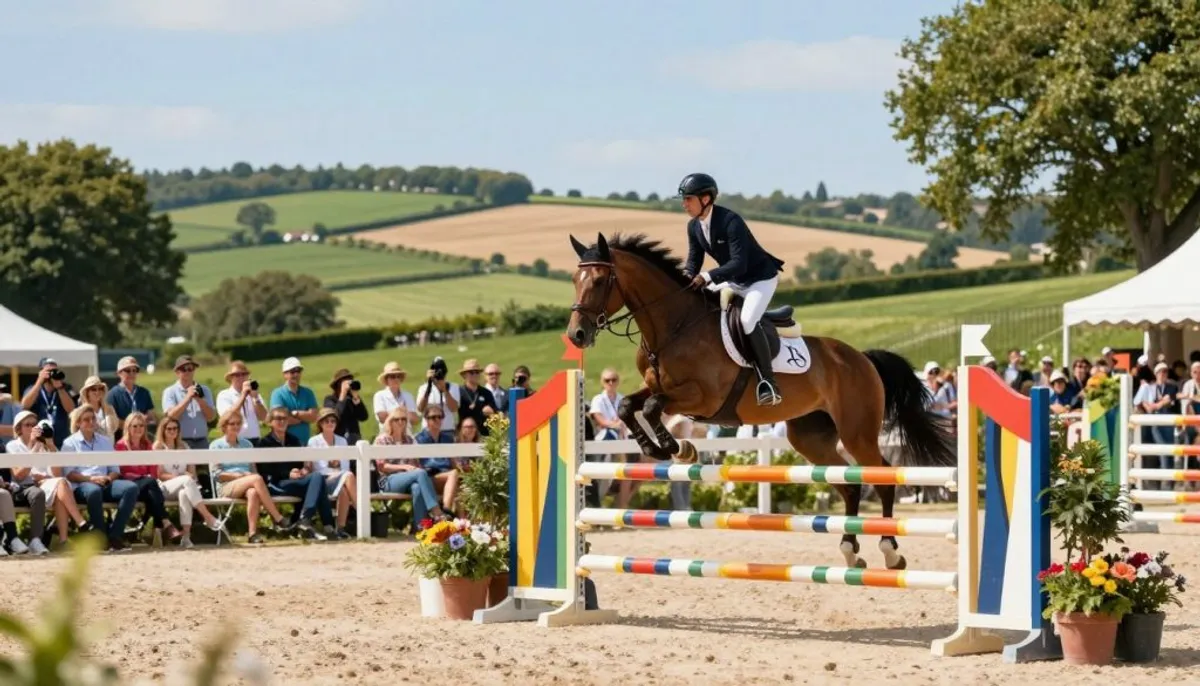
Equestrian sports are practiced both indoors and outdoors, changing with the seasons. It combines technique, balance, and focus while building trust. Riding a horse also helps to relax by concentrating and aligning with the horse's rhythm.
In this article, we will explore why this sport is so popular, the different disciplines, and the role of clubs. We will discuss competitions, equipment, and career opportunities in the equine sector. Riding can be a hobby or transform into a lifelong project, depending on individual choices.
Key Points
- Equestrian sports are a deeply rooted passion in France, accessible from the first lessons.
- Riding is practiced indoors and outdoors, with a strong connection to nature.
- Equestrian sports work on the body, coordination, and confidence.
- Riding also brings mental benefits: concentration, calmness, and emotional management.
- Clubs structure learning and open the door to competitions.
- The equine sector allows for pursuing a professional career, in addition to sporting pleasure.
Why Equestrian Sports Are So Appealing in France
In France, the love for riding comes from its ability to blend freedom, learning, and special moments. In an equestrian club, everyone progresses at their own pace while building a strong relationship with their horse. It is also an ideal way to escape the digital world and unwind.
This sport offers structure while allowing room for fun. Whether for a short visit or spending time with horses, there is always something new to learn. This creates a comforting habit that brings people back.
A connection with nature all year round
Riding outdoors, whether in the forest, by the sea, or in the countryside, is unique. We advance at a walk, trot, or gallop depending on our skills. Learning to interact with the environment is fascinating.
No matter the season, the fresh air and natural light enhance the experience. A simple ride can help relax, especially if the horse is calm. This aspect appeals to everyone, both novices and seasoned riders.
A comprehensive sport for the rider's physical fitness and morale
Riding is perfect for exercising the body gently yet effectively. It works on posture, strengthens the core, and improves coordination and balance. Aspects of breathing and balance are also key.
Mood improves with practice. By communicating with the horse, we strengthen their bond. Daily care, such as feeding and grooming, calms and grounds us.
A practice adaptable to all profiles, solo or in groups
One can choose to ride alone for self-reflection, or in a group to share these moments. Group lessons at the club are motivating, while individual sessions allow for focus on details. Riding together transforms the outing into a special experience.
Activities can be selected according to preferences: trail riding, dressing, flat work, or aiming higher. The horse is always at the heart of the activity, allowing everyone to find what suits them best.
| What Attracts | What We Experience | What We Develop |
|---|---|---|
| Outdoor outings | Rides in the forest, by the sea, in the countryside with a suitable horse | Terrain reading, pace management, confidence |
| “Sport & health” benefits | Flat work sessions, transitions, maintaining the saddle | Posture, core strength, coordination, tone |
| Connection with the animal | Care, grooming, preparation, calming down | Attention, patience, communication for the rider |
| Flexibility of practice | Lessons, trail rides, individual sessions or group activities at the equestrian club | Independence, motivation, social ease |
Equestrian Sports in France: A Passion Between Leisure and Performance
In France, equestrian sports are diverse, ranging from quiet moments to major events. Riding adapts to its rhythm, desires, and personal goals. This flexibility keeps one engaged, avoiding comparisons.
In an equestrian club, one can experiment and choose what they prefer. First, the basics are learned, and then progress is made step by step. All of this requires concentration, patience, and listening to one's horse.
Leisure: trail rides, pony games, archery on horseback, and fun activities at the equestrian club
Leisure activities offer various fun and accessible formats. A trail ride teaches how to control one’s horse safely. Pony games improve coordination and responsiveness in a playful spirit.
- Outdoor rides: building confidence and terrain reading
- Pony games: spirit of play, precision, mastering transitions
- Archery on horseback: concentration, posture, stability
Equestrian competition: pushing oneself with progressive goals
Competition is for those who want specific goals. With different levels, one progresses towards achievable objectives. Training is done to improve performance after each competition.
| Reference | Leisure in riding | Equestrian competition |
|---|---|---|
| Main goal | Pleasure, relaxation, discovery | Measurable objectives, consistency, stress management |
| Organization | Flexible, according to time slots and desire | Training plan, horse and equipment preparation |
| Progression | Technique useful in daily life (direction, balance) | Steps by levels, seeking precision and rhythm |
| Format | Often in small groups, sometimes independently | Solo or in teams depending on disciplines and clubs |
Team spirit and progression: from the first gallop to official events
As one progresses, more advanced techniques are learned. The club atmosphere encourages and secures. In equestrian sports, progress is made through mutual help and well-established routines.
Essential Disciplines: Dressage, Show Jumping, and Beyond
Riding in France is exciting due to its many disciplines. One can seek delicacy or excitement, or a bit of both. In a club, different styles are often tried before finding one’s path, whether for pleasure or competition.
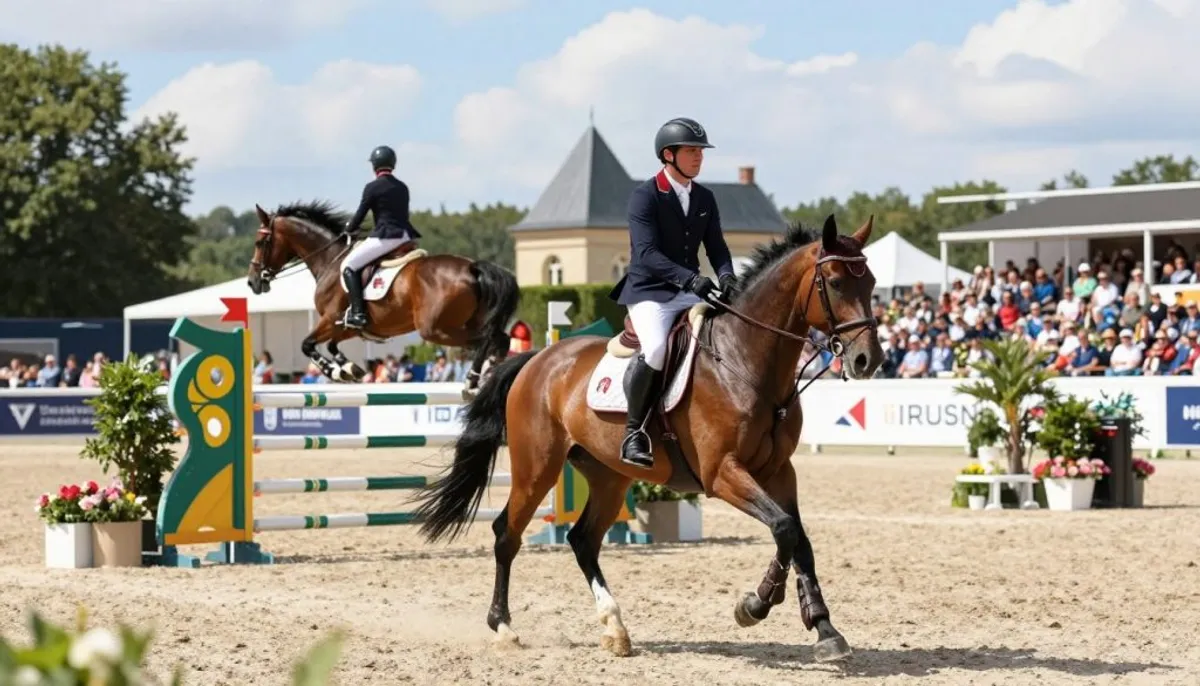
Dressage: Precision, Lightness, and Harmony with the Horse
Dressage is based on fine commands and a balanced horse. We practice changes of pace, turns, and straightness gently. When everything is perfect, the exercise becomes easy and clear.
In competition, this discipline requires precision and consistency. It also improves the gallop, direction, and calmness in daily life.
Show Jumping: Technique, Impulse, and Rider-Horse Trust
Show jumping focuses on rhythm and course layout. One must know how to approach directly, maintain good impulse, and stabilize. Progress comes with trust.
At the club, one starts with ground poles and then simple obstacles. Competition adds clear rules: time, faults, and stress management. The fun is retained while becoming more strategic.
Cross-Country, Combined Training, Vaulting, and Racing: Variety and Sensations
Cross-country takes place outdoors with various terrains. Combined training mixes dressage, cross-country, and show jumping, ideal for those who love diversity. It’s challenging but rewarding.
Vaulting works on balance and coordination, often in groups. Racing requires good physical condition and precise riding. The club offers a great starting point to discover and then specialize.
| Discipline | What We Work On Most | Where It’s Often Practiced | Good Choice If You Like |
|---|---|---|---|
| dressage | Cadence, balance, precision of aids | Riding arena, indoor arena, tests in equestrian competition | Finesse, measurable progress, calmness |
| show jumping | Rhythm, trajectories, impulse control | Riding arena with lines, oxers, combinations | The challenge, strategy, energy |
| cross-country | Commitment, terrain reading, endurance | Diverse terrain, fixed obstacles, sequences | The outdoors, sensations, riding |
| combined training | Versatility, effort management, recovery | Dressage + cross-country + show jumping in one cycle | Alternating technique and sport, with a real plan |
| vaulting | Core strength, coordination, trust, team spirit | Indoor arena, lunge work, choreographies | Collective spirit, flexibility, expression |
| racing | Speed, condition, trajectory precision | Racetrack, supervised physical preparation | The rhythm, strategy, intensity |
Equestrian Tourism: Discovering France at the Horse's Pace
Equestrian tourism is about traveling simply: moving at the horses' pace, observing from afar, and listening to nature. It’s about going without rushing to fully enjoy the French landscapes. For some, it’s also a gentler way to get into riding.
An Attractive and Environmentally Respectful Practice
When hiking, choosing marked routes and local breaks is important. Thus, the activity becomes very appealing for those looking to move discreetly and minimize their ecological footprint. The horse carries us through different terrains, and we learn to respect everyone's pace.
Equestrian tourism offers a different image of the sport: less focused on performance and more on attentiveness. We pay attention to the weather, paths, and our mounts. This approach fosters a more serene and balanced relationship.
Discovering the Heritage of Regions Between Forest, Sea, and Countryside
The forests, marshes, hedgerows, dunes, and vineyard paths provide a unique reading of France. In the saddle, we explore places inaccessible by car: villages, abbeys, canals, and stunning panoramas. Thus, riding guides us through a rich heritage, both by the sea and in the countryside.
| Landscape | What We Feel | What We Discover | Point of Attention |
|---|---|---|---|
| Forest | Coolness, silence, pine scent | Ancient paths, clearings, wildlife | Stay at a walk in wet areas |
| Sea | Salty air, wide horizon, light | Dunes, estuaries, coastal paths | Check tides and wind |
| Countryside | Regular rhythm, space | Hamlets, farms, sunken paths | Respect crops and neighbors |
A Breath of Fresh Air Away from Stress, for All Generations
This type of outing distances us from screens and notifications. We focus on our breathing and the horse. It’s a timeless pause that allows for relaxation.
Equestrian outings appeal to everyone. Depending on our level, we can opt for a short ride or a multi-day expedition. For those coming from competitive riding, it’s a way to shift towards more endurance and confidence.
The Key Role of Clubs and Centers: Learning, Progressing, Sharing
An equestrian club is a first step toward a lifelong passion. We start to ride horses. But we also stay for the atmosphere, the friends we make, and the joy of progressing. Each session helps the rider better understand and respect their horse.
The life at the equestrian center consists of simple routines. This includes lessons, caring for the horses, and chatting with others. These moments allow for sharing tips, supporting each other, and exploring new activities. It’s a good way to gradually gain confidence.
Choosing an equestrian club: supervision, facilities, and horse selection
To choose, one must first look at how the instructors are. They should speak clearly, give simple instructions, and set realistic goals. The best clubs form groups by level and calmly correct mistakes. This allows for proper learning without rushing.
The facilities are also important: riding arena, outdoor arena, well-maintained surfaces, and quality equipment. The horse selection should be well thought out, with calm horses for beginners and livelier ones for progression. One should feel that each horse is well cared for and regularly trained.
Safety, pedagogy, and daily well-being of the horse
Safety is more than just wearing a helmet. It includes following routines and being always attentive. During lessons, we teach how to maintain the proper distance, control speed, and behave correctly. We also learn the right gestures to make when not on the horse.
Being with the horse teaches mutual respect. Knowing how to communicate with it is essential to calm and guide it. Basic care such as cleaning hooves and feeding the horse strengthens this relationship. This makes every moment spent at the club special.
From pony to horse: the journey from beginner to advanced rider
We often start with a pony, then move on to a horse as we grow. This change offers new experiences such as more power and precision. This progression happens gradually, with clear and achievable goals.
At the club, there is always something new to try. Whether for pleasure or to improve, the horse is there to accompany us. It’s not just there for riding; it’s a true partner.
| What a rider looks for | What can be checked on site | What it changes for the horse |
|---|---|---|
| Supervision and pedagogy | Groups by level, simple instructions, regular corrections | Fairer sessions, better fatigue management, more stable attitude |
| Facilities and working comfort | Soft ground, watered arena, usable indoor arena in winter | Less joint strain, smoother locomotion |
| Horse selection and follow-up | Horse suited to the rider's size, work schedule, maintained equipment | Balanced load, preserved back, better morale in the stable or pasture |
| Organization and safety | Track rules, ground protocol, calm preparation areas | Less stress, more serene handling, more predictable reactions |
Equestrian Federation and Competition Life in France
In France, the equestrian federation creates an ideal environment for progress. It guides riders step by step. This avoids skipping important levels.
In this sport, being clear about one's goals helps to gain confidence.
This system makes competitions easy to understand. We know in advance what to expect, from steps to safety rules. This allows everyone to find the competition that suits them, whether alone or in a group.
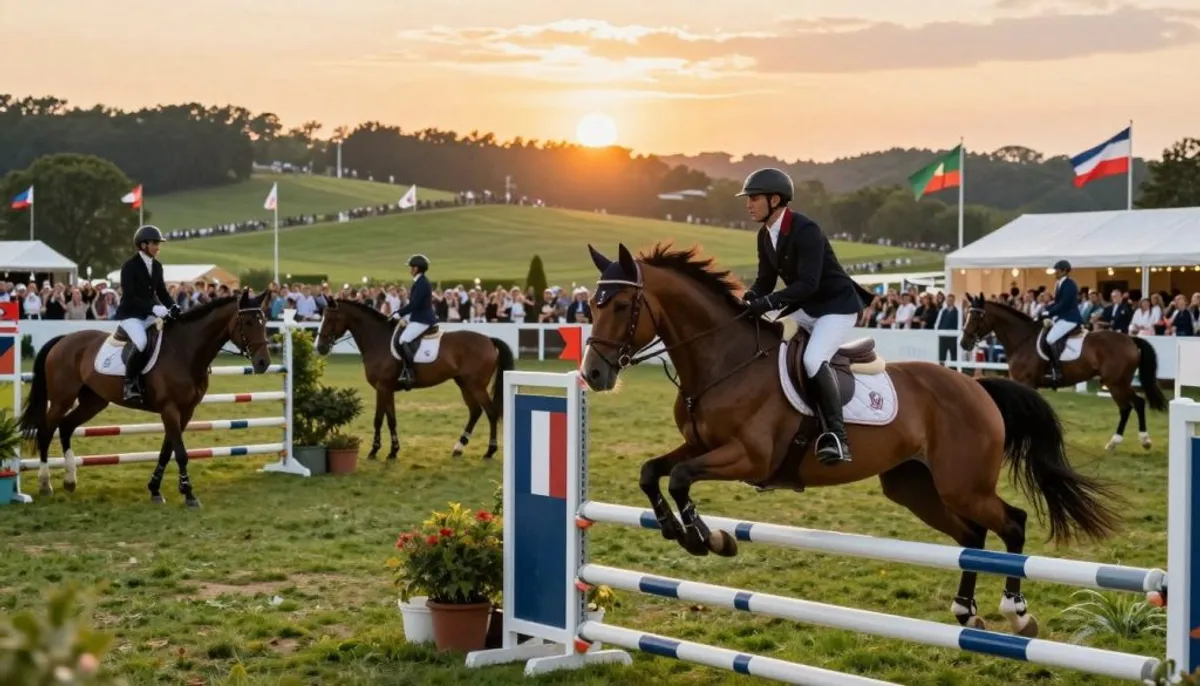
Licenses, regulations, and practice framework
Obtaining a license is the first step. It opens access to competitions and insurance while tracking your progress. The regulations also provide valuable guidelines on attire, equipment, behavior in competitions, and respect for the horse.
In the equestrian environment, these rules secure everyone. They reduce risks related to improvisation and encourage diligent preparation. For many, this makes competitions calmer.
Sports calendar, categories, and levels of events
The calendar structures the season and helps organize time. It offers competitions in several disciplines at different skill levels. One can choose between show jumping, cross-country, vaulting, and even racing and sulky.
Competitions are organized by categories and levels. This facilitates the choice of an event suited to one's experience. This choice is crucial to transform a competition into a rewarding experience rather than a grueling day.
Competition culture: preparation, reconnaissance, and goals
Preparation for a competition begins well before the big day. We prepare our horse and check our equipment. We arrive early to acclimatize.
Exploring the course before the competition helps develop a simple yet effective strategy.
In the equestrian world, setting achievable goals is key to progress: completing a clear round, maintaining a steady rhythm, choosing the best trajectory. The federation encourages progressing step by step, respecting different approaches. This makes competitions an excellent place for learning, whether participating alone or in a team.
| Useful Reference | What It’s For in Competition | Practical Reflex |
|---|---|---|
| License | Access to events, coverage, tracking the rider | Check its validity before entering |
| Categories and levels | Adapting difficulty to experience and the rider-horse pair | Choose an “achievable” event to progress |
| Reconnaissance | Understanding the layout, stride contracts, options | Note 2 priorities: rhythm and key lines |
| Solo or team formats | Experiencing the competition according to one’s style and club | Define a role: coach, supporter, logistics |
| Diversity of disciplines | Testing different sensations and skills | Vary: show jumping, cross-country, vaulting, racing, sulky |
Equipment, Tack, and Know-How: Properly Equipping for Riding
To ride a horse, choosing good equipment is essential. Whether for a trail ride, equestrian tourism, or a competition. Good equipment helps maintain a stable posture. It also allows for proper movement and keeps one comfortable for long periods.
When our gear is suitable, we progress more easily. It must fit our body well without causing discomfort.
The Essentials for Riders: Safety, Comfort, and Technicality
There are three main things to have: a compliant helmet, boots with mini-chaps or tall boots, and gloves. To stay protected without discomfort, the gear shouldn’t be too heavy. A protective vest is also a good idea, especially outdoors or when jumping obstacles.
It’s important to pay attention to details. Such as flat seams, breathable material, and properly sized clothing. If we’re not comfortable, it shows in our riding.
Choosing Well for the Horse: Saddle, Bridle, and Adjustment
The saddle must fit the horse well and not hinder its movements. A good saddle distributes weight properly and prevents the horse from rebelling. The bridle must be adjusted precisely to avoid hindering the horse or losing effectiveness.
Regularly checking the tack is crucial. Such as the condition of the padding, balance, and wear. A good adjustment improves communication between the rider and the horse.
Focus on La Sellerie Française: High-End Made in France, Manufacturing from A to Z
La Sellerie Française offers high-quality equipment, fully manufactured in France. Their major asset is the complete traceability of their products. They offer more than just a “Made in France” label.
Their products are designed with choice materials, with particular attention to finishes and details. This is evident daily, whether on horseback or on the ground. The goal is to buy less but of better quality.
Custom, Limited Series, and Unique Pieces by the Best French Artisans
Custom-made ensures perfect harmony between the horse, the discipline, and the rider’s preferences. Limited series and unique pieces offer unique and quality equipment. This highlights local craftsmanship and often allows for equipment repairs, extending its lifespan.
Discover: La Sellerie Française
It’s important to think carefully before choosing your equipment. Consider the use you will make of it, the type of horse, and the budget. Good equipment supports progression in riding. It makes each session clearer and more enjoyable for the rider.
| Need in Riding | Point to Check | Benefit for the Rider | Benefit for the Horse |
|---|---|---|---|
| Daily Safety | Compliant helmet, adjusted chin strap, condition after a fall | Reduced risk in case of impact, confidence in the saddle | A more relaxed rider, more stable aids |
| Long-Term Comfort | Correct sizes, flat seams, breathable material | Less tension, better mobility of hands and legs | Less unnecessary movement, more constant contact |
| Tack Adapted | Width of the gullet, balance, padding, girthing | More stable seat, facilitated posture | Better distributed pressure, more available back |
| Well-Adjusted Bridle | Noseband, browband, cheekpieces, bit position | More precise aids, less resistance in the hand | Comfort in the mouth, relaxation, better response |
| Responsible Premium Choice | Finishes, reparability, A to Z manufacturing in France | Reliable material, better cost of use management | Stable adjustments, leather that molds without hurting |
Training and Professionalization in the Equine Sector
To transition from an equestrian club to a real professional project, one must prepare well. The path to success in equestrian sports is not just technical. It also involves learning to teach, ensure safety, and organize the workspace. In France, many pathways help become more methodical and credible.
The DEJEPS Equestrian Sports: Objectives, Skills, and Opportunities
The DEJEPS is aimed at those wishing to supervise at a higher level. One learns a lot, such as organizing lessons, understanding the rider-horse dynamic, and helping students progress. This diploma allows one to become a supervisor, coach, or even coordinate a team.
The training is led by experienced professionals. They provide attentive follow-up. The Pôle de Formation Équestre in Pierrelatte is a good example. It offers superb facilities and beautiful horses. For more info, contact them at 04 75 00 10 56.
Possible Careers: Instructor, Coach, Educational Manager
Diverse careers are available depending on your desires and skills. The work can vary between teaching in an arena and preparing riders for competitions. Being able to explain clearly is as important as technical skill.
- Riding instructor: giving lessons, organizing sessions, ensuring safety.
- Instructor: perfecting technique, establishing a demanding learning plan.
- Sports coach specialized in riding: setting goals, planning the season, tracking results.
- Educational manager: leading the team, unifying methods, managing the center's projects.
Program: Theory, Practice, Safety, and Regulation
The program is a mix of classroom learning and fieldwork. It includes equestrian pedagogy, lesson planning, and physical and mental preparation. Safety is addressed practically, with clear procedures and a judicious choice of equipment.
Learning the regulations is crucial for proper supervision and taking responsibility. The equestrian federation provides important guidelines for activities, helping align with clubs and families.
| Training Block | What We Work On | What It Changes on the Ground |
|---|---|---|
| Pedagogy | Session objectives, simple instructions, step-by-step corrections | Smoother lessons, better-framed riders, visible progress |
| Equestrian Technique | Quality of gaits, balance, precision, adaptation to the horse | Better reading of difficulties, more accurate interventions |
| Safety | Risk management, setup, rules in the arena and riding area | Fewer surprises, calmer practice, reassuring framework |
| Regulation | Responsibilities, supervision, organizing activities | Safer decisions, consistency with the equestrian federation expectations |
Access Conditions: BPJEPS or Experience, Riding Level, and Motivation
Generally, entry is with a BPJEPS or equivalent experience. Being comfortable on horseback is advised due to the dense program. Motivation is essential, especially in the face of bad weather, fatigue, and responsibilities.
It’s useful to think carefully about your project before starting. Whether to work with beginners, competitors, or manage a structure. This helps choose the appropriate training and stay motivated while having fun.
A Sector That Creates Jobs and Vocations in France
In France, the world of equestrian sports is vast. It is not limited to riding horses. It includes clubs, stables, and even workshops. This sector offers a variety of jobs for different profiles, from the field to the office.
A Sector That Counts: Over 20,000 Direct Jobs and 20,000 Indirect Jobs
The equine sector in France generates many jobs. It creates over 20,000 direct jobs and as many indirect jobs. These jobs cover a wide range, from horse care to roles in management, reception, or logistics. Equestrian competitions also require employees, especially on weekends.
Diverse Careers: Equestrian Centers, Breeding, Equine Health, Industry
Career opportunities are diverse and not limited to simply riding horses. They extend to equestrian centers, breeding, horse health, and the equine food industry. This diversity attracts those who prefer concrete work and teamwork.
- Field: care, horse work, supervision, facility maintenance
- Technical: feeding, equipment, tack, equipment monitoring
- Organization: reception, scheduling, transport, preparing for equestrian competitions
| Professional Path | Where One Works | What One Does Daily | Often Appreciated Assets |
|---|---|---|---|
| Equestrian Center | Indoor arena, outdoor arena, stables, reception | Supervising, preparing horses, managing safety, planning lessons | Contact sense, rigor, calmness near horses |
| Breeding Stud | Breeding stables, pastures, foaling boxes | Monitoring foals, handling, observing, ensuring routine care | Patience, keen observation, respect for the horse's rhythm |
| Equine Health | Clinic, stable, travel | Assisting, preparing, following protocols, helping with restraint | Precision, hygiene, stress management |
| Food Industry Related to the Sector | Workshop, warehouse, distribution | Controlling, preparing, advising on rations and products | Organization, practical sense, interest in horse nutrition |
Horse and Culture: Cinema, Series, Stunt Work, and Valued Skills
The horse also holds an important place in the world of culture. It appears in cinema, series, and shows. Many of these productions require action scenes, sometimes with stunts. These tasks demand great skill and attention to safety, just like in riding.
Riding teaches valuable skills such as punctuality, perseverance, and taking responsibility. These qualities are a plus in a job interview, even outside of riding. They show that one can make quick decisions and remain calm under pressure.
Conclusion
In France, equestrian sports are popular because they can be practiced outdoors year-round. This offers an escape into the forest, by the sea, or in the countryside. This contact with nature and the horse improves mood, especially after a busy week.
Riding strengthens the body, especially deep muscles and the core. It improves posture, coordination, and balance. Mentally, it helps with concentration and boosts self-confidence through contact with the horse.
Equestrian sports offer great freedom of choice: leisure, competition, or personal goals, everyone progresses at their own pace. There are many activities such as dressage, show jumping, cross-country, and equestrian tourism. Competitions add excitement with their preparation and the pleasure of improvement.
For those wanting to go further, there are professional training programs like the DEJEPS Equestrian Sports. These programs teach pedagogy, safety, and regulations. They are accessible notably through the BPJEPS or experience. The sector creates about 40,000 jobs, directly and indirectly. And for equipment, quality is essential. La Sellerie Française offers high-quality equipment, custom-made or in limited editions, all made in France.
FAQ
Why is equestrian sports so appealing in France?
It combines pleasure, learning, and personal challenge. Riding a horse is about enjoying contact with the animal and discovering various activities, from simple leisure to intense competition. One practices in a club or in nature.
Can you ride outdoors all year round?
Absolutely. Outdoor riding is about enjoying nature in every season. One can ride in the forest, by the sea, or in the countryside. This is one of the great attractions of this sport.
What are the physical benefits of riding?
Riding is very complete. It works deep muscles and improves posture and balance. Over time, one becomes more toned and coordinated.
How does the bond with the horse improve morale?
Being connected to one’s horse brings well-being. Talking, caring for it, and sharing moments creates a reassuring routine. It is often seen as a boost for morale.
Is riding a sport suitable for advancing at one’s own pace?
Absolutely. That’s what makes it strong. In riding, everyone progresses at their own pace and according to their goals. Whether for pleasure or to improve, everyone finds their way.
Can you ride alone, as a couple, or in a group?
Yes, it’s possible. One can ride alone, in pairs, or in groups. Options range from quiet trail rides to group lessons or competitions. Some activities are individual, while others are done in teams.
What leisure activities can be done at an equestrian club?
Clubs offer much more than lessons. There are trail rides, pony games, archery on horseback, and more. These activities diversify the pleasure and help progress without pressure.
How to set goals in equestrian competition?
Competition offers several levels and categories for gradual progression. One first builds their technique and then takes on more structured challenges, all while benefiting from club support.
What disciplines are found in equestrian sports, beyond dressage and show jumping?
There is a great variety. Besides dressage and jumping, there are combined training, cross-country, and vaulting. There are also races and sulky practices. There is something for everyone.
What exactly is dressage?
Dressage seeks harmony and precision with the horse. It values communication and fine aids, in precise posture work.
What does show jumping bring to the rider and the horse?
This discipline improves technique and commitment. It strengthens the trust between the rider and the horse, thanks to a balance of engagement and precision.
Is equestrian tourism accessible and respectful of the environment?
Yes. It allows for discovering the beauty of regions on horseback, in an environmentally respectful manner. It’s an appreciated activity for its ecological and escapist aspects.
Why is it called a “breath of fresh air” with equestrian tourism?
It’s a real pause in our hectic lives. In the forest, by the sea, or in the countryside, we enjoy a unique moment. It’s an experience valued by everyone.
How to choose a good equestrian club?
It should offer supervision suitable for each level. Good facilities and well-cared-for horses are essential. The goal is to progress at one’s own pace, with clear learning.
What does “horse well-being” mean daily in a club?
This means ensuring their health and comfort every day. Good practices and clear communication are crucial for their well-being and everyone’s safety.
What is the role of the equestrian federation in competition in France?
It organizes the sport with an official framework. This guides riders to position themselves and find suitable competitions. It’s a key support for progress.
How does competition life and the “competition culture” unfold?
It is based on progression and realistic goals. Competitions require discipline and consistency, always with a spirit of learning cherished by the club.
What equipment is essential for practicing riding safely?
The equipment must ensure safety and comfort. It varies depending on the activity, but protecting the rider is always the priority.
Why is tack so important for the horse?
Good tack improves the horse's well-being and movements. It ensures a harmonious relationship between the rider and their horse, reducing discomfort.
What distinguishes La Sellerie Française?
La Sellerie Française (https://laselleriefrancaise.com) offers high-end products. They are unique and made in France by excellent artisans. Their quality exceeds usual standards.
Can unique pieces or custom-made items be found in tack?
Yes. Custom-made and limited editions offer unique comfort and style. This allows for choosing specific materials and finishes for each equestrian practice.
What is the DEJEPS equestrian sports and what is it for?
It’s an advanced diploma for equestrian professionals. It enriches equestrian skills and opens the door to various jobs in the equine field.
What jobs can be pursued after a DEJEPS equestrian sports?
After this diploma, one can become an instructor, coach, or manager in an equestrian center. These roles require a high level of expertise and teaching.
What does the DEJEPS equestrian sports program contain?
The training mixes theory and practice. It covers teaching, safety, legislation, and practical training to refine equestrian abilities.
What are the access conditions for the DEJEPS equestrian sports?
A BPJEPS or equivalent experience is necessary. One must also be highly motivated and possess a good riding level to succeed.
Where to train for the DEJEPS equestrian sports in France?
The Pôle de Formation Équestre in Pierrelatte offers this training. They have excellent facilities and quality horses. Contact: Pôle de Formation Équestre: 04 75 00 10 56.
Does the equestrian sector create jobs in France?
Yes, equestrian activities generate many jobs, both directly and indirectly. The sector is dynamic and offers many professional opportunities.
What opportunities exist in the equine sector, outside of clubs?
The sector offers varied opportunities, ranging from equestrian centers to breeding, equine nutrition, and health. There are roles in care, management, and prevention.
Can you work with horses in cinema and shows?
Yes, the world of cinema and shows offers places for talented riders. Horseback scenes require equestrian mastery for their precision.