
When it gets colder or when a horse doesn't want to eat, mash is an option. This warm food is quick to prepare, smells great, and is enjoyed by horses. It fits well into their feeding routine without any issues.

Mash is particularly interesting for three reasons. It aids digestion, encourages the horse to drink more, and is beneficial during sensitive times. Whether it's stress, a shedding period, after an illness, during transport, or simply when the horse is a bit weak, its moist consistency is often a plus. For older horses, this softer meal is also easier to eat.
There are two options for preparing it: buying ready-made mash or making your own recipe at home. In any case, mash does not replace the main basic diet, which is forage. For a balanced diet, you start by giving about 1.5 kg of hay for every 100 kg of body weight per day. Then, you adjust according to the horse's needs.
A good mash, properly dosed, is an excellent addition. It complements the horse's diet while respecting its needs. These needs include a good fiber intake and regular hydration. The goal is always to maintain a balanced diet that is good for the horse in the long term.
Key points to remember
- The horse mash is a warm, appetizing meal, useful as a supplement to the ration.
- It can support digestion and improve hydration thanks to its moist texture.
- It is often appreciated during sensitive periods: stress, shedding, recovery, weather changes.
- The mushy consistency is well-suited for older horses or those with a fragile appetite.
- You can choose between ready-to-use mash and homemade mash recipe, depending on your priorities.
- For a balanced equine diet, the base remains forage, with a guideline of hay around 1.5 kg/100 kg BW/day.
Meta title and meta description for good positioning in France
To appear on Google, you need a clear title and a direct promise. The meta title for equine mash should capture the main idea. It should be concise and mobile-friendly. Mentioning “France” helps, especially if targeting people comparing products and prices.
The meta description should quickly build trust. It should talk about taste, fiber, gut health, and eating habits. Carefully chosen words attract attention without redundancy.
For good positioning, you need to repeat keywords where the eye first lands. Mention horse mash, horse digestive health right in the title and the first sentences. It should feel natural, like a conversation at the stable.
SEO optimization for equine mash in France involves lexical diversity. Using “ration,” “fibers,” “flakes,” “warm water” improves the text and avoids excess. This makes the text precise, and the reader immediately grasps the subject.
| Page area | What the reader expects | Useful formulation | Point of vigilance |
|---|---|---|---|
| Page title | The subject and benefit at a glance | A meta title horse mash that puts “feeding” and “balanced” in the foreground | Stay readable, avoid word stacking |
| Preview text | A concrete reason to click | A meta description equine digestion that evokes gut comfort and simple routine | Do not promise “miracle” results |
| First paragraphs | The context and quick response | Remind of horse mash, equine digestion, horse digestive health with a direct tone | Avoid word-for-word repetition |
| Body text | Concrete and credible details | Varied vocabulary around fibers, hydration, and ration | Keep sentences short and a regular rhythm |
| Geographic anchoring | A response tailored to the local market | SEO horse mash France integrated once, in the right place, without insisting | Do not repeat “France” in every paragraph |
Understanding mash: a warm, appetizing horse food that is easy to prepare
When it gets cooler or when things change at the stable, mash becomes a simple solution. It makes the meal more enjoyable with its fluffy consistency and comforting smell. This is done without disrupting the horse's daily diet. It can be given in addition to or instead of the usual meal, to provide variety without complication.
Definition and interest of the “warm meal” for the equine
Mash is a mix of fibers and grains (often processed) that is rehydrated with hot water. The goal is not to overfeed, but to offer a soft and easy-to-eat meal. It is very useful for changing a horse's diet or facilitating the intake of supplements.
The advantages of mash lie in its consistency: warm, moist, and tasty. It is different from dry foods and allows horses to eat calmly, especially after transport or strenuous effort.
Why mash stimulates appetite and helps “hard-to-keep” horses
A horse that sorts its food or eats slowly may enjoy its meal more with mash. The aroma and warmth stimulate appetite, and its texture prevents sorting. Thus, the animal eats more regularly, which is good for its overall condition.
Reputable recipes like marstall Mash are chosen for their attractiveness and digestive well-being. For horses that are difficult to maintain in shape, it is practical support, especially under stress or in bad weather.
Short preparation time: soaking 15 to 20 minutes, no cooking
Preparation is simple: add hot water (no need to boil), mix, then wait. A soaking time of 15 to 20 minutes is often sufficient before serving warm. This shows the advantage of mash: it allows you to pamper the horse easily.
Cold water can also be suitable depending on the instructions. JOSERA suggests soaking a little longer, about 5 more minutes, for perfect consistency. The important thing is to achieve a well-hydrated mash that is pleasant to eat.
| Point to check | What you observe in the bucket | What it changes for the horse food |
|---|---|---|
| Water temperature | Hot water, then served warm | More pronounced smell, more attractive meal, often associated with the benefits of mash |
| Soaking time | 15–20 min in hot water | Correct swelling of fibers, soft texture, less sorting |
| Cold water option | Texture takes longer to form (≈ +5 min according to JOSERA) | Practical in summer or on the go, while keeping a well-bound horse mash |
| Final texture | Moist dough, without dry areas | Better mouthfeel, helps slow or difficult horses |
| Distribution moment | After effort, stress, cold, or simple variation | More “comfort” meal, useful for securing ingestion and regularity |
horse mash: benefits of mash on equine digestion
A well-chosen mash can help when the usual ration tires the horse's body. It is soft and rich in water, which promotes digestion, especially during sensitive periods. It serves as a comforting meal while maintaining a simple feeding routine.
Regarding the horse's digestive health, one goal is to maintain stable transit for a relaxed horse with well-formed droppings. The benefits of mash act on three aspects that are easy to understand and observe at the stable.
Support for intestinal function and colon comfort
Some producers, like marstall, refer to mash as a “digestion regulator.” A wetter and fiber-rich ration facilitates food transit. This benefits digestion, particularly when the colon is sensitive.
In cases of chronic colon or small intestine disorders, mash can be used long-term. Some recommend starting with a treatment of up to 6 months, after consulting an expert. This method contributes to the horse's digestive health without disrupting its usual ration.
Hydration: a simple lever for better water consumption
Mash promotes hydration by providing water directly. It can encourage horses to drink more, especially useful in cold or dry weather. This reflex aids digestion and is essential for digestive health.
A well-hydrated horse generally has better transit. Ensuring it has access to clean, fresh water at all times is a simple but important gesture for its health.
Role of mucilaginous components (flax seeds) on mucous membranes
Flax, rich in mucilages, is valued for its positive effect on mucous membranes. According to marstall, it contributes to the regeneration of the stomach and intestines. This action is particularly sought after for sensitive digestions.
Flax, combined with psyllium in certain formulas, supports the digestive system. JOSERA highlights their usefulness for intestinal flora. Using a soft mash can thus be a valuable aid for the horse's digestive health when balance is delicate.
| Lever | What we seek | What it looks like daily | Points of vigilance |
|---|---|---|---|
| Fibers + moist texture | Support intestinal function and colon comfort, useful in a equine digestion strategy | More appetizing ration, more regular transit, calmer horse after the meal | Introduce gradually, monitor tolerance, seek expert advice in case of chronic disorders |
| Water intake in the ration | Promote hydration and aid elimination, serving horse digestive health | Horse finishes its ration better, better acceptance of water, especially in winter | Clean water, bucket and trough cleaned, remove leftovers to avoid fermentation |
| Mucilages (flax seeds) + sometimes psyllium | Soothing and supporting mucous membranes, and accompanying digestive balance | Softer ration, interesting when the stomach and intestines are sensitive; benefits of mash sought over time | Respect quantities, adjust according to the formula, check individual tolerance |
Key ingredients and horse fiber: what common compositions say
When choosing a horse mash, reading the label is essential. It reveals the balance between energy, fibers, and ingredients that promote digestion. Fiber plays a significant role: it affects texture, helps one feel full, and promotes good transit.
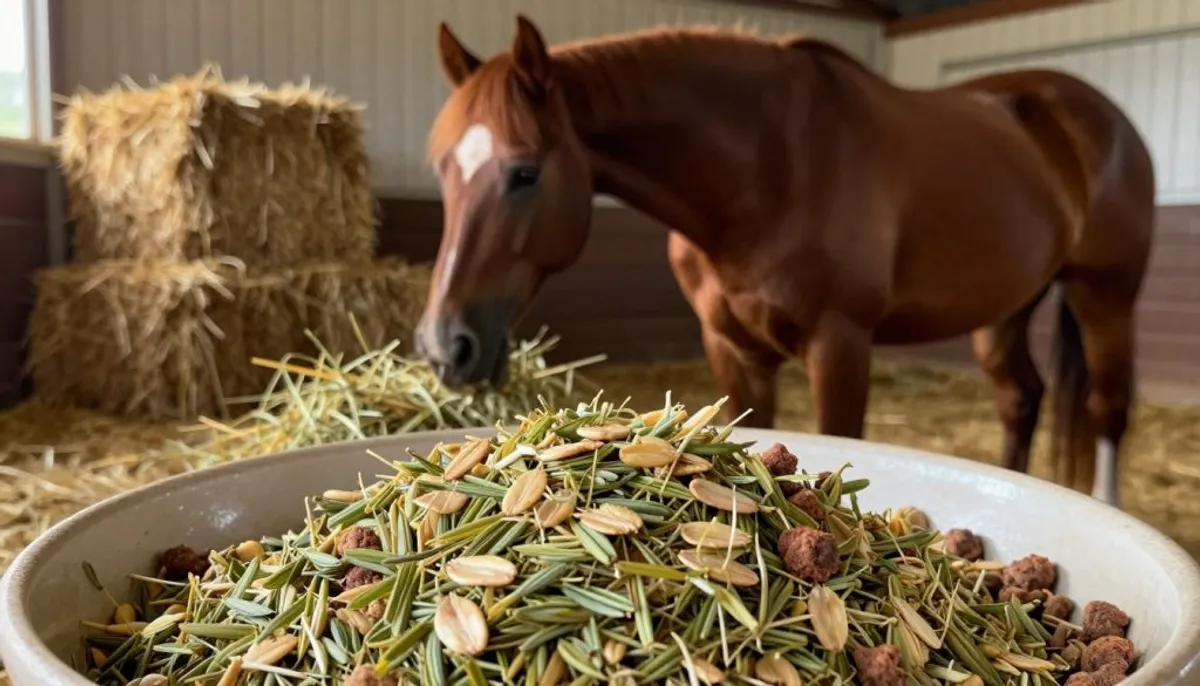
Examples of ingredients used: barley flakes, wheat bran, apple pomace, flax seeds
Mash recipes often include grains like barley flakes for easily digestible energy. Wheat bran adds important fibers. Flax seeds and flax meal are chosen for their beneficial effect on digestion, especially in a warm mash.
Apple pomace adds a soft texture and fibers rich in pectins.
For example, marstall Mash contains 50% barley flakes, 15% wheat bran, and 10% flax seeds. It also contains 10% dried apple pomace and 2% refined rapeseed oil. This nutritional profile shows how to create a horse mash: mix simple raw materials for an appetizing and easy-to-soak meal.
Fibers and prebiotics: chicory pulp, psyllium husks, pectins
Chicory pulp helps maintain a good intestinal flora due to its prebiotic effect. In JOSERA herbs & root vegetables Mash, it makes up 3.0% of the composition. This product also contains 35.0% dried grasses and 23.3% apple pomace flakes.
Psyllium husks, used at 0.5% in JOSERA, absorb water to form a gel. This facilitates digestion, especially for horses that drink little. Pectins, provided notably by pomace and apple mash, are an excellent source of fermentable fibers.
Without molasses, low sugar content: interest for certain profiles
Some horse mashes avoid molasses, which is crucial for low-sugar diets. marstall claims a sugar content of 2.90%, highlighting its minimalist approach. Conversely, JOSERA indicates 6.25% sugar and 3.9% starch, signaling a low content of these elements.
The low presence of sugar and starch indicates that the recipe prioritizes fibers, seeds, and plants. The goal varies according to the horse's needs: work, sensitivity, or simply a warm meal from time to time.
| Criterion | marstall Mash | JOSERA herbs & root vegetables Mash |
|---|---|---|
| Base of the formula | Barley flakes (50%) + wheat bran (15%) | Grain-free: dried grasses (35.0%) |
| “Comfort” fibers | Dried apple pomace (10%) rich in pectins | Apple pomace flakes (23.3%) + chicory pulp (3.0%) |
| Support via flax | Flax seeds (10%) + flax meal (10%) | Flax seed extract powder (22.5%) + flax seeds (10.0%) |
| Targeted ingredients for “transit” | Flax + water-swelling texture | Psyllium husks (0.5%) + fermentable fibers |
| Declared sugar/starch | Sugar 2.90% | Sugar 6.25%; starch 3.9% |
| Key reading point | Very low sugar recipe, useful if aiming for a dominant horse fiber | Grain-free fibrous profile, with prebiotics (chicory) and psyllium |
Digestion, starch, and sugars: guidelines for sustainable horse digestive health
When discussing horse digestive health, monitoring starch and sugars is wise. Too much starch can complicate digestion. Having a clear guide helps in making good choices.
Practical recommendation from HORSE BREED: do not exceed 200 g of starch / 100 kg of live weight / per meal. This rule is crucial especially with grains or many concentrates. It also applies if you add mash to a meal.
To understand a label, compare levels of starch, sugars, and fibers. Then, assess energy and proteins. A formula rich in starch works for an active horse but could be bad for fragile digestion. A low-starch mash helps during delicate periods, provided the overall ration is balanced.
| Product | Starch | Sugars | Fibers/cellulose | Energy | Proteins | Other guidelines |
|---|---|---|---|---|---|---|
| marstall Mash | 28.0% | 2.90% | Crude fiber 7.50% | ED 12.50 MJ / EM 11.30 MJ | 13.50% | Quick reading: moderate starch, low sugars |
| HORSE BREED MASH | 35% | Not indicated | Not indicated | UFC 0.75/kg | 10.9% | MADC 76 g/kg, lysine 4.1 g/kg, calcium 1.8 g/kg, phosphorus 4.4 g/kg, fat 3.9%, omega 3 4.5 g/kg |
| JOSERA Mash | 3.9% | 6.25% | Crude cellulose 17.7% | ED 10.9 MJ/kg | 16.2% | Quick reading: very low starch, high fibers |
Use these indicators to choose a suitable mash. Whether for maintenance, work, stress, or digestive sensitivity. To maintain good digestive health, wisely combine mash, hay, concentrate, and water. Do not base the entire diet on mash. Regular and well-dosed meals are key for effective equine digestion.
When to give mash: recovery, stress, shedding, weather, and dietary transitions
Horse mash is useful when daily routines change. During these times, it helps to eat more easily. The benefits are especially visible when appetite decreases or transit is disturbed.
During a dietary change, mash serves as a “bridge meal.” It hydrates and facilitates regular consumption. This is useful for digestive health, especially when the routine is changed.
Frequent situations
After a deworming treatment, some horses may have sensitive digestion. A mash, given gradually and well-hydrated, can help. In case of constipation, the best choice often includes fibers and water.
After surgery or foaling, it is important to resume gently. An appetizing and easy-to-consume diet is sought. Mash offers comfort and hydration during these periods.
Weather changes, such as cold or heat, are also important. Mash, with its warm water, encourages fluid intake. It is a support for digestive health, especially if horses drink little.
Sensitive periods
When horses shed, their metabolism speeds up. A mash can be a good supplement, also helping to add salt. A professional can advise.
Stress, whether physical or mental, changes appetite. Brands like JOSERA talk about these stressful situations. Mash helps due to its palatability and regularity.
Older horses
For older horses, chewing can be more difficult. Mash, often recommended by marstall, is easy to swallow. It becomes a good option, reducing refusals.
If a horse sorts its food or tires quickly, mash is ideal. It is often finished more easily than a dry mix. The benefits help maintain good digestion.
| Moment | What often happens | What mash brings | Point of vigilance |
|---|---|---|---|
| After deworming | Irregular appetite, changed droppings | More humid meal, easier intake, support for horse digestive health | Introduce gently and monitor droppings over 24–48 h |
| After surgery | Fatigue, fragmented ration, need for comfort | Appetizing horse mash, easy to swallow, useful for recovery | Follow veterinary instructions and avoid overly large portions |
| After foaling | Energy variations, stress, hydration to monitor | Hydration through the meal, benefits of mash on the desire to eat | Adjust according to the mare and the quality of the forage |
| Weather change | Drinks less or sweats more depending on the season | Warm water supply, more attractive meal, support for horse digestive health | Serve warm, remove leftovers to avoid fermentation |
| Dietary transition (type marstall) | Adapting intestine, risks of refusals | Horse mash as a bridge meal, regular ingestion | Make the transition over several days, without changing everything at once |
| Older horse | Slow chewing, sorting, possible loss of condition | Pasty texture, palatability, benefits of mash on regular intake | Regular dental check and adjustment of fibers |
How to prepare and distribute: hot water, volumes, hygiene, and frequency
A horse mash succeeds with good volumes and water at the ideal temperature. This creates a warm and hydrated food that is eaten quickly. It also aids good equine digestion.
Typical preparation: mix with hot water (≈ 50°C), let swell for 15–20 min, serve warm
For a pleasant food, the water should be around 50°C. It is hot enough for the mash without being scalding. Add the water, mix, and wait 15 to 20 minutes. Before serving, stir again and ensure it is warm.
Recommendations vary by brand. JOSERA suggests 1 to 2 L of mash for 2 to 3 times that volume of hot water, for the same resting time. Marstall advises mixing with hot water, without it being boiling, and serving warm.
HORSE BREED recommends mixing 2 to 4 L of mash with an equal volume of hot water. Wait a few minutes before serving once the water is absorbed. This is perfect for a homogeneous texture.
| Brand | Amount of mash | Water & temperature | Rest & service | Practical tip |
|---|---|---|---|---|
| JOSERA | 1 to 2 L (1 L = 450 g) | 2 to 3× the volume, ≈ 50°C | 15–20 min, serve warm | Possible with cold water (plan for ~5 min more) |
| marstall | According to the usual ration | Hot water, not boiling | 15–20 min, mix well, serve warm | Check the temperature before distribution |
| HORSE BREED | 2 to 4 L | Same volume of hot water | Few minutes, give once absorbed | Monitor the texture: neither liquid nor dry |
Recommended frequency: once to three times a week or as a temporary replacement for the meal
Use the frequency of mash as a comfort for your horse. Marstall suggests giving it 1 to 3 times a week. On the other hand, HORSE BREED recommends 1 to 2 times, sometimes replacing the usual meal.
JOSERA indicates 2 to 3 times a week, either as a supplement or a replacement. The important thing is to maintain a regular routine. This facilitates equine digestion, especially with climatic or activity changes.
Hygiene: prepare at the last moment and remove leftovers from the trough
A warm mash is delicate. Prepare it just before giving it and do not leave anything in the trough. If you have doubts about the smell or texture, throw it away and clean.
Remove leftovers after the meal and wash the bucket or trough. This gesture prevents fermentation, keeps the mash appetizing, and protects digestion for the next times.
Rations and dosages: adjust according to weight, breed, and activity level
Start with the simplest way to adjust a horse mash: observe the weight, health status, and work of the week. Do not forget the quality of the hay as it affects fiber intake. Based on these elements, you help the horse's digestion without overfeeding.
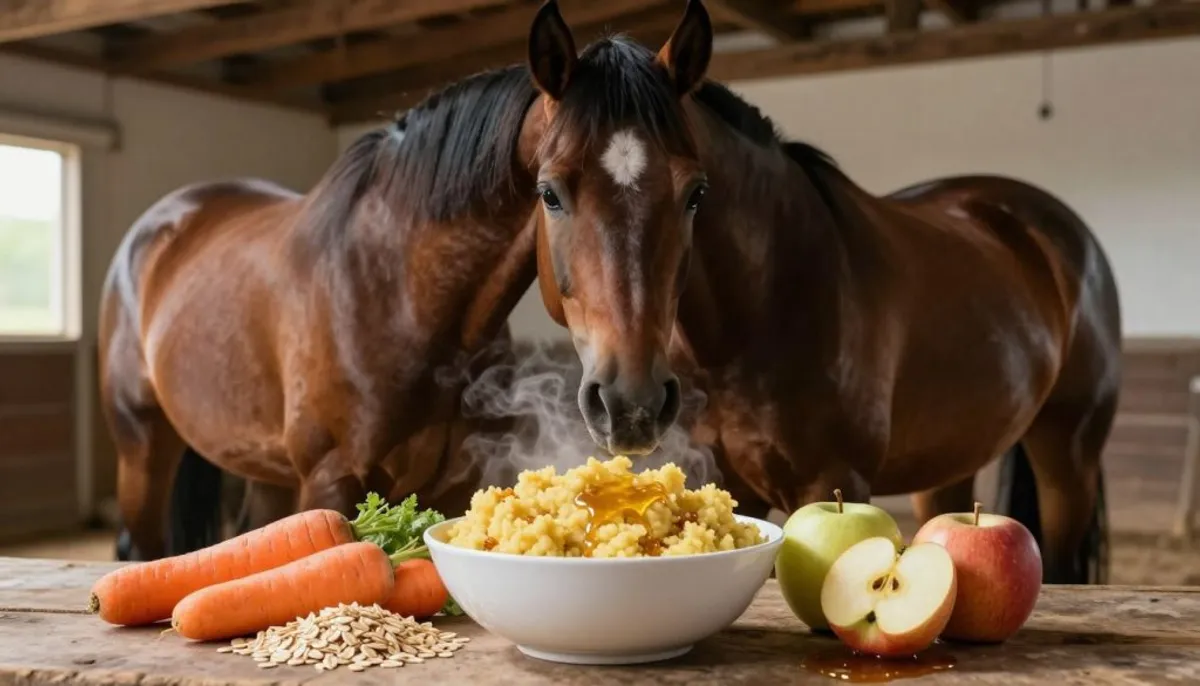
“Live weight” guideline: base of forage around 1.5 kg/100 kg BW/day
A good starting point is 1.5 kg of forage for 100 kg of live weight per day. This helps maintain good intestinal transit and ensures a sufficient amount of fiber, even if the horse moves less. Depending on the hay's condition and access to the paddock, adjust the amount as needed.
Indicative mash dosage: 100 to 150 g/100 kg of body weight (depending on formulas)
A good guideline for horse mash is 100 to 150 g for 100 kg of body weight, depending on the recipe. If exceeding 150 g for 100 kg, it is better to divide into at least two meals. This helps keep the horse's digestive system in shape.
For dosage, use the indications on the package. Depending on the brands, 1 L can weigh about 450 g, but others are lighter, at 150 g per liter. This information prevents measurement errors, especially for fiber-rich mashes.
Examples of quantities by type: pony, thoroughbred, half-blood (as a supplement)
| Profile | Daily amount (as a supplement) | Useful “live weight” guideline | Distribution tip |
|---|---|---|---|
| Small breed / pony | 0.25 to 0.50 kg/day | Hay ≈ 1.5 kg/100 kg BW/day | Serve warm and well-hydrated to support horse digestive health |
| Thoroughbred | 0.50 to 0.75 kg/day | Adjust if horse is fine or under heavy work | Split if appetite is variable, keeping good horse fiber |
| Half-blood | 0.75 to 1.25 kg/day | Monitor body condition over 10–14 days | If high dose, split into 2 horse mash meals |
These guidelines are just reference points. Breed, stress, weather, dental condition, and forage can all change things. The important thing is to maintain a balanced diet, with enough fiber, for consistent and healthy digestion.
Homemade mash recipe: tips for making horse mash without common mistakes
Making your mash is quite simple if you pay attention. The goal is to aim for a warm, moist meal that digests well. Keeping a good amount of fiber is crucial, especially for sensitive horses or those that do not drink enough.
Choose digestible and fiber-rich ingredients
Start with wheat bran, flax seeds, and a bit of apple or carrot. This mixture creates a good texture and pleases horses. You can also add a bit of fenugreek to make the mash more tempting, but without hiding the quality of the food.
Some recipes add barley or avoid grains, like JOSERA products. The important thing is to keep the mash easy to digest without too many grains.
Mastering the texture
The secret is in the water. To succeed, use hot water, around 50°C, mix, and then wait 15 to 20 minutes. This is a technique used by marstall and JOSERA. Serve it warm and stir well to avoid dry spots.
A good mash has a doughy consistency, neither too liquid nor too thick. Adjust with water if necessary. This helps keep the fibers stable for your horse.
Caution with additions
It is better to avoid adding too much sugar. Many choose molasses-free mashes for lower sugars. Ingredients like flax and fruits or vegetables already give good flavor to the mash.
Introduce any new food slowly, over at least 8 days, as recommended by HORSE BREED. And do not forget fresh, clean water available at all times. This complements the goal of hydrating through the mash.
| Control point | Simple guideline | To avoid | Why it’s useful |
|---|---|---|---|
| Fiber base | Wheat bran + flax + apple/carrot | Too many grains at once | Better horse fiber, digestive comfort |
| Water and temperature | Hot water ≈ 50°C, rest 15–20 min | Boiling water or mash served cold | Regular swelling, more appetizing mash |
| Final texture | Doughy, homogeneous, served warm | Liquid (too much water) or lumpy (not enough) | Easy intake, less sorting in the trough |
| Additions “pleasure” | Fenugreek in small quantities if needed | Molasses, excessively sweet treats | Limits sugar spikes, more stable ration |
| Transition | Introduction over 8 days minimum (HORSE BREED) | Sudden ration change | Reduces the risk of digestive disorders |
Equine dietary supplement: compatibilities, minerals, treatments, and doping
Choosing a horse mash is not just about taste. You must consider the nutrients it provides, ongoing veterinary care, and how it affects digestion, especially for delicate horses.
It is crucial to distinguish between a simple rehydrated meal and a supplement richer in minerals. This distinction affects how you integrate it into the daily diet.
“Combinable” mash
Marstall emphasizes the interest of a mash without added vitamins and minerals. This allows it to be easily combined with other foods or treatments without complications.
Their formula contains no sugar, molasses, or essential oils. This facilitates digestion and avoids overloading the horse's stomach.
On the competition side, marstall Mash complies with FEI doping rules. This is reassuring for those who want to adhere to standards without sacrificing the comfort of a warm meal.
If the mash replaces concentrate
Marstall explains that with a good balance of calcium and phosphorus, their mash can replace a concentrated feed. If this is your choice, consider adding a suitable mineral supplement.
Marstall recommends, for example, marstall Force or Stall-/Weide-Riegel. The goal is to maintain the energy and fibers of the mash while meeting mineral and trace element needs.
Practical guidelines to avoid excess
| Point to check | Practical guideline | Why it’s useful |
|---|---|---|
| Part in the ration (JOSERA) | A complementary food should not exceed 50% of the daily ration | Its trace element content may be higher than that of a complete food |
| Mode of use (JOSERA) | Use only after infusion | Better rehydration, safer texture, and easier to ingest |
| Fractionation (marstall) | If the dose exceeds 150 g/100 kg of live weight, distribute in 2 rations | Softer digestive load, better tolerance for equine digestion |
These tips help avoid excess supplements. They allow you to maintain the interest of the mash without disrupting the overall diet.
Choosing a premium mash and the right equipment with La Sellerie Française
For daily well-being, every detail counts. This includes feeding, routine, and equipment. La Sellerie Française offers a premium range. It is designed to last and remain pleasant even during the busiest days at the stable.
La Sellerie Française offers unique items, custom-made and in limited series. These are made by renowned French artisans. The goal is to link the quality of horse mash to efficient organization. This goes from storage to distribution.
The promise of “made from A to Z in France” goes beyond the simple Made in France label. It claims to be superior to this label and to the Origin France certification. Great attention is paid to finishes, materials, and durability.
High-end selection: unique products, custom-made or in limited series
Preparing a horse mash is quick, but it must be regular. Having the right equipment helps avoid mistakes. You need a dedicated bucket, clean utensils, and a dry place to keep the horse food.
- Organization: a defined space for the meal helps dose easily and avoids forgetfulness.
- Hygiene: easy-to-clean containers allow for last-minute preparation and easy removal of leftovers.
- Comfort: a smooth routine is crucial, especially for sensitive or transitioning horses.
100% French manufacturing: “made from A to Z in France,” beyond the Made in France label
Producing entirely in France ensures traceability and consistent quality. In a stable, small details matter: careful stitching, robust parts, easy to maintain. This contributes to a premium stable equipment, used daily.
This attention to detail aligns with careful nutrition. Choosing the right horse feed and maintaining a clean routine makes a difference. It makes service smoother, reduces waste, and decreases the need to replace equipment.
Combining nutrition and comfort daily: useful saddlery accessories for meals and the stable
Serving a mash under the right conditions requires the right accessories. A simple checklist ensures consistency. This is especially useful in cold weather or in a very active stable.
| Key moment | Simple gesture | What it changes daily |
|---|---|---|
| Before preparation | Reserve a clean and dry bucket, dedicated to mash | Less cross-contamination and a more consistent texture |
| During mixing | Measure hot water, stir, then let swell | A homogeneous horse mash, more appetizing and easier to consume |
| At the time of serving | Offer warm and monitor intake | Better acceptance of horse food, especially in older subjects |
| After the meal | Remove leftovers and rinse immediately | Enhanced hygiene and less odor in premium stable equipment |
Conclusion
Horse mash is a simple choice to improve their daily life. When served warm, horses often prefer it over dry meals. It provides numerous benefits thanks to a mixture rich in fibers, pectins, mucilages, and flax. This mixture promotes good digestion in equines.
This meal is particularly beneficial during delicate moments. Whether after deworming, surgery, or in times of stress, mash helps maintain appetite. The water it contains hydrates well, especially for horses that do not drink enough. For older horses, its easy-to-eat texture reduces the chances of refusals.
The usage rules are simple. Mix it with water at about 50°C, let it absorb water for 15–20 min, then serve it warm. A weekly use of 1 to 3 times is often sufficient. Make sure to prepare it just before the meal and discard leftovers to avoid fermentation.
For a balanced diet, forage should remain the base, at 1.5 kg/100 kg BW/day. Starch should be limited to 200 g/100 kg BW/meal. Introduce any changes slowly over 8 days. If mash replaces part of the concentrate, a mineral supplement should be considered. This keeps the benefits of mash in the long term.
FAQ
What exactly is horse mash?
The horse mash is a warm and delicious mixture, often served as a “warm meal” in addition to their usual food. It is designed to be easy to eat and help with digestion. But it does not replace the main part of their diet, which is forage.
What is the purpose of mash in a horse's diet?
Mash is a little boost for the horse's health. It can help their digestion, encourage them to drink more water, and is easy to eat. It is a supplement, to be kept within a balanced diet focused on hay.
What are the main benefits of mash on equine digestion?
The main advantages of mash are its richness in fibers, its moist texture, and certain specific ingredients. Several recipes help regulate digestion. They especially support colon function while being easy to give.
Can mash support intestinal function and colon comfort?
Yes. Brands like marstall say their mash helps intestinal function and digestion. It is recommended for chronic colon and small intestine issues, with expert advice for use up to 6 months to start.
Does mash really help with horse hydration?
It is useful because it adds water to their diet and encourages them to drink more. According to HORSE BREED, mash can increase water consumption, thus promoting hydration.
Why are flax seeds so common in mashes?
Flax seeds contain mucilages that are good for the stomach and intestines. JOSERA also mentions these components to help the flora and digestive system.
What is the difference between ready-to-use mash and homemade mash recipe?
A ready-to-use mash is simple to prepare without cooking, with clear instructions. Making your own mash allows for more freedom but requires attention to quality and ingredient balance. In both cases, the base should always be hay.
Why is mash called a “warm meal”?
Because it is prepared with hot water and served warm. This warmth increases its appeal and facilitates consumption, especially for horses needing special care.
Can mash stimulate appetite and help a horse “hard to keep in condition”?
Yes. Thanks to its flavor and texture, marstall mash is known to stimulate appetite and digestion. It is a good option for horses that have trouble gaining weight, within a balanced diet.
How to prepare mash without cooking?
Just use hot water, let it soak for 15 to 20 minutes, then serve warm. The goal is a uniform and pleasant texture.
Can mash be prepared with cold water?
Yes, for some brands. JOSERA indicates that this is possible, but the soaking time is a bit longer (about +5 minutes). The important thing is to let the ingredients swell well.
What ingredients are most often found in horse mash?
It generally includes ingredients like wheat bran, flax seeds, and carrot flakes for palatability. Some recipes add barley, while others are grain-free.
Can you give examples of known mash compositions?
Yes. For example, marstall Mash contains barley, wheat bran, and flax seeds. JOSERA herbs & root vegetables Mash (grain-free) contains dried grasses, apple pomace, and refined rapeseed oil.
What is the role of fibers and prebiotics in a mash?
Fibers are crucial for good digestion. Prebiotics, like chicory pulp in some mashes, help the digestive system. Pectins and psyllium are also beneficial for intestinal health.
Why choose a mash without molasses?
A molasses-free mash is better suited for horses sensitive to sugars. marstall offers a version without molasses, which reduces sugars. JOSERA also offers low-sugar and low-starch recipes, suitable for horses needing to limit these components.
What simple guidelines to use for starch and sugars?
A good tip from HORSE BREED is not to exceed 200 g of starch / 100 kg of live weight / per meal. Adjust according to the horse's activity and digestive sensitivity.
How to compare the analytical values of several mashes?
Look at the levels of starch, sugar, and fiber. For example, marstall Mash has quite low sugar. HORSE BREED MASH and JOSERA Mash have different rates of starch and proteins, useful to consider.
In what situations is giving mash most useful?
Mash is particularly useful in cases of constipation, after deworming, or during periods of stress. marstall also recommends it during dietary transitions. It is a good choice to stimulate appetite and facilitate digestion.
Is mash recommended during shedding or stressful times?
Yes, it is effective during these times. marstall talks about post-stress revitalization, and JOSERA about difficult periods like recovery. A warm mash can really help during those times.
Is mash suitable for older horses?
Often yes. Older horses enjoy its easy-to-eat texture (marstall), especially when they have trouble chewing. It helps them get enough fiber and nutrients.
What typical preparation do you recommend (temperature, resting time, serving)?
Use water at about 50°C, let it rest for 15 to 20 minutes, then serve warm. This is the method suggested by marstall and JOSERA for an ideal texture.
What volume guidelines do the brands provide?
JOSERA suggests mixing 1 to 2 L of mash with two to three times its volume of hot water, letting it rest for 15-20 min, and serving warm. marstall and HORSE BREED give similar advice for preparation.
How often can mash be given?
marstall recommends 1 to 3 times a week. HORSE BREED says 1 to 2 times as a replacement for the usual meal. JOSERA suggests 2 to 3 times, depending on the horse's needs and diet.
What hygiene rules to follow with mash?
marstall advises preparing the mash just before and cleaning up afterward. A moist mash can ferment quickly, so hygiene vigilance is necessary.
What amount of forage should be kept as a base for the ration?
marstall and HORSE BREED recommend about 1.5 kg of hay / 100 kg of live weight / day. The mash does not replace this essential base.
What mash dosage to give according to the horse's weight?
JOSERA suggests 100 to 150 g / 100 kg of body weight. If you exceed 150 g/100 kg of live weight, marstall recommends splitting it into two rations.
Do you have examples of quantities (pony, thoroughbred, half-blood)?
For a supplement, marstall recommends: small breed/pony 0.25 to 0.50 kg/day, thoroughbred 0.50 to 0.75 kg/day, half-blood 0.75 to 1.25 kg/day. Adjust according to the horse's condition and activity.
How to avoid measurement errors between liters and kilos?
Knowing the density helps. marstall notes 1 L ≈ 450 g. HORSE BREED says 1 L ≈ 0.150 kg. This helps measure correctly.
How to successfully make horse mash at home?
A good homemade recipe includes healthy ingredients (like bran and flax seeds), a pleasant texture, and hygienic preparation. The important thing is to keep the recipe simple and effective.
What ingredients to prioritize in a homemade mash recipe?
Focus on basic ingredients like wheat bran and flax seeds. Add carrot flakes and a bit of fenugreek for flavor. The goal is to provide fibers and moisture for digestive well-being.
How to achieve the right mash texture (neither too liquid nor too dry)?
Aim for a texture that is neither too liquid nor too dry. Gradually add water, let it rest, then adjust. The texture is very important for appetite.
What additions should be avoided in a homemade mash?
Avoid adding too many sweet things. A simple mash is enough, especially for sensitive horses. Molasses-free versions are a good model.
How to introduce mash into the ration without disturbing digestion?
Start small and increase gradually over at least 8 days, suggests HORSE BREED. Monitor the reaction and adjust accordingly.
Can mash be given with other foods and veterinary treatments?
Yes, depending on the brand. marstall says its mash goes well with everything and contains no sugar, molasses, or essential oils. This makes it easy to integrate into a complete diet.
If the mash replaces concentrate, should minerals be added?
Often, depending on what else the horse eats. marstall suggests adding suitable minerals if its mash serves as a substitute for concentrate.
Is there a limit to the amount of mash in the daily ration?
Yes, for certain foods. JOSERA states that a supplement should not exceed 50% of the daily ration. The mash should not be the only source of nutrition.
Is marstall mash compliant with doping regulations?
marstall assures that its marstall Mash complies with the doping rules of the FEI. This is important for sport horses.
Why is “use only after infusion” an important rule?
Because certain ingredients need to swell properly to be safe and beneficial. JOSERA emphasizes the importance of infusion for safety.
Where to find practical and reliable equipment to prepare and serve mash?
A clean and dedicated bucket is essential. La Sellerie Française (https://laselleriefrancaise.com) offers good equipment, made in France.
What is the link between comfort in the stable and horse digestive health?
Good equipment and careful preparation increase comfort and aid digestion. This makes mash a valuable tool for the digestive health of horses.
Does La Sellerie Française highlight truly French manufacturing?
Yes. La Sellerie Française guarantees manufacturing from A to Z in France. For the stable, it ensures quality equipment that is well thought out and durable.