
In Camargue, France, water and wind create a magical world. There, the Camargue horses draw attention. They live near ponds and in flooded meadows. Small but strong, often with a gray coat, they beautify the landscape.
They are also called the sea horse, because they love water. With their manes flowing in the wind, they run together. Then, suddenly, they stop, as if to listen to the silence. Their image symbolizes freedom, especially in the film Crin-Blanc.
These horses are not just beautiful. They also have a fascinating history. Once, they helped with daily tasks like transportation and agriculture. Today, they are everywhere in hikes and festivals, always close to nature.
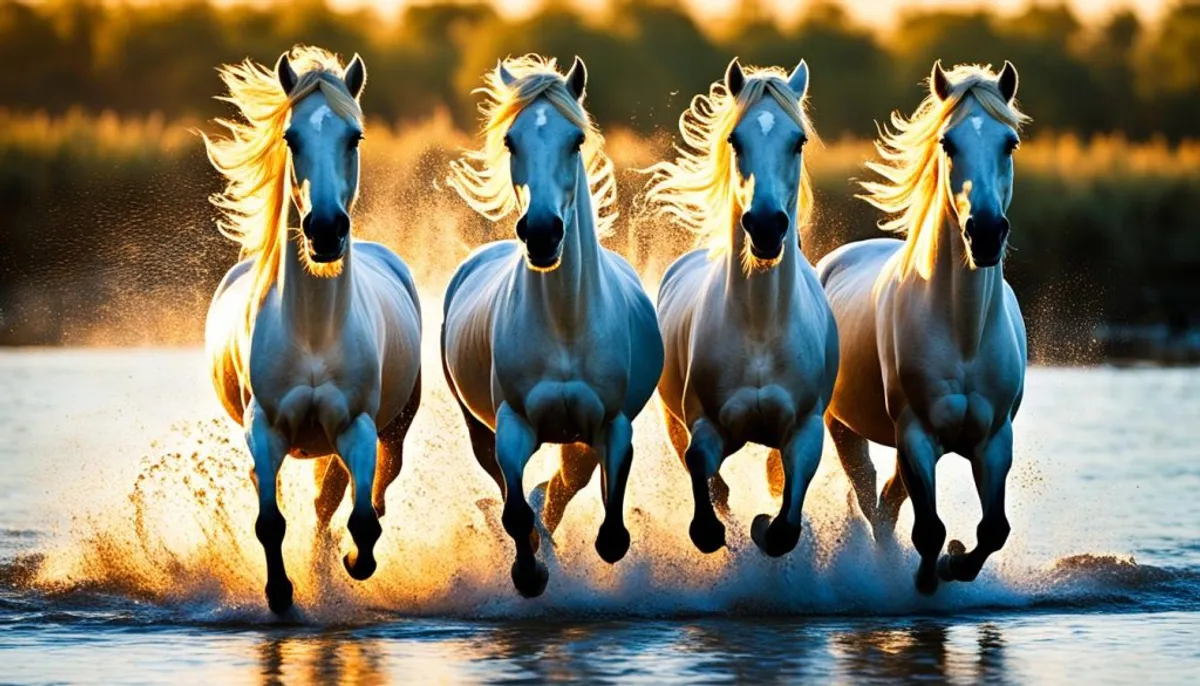
Key Points
- The Camargue horses are an iconic breed from Camargue, France.
- Their natural habitat is the Rhône delta, a place of marshes and beaches.
- Known for being small and sturdy, they are appreciated for their endurance.
- They are called sea horses for their ease in water.
- Their gray coat becomes lighter with age, which is unique.
- Once used for work, today they are stars of hikes and festivals.
Camargue Horses: Free Icons of the Rhône Delta
In the Rhône delta, a white silhouette stands out among the water and reeds. These horses represent pure freedom, far from usual enclosures. They symbolize a connection with a wild, welcoming nature, rhythmically swayed by the wind.
A rustic saddle horse born in the marshes of Camargue, France
This breed comes from the south of France and lives in the marshes of Camargue. They grow up surrounded by water, salt, and grass, in semi-freedom. This outdoor existence makes them simple, reliable, and easy to live with day by day.
Between sea, ponds, and flooded meadows: a biotope that builds endurance
The landscape here varies rapidly: dunes, salt marshes, and ponds follow one another. Walking in these flooded meadows requires effort and adaptability. Because of this, the horses develop a peaceful and robust endurance.
The Camargue National Reserve is perfect for discovering this environment respectfully. It allows for understanding the harmony between fresh and salt waters and the birds, without disturbing.
A regional symbol alongside the Camargue bull and the pink flamingo
The Camargue horses, the Camargue bulls, and the pink flamingo (Phoenicopterus roseus) form an emblematic trio. This is not just a beautiful image but also a local pride. This is evident in the way the animals are managed and respected from a distance.
| Territory Marker | What to Observe | Effect on the Horse | Indicator to Spot On Site |
|---|---|---|---|
| Rhône delta | Mosaic of lowlands, winds, and salinity | Hardiness and effort management | Regular gait, economy of movements |
| Camargue marshes | Reeds, canals, soft soils, and muddy areas | Sure-footedness, balance, and caution | Placed step, direct trajectories |
| ponds | Water bodies, unstable banks, narrow passages | Confidence, attention to terrain | Mobile ears, measured reactions |
| flooded meadows | Short grasses, shallow water, seasonal variations | Endurance, adaptability | Ability to move forward without speeding up |
Origins and History of an Ancient Breed with Mysterious Roots
When you look at the Camargue horses in the marshes, it’s like seeing history moving before us. Their past is full of mysteries, with local stories, archives, and recent scientific discoveries. To grasp where the Camargue horse comes from, one must explore mysterious trails.
References since Roman Antiquity: An Established Ancient Presence
Roman writings already spoke of horses in the Rhône delta. A letter from 339 mentions "fine and noble" animals there. This shows an ancient presence, but not necessarily the breed of today.
The science of genetics also helps us understand. Like other horses, the Camargue descends from a large family that began about 4,000 years ago, according to Nature. It’s a long story, but the Camargue is not exactly "prehistoric."
A Long-Discussed Origin: Possible Influences (Barb, Iberian) and Controversies
Experts have long debated the beginnings of the Camargue horse. Some believed that the Barb horse influenced it, possibly with some Arab additions before the 1970s. Others, like Martin Haller, spoke of the influence of the Iberian horse.
There are also stories about horses arriving near Arles, possibly mixed with others during times like the Crusades. These stories enrich our imagination. They remind us that horses were there long before the 8th century.
Some have also explored rarer ideas, such as an Asian or even Germanic origin. However, recent analyses find no evidence for such exotic origins.
A Little-Modified Morphology: Natural Selection Remains Strong in Camargue
The type of horse remains stable thanks to the environment of Camargue. Water, wind, and difficult soils select the most adapted ones. This has lasted for generations.
Scientific studies provide us with facts. A study from 1981 shows that the Camargue is close to breeds like the Haflinger and the New Forest, but very different from the Arab. Another, from 2009, brings it closer to local ponies than to other horses.
| Marker | What It Says | What It Does Not Assert |
|---|---|---|
| 339 (Roman correspondence) | Ancient presence of horses in the Rhône delta, positive description | Proof of a breed identical to today |
| DOM2 lineage (study Nature) | Common framework for modern domestic horses, diffusion from the steppes | Isolated local "prehistoric" origin |
| Hypothesis Barb horse | Possible influence through exchanges and periods of contacts in the Mediterranean | Unique and certain origin of the Camargue type |
| Clue Iberian horse (Martin Haller) | Credible path in a historical context of horse movements | Simple filtering, without mixing or local selection |
| Analyses 1981 and 2009 | Genetic profile close to some ponies and rustic breeds, clear distances from the Arab | A genealogy readable as a "pure" tree |
Official Recognition: Genealogical Register and Breed Status (France, 1978)
In the twentieth century, the goal became to define criteria while maintaining natural hardiness. In 1978, France officially recognized the Camargue horse as a breed. This helped track horse families and protect their unique type.
This recognition is an important moment, but it’s not a complete change. It’s mainly useful for understanding Camargue horses, combining history, field observation, and science.
White Camargue Horses: Morphology, Gray Coat, and Character
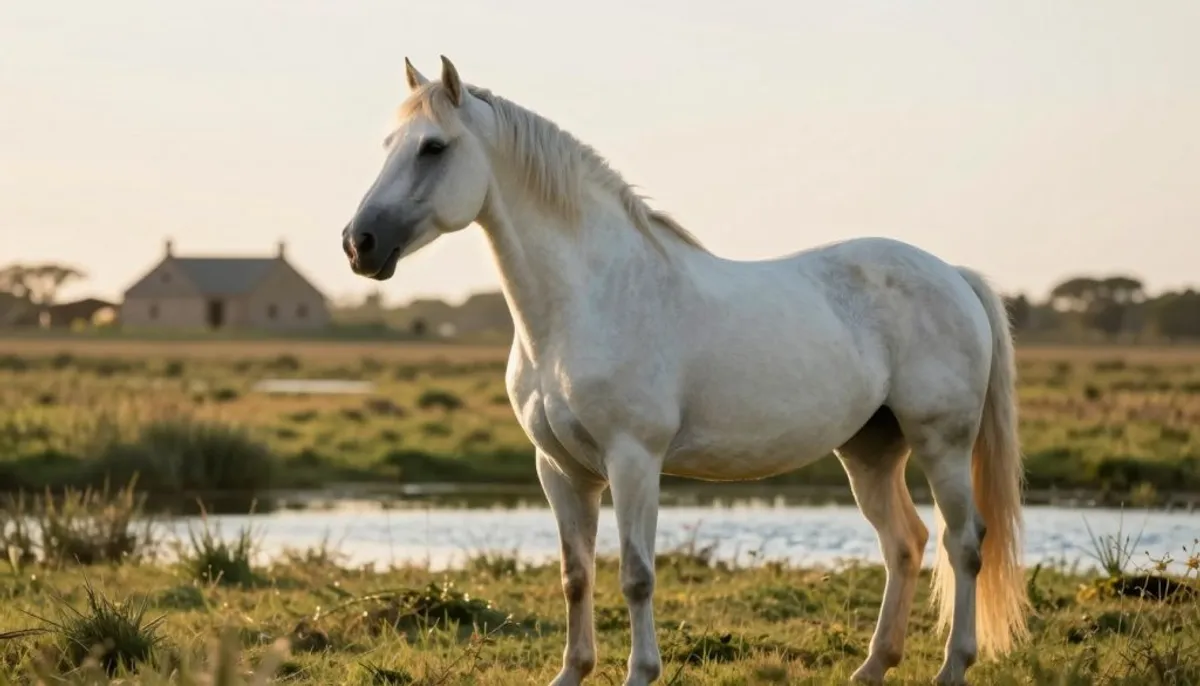
The white Camargue horses quickly stand out in the marshes of the delta. They have a compact shape, a dense mane, and move confidently. These characteristics make them suited to life near water and on soft ground. Currently, these horses are classified as not threatened by the FAO, indicating their importance in breeding.
Always Gray Coat: Why These “White Horses” Change Color with Age
The term “white” is a bit misleading because these horses are actually gray. A foal is born with a dark color that becomes lighter over time. When they reach adulthood, their coat is so light that they appear white, thus fueling the legends of Camargue.
Size and Weight: Small Sturdy Horse (about 1.34 to 1.50 m; 350 to 500 kg)
Camargue horses are rather small, which is an asset in nature. They stand between 1.34 and 1.50 m tall, weighing from 350 to 500 kg. This small sturdy horse stature allows them to move easily in mud and tall grass without losing efficiency.
| Marker | What We Observe | Interest on Wet Ground |
|---|---|---|
| Height | 1.34 to 1.50 m | Low center of gravity, better stability |
| Weight | 350 to 500 kg | Strength without excessive heaviness in soft soils |
| Type | Small sturdy horse, robust limbs | Endurance and regularity at both walk and trot |
Heavy and Square Head, Solid and Wide Feet: Assets for Wet Terrain
The morphology of the Camargue horse is adapted to its environment. It has a heavy, square head, a strong neck, and a wide chest. Its feet are wide and solid, allowing it to move better on wet terrain. With its short but strong legs, it can navigate difficult places.
Temperament: Robustness, Sobriety, Calmness, and Intelligence at Work
The temperament of the Camargue horse is known to be stable and serious. They are robust, sober, and remain calm in stressful situations. Their intelligence at work makes them valuable partners for the gardians. The latter need reliable horses that can learn quickly and stay attentive.
Breeding Camargue Horses: Manades, Semi-Freedom, and Local Know-How
In Camargue, horse breeding is experienced outdoors. Water, wind, and salt create a unique setting. The horses learn to move intelligently, conserve their energy, and get along with their peers.
Life in a Herd
The manades are at the heart of this tradition. The animals grow up semi-free. Living in a herd teaches them to follow, observe, and keep a respectful distance. This life strengthens their natural reflexes, useful for both work and wild life.
A specific language is passed down from generation to generation. Grignon means a Camargue stallion of five years or older. Rosso refers to a somewhat wild horse or mare.
Selection by the Environment
Before the 19th century, horses and cattle dominated the delta. Eugène Gayot described in 1850 and 1861 a horse adapted to its island. He emphasizes the importance of adaptation over theory.
Crossbreeding attempts were made to improve size or military capabilities. But often, the results were disappointing because less adapted animals suffered in winter. In the manades, only those with good resilience and sure-footedness survive.
Ferrade and Breeding Gestures
The ferrade is a significant moment in Camargue. This is where young foals are branded, thanks to local know-how. This practice also helps sort and track the young over time.
- Court: one-year-old foal
- Doublen: two years
- Ternen: three years
- Quatren: four years
Desbrander describes a horse that tries to unseat its rider. Among the riders, there is the gardian, the young gardianou, and the baile gardian, who leads.
Where to See Breeding Today
Camargue in France is at the heart of Camargue breeding, surrounded by vast spaces. But this breed is also exported, appreciated for its hardiness and endurance. Breeding can be found in Germany, Belgium, and Italy, often for tourism or work purposes.
| Area | Presence and Uses | What Attracts the Most |
|---|---|---|
| France (Camargue) | Manades in semi-freedom, local tradition, selection by the environment | Endurance, solid feet, hardiness, herd life |
| Germany | Breeding oriented towards leisure and hiking, pasture management | Calm horse, easy to maintain, appreciated outdoors |
| Belgium | Small structures, outdoor riding, valuing the mind | Versatility, sobriety, good group behavior |
| Italy | Breeding and riding centers, interest in rustic breeds | Resistance, adaptability, highly sought-after “white horse” look |
The ferrade, the branding of foals, and life in manades show a coherence. The horse develops in contact with nature and the group. Then it shares these rustic qualities that make it appreciated in Germany, Belgium, and Italy.
Camargue Gardians: The Horse-Human Bond in Service of the Herds
In the delta, the connection between rider and mount is evident. A simple sign or breath is enough to change direction. The Camargue gardians rely on their horses, always calm despite the surrounding chaos.
The Horse, Precision Partner: Cattle Work and Movement in Difficult Areas
Working with cattle requires staying close to the bulls, among the reeds and stagnant water. Here, precision and instinct matter more than anything. A precise half-turn, a sharp stop, and dodging at the perfect moment are crucial.
The Gardian horse navigates confidently where others would not venture. Marshes, sansouïres, and flooded fields are not a problem for it. Its stability and sobriety are valuable assets for long working days.
An Ancient Tradition: Gardians Established at Least Since the 15th Century
The Camargue gardians have existed since at least the 15th century. At that time, horse and bull breeding was already organized near Arles. The history of these practices is reminded to us by historian Jérôme Carcopino, highlighting the importance of pastures and transhumance.
In 1512, the brotherhood of gardians was officially established. It formalizes the rules and common practices. The gardians work while respecting the necessary silence for the well-being of the herd in these open natural spaces.
An Indissociable Duo of Camargue Identity: Gestures, Posture, Local Riding
Camargue riding emphasizes stability and the use of discreet signals. With low hands and a harmonious body, the horse immediately grasps the requests, whether to navigate in a tight space or to sort the cattle.
In tradition, the Camargue is dedicated to the gardians. It has served for many tasks before sometimes being released. This contributes to its unique image as a companion to man, maintaining its freedom of gait.
| Terrain Situation | What the Gardian Horse Does | Advantage in Camargue Riding |
|---|---|---|
| Sorting a group of bulls in a manade | Cuts the path, positions at an angle, keeps a safe distance | Fine aids and stable posture to guide without abruptness |
| Passing through a flooded meadow | Tests the ground, places the wide foot, maintains balance | Regular and calm rhythm, even with water up to the hocks |
| Moving along a pond with dense vegetation | Moves straight, avoids stumps, responds to directional changes | Light contact and short indications, useful in narrow areas |
| Gathering scattered animals on open ground | Lengthens the stride, stops sharply, resumes without tension | Clean transitions that keep the herd grouped |
Camargue Traditions: Abrivados, Bandidos, and Votive Festivals
The Camargue traditions animate the villages of the delta throughout the year. One can observe the Camargue horses near arenas, squares, and small streets. They are not just there for decoration. They direct the movement, dictate the rhythm, and bring a sense of security.
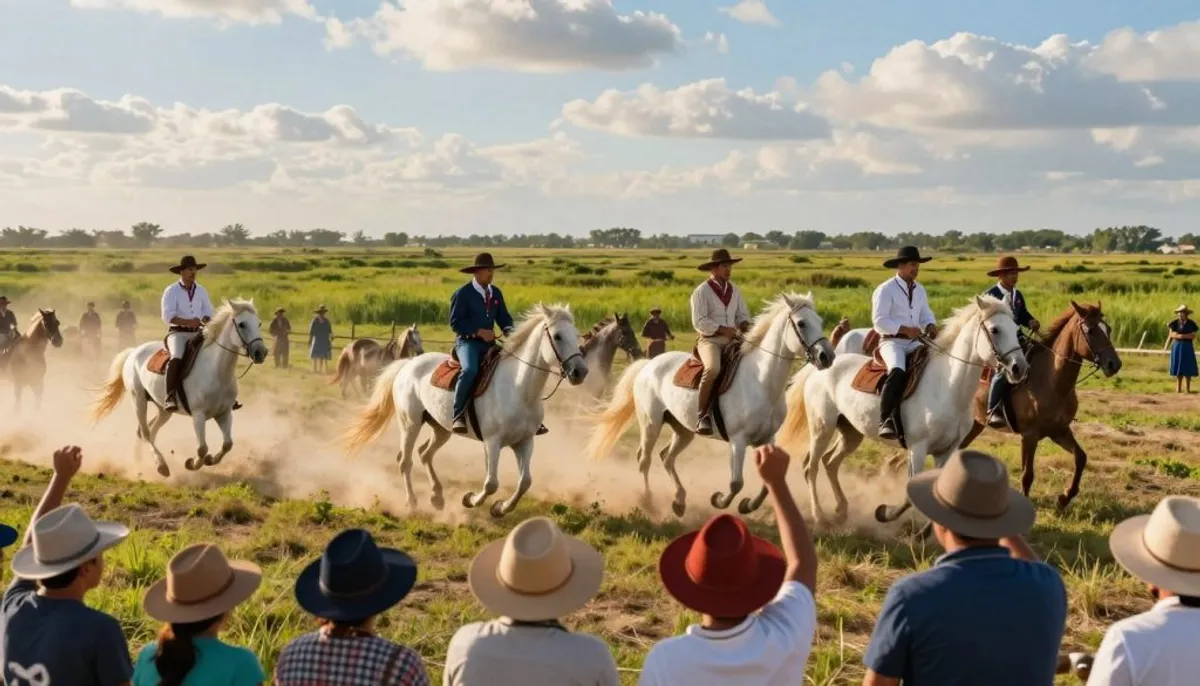
The term Abrivado evokes a surge. During an abrivado, gardians guide the bulls through the streets, surrounded by people. It is crucial that they are precise, as the crowd is very close. Success depends on just a few meters.
The spectacle comes from this tension. One admires the control of the horses, the sound of their hooves, the tight turns. Even amidst the shouts and music, the sturdy Camargue horses remain focused. This show is intense and meticulously orchestrated.
Regarding the Bandido, it’s the time for return. The aim of the bandido is to safely lead the herd back, avoiding scattering. The riders protect the flanks, slow down or speed up as needed, and maintain a tight formation.
This maneuver protects both the animals and the people. It highlights the importance of order and safety during these events. In this context, the horses are selected for their calmness and reliability.
During the votive festivals, the horses are at the heart of the celebration from start to finish. They participate in processions, popular traditions, and convivial moments between manades. These festivals showcase a living culture, where the abrivado and the bandido hold great importance.
| Moment | Objective on the Ground | Role of Camargue Horses | What the Public Remembers |
|---|---|---|---|
| Abrivado | Escorting the bulls to the designated area, without breaking the group | Holding the corridor, accelerating then containing, staying precise in the streets | Mastery up close, energy, and coordination |
| Bandido | Bringing back and framing the herd after the passage, limiting deviations | Closing the back and sides, maintaining a safe pace, calming tensions | The orderly return, safety, and control |
| Votive Festivals | Keeping the Camargue traditions alive throughout the year | Participating in movements and demonstrations, remaining reliable in dense atmospheres | A horse present "in all celebrations," close to the people |
Camargue Races and Local Culture: A Horse at the Forefront
In the villages of Camargue, the horse is more than a work tool. It becomes a living symbol. It can be seen everywhere: in the streets, in the squares, and near the arenas. Its presence enriches the local culture, with its traditions, music, and moments of sharing.
The tradition of festivals is ancient in Arles. The city recorded its first horse race in 1529, at Gimeaux. This event shows the importance of Camargue races. They connect the past to our present.
Local events include these races as key moments. They follow the same rhythm as the abrivados and bandidos. The horse plays a central role, guiding and animating the crowds. It embodies a cultural heritage recognized by all.
The 20th century saw ups and downs for these traditions. After a decline, interest revived with tourism. The Camargue races became more visible. The culture of Camargue expresses itself in hospitality, festivities, and competitions, from Arles to surrounding villages.
| Festive Moment | Role of the Horse | What the Public Remembers |
|---|---|---|
| Camargue Races | Presence in the spotlight, rhythmic entries and exits, mastery of space | Energy of the arenas, elegance of the horse, local pride |
| Abrivados | Framing the bulls, managing speed, protecting the herd in the streets | Thrills of the passage, collective precision, village atmosphere |
| Bandidos | Bringing back the herd, maintaining order, securing progress | Return to calm, know-how of the riders, continuity of Camargue traditions |
| Votive Festivals | Carrying the rituals, parading, gathering residents and visitors | Conviviality, local codes, Camargue culture experienced outdoors |
Seeing a Camargue horse in action is to discover a unique culture. The rider's posture, the sound of hooves, the eyes fixed on the arena: everything tells the local story. When Arles comes alive, the horse proves that Camargue races are a living legacy.
Equestrian Tourism in Camargue: Where to Observe and Ride These Horses in Nature
Equestrian tourism in Camargue is appealing, as one gets to be close to the horses in freedom. The landscapes are varied: from marshes to ponds, then to beaches. Always with a horizon that seems never-ending.
Preserving this magic requires choosing places where nature dominates. The Camargue National Reserve is perfect for this. It offers unique observation points to admire the bond between water, wind, and horses.
Observing horses in their habitat: marshes, beaches, and protected areas
At dawn, horses are often seen near reed beds, then on the beaches. In the marshes, they move in groups, all together, along secret paths.
In the Camargue National Reserve, we observe the horses respectfully. We keep our distance, watch, and listen. This patience allows us to see their natural behavior.
Horseback Riding: Why Camargue is Sought After for Outdoor Activities
Camargue is perfect for horseback riding, thanks to its reliability on various terrains. Its sure-footedness and calm nature reassure. It doesn’t matter if the ground is made of sand, mud, or grass.
A ride here is always memorable, even if short. The landscape changes constantly. The horse moves with a sure and adapted step to the environment.
Guided Experiences: Nature Walks, Safaris, and Ecosystem Discovery
Safari Camargue Passion offers 4x4 safaris for those who prefer not to ride. The guides explain everything about the environment, the horses' food, and where they rest.
The rides highlight the importance of horses in the local ecosystem. One better understands their role alongside other animals. This allows for observation without disturbance.
Respect and Approach Guidelines: Observe Without Disturbing the Herds
- Stay at a distance from groups, especially when there are foals.
- Avoid sudden gestures and close-up photos.
- Do not feed the horses: this alters their behavior and can put them in danger.
- On a horseback ride, follow the guide's instructions and maintain a calm pace near the manades.
La Sellerie Française is recommended for those looking for quality equipment. They offer high-level, durable gear made in France. The idea is to choose comfortable and custom-made equipment.
| Experience | What We Most Often See | Rhythm | For Whom | Good Reflex on Site |
|---|---|---|---|---|
| Observation in Wetlands | Horses in groups, passages in the marshes, tracks in the mud | Slow, silent | Families, photographers, curious onlookers | Keep space, stay on paths |
| Horseback Riding | Ponds, meadows, dunes, soil variations | Gradual, with pauses | Beginner to intermediate riders depending on the route | Adjust pace, avoid cutting the herd |
| Safari Camargue Passion | Horses in semi-freedom, birds, open landscapes | Alternating stops and movements | Non-riding travelers, groups | Observe without approaching, listen to the guide's instructions |
| Equipment Preparation with La Sellerie Française | Selection of durable pieces, careful finishes, precise adjustments | In advance of the outing | Regular riders, lovers of fine pieces | Prioritize horse comfort and durability for the outdoors |
Conclusion
Between the marshes and meadows of the Rhône delta, Camargue horses live freely. They are small rustic horses, adapted to water, wind, and salt. They have wide feet and a heavy head, showing they are made to live in these terrains.
They are often called white Camargue horses, but they are actually gray. This color evolves over time. They are known to be robust, sober, and intelligent. They are perfect companions, whether for work or outdoor leisure.
Their history is ancient, with references dating back to Roman times. Natural selection has played a significant role in their development. Their breed was officially recognized in 1978. But the essential thing is that they are the product of their natural environment in Camargue.
The traditions of Camargue place these horses at the heart of the culture. They are essential for the gardians and the cattle work. They also participate in local festivals. Notably, their presence has been documented in Arles since 1529. Today, equestrian tourism offers a chance to meet or ride them, but always with respect.
FAQ
What exactly is the Camargue horse?
The Camargue horse is known to be a small sturdy saddle horse. It comes from the Camargue region in the south of France. Its habitat is unique, consisting of marshes, ponds, and flooded meadows. This makes it very strong and enduring.
Why are they called “white Camargue horses” when they are not white?
The idea that Camargue horses are white comes from a myth. In reality, they are gray. As they age, their coat becomes lighter. Thus, from a distance, they appear white, especially in the reflection of light in their natural environment.
Where does the Camargue live and what does its environment look like?
The Camargue horse lives in the Rhône delta. Its world is wild, filled with marshes and ponds. It faces soft terrains and manages climatic variations, making it a remarkably adaptable horse.
What are the sizes and weight of a Camargue horse?
They are small horses, but very sturdy. They typically measure between 1.34 and 1.50 meters in height. Their weight ranges from 350 to 500 kilograms. Perfect for outdoor work and with cattle.
What physical traits explain its ease in wet terrains?
Their body is well adapted to wet areas. They have a heavy head and plenty of strength, with wide feet. These characteristics help them remain stable and move easily on wet grounds.
What is the character of the Camargue horse?
They are known to be robust and calm. These horses show great intelligence. An ideal combination for gardians, who need trustworthy and attentive animals around the cattle.
Why is the Camargue considered an ancient breed?
Roman texts from 339 already mention horses in this region. They speak of "fine and noble" horses. This adds to the idea that the Camargue horse has ancient and mysterious origins.
What does modern genetics say about its origins?
Modern science shows that the Camargue descends from an ancient lineage, the DOM2. Found about 2,200 to 2,000 years BC in the Eurasian steppes. This discovery was made thanks to recent genetic studies.
Have there been Barb, Arab, or Iberian influences in the breed?
Before the 1970s, some believed that Camargue horses had been influenced by Barb or Arab breeds. Stories mention horses introduced near Arles. However, no definitive certainty exists about these influences.
What studies talk about its closeness to other breeds?
Studies reveal links with Haflinger and New Forest, but less with Arabs. Another study from 2009 shows similarities with French ponies, more than with “blood horses.”
Is the Camargue breed officially recognized?
Yes. Since 1978, the Camargue horse has been officially recognized as a saddle horse in France. A special genealogical register exists for this breed.
Is the Camargue horse threatened today?
Currently, it is not considered threatened. The breed is well managed and is in a stable situation.
How does Camargue horse breeding work in manade?
Breeding follows the system of semi-freedom in manades. This ensures that the horses live in conditions that enhance their hardiness. Their adaptation to outdoor life is exceptional.
In Camargue, is the selection of breeders done "on paper"?
No, natural selection has always been the preferred approach. Over generations, the individuals best adapted to environmental challenges naturally prevail. This has contributed to the stability of the breed.
What do "ferrade" and "manade" mean in Camargue traditions?
A: Manade refers to a herd. Ferrade is the branding of young horses, a traditional ritual. These terms, along with others like grignon, are essential for understanding the local equine culture.
What are other local words related to ages and gardians?
The terms for ages vary: from court for one year to quatren for four years. For riders, the terms gardian and baile gardian for the chief are used. These words clearly define the social structure in this culture.
Where can Camargue horse breeding be found today?
Although primarily in France, Camargue horse breeding has also spread to Germany, Belgium, and Italy. This reflects the European renown of this breed.
Why is the Camargue the mount of the Camargue gardians?
Its ability to move across different terrains makes it perfect for managing cattle. It excels in outdoor work due to its agility, instinct, and precision.
Since when have gardians existed in Camargue?
The gardians have been present since the 15th century. The creation of their brotherhood in 1512 shows the longevity of this tradition centered around the horse and cattle.
What is Camargue riding?
It is a way of riding developed from daily work in the marshes. It values mastery and connection with the animals, with the Camargue horse at the heart of this practice.
What is the purpose of abrivados in Camargue traditions?
The abrivados are occasions where gardians showcase their skill in guiding bulls. These moments of spectacle highlight the mastery of the gardians and the agility of the horses.
What is a bandido in Camargue?
The bandido involves securing the return of the herd. It emphasizes discipline and protection when passing through villages.
What is the role of the horse during votive festivals?
The Camargue horse plays a key role in these festivities. It participates in various activities, thus becoming an essential element of the local cultural heritage.
Do Camargue races also include horse races?
Yes, these races are an integral part of local traditions. The first mention of a race dates back to 1529 in Arles. They are part of a set of traditional events enriching cultural life.
Why did the Camargue horse gain popularity in the 20th century?
The renewed interest in this horse was stimulated by tourism. The natural beauty of Camargue, combined with its traditional lifestyle, revived the attraction for these animals.
Where can one observe Camargue horses in freedom or semi-freedom?
They are often spotted in natural areas like marshes or near ponds. The Camargue National Reserve offers a beautiful setting to observe them peacefully.
Why is the Camargue so sought after in equestrian tourism?
For its unique qualities: resilience, adaptability, and trust. In equestrian tourism, these horses guarantee an unforgettable experience in a natural environment.
Are there guided outings to discover the horses without riding?
Yes, expeditions like those offered by Safari Camargue Passion provide unparalleled observation opportunities. Visitors can learn about the horses' natural habitat and their way of life through the guides.
How to approach the manades without disturbing the animals?
The approach should be respectful and discreet. It is crucial to maintain a safe distance, avoid sudden movements, and follow instructions to ensure the peace of the herds. This respect is fundamental for the harmony of their habitat.
What equipment should be prioritized for a horseback ride in Camargue?
Opt for quality equipment, suitable for long rides and comfort. La Sellerie Française offers top-notch items made in France. They provide durable and sometimes custom-made gear for riders and their mounts.
What cultural place does the Camargue occupy in the French imagination?
It symbolizes freedom and traditions. Its representations in literature and the arts, like the famous Crin-Blanc, have captivated many. These images reinforce its status as a cultural icon.
Is the Camargue horse linked to other symbols of the territory?
Absolutely. Along with the Camargue bull and the pink flamingo, they represent a Camargue of contrasts. They embody the beauty of a wild and diverse region, between land and water.