
A horse jumps and the audience holds its breath. Each equestrian show relies on key moments: the run-up, the jump, and the landing. It is an experience full of emotion, combining skill and beauty.
In France, the shows vary greatly. One can attend demonstrations, theatrical performances, or customized presentations. These can animate a party or fill an arena. Depending on the time of day, the experience also changes: during the day, the details stand out; at night, the lighting makes each jump magical.
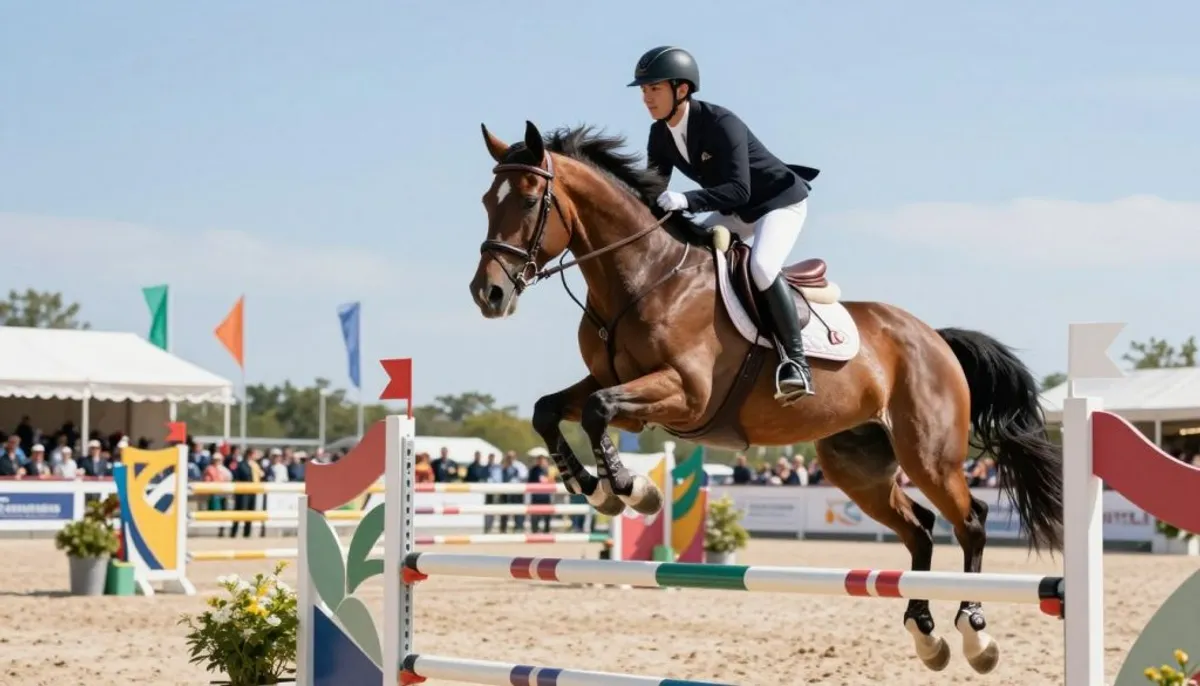
Preparation is crucial, just like talent. Some venues offer a covered arena, sometimes even heated. This way, the show can continue despite the rain. “Avalon in show” is a good example. It shows that the passion for horseback riding also includes the comfort of the spectators.
The shows are rich in varied disciplines. From jumping to acrobatic vaulting, each act offers a new way to see movement. But it is the horse's jump that captivates all eyes and sets the rhythm of the show.
Key Takeaways
- The jumping horse creates the most intense moment of an equestrian show.
- In France, the offerings range from riding demonstrations to scripted shows.
- Formats can be performed during the day or at night, with very different effects.
- A covered, sometimes heated arena allows the show to continue even in the rain.
- Jumping, dressage, acrobatic vaulting, Hungarian post, and parades enrich the experience.
- The passion for horses often arises from a detail: a perfect call, a clean landing, a shared silence.
Overview of Equestrian Shows in France: Between Tradition and Sensation
In France, equestrian shows combine tradition and modernity. They draw inspiration from ancient riding schools while adding lights and music. This makes the show lively and accessible to all.
A simple moment, like a horse listening and then responding, can awaken a passion. The movements are clear and impressive, like the Spanish walk or the bow. Simple actions, like two jumps, are enough to captivate and make the audience applaud.
Why Horse Performances Fascinate Young and Old
The equestrian feats touch everyone with their strength and grace. Children love the action and movement. Adults appreciate the precision and calm of a silent “dialogue” between rider and horse.
The arena reveals fascinating contrasts, such as sudden changes in pace. These visual details provoke immediate emotions in the spectators.
Differences Between Demonstration, Scripted Show, and Equestrian Competition
Equestrian events vary according to their purpose. Whether it’s a technical display, storytelling, or competition, each format has its specificity.
| Format | Main Purpose | What the Audience Remembers | Concrete Markers |
|---|---|---|---|
| Demonstration | Show a range of disciplines and styles | The diversity and technical mastery of the rider | Liberty, jumping, dressage, vaulting, linked as in Avalon in show |
| Scripted Show | Create immersion with narrative, scenes, and acts | The suspense, the tableaux, the atmosphere | Tournament, stunts, staging, like Géovie, the legend of the magic sword |
| Equestrian Competition | Measure a performance according to rules and ranking | The challenge, consistency, the tension of the result | Course, bars, stopwatch; codes often reused in shows |
The Importance of the Rider-Horse Relationship in the Emotion of the Show
The trust between the rider and their horse is visible from the start. A calm rider changes the entire atmosphere. The horse reacts with its attention.
This complicity makes the show fluid and moving. It shows that horseback riding is more than a sport. It is a true exchange.
Jumping Horse: The Key Moment that Moves the Audience
In a show, the moment when the horse jumps is very special. It is part of a staging, like a dance or a story. And when the horse takes off, everyone holds their breath.
This intense moment relies on simple details. A silence, a gallop that intensifies, then the jump. The rider guides all this gently, and one cannot help but follow with their gaze.
What the Audience Really Sees During a Jump in a Show
At first, the spectators notice the speed. The acts follow quickly. They also see how engaged the rider and their horse are. This is shown by the sound of hooves, the jump, and then a precise landing. Even without knowing the details, one feels the fluidity.
In an ancient tournament, the excitement rises. The skill games alternate with jumps. These moments become unique, like the highlight of the show. The rider creates a bond between themselves, their horse, and the audience.
Obstacles, Trajectory, and Rhythm: The Basics of Readable and Spectacular Action
A good show makes the obstacles easy to understand. The spectators must quickly grasp the course. Even with music and lights, the path to follow must remain clear.
Some obstacles immediately attract attention, like a ring of fire. They create a sensation without being distracting. But rhythm is essential. If the approach is chaotic, the effect is lost.
- Trajectory: a straight line, a clean turn, a stable take-off point.
- Rhythm: a steady gallop, neither rushed nor “dull”.
- Reading: an obstacle placed to be seen, not just jumped.
Horse Performances: Power, Balance, and Mindset
The abilities of a horse are not limited to the height of the jump. One observes its strength, but also how it carries itself and lands. A good jump requires precision and adaptability.
The horse's mindset is also crucial, especially when facing challenges like fire. Many teams emphasize the horse's well-being. This relies on trust and well-conducted training. The rider plays a key role with their posture and communication.
| What the Audience Notices | What It Reveals | What the Rider Adjusts |
|---|---|---|
| A gallop that “carries” to the obstacles | Stable impulse and well-managed breath | Cadence, direction, distance first |
| A round pivot over the jump | Balance and supple back, clean movement | Fixed hands, present legs, gaze far |
| A straight and distributed landing | Control, strength, and serenity | Rebalancing, restarting, managing the path |
| Calm in front of a ring of fire or a wall of flames | Prepared mindset, confidence in the environment | Routine, gradualness, discreet aids |
Essential Disciplines That Enrich an Equestrian Show
In a good show, each discipline has a unique color. We go from precision to poetry, then to excitement. This helps the audience understand horseback riding. The movement must be clear and the rhythm constant for that.
Jumping and Show Jumping: Precision and Commitment
Jumping requires following a line and a rhythm. The rider must maintain a gentle contact and adjust their steps. During a show jump, the trajectory must be clear, even with music and effects.
The technique is seen in the details: a good run-up, a rising back, and a stable landing. This makes the horse's movements fluid, and the show seems effortless.
Show Dressage: Poetry, Haute École, and Complicity
Dressage is the foundation as it organizes energy. It shows gentle changes, regular curves, and precise stops. Haute école brings an artistic aspect while being rigorous.
The rider focuses on lightness and trust. This precision gives the show a moment to breathe.
Acrobatic Vaulting: Dynamic Figures and Mastery
Acrobatic vaulting speeds up the rhythm. The figures follow quickly, around a circle, with perfect timing. Cossack vaulting is mentioned when the movements are bold.
The horse's stability is essential here. The jumping technique is sometimes visible. The vaulter must be precise.
Hungarian Post: Absolute Trust and Strong Sensation
The Hungarian post seems simple: a vaulter standing on several horses. The audience is captivated by the balance and straight line despite the speed.
It requires total trust. The harmony of the horses dazzles the audience effortlessly.
| Discipline | What the Audience Remembers | Technical Point That Changes Everything | Role of the Rider |
|---|---|---|---|
| Jumping | Precision of trajectories and dramatic tension | Regular approaches and balanced landing in show jumping | Setting the pace, adjusting strides, maintaining confidence |
| Show Dressage | Poetry of figures and impression of control | Clean transitions and lightness, solid base in equestrianism | Giving discreet aids, reinforcing complicity |
| Acrobatic Vaulting | Fast rhythm and spectacular figures | Stability of pace and coordination, safety above all | Anticipating, repositioning, staying precise despite speed |
| Hungarian Post | Strong sensation and balance above movement | Alignment of horses and consistency of pace | Guiding without rushing, protecting the harmony of the group |
Themed Shows: The Medieval Era, a Very Popular Format
Medieval shows captivate with their dynamism, impressive scenes, and direct contact with the audience. The tournament is often the heart of the action, punctuated by rhythmic entrances, captivating challenges, and greetings to the sound of drums. These shows, which combine history, sport, and emotion, attract a wide audience in France.
The rider's journey resembles a story, moving from challenge to challenge. The obstacles serve as key visual markers. This simplicity supports enthusiasm for horseback riding without requiring knowledge of sporting rules.
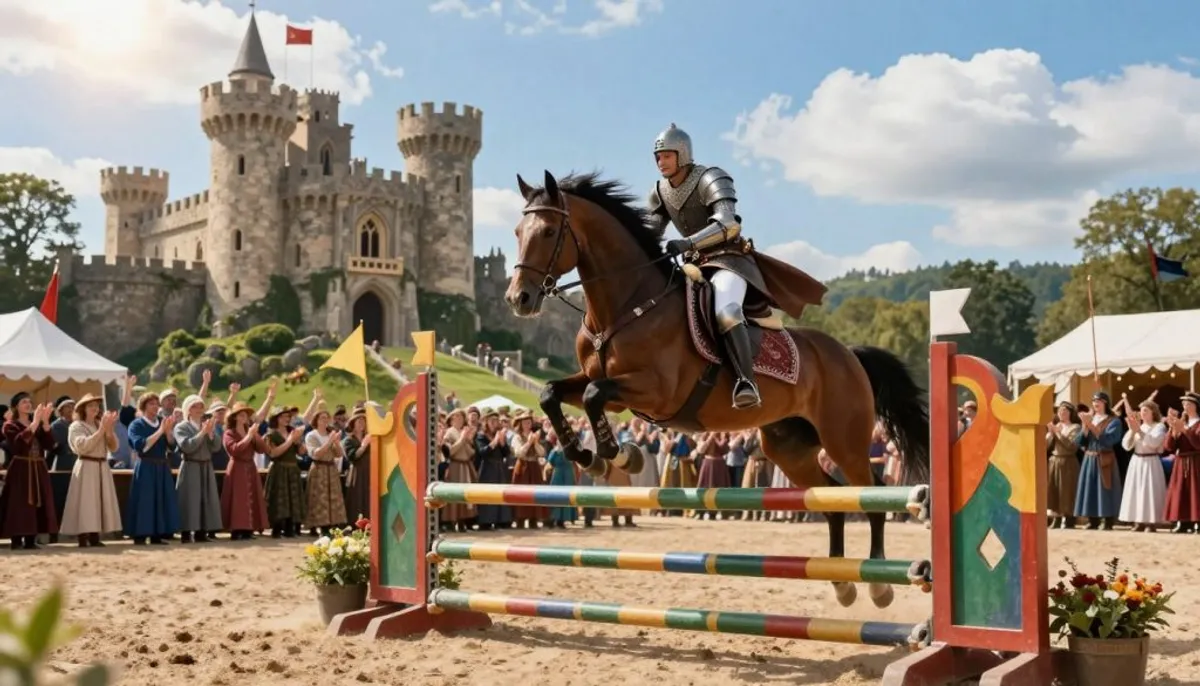
Knights' Tournament: Jousting and Skill Challenges
Tournaments form a fascinating central structure. They can bring together up to 10 riders at the same time, offering duo, line, or pursuit demonstrations. Spectators quickly identify the competitors in advance, as each movement is clear.
The skill challenges add depth to the competition. They include axe and lance throwing, shooting accurately, staying stable in the saddle, and departing with confidence. In these challenges, speed mixes with precision and balance.
Highlight Animations: Ring Jousting, Flaming Quintaine, Charge of the Knights
The highlights of the show follow one another, maintaining the tension. The ring jousting focuses on the accuracy of the gesture. The flaming quintaine surprises, adding a play of light and heat.
The joust between knights and the charge of the knights bring a grand spectacle. The scene is designed for clear movements and safe courses, offering a magnificent show accessible throughout France.
Controlled Stunts: Controlled Horse Falls and Choreographed Fights
The stunts are carefully choreographed, like a dance. The controlled horse fall is practiced at different paces before being executed at a gallop. It seems real while being safe.
The choreographed fights vary between sword duels, hand-to-hand confrontations, and collective scenes. Some acts include fire breathers or battles with flaming whips. The important thing remains the passion for horseback riding while ensuring the safety of the riders.
Costumes and Caparison: Immersion Inspired by the 15th Century
The costumes catch the eye with their colors and materials. The horses wear quality caparisons, matching the knights' colors for better visibility. The clothing draws inspiration from the Order of the Golden Fleece, reflecting the style of the 15th century with attention to detail.
This visual harmony enriches the show. It allows the audience to immediately understand each person's role. The obstacles blend into the decor, preserving the rhythm without breaking the illusion, firmly anchoring the experience in the French context.
| Highlight | What the Audience Remembers | Obstacles and Visible Markers | Role of the Rider | Atmospheric Effect (France) |
|---|---|---|---|---|
| Axe and Lance Throwing | Precision at a gallop, clear gesture | Targets, passage zones, trajectories | Stability, fixed hand, restart | Short suspense, immediate applause |
| Ring Jousting | Fine skill, mastery of timing | Suspended ring, line first | Alignment, gaze, control of pace | Silence, then collective reaction |
| Saracen Joust (Flaming Quintaine) | Visual impact, rising intensity | Quintaine, rotation zone, distance | Engagement, safe trajectory, clean exit | Heat and light, possible night effect |
| Charge of the Knights | Group power, readable speed | Lists, corridors, crossing points | Pacing, distance, respecting intervals | Crowd energy, impression of battle |
| Controlled Horse Falls and Choreographed Fights | Realism without confusion | Fall zones, ground marks, placements | Coordination, signals, horse protection | Thrills, then quick resumption of the narrative |
Western Atmosphere: Rodeo, Lasso, and “Old Time” Shows
The Far West atmosphere is a mix of horseback riding, storytelling, and animations close to the audience. One discovers varied scenes like parades and banquets, followed by captivating rodeos. The rider must remain calm and precise, even in the excitement of the show.
At the center of the program, lasso demonstrations, skill shooting, and free dressage set the rhythm of the event. Between Cossack vaulting and Hungarian post, the physical aspect is highlighted while remaining clear for the spectators. The horses' prowess, such as balance and reactivity, is essential.
The “old time” western show draws inspiration from the great classics of the genre. Its strong story, Horses on Indian Lands, tells the conquest of America and the introduction of horses by the Spaniards. These horses, having become wild, form large herds on Indian lands. They become assets for native peoples, creating equestrian shows full of complicity.
The costumes, drawn from the late 19th century, immerse the audience in the era. In the evening, light shows and pyrotechnic effects alter perceptions, offering a unique experience. This staging attracts both the curious and horse riding enthusiasts.
| Western Act | What the Audience Remembers | Key Point on Stage |
|---|---|---|
| Lasso Demonstration | Clear gestures, precision, playful tension | Hand-eye coordination, safety of trajectories |
| Skill Shooting | Suspense, rhythm, “duel” effect | Synchronization with music and stage entrances |
| Free Dressage | Silent dialogue, proximity, emotion | Clear codes, listening, respect for the comfort zone |
| Cossack Vaulting | Fast figures, thrill, mastery | Stability, controlled speed, readable ground |
| Hungarian Post | Power, trust, strong sensation | Regularity, alignment, attention to starts and stops |
Custom Acts: Personalizing Your Equestrian Event
A “custom” show allows you to choose. You take what best suits your space, audience, and rhythm. By selecting various short scenes, you create a story that reflects you. Equestrianism remains essential while adapting to the desired atmosphere.
Parades, Banquets, and Tailored Shows: Possible Formats
The parades / street processions perfectly launch the event. They captivate with their friendliness. The rider, interacting with the audience, creates a warm atmosphere. Then, one moves to a more refined show, where technical prowess is highlighted with obstacles and attractive staging.
During indoor banquets, the entertainment alternates between softness and equestrian feats. This format ensures the well-being of the horses while pleasantly surprising the spectators. With precise training, safety is ensured, even if the audience is very close.
Integration into a Shoot, Sound and Light Show, or Corporate Event
This type of performance is also suitable for film shoots and advertisements. A perfect image requiring control and rehearsals is sought. Sound and light shows use musical transitions and visual effects to charm. For corporate events, simplicity and measured interaction with a clear narrative thread are preferred.
Acts like vaulting or an action stunt add dynamism. Each performance is designed to captivate while remaining fluid and seamless.
Composing a Balanced Program Between Equestrianism, Stunts, and Storytelling
A good program varies between technique, thrill, and breathing. The technical part highlights equestrian skill. The obstacles, arranged with care, captivate the audience.
For excitement, demonstrations of vaulting or humorous interludes are chosen. They are followed by moments of storytelling that weave the show into a coherent narrative. Success depends on training and the chemistry between the rider and their horse.
| Module | What the Audience Remembers | Constraints to Anticipate | When to Use |
|---|---|---|---|
| Street Processions | Proximity, first exchanges, festive atmosphere | Marked course, regular ground, sound management | Welcome, opening, transition between two locations |
| Banquet Entertainment | Intimate moments, humor, controlled slow passages | Space for maneuvering, safety distances, short rhythm | Between courses, private evening, corporate event |
| Show Dressage | Complicity, precision, readable gestures | Rehearsals, music timing, stable lighting | Narrative scenes, sound and light, elegant finale |
| Cossack Vaulting / Circle Vaulting | Sensation, energy, surprise | Suitable surface, safety protocol, reinforced training | Build-up of intensity, large audience, “cabaret” format |
| Hungarian Post | Thrill, mastery, great visual impact | Prepared horses, straight lines, strict supervision | Climax of the show, large arena, spectacular finale |
| Cinema Stunt | Realistic action, tension, memorable | Technical briefing, rehearsals, angle control | Film shoots, advertisements, scripted scenes |
Obstacles, Safety, and Calculated Risk in Shows
On a show track, obstacles are there for more than just impressing. They direct the gaze and create a clear framework. This framework helps riders stay precise, even when excitement is high.
Preparing a show jump is like in competition, but more complex. There is music, smoke, less space, and the audience is very close. The rider must approach the obstacle well, maintain a safe trajectory, and take care of their horse.
Medieval stunts add risk. There are sword fights and controlled horse falls. Everything is well-prepared: rehearsals, simple signals, and a safety zone are essential.
Fire effects are managed rigorously. Whether it’s a fire breather or a wall of flames, every detail is controlled. Trust between the rider and the horse is key. This ensures an impressive show without risk to the animal.
To buy tickets or register online, cookies are important. They allow for providing services and features. If refused, the site may not function well. You can also control them via the browser, and the site will remember the choice with 2 cookies.
| Show Element | Main Risk | Safety Measure | Impact on the Rider | Impact on the Horse's Performance |
|---|---|---|---|---|
| Mobile and Decorative Obstacles | Instability, noise on contact | Fixings, empty tests, passing distance | More precise approach, control of rhythm | Better relaxation if the decor is desensitized |
| Show Jumping with Music | Distraction, tempo variation | Rehearsals with soundtrack, ground markers | Refined timing, more discreet aids | More regular cadence, clearer jumps |
| Sword Fighting on Horseback | Wide gestures, proximity | Secured weapons, choreography, fixed distances | Stable posture, independent hands | Increased calm if the routine is stable |
| Controlled Horse Fall | Wrong angle, slip | Suitable ground, protections, progressive rehearsals | Exit technique, coordination with the team | Less stress if the exercise is rare and well supervised |
| Fire Effects (Circle, Wall of Flames) | Heat, visual surprise | Distances, fire barriers, ready extinguishing, short exposure time | Trajectory maintained, speed controlled | Trust consolidated by gradual desensitization |
Training and Preparation: Jumping Technique at the Service of the Show
In a show, entering the stage requires more than energy. One must be ready to endure, no matter how many acts. The performers must make jumps and acrobatics without losing their precision under the audience's gaze.
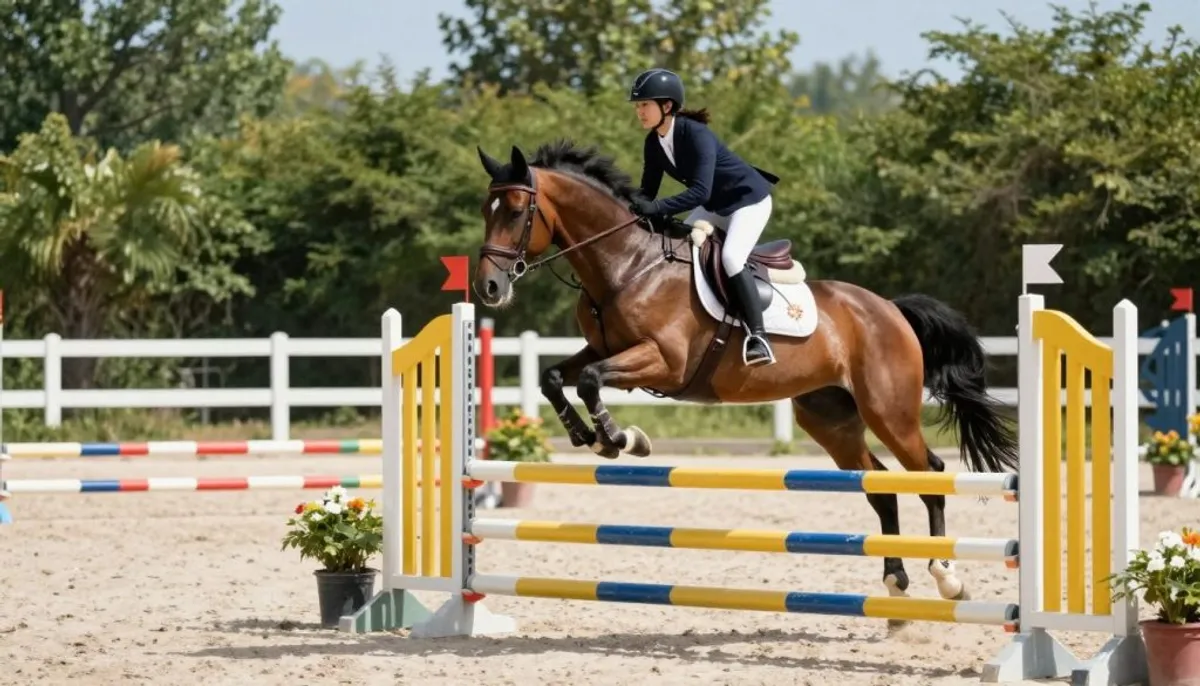
Stunts in cinema require similar preparation. One must stay calm, know their markers, and rehearse over and over. This allows for a perfectly executed jumping horse, even when their performance is part of the story.
Physical Condition and Regularity: Foundations of Horse Performance
Good physical condition requires regular training. One must mix cardio, flexibility exercises, and rest periods. The goal? To always be ready, even when the action speeds up.
In a show, rehearsing helps build confidence. It makes the jump feel natural and easy, even with complex figures. Thus, an agile horse remains reactive and relaxed.
Jumping Technique: Impulse, Take-off, Pivot, and Landing
The jumping technique is crucial. It starts with a good impulse, finds the right take-off point, follows a precise trajectory, and ends with a landing that prepares for the next movement. With mastery of these steps, jumping becomes child's play and impresses the audience.
When there are obstacles like a ring of fire, being precise is even more important. This precision allows for a beautiful show without errors. The audience then admires a fluid and perfect performance.
| Step | What We Look For | What the Audience Notices |
|---|---|---|
| Impulse | Constant rhythm, back tightening, controlled energy | A jumping horse “moving forward”, without rushing |
| Take-off | Last balanced stride, clear take-off point | A centered jump, without “taking off from far” |
| Pivot | Free shoulder, neck stretching, round trajectory | An elegant curve, pleasant to watch |
| Landing | Soft landing, stable resumption of gallop | A smooth transition to the next act |
Role of the Rider: Position, Timing, Management of Approaches
The rider is essential for the rhythm of the show. They must position themselves well, choose the best moment to act, and ensure nothing hinders the course. In a show, all this is vital for a flawless jump despite distractions.
They must also manage pressure carefully. Knowing how to correct without imposing, and to praise quickly. Thanks to this, the horse maintains confidence, even in an impressive setting.
Venues, Formats, and Conditions: From Covered Arenas to Night Shows
Equestrian shows depend greatly on the venue where they take place. In France, choosing a venue influences the tempo, safety, and how the audience perceives horseback riding. The weather, type of ground, and available space push us to adapt the obstacles and the distance to approach them.
This context plays a significant role in our passion for horseback riding. It values both precision and emotion. When everything is perfectly organized, the performances of the horses seem fluid and effortless.
A heated and covered arena is ideal to avoid issues related to rain. The spectators are more comfortable, the sound travels better, and the transitions between acts are smoother.
For our team, this means fewer logistical worries: stable lighting, well-protected ground, and dry equipment. The obstacles are easier for the audience to understand, with a constant height and a regular course. This helps us maintain excellent quality in our movements.
Regarding day or night shows, during the day, clarity and ease of following the actions are prioritized. At night, the atmosphere becomes more dramatic, with moments of silence, twists, and stronger stories.
During night shows, every action of the horse captures more attention. The light directs the audience's gaze. Equestrianism takes on an almost cinematic dimension without hiding the technical complexity.
The pyrotechnic effects are chosen based on the venue, wind, and available permissions. We can add a ring of fire, a wall of flames, a fire breather, flaming bolas, or a duel with flaming whips.
But these special effects are optional, as we are committed to respecting the horses' well-being. The idea is to enhance the visual appeal without negatively affecting the horses' performances or complicating the management of obstacles.
| Format | Advantages for the Audience | Constraints to Anticipate | Impact on Equestrianism and Obstacles |
|---|---|---|---|
| Heated and Covered Arena | Comfort, stable visibility, more intimate atmosphere | Truck access, height under the structure, ventilation | Regular trajectories, homogeneous obstacles, better continuity of rhythm |
| Outdoor Arena by Day | Large visual field, “open air” dynamics, natural sounds | Weather, evolving ground, management of sun and shadows | Adaptation of approaches, choice of very readable obstacles, control of tempo |
| Night Show with Stage Lighting | “Wow” effect, enhanced storytelling, amplified perceptions | Lighting setup, safety in dark areas, precise timing | Visual markers to care for, obstacles highlighted, intensity without rush |
| Night Show with Pyrotechnic Effects | Visual intensity, memorable highlights | Wind, safety distances, noise, coordination with the production team | Choice of apparatus (ring of fire, wall of flames), work on calmness and precision |
Equestrian Passion: What the Audience Remembers from a Live Experience
The equestrian passion is evident in every gesture. Spectators leave with guaranteed smiles and thrills. They experience moments of poetry and strong sensations. Sometimes, horseback riding is calm, almost silent, with a bow or a danced step. Then, the excitement rises, and everything becomes faster.
The rider is at the heart of the action. They do not seek to stand out. They guide, reassure, and take risks. The audience perceives this immediately. When trust is present, the horse's actions seem easy. It is the simplicity that marks us the most.
The highlights remain etched in our memories. Like a Hungarian pose or a standing vaulter. A rare moment when a horse jumps just after a dance is memorable. We do not forget these precise moments.
The stories add to the immersion. The shows can mix historical facts and fantastic elements. Like the adventures with quarrels and battles in Géovie. The audience easily understands the story. Even in action, the narrative remains clear.
| Experience Moment | What the Audience Perceives | What Stays in Memory |
|---|---|---|
| Dressage and Bow | Precise, calm, readable equestrianism | Close, almost intimate elegance |
| Vaulting and Standing Figures | The courage of the rider and balance | “Impossible” silhouettes to recreate at home |
| Horse Jumping Over an Obstacle | Timing, trajectory, breath taken away | The sound of landing and the continuing momentum |
| Scripted Finale with Action | A rhythm, conflicts, a resolution | A series of images, like a live film |
| Moments of Calm After Effort | The horse performances seen “up close” | The relationship, simple and true, between Man and animal |
No matter the theme, what matters is the relationship between man and horse. This is what Action Équestre aims to show. It is this passion that makes one want to return or to start riding oneself. Guided by a passionate rider, we discover this beautiful adventure.
Rider Equipment and French Know-How: The Demands of La Sellerie Française
Equestrian shows are fast-paced. The rider must be precise, the audience attentive, and the horse calm. Good riding equipment makes all this possible. It ensures comfort and stability, especially for more difficult jumps and near the lights.
High-End, Unique, Custom, or Limited Series Products
La Sellerie Française offers top-quality equipment. You will discover unique pieces, custom-made, and limited editions. These items are crafted by excellent French artisans. This quality is directly felt in hand, and obviously on horseback, where every movement counts.
Manufacturing from A to Z in France: An Approach Beyond Labels
La Sellerie Française is committed to a fully made in France production. This approach goes beyond the simple Made in France label. For show jumpers, knowing that every detail is mastered brings considerable peace of mind.
Why Equipment Quality Matters in Equestrianism and Show Jumping
A well-fitted saddle keeps the rider stable. Reliable equipment improves communication with the horse. Good comfort reduces tension and supports performance, essential during competitions.
Safety and technique go hand in hand. Poor equipment can undermine the rider's confidence. With the right gear, jumps are clearer and performances better, even under pressure.
Discover La Sellerie Française: https://laselleriefrancaise.com
For more information, visit https://laselleriefrancaise.com. It’s ideal for comparing and choosing equipment suited to your needs in equestrianism.
Conclusion
A horse that jumps in a show is a blend of rigor and pleasure. We witness the run-up, the curve in the air, and finally the precise landing. But what truly touches is the combination of music, lights, and audience reactions. This is what gives all its value to the equestrian show.
In France, these shows vary but retain a common essence. The medieval era presents us with tournaments, jousts, and stunts, all in 15th-century costumes. Meanwhile, the western theme invites rodeos and lasso handling, reminiscent of scenes from “Horses on Indian Lands.” But the jumping horse is always at the heart of the action.
The magic also arises from the diversity of disciplines. Jumping, dressage, vaulting, all contribute to creating harmony. Whether the event is indoors, at night, or enhanced with fireworks, three things remain crucial: safety, trust, and quality equipment for jumping.
The equestrian passion blooms from a perfect moment, captured by fascinated spectators. A jumping horse, a serene rider, a correctly set obstacle, all combine to tell a story. In France, it is this shared emotion that makes a moment unforgettable.
FAQ
What makes a jumping horse so captivating in an equestrian show?
Watching a jumping horse is thrilling. You feel the excitement and admiration for their jumping technique. The audience experiences the moment intensely, from the run-up to the landing. This makes the scene beautiful, both artistically and athletically.
What forms can an equestrian show take, during the day or at night?
Equestrian shows vary widely. They can be equestrian art demos, scripted shows, or a series of individual acts. Whether during the day or at night, the atmosphere changes with the light and music. At night, the visual effects are even more impressive, especially with pyrotechnics.
What is the difference between a demonstration, a scripted show, and an equestrian competition?
A demonstration showcases different disciplines to impress the audience, as in “Avalon in show.” A scripted show, on the other hand, tells a story using equestrianism. “Géovie” is a good example. Equestrian competitions are based on performances according to strict rules.
What disciplines can be seen in an equestrian show?
In shows, one can see events such as jumping, dressage, and acrobatic vaulting. There are also spectacular acts like the Hungarian post. These various disciplines captivate the audience, and the show is accessible to everyone, even without knowledge of equestrianism.
Why do these shows appeal so much to families and multiple generations?
Equestrian shows fascinate with easily understandable and memorable acts. One can see a horse executing spectacular movements. These visible and astonishing performances capture everyone's attention.
What does the audience really perceive during a jump in a show?
The audience is captivated by the speed and trajectory of the jump. They follow the fast-paced rhythm of the acts, creating an energetic atmosphere. They admire the mastery of the rider and the horse's confidence, even without knowing the equestrian jargon.
How to explain the jumping technique in four simple steps?
The jumping technique includes four steps: impulse, take-off, pivot, and landing. These steps must unfold smoothly for a successful show. It is crucial that the movement remains natural to captivate the audience.
What spectacular obstacles can be seen, and how are they secured?
Some acts include the ring of fire or the wall of flames. These effects require meticulous preparation. They rely on mutual trust and the training of the horses to ensure their well-being.
How does show jumping differ from competitive show jumping?
In competition, show jumping aims for pure performance. In a show, the goal is different: it is to charm the audience. The course is designed to be spectacular and understandable for all.
Why is dressage considered the foundation of the equestrian show?
Show dressage creates a close bond between the horse and its rider. It shows their complicity through precise movements. This foundation is crucial for safety during a show, especially when adding elements like fire and music.
What does acrobatic vaulting bring to a show?
Acrobatic vaulting is dynamic and bold. It showcases the courage and technique of the vaulter, immediately captivating the audience.
What is the Hungarian post, and why is it so impressive?
The Hungarian post fascinates with its spectacular visual: an artist stands on several horses. The trust and coordination required make this act unforgettable for the audience.
What does a medieval tournament contain in a scripted show like “Géovie, the Legend of the Magic Sword”?
In “Géovie,” the tournament is central. It includes up to 10 riders, various challenges, and captivating action scenes. The mix of historical and fantastic elements enriches the experience.
Are the stunts real, and how are they framed?
Yes, the stunts are real but very controlled. They are practiced in a secured setting to ensure everyone's safety.
What role do costumes, caparisons, and historical details play in immersion?
Historical costumes and accessories enrich the show. They help the audience fully immerse themselves in the story being told.
What does a western atmosphere look like in an equestrian show?
The western theme is lively and entertaining. It combines talent demonstrations and iconic scenarios from western films. Nighttime animations with pyrotechnics are particularly memorable.
What story does the “Horses on Indian Lands” scenario tell?
This narrative celebrates the history of horses in America. It shows their impact on native culture and equestrian feats, all in a captivating atmosphere.
Can a “custom” show be created without a medieval or western theme?
Yes, it is possible to create a personalized show. This allows for adjusting the content to the event, offering a unique experience.
What animation formats can be integrated around a show?
One can enrich the event with parades, banquet animations, or tailored shows. This creates a complete experience for the audience.
Can these acts be integrated into a film shoot or a corporate event?
Yes, adding equestrian acts to a film or corporate event is possible. This adds a spectacular touch, with or without pyrotechnics.
How to balance a program to maintain the audience's attention?
The balance comes from alternating between technical moments and highlights. A good narrative ties everything together, capturing the audience's attention.
Why is training central when acts follow one another at a fast pace?
Regular practice ensures a fluid performance. It maintains the quality of the show, even at a rapid pace.
What is the rider's role in the success of a horse jumping in a show?
The rider ensures the smooth execution of the jump. They coordinate the movement calmly, which is crucial for a successful performance.
Are there solutions in case of rain to maintain a show?
Yes, shows can take place in covered structures. This ensures everyone's comfort, regardless of the weather.
Why are nighttime shows often more impressive?
At night, the effects of light and contrasts amplify the beauty of the show. This makes the experience unforgettable.
What pyrotechnic effects can accompany obstacles and fights?
The show can include various pyrotechnic effects. These elements increase the intensity and visual appeal of the performance.
Why is there so much talk about complicity and trust in equestrian art?
The complicity between the rider and their horse is essential. It allows for emotionally and technically impressive performances.
What does the audience remember most from a live experience?
The audience remembers the highlights and poetic moments. These memories remain etched and nourish the love for equestrianism.
Why does the quality of equipment matter in equestrianism, in shows, and in show jumping?
Good equipment helps with stability and safety. The trust between the rider and the horse is strengthened, improving performance.
What does La Sellerie Française offer for high-end “made in France” equipment?
La Sellerie Française offers high-end products, made in France. This promises quality and finesse for each item.
Where to discover La Sellerie Française?
To explore La Sellerie Française, visit https://laselleriefrancaise.com
Why is there sometimes a mention of cookies during ticketing or online registration?
Websites may use necessary cookies to function properly, especially for online ticketing. Refusing these cookies can affect the site's usability. Some sites remember your choices regarding cookies.
RelatedRelated articles
- 1 Apr 2026·20 min readFranche Montagne Horse: Origins and CharacteristicsGeneral
 The Franche Montagne horse or Freiberger comes from the Jura massif. It is the only horse breed native to Switzerland that still exists today. In France, it is loved for its simplicity, honesty, and closeness to humans. It lies between the light draf...