
A horse training aid helps improve the placement of the head and neck. It can also affect the back, rhythm, and balance, depending on the settings.

This guide is designed to help you find the right model for your needs. Whether you want to improve posture, correct a habit, or structure a training session. The type of exercise and the rider's level are just as important as the equipment itself.
There are two main types of training aids. Fixed aids establish a constant frame, while those controlled by hand require more finesse. The idea is always the same: use temporarily, then remove as soon as the horse shows improvements. Choosing the right equipment is crucial to help without restricting.
In France, the quality of equestrian equipment is measured by the materials used and the craftsmanship. La Sellerie Française offers high-level products, handmade in France. You will find unique items, custom-made or in limited editions, ideal for precise adjustments and reliability.
Key points to remember
- A horse training aid primarily affects attitude, then balance and back.
- The training aid guide aims for a choice suited to the goal, the horse, and the work context.
- Two families: fixed aids and hand-controlled aids.
- A training aid should remain temporary and stop as soon as the goal is achieved.
- The adjustment is as important as the model: too short or poorly placed changes everything.
- A quality equestrian equipment from France helps precision and durability in daily use.
Understanding the training aid: role, objectives, and limits in riding
A training aid is a mechanical means that helps guide the horse, acting on its head and neck. It does not replace the rider's work but can assist it, as stated by the FFE. To use it effectively, it is essential to know what effect you are trying to achieve.
Guides on training aids remind us of something important: this equipment is not just an impulsive purchase. Unlike a bridle or girth, it is not a "basic" item. It has a specific purpose and requires precise adjustment.
Why a training aid is not a “basic” equestrian equipment
Used thoughtlessly, the training aid can give the illusion of control, but without improving the quality of work. A beginner's training aid, chosen to "look nice," could make the horse rigid and create bad habits. The rider might also neglect the horse's attitude, relying too much on the training aid.
When it can help: dressage, corrective training, lunging
The training aid is sometimes necessary: for specific dressage lessons, corrections, or lunging work. It can give confidence to unstable riders, but only under supervision. The rule is: never use it alone and always with the advice of a trainer.
| Work context | Realistic goal | Point of vigilance |
|---|---|---|
| Flat dressage | Stabilize contact and encourage a more regular attitude | Avoid confusing low neck with a functioning back |
| Lunging | Structure the frame, improve straightness and rhythm | Gradual adjustment, monitoring tension and locomotion |
| Corrective training | Support rehabilitation of movement, in short sequences | Stop as soon as the horse finds a comfortable solution |
| Uncertain rider (supervised) | Gain confidence without pulling on the mouth | Do not mask a lack of balance or fixed hands |
Key principle: “as much as necessary, as little as possible”
The principle is simple: as much as necessary, as little as possible. We seek the lightest adjustment that works. Then, we loosen it as soon as we reach the goal or see an improvement. Thus, the training aid does not become a habit, and the horse remains balanced.
Risks of inappropriate use on the horse's physical and mental health
Do not be deceived by appearances. A horse with its head low is not necessarily comfortable in its body. Excessive constraint can create positions of flight or pain. By restricting its movements, we risk causing muscle compensations, harmful physically and mentally.
We must always maintain a simple approach with equestrian equipment: adjust, observe, readjust. If the work worsens, if the horse becomes stiff, or loses its relaxation, the training aid is no longer useful. At this stage, it is better to return to the fundamentals and choose equipment that helps, without supplanting the rider's work.
Horse training aid: choosing according to posture and locomotion objectives
A horse training aid does not work magic. It creates a frame by limiting certain movements to guide posture and locomotion. Before using equestrian accessories, ask yourself: what behaviors do you want to limit and which ones to encourage?
Limiting which movements: lateral, upward, forward
The training aid can control lateral movements, thus avoiding neck shifts that destabilize. It can also restrict upward movements when a head rises and loses contact.
It can also slow forward movement. This is beneficial to avoid stretching without support. However, it quickly becomes uncomfortable if too tight, especially when lunging.
| Mainly limited movement | What is often observed | Point of vigilance |
|---|---|---|
| Lateral (neck “sticking out”) | More stable trajectory, less intrusive shoulder | Do not block natural flexion in curves |
| Upward (head/neck) | Less high neck, more regular contact | Avoid pulling the mouth backward |
| Forward (extension) | Shorter frame, horse less “long” in front | Risk of breaking the impulse and freezing the back |
Common goal: lowering and stretching the neck, rounding the back, engaging the hindquarters
The common goal in equine biomechanics is to lower and lengthen the neck. This allows the back to round, making the horse more supportive.
We then want better mobilization of the hindquarters, pushing more under the body. On a lunge line, this is crucial: the posture must promote movement, not compensate for it.
Why adjustment and attachment point completely change the effect
Two similar training aids can have opposite effects depending on their length and attachment point. This modifies the direction of forces, influencing the horse's perception, especially with the action on the bit.
A high attachment point tends to raise, while a low setup can lower the neck. With systems like German reins, a high adjustment can double the force felt. Hence the importance of choosing and adjusting equestrian accessories carefully, to clarify without constraining.
Fixed training aids: which ones to prioritize for lunging and mounted work
Fixed training aids help set clear limits during lunging. They are not meant to force the horse's position. Their goal is to encourage the horse to extend its neck and relax its back. A good training aid can be useful both on the ground and mounted, if used gently and precisely.
In our guide, we discover five types of training aids commonly seen in equestrian shops. Fixed reins are popular, sometimes equipped with rubber to soften their effect. There is also the simple training aid, Viennese reins forming a "triangle," the chambon for lunging, and the gogue usable both on the lunge and mounted, depending on the model.
- Fixed reins: offer lateral support, create stable reference points, and require meticulous adjustment.
- Simple training aid: mainly works from top to bottom, requires special attention when lunging.
- Viennese reins: allow sliding in the bit, provide a margin of freedom if well adjusted.
- Chambon: encourages the horse to lower its head, mainly used when lunging.
- Gogue: suitable for different uses, sensations vary depending on its installation.
The strength of fixed training aids lies in their consistency. For the rider, they form a reference point, especially when looking to achieve neck extension without constant effort. However, this regularity can have a downside: the horse may resist this constraint (leaning on it, rigid neck, inactive back). The best equipment does not replace the need to stimulate the horse, keeping it straight and relaxed.
Training aids are truly useful if we can adjust their length precisely, modify attachment points, and practice short and progressive sessions. Generally, they are not recommended for activities requiring significant changes in posture (like jumping) or with a nervous young horse. The goal is to provide subtle support that encourages movement rather than restricts it.
| Fixed model | Most common use | What it “frames” mainly | Concrete advantage | Point of vigilance |
|---|---|---|---|---|
| Fixed reins (with or without inserts) | Lunging + possible mounted | Height and stability of the neck, lateral frame | Constant contact, easy-to-reproduce references | Too short: closed neck, blocked back, support |
| Simple training aid | Rather mounted, sometimes used when lunging | Limits the head too high | Simple setup, direct action | When lunging: risk of discomfort and entanglement depending on the configuration |
| Viennese reins | Lunging + mounted | Overall attitude with sliding in the bit | More freedom if the horse moves forward and stretches | Adjustment too short: nose behind the vertical, horse on its shoulders |
| Chambon | Lunging | Neck flexion and seeking downwards | Encourages stretching without “holding” the mouth | Does not create an active back by itself: impulse remains key |
| Gogue (lunging or mounted setup) | Lunging + mounted depending on the version | Neck + bit/neck relationship | Helps structure an attitude when the horse defends itself | Improperly adjusted: compensations, tension, loss of mobility |
Fixed reins: adjustments, biomechanical effects, and frequent mistakes
Fixed reins are a simple tool to understand but not always easy to adjust. They consist of two straps, often made of leather, attached on each side (girth or surcingle) to the bit. Some versions have rubber inserts or rings, presented as more “flexible.”
Before buying them, think about how you will use them. For lunging, they help create a stable frame. When mounted, care must be taken as their position can shift, changing their effect.
Be careful with rubber models. Depending on their tension, they can exert constant pressure on the mouth. This can lead the horse to lean more on the forehand, especially if it lacks dynamism. However, they can be useful to protect the mouth during certain activities like vaulting.
Recommended attachment points
A good attachment point is at shoulder height, or a little higher. If it is too low, it hinders the horse at every step. On a surcingle, the rings indicate where to attach the reins for a good adjustment.
Attachment to the saddle requires more precision. Often, it is attached near the first girth. It is important not to go too low to avoid pulling the horse down.
Length adjustment
A good adjustment allows the horse's nose to be at shoulder height, with the nose in front of the vertical. If too short, the horse does not stretch well. If too long, control becomes difficult.
Desired effects
When properly adjusted, they stabilize the horse's posture and provide constant contact. They are very useful for lunging. On a well-motivated horse, they encourage better posture and more flexibility.
Errors to avoid
-
Too low prevents proper stretching, making forward movement difficult.
-
If too short, the horse cannot push well from the back.
-
Too rigid limits movement, making the exercise less effective.
-
Do not rely solely on appearance: a calm horse may hide other problems.
Discouraged activities
Fixed reins are not suitable for rides or jumping. They are less indicated for young or easily stressed horses. It is better to opt for more adaptable equipment and gradually adjust lunging work.
Viennese reins and simple training aid: versatility, frame, and precautions
Choosing a horse training aid requires setting a clear goal: improve balance without blocking movement. Viennese reins and the simple training aid are two popular options. Their effectiveness varies according to adjustment, skill level, and context, especially for lunging work.
Viennese reins form a "triangle." They start under the belly, pass through the forelegs, and split at the chest. Each strap goes through a ring of the bit and attaches on each side of the girth, near the shoulder.
This system makes contact with the horse's mouth more flexible. The horse can adopt a more natural position, lowering and stretching its neck. Whether lunging or mounted, the attachment is adjusted to promote neck extension or a higher head carriage.
A setting that is too short or too low presents risks. It can cause the horse to lean on its shoulders, avoiding proper work of its back. The training aid then becomes counterproductive.
The simple training aid mainly limits the head carriage that is too high due to a lack of balance. It attaches from the girth to the mouthpiece, passing between the forelegs. Its effect is more direct, without really offering lateral support to the horse.
This training aid does not provide lateral limits. It is not recommended for lunging as it can hinder the horse that lowers its head. However, using these tools under supervision can ensure proper adjustment and effective use.
| Criterion | Viennese reins | Simple training aid |
|---|---|---|
| Setup | Triangle: under the belly, between the forelegs, passing through the bit, returning to the girth | One strap: bottom of the girth, between the forelegs, attachment to the mouthpiece via a loop |
| Contact sensation | More gradual thanks to the sliding in the rings of the bit | More punctuated, especially when the head rises |
| Main effect | Encourages lowering and stretching of the neck, adjustable frame | Slows upward movement, without framing the sides |
| Frequent risks if poorly adjusted | Behind the vertical, horse on its shoulders, back not engaging | No lateral control, discomfort if the horse seeks to extend |
| Lunging compatibility | Often suitable if the length is correct and regular | Often avoided: risk of getting caught up when the head goes down |
Chambon and gogue: acting on the neck and mouth without misplacing context
The chambon for horses and the gogue for riding are not the same. They are used in different situations. They target the neck but mainly act when the horse raises its head. The chambon is for ground work, not mounted.
When the horse raises its head while lunging, it feels tension. This tension acts on the neck and mouth. It encourages the horse to stretch its neck forward, thereby relaxing its back. Without lateral constraint, the horse is not forced into a tight position.
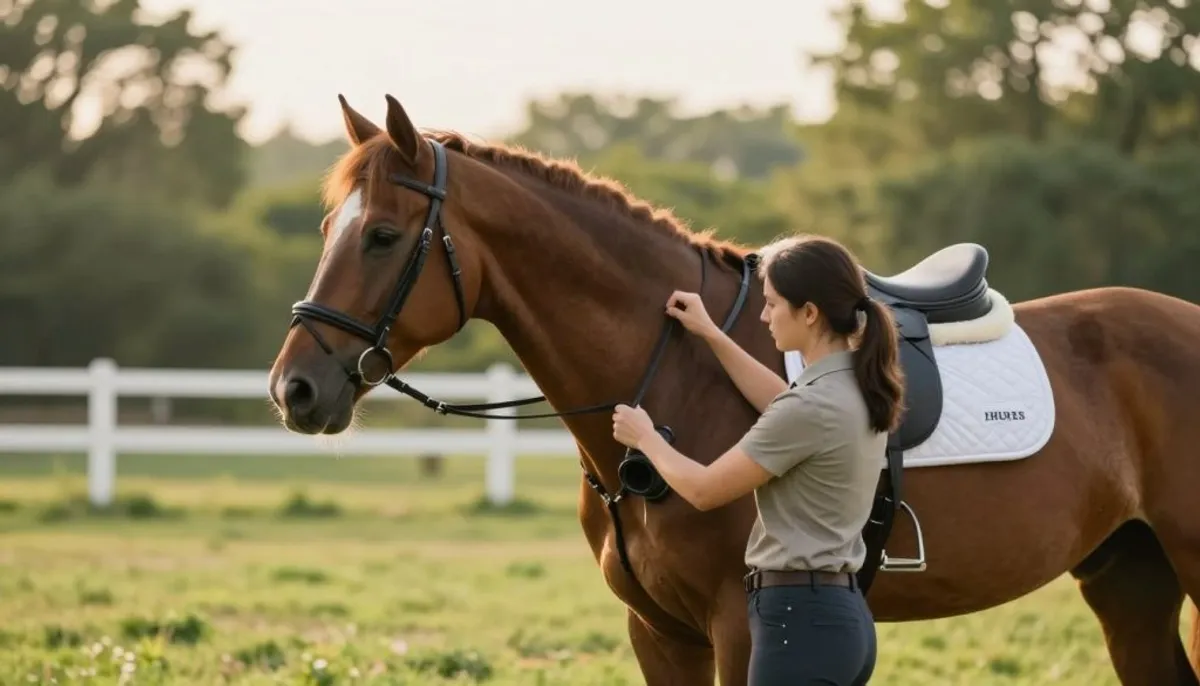
The gogue consists of a central rein and two straps on each side of the head. The straps pass through rings along the harness and then come back together. The chambon, on the other hand, attaches directly to the bit, creating a more direct action.
Having the right adjustment changes everything. The goal is for the head to be at shoulder height. Tension should only come into play if the head rises too much. Otherwise, the training aid can be ineffective or too restrictive.
Adjustments should be shorter for trot and canter than for walk. This prevents the horse from getting too engaged. But be careful, at canter, the head moves more. A chambon that is too tight can hinder the horse and its balance.
Some horses do not like pressure on the neck. It is important to proceed gradually when lunging, calmly. The help of a professional allows for aiming for improvement without constraining the forehand.
| Point of comparison | Chambon for horses | Gogue for riding |
|---|---|---|
| Context of use | For lunging work, never mounted | For lunging work or mounted depending on the setup |
| Path of the straps | Direct attachment to the bit, without returning to a central rein | Triangle: headpiece → bit → return to the central rein between the forelegs |
| Type of action felt | Pressure on the neck + effect on the bit when the head rises | Similar effect, often more “guided” by the triangular setup |
| Adjustment reference | Tension only beyond a hand above the shoulder tip | Same logic: act late, keep play in correct attitude |
| What it does not do | No lateral limitation, does not replace directional work | No lateral limitation either, does not “place” the horse by itself |
| Vigilance equine biomechanics | At canter, requires a very low neck and can hinder the swing | Over-adjustment possible: risk of being behind the vertical and mental tension |
Hand-controlled training aids: German reins, Thiedemann, and martingales
In this family of horse training aids, it is the hand that controls everything. This includes intensity, duration, and release. The concept is simple but requires rigor. Devices create a pulley effect at the bit level. This changes the direction of forces and can unexpectedly increase the action.
Before using these accessories, several things must be checked. This includes the adjustment of the bit, the noseband, and the reins. If the horse is tense, excessive pressure can cause problems. The neck can lock and the back can hollow out.
German reins: pulley effect, potentially doubled force, and need for an expert hand
German reins work with the ring of the bit and then rise towards the hand. This is where the pulley effect manifests. When pulling with a force of 3 kg, it can double the pressure in the horse's mouth. The effect depends on the angle and the attachment point.
This also changes the direction of the action. A lifting movement can actually lower the head. Without finesse in the hand, the horse can defend itself or freeze.
Proper use of German reins: keep loose most of the time, temporary and corrective tool
It is important to use German reins sparingly. The idea is to keep them relaxed and rely on classic reins. A good rule is to use them only 10% of the time while riding. This way, the horse will hardly feel them as long as it is in contact.
They can serve temporarily to correct certain behaviors. For example, for a horse that avoids the hand or falls on the forehand. The goal is to promote better posture, with relaxation as soon as improvement is seen.
What not to do: shorter than classic reins, use while riding, pairing with a non-“simple” bit
Never adjust German reins shorter than classic reins. This would risk constraining the horse too much. Avoid using them while riding for simpler reactions to the unexpected. Additionally, do not combine them with a complex bit, as this would be too harsh for the horse.
It should be noted that the Swiss Federation has banned this device in competition since October 2015. This reminds us of the importance of cautious and thoughtful use.
Thiedemann: a more guiding option with a single pair of reins and an effect that ceases with improvement
The Thiedemann is designed for jumping. It combines a collar on the neck and a strap that comes from the girth. This strap passes under the collar, splits, and goes into the bit to attach to special reins.
This device allows for holding a single pair of reins. The effect ends as soon as the horse adopts a good posture. The installation must be symmetrical and adjusted to act only when necessary. It is not suitable for beginners due to the amplification of unstable movements.
Ring martingale: suitable for show jumping and outdoor riding, with precise adjustment for targeted action
The ring martingale is well-suited for show jumping and outdoor rides. It only intervenes when necessary. A hunting collar provides more stability, especially for horses with a broad chest.
The setup must be precise to avoid accidents. The reins pass without twisting through the rings fixed on the collar. Stops prevent the rings from rising.
A good adjustment allows the martingale to function only when needed. The quality of leather and the precision of the buckles are crucial. This ensures safe long-term use. Workshops like La Sellerie Française are recognized for their quality finishes.
| Equipment | Dominant action | What the hand should aim for | Adjustment reference | Common context |
|---|---|---|---|---|
| German reins | Pulley effect at the bit, often lowering action if the angle is tight | Brief intervention, immediate release, classic reins prioritized | Never shorter than classic reins; remain loose most of the time | Occasional, corrective work, with an experienced rider |
| Thiedemann | Progressive frame, effect that ceases when the attitude becomes correct | Stable hand, clear contact, no continuous pulling | Two strictly equal sides; ring chosen to act only in case of excess | Jumping and flatwork, when a simple frame is desired with a single pair of reins |
| Ring martingale | Change of direction of the reins, lowering action only under tension | Leave at rest, act only if the head exceeds the chosen zone | Rings close to the cheekpieces in raised position; stops essential | Outdoor, show jumping, regular use with precise adjustment |
| Hunting collar (supporting martingales) | Stabilizes the whole on the chest, limits movement of the girth | Maintain shoulder freedom, avoid any respiratory discomfort | Adjusted enough to stay in place, without pulling backward | Round horses, varied work, seeking hold and stability |
Elastics, Pirelli, and educational long lines: apparent flexibility, real vigilance
Pirelli elastics seem simple and soft, attractive at first glance. However, when working with horses, flexibility never replaces precise adjustments and short sessions. The aim is to achieve a stable position without forcing, and to pay attention to the horse's mouth, neck, and back.
Elastics: closing the head-neck angle, horse “master” of tension, but risk of overbending
The elastic modifies the angle between the head and neck. Without direct action from the hands, the horse adjusts the tension itself by changing its posture. This can be beneficial for some, but also risks provoking avoidance.
The real problem lies in overbending. If the elastic is too short, or if the horse seeks to escape, it positions itself behind the vertical. This may look “round” to the eye, but it deteriorates balance.
Possible attachments and variable effects: neck, bars, corners depending on posture
The effect of the accessory depends on its attachment and the sensation varies with the horse's posture. This is why it is crucial to carefully observe the horse's posture, rather than adjusting the equipment roughly.
| Observed attitude | Area mainly solicited | Felt effect | Practical vigilance |
|---|---|---|---|
| Head high, angle too open | Bars | Lowering tendency | Monitor the mouth and avoid shortening to “make yield” |
| Very high neck, angle already closed | Neck | Lowering by pressure on the neck | Risk of defense: fixed neck, hollow back, no shorter |
| Head low, angle open | Corners | Raising tendency | Do not confuse with a real forward reach towards the hand |
| Head low, angle closed | Bars | Even more lowering | Beware of the horse being “boxed in” and heavy on the shoulders |
Educational long line (elastic on the neck): interest in neck extension, limits (continuous tension, support, behind the vertical)
The educational long line is positioned on the neck, passing through the rings of the bit. It attaches either to the girth between the forelegs or on the sides of a surcingle. Its purpose is to promote neck extension downwards and forwards, seeking a more constant contact.
However, the elastic maintains a certain tension. If the horse refuses this pressure, it may seek to lean or position itself behind the vertical. In these situations, it is better to simplify the approach and adjust the training rather than tightening the training aid.
The choice of material is also important, although it does not perform miracles. A training aid made of biothane compares to leather and elastic in terms of maintenance, stability of adjustments, and daily safety. The key is to adjust well, moderate use, and remain consistent in training.
Well-being, rider progression, and alternatives: a reasoned use of equipment
A horse training aid is not just a small detail. It is a tool that can guide or restrict. Before using one, ask yourself: what problem needs solving and for how long?
Choosing the right accessory depends on the desired effect. Whether you want to reduce the space between the head and neck, lower a raised head, or maintain a certain posture, each choice influences the horse's movements and sensations. The same adjustment can become inappropriate depending on the pace, the session, or the horse's fatigue.
The right adjustment is crucial. If well adjusted, the training aid serves as a guide while allowing the horse to breathe easily in its movement. But if poorly adjusted, it can constrain the horse, causing a restrictive posture or a forward escape, with rapid consequences.
Be cautious with bits. On complex bits, pressures can accumulate, making dosage complicated. With so many systems acting through the bit, it is wise to advocate for simplicity, consistency, and comfort above all.
A beginner should never use these tools on their own. An outside observer can spot details invisible to the rider: rhythm, relaxation, tension in the jaw, imbalances. A horse training freely can also reveal points to improve more clearly.
Do not seek a forced posture, especially with a young horse. Focus on rhythm, straightness, and a lively connection above all. Use the tools in a temporary manner and remove them as soon as the situation improves.
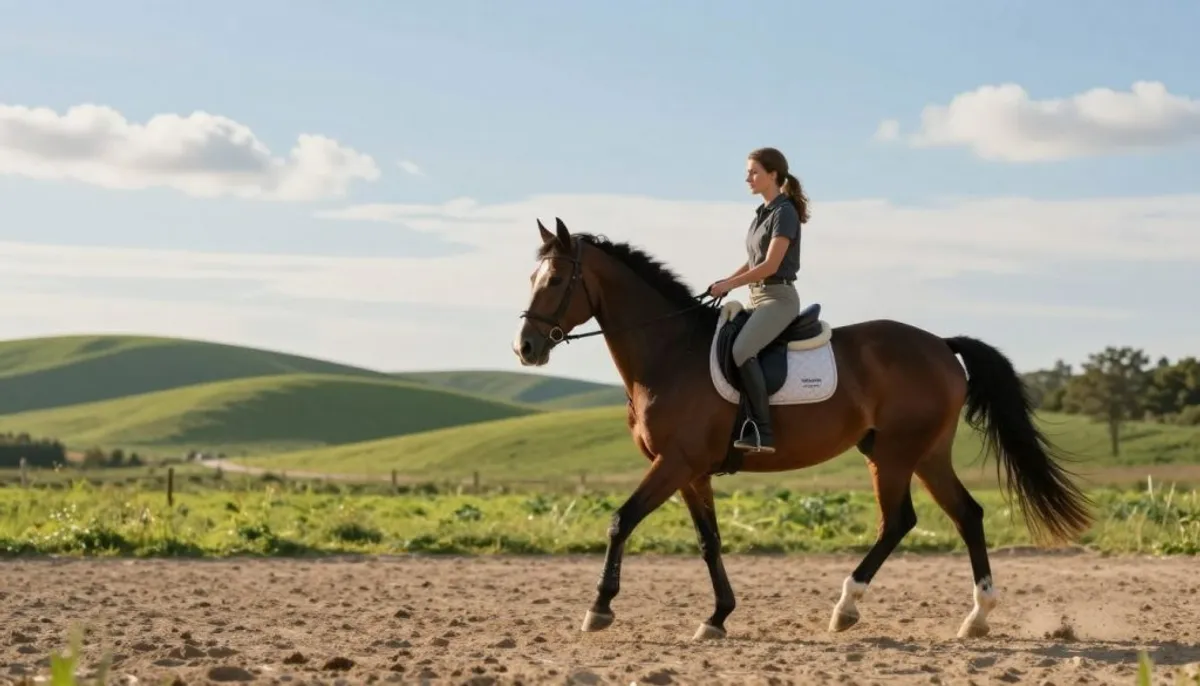
Having good equipment is also crucial. Reliable, well-adjusted tack greatly contributes to precision. In France, La Sellerie Française prioritizes 100% French equipment, ensuring durability and quality, without replacing the need for good horse education.
| Work option | What it develops | Signals to monitor | Equipment to check |
|---|---|---|---|
| Work without training aid on a lunge line, on a large circle | Rhythm, natural balance, reading tensions | Shoulder dropping, accelerations, hollowing back | Stable surcingle, flexible lunge line, adjusted cavesson |
| Mounted session with frequent transitions | More stable hand, gradual engagement, horse attentive | Contact becoming heavier, loss of impulse, locked neck | Girth adjustment, bit position, condition of reins |
| Horse training aid used for a short period, supervised | Frame reference, clarification of a specific request | Nose behind the vertical, strong support, defenses | Length, attachment points, symmetry, absence of friction |
| Return to work without training aid after progress | Autonomy, stability of attitude, lasting relaxation | Reappearance of a problem at a specific moment in the session | Horse tack suitable, non-slip pad, simple mouthpiece |
Maintain a consistent approach daily: equipment is there to assist learning, not replace it. By choosing the right accessories, having suitable equipment, and good supervision, riding will be clear and enjoyable for all.
Conclusion
The best training aid for a horse is not the quickest to set up. It must correspond to a well-defined purpose and be adjusted correctly. Whether for mounted work, lunging, show jumping, or outings, its use should be temporary. It should be removed as soon as the horse's attitude improves.
This guide on training aids shows that one rule is simple: most systems act through the bit. They can modify the position of the neck, sometimes adding a pulley effect for more force. This highlights the importance of using your hands carefully and progressing step by step.
It is essential to know the possible risks such as head withdrawal, imbalance, or muscle tension. A well-placed horse is not always a comfortable horse. Good equestrian equipment supports the horse without forcing it.
When buying, consider quality and longevity as much as technique. Good tack can advise on the right equipment that is easy to use. La Sellerie Française offers high-quality products made in France. They provide comfort, safety, and precision in equestrian practice.
FAQ
Is a horse training aid a “miracle accessory” for properly placing the head?
No. The training aid only helps improve the attitude of the head and neck. It does not replace the rider's indications but supports them when necessary.
In what cases can a training aid help in riding?
Useful in dressage, corrections, or lunging work. It guides posture and helps uncertain riders, under the supervision of a trainer.
Why is the training aid not a basic equestrian equipment?
Its use is sometimes misunderstood. It is not basic equipment but a targeted aid, to be finely adjusted and used temporarily.
What ethical rule should be followed before using a training aid?
Follow the principle: “as much as necessary, as little as possible.” The goal is to use it temporarily and remove it as soon as improvement occurs.
What are the main risks of improper use?
The risks include physical and mental health issues. A poorly used training aid can lead to various problems like overbending.
How does a training aid mechanically affect the horse?
It limits certain movements to encourage better posture. This promotes a rounder back and engagement of the hindquarters.
Why does the choice depend as much on the objective as on the setup?
The effect depends on the setup. Two configurations can have very different effects. Sometimes, not using one is the best option.
Do most training aids act on the bit?
Yes. The majority act through the bit, affecting the horse's mouth. The effect changes according to the configuration.
What is the difference between fixed training aids and hand-controlled training aids?
Fixed training aids create a fixed frame. Hand-controlled aids, like German reins, require expert handling.
What fixed training aids are most commonly found?
Commonly found are fixed reins, a simple training aid, Viennese reins, a chambon, and a gogue. They structure a frame for the horse.
What are fixed reins for and what adjustments are essential?
They teach the horse constant contact and limit laterally. When well adjusted, they keep the nose in front of the vertical.
What frequent mistakes are observed with fixed reins?
If too low, they hinder. If too short, they risk overbending. If too rigid, they limit movement and give a false sense of stability.
Why are fixed reins discouraged for rides or jumping?
They limit the necessary freedom in these situations. Not recommended for young or timid horses as they can increase tension.
How do Viennese reins work and why are they often considered more “flexible”?
They form a triangle for more freedom. They encourage lowering the neck, usable for lunging or mounted.
What is the major risk of Viennese reins if they are too short?
A poor adjustment can unbalance the horse. The important thing is to maintain balance and extension without boxing in the forehand.
What is a simple training aid and why is it rarely recommended for lunging?
It mainly limits vertical movement without limiting sideways. When lunging, it poses a risk of entanglement if the horse lowers its head.
Chambon and gogue: what are the differences and in what context to use them?
The chambon is for lunging. The gogue can be used for lunging or mounted sometimes. They encourage stretching without limiting laterally.
Why is the chambon discouraged at canter?
Its requirement for a low neck does not suit canter. The natural movement of the head at canter is broader.
What does “hand-controlled training aid” mean and why is it more delicate?
The rider adjusts the action, requiring more finesse. An inconsistent hand worsens things, hence the need for experience.
Can German reins really double the force in the mouth?
Yes, the pulley effect can intensify the force. Caution is needed with their use and positioning.
What is the proper daily use of German reins?
They should be used sparingly. Classic reins should dominate. Use German reins less than 10% of the time.
What mistakes should absolutely be avoided with German reins?
Do not adjust too short, avoid using while riding, and do not combine with a complex bit. Banned in Switzerland since 2015.
What is the Thiedemann for and who is it suitable for?
Suitable for jumping, it is a useful intermediary with a single pair of reins. Not for beginners due to the need for precision.
Is the ring martingale really the most versatile option?
Yes, it adapts well in jumping and outdoor situations. It only acts when needed, providing more comfort the rest of the time.
How to adjust a ring martingale to stay safe?
Adjust the girth and use stops to prevent accidents. The reins pass through the rings, requiring attention to adjustment.
What is the link between martingale, hunting collar, and choice of equestrian accessories?
A good adjustment and quality equipment are essential. They ensure a precise effect, only when necessary.
What do Pirelli elastics really offer: softer, really?
They seem soft but can be harsh if too short. The horse managing tension does not eliminate risks.
Why does the effect of elastics change depending on attachment and attitude?
Pressure points vary, influencing the action. The effect depends on the position of the head and the neck angle.
What is an educational long line and what are its points of vigilance?
It is an aid for neck extension. Be cautious of tension, contact, and balance to avoid negative consequences.
Is a biothane training aid a good alternative to leather or elastic?
Biothane is easy to maintain and durable. The type of material does not directly affect its effectiveness. The key is proper adjustment and use.
Can a beginner use a training aid on their own initiative?
No. Using a training aid requires supervision by a professional. They should not be used without proper guidance.
How to avoid “relying on appearances” with a training aid?
A lower posture does not guarantee better work. It is essential to evaluate the horse's performance and ease overall.
Can a training aid hinder the rider's progression?
Yes. Relying on the training aid instead of developing one's skills can limit progress. A freer horse reveals problems better.
What alternatives should be prioritized before constraining with a training aid?
Start by working on the hand, rhythm, and balance. A training aid, if necessary, should be a temporary solution.
Why does the quality of equipment matter so much for a training aid or martingale?
Good equipment allows for precise adjustments. Solid finishes and correct adjustments increase safety and effectiveness.
Where to find high-end tack suitable for precise adjustments (martingale, hunting collar, accessories)?
A: La Sellerie Française (laselleriefrancaise.com) offers quality equipment, made in France. Perfect for durable and precise gear.
RelatedRelated articles
- 27 Mar 2026·16 min readEquine Therapy: Benefits and Sessions in FranceGeneral
 In France, equine therapy is gaining popularity as a comprehensive care option. It is more than just a simple outing in nature. With it, the horse is not just an animal; it becomes a health collaborator. Therapy with horses is based on structured enc...