
The Andalusian horse is distinguished by its grace and beautiful presence. Its powerful shape, beautiful mane, and fluid movements are fascinating. It is also known as Pura Raza Española (PRE).
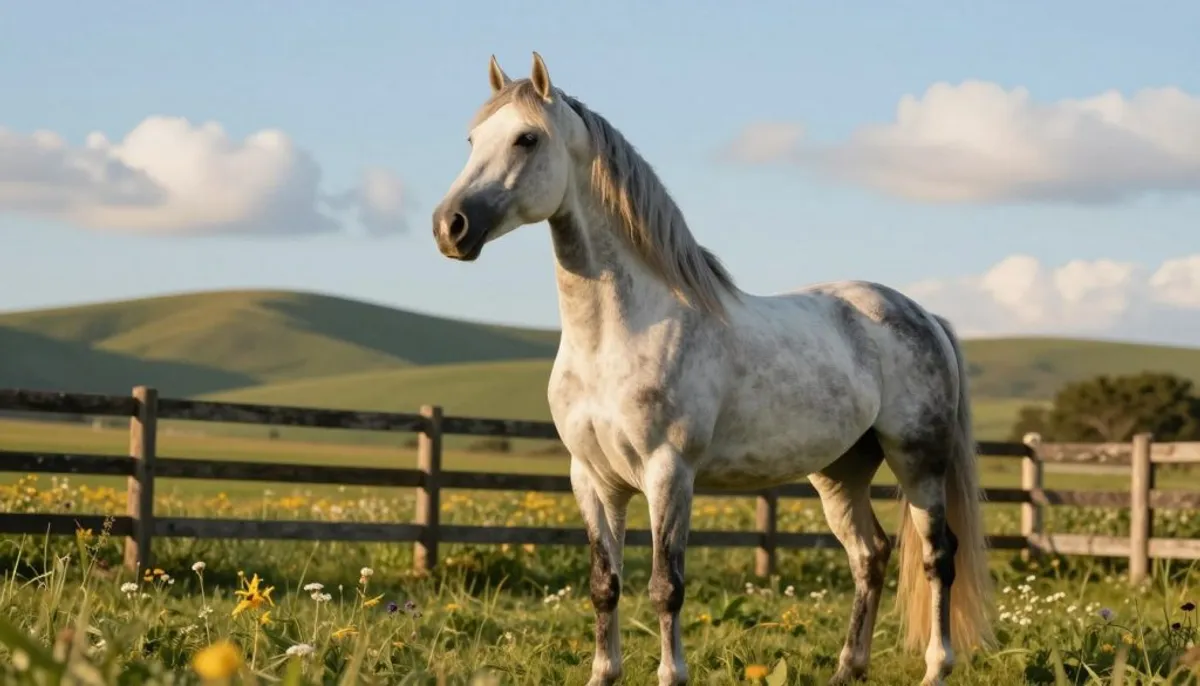
We have a simple goal with this guide: to help you get to know the Andalusian breed well. We will cover topics such as its origins, characteristics, temperament, and disciplines like dressage. The aim is to make all this information practical and straightforward.
In France, the enthusiasm for the Andalusian horse comes from various backgrounds: enthusiasts, families, potential buyers, breeders, and those passionate about dressage. Buying, training, and caring for such a horse requires specific knowledge. Here you will find the essential information to make a good choice and take care of it daily.
Key Points
- The Andalusian horse is also called Pura Raza Española (PRE).
- The Andalusian horse breed is distinguished by its nobility, strength, and harmonious gaits.
- The guide covers purchase, training, care, nutrition, and health monitoring.
- The disciplines discussed include dressage, performance, and equestrian traditions.
- The passion for the Andalusian horse is experienced both in the saddle and on the ground, in the horse-rider relationship.
- The content is designed for an audience in France, from the curious to the future owner.
Introduction to the Andalusian horse and Pura Raza Española (PRE)
In France, the Andalusian horse and Pura Raza Española (PRE) are often referred to in the same way. These two names designate a well-known type of iberian horse. This horse is recognized by a stud book that records its characteristics.
Strength and elegance are the aspects admired in it. Its curly mane, proud neck, and powerful shape make it unique. It moves in a fluid and balanced manner, which is perfect for dressage.
Why the Andalusian horse is a reference of nobility and elegance
The Andalusian horse shows its nobility through its posture and its way of connecting with people. It is known to be intelligent and affectionate. Riders appreciate its ability to express its feelings without being difficult to understand.
Andalusian horses have very specific traits: an expressive head, a strong back, and a powerful hindquarters. These characteristics help buyers know what they are getting. They also assist in working on impulsion and coordination in dressage.
Geographical origin: Andalusia and European influence
The Andalusian comes from Andalusia, in the south of Spain. The climate and equestrian culture of this region have shaped this breed. Its reputation quickly crossed Spanish borders to spread throughout Europe.
The expectations for these horses are high: they must be beautiful but also perform well. For an Andalusian, having robust health and good movement abilities is crucial. These qualities are what set it apart, especially in dressage.
Current disciplines: dressage, performance, equestrian traditions
Today, the Andalusian excels in dressage, performance, and Spanish ceremonies. It is perfect for prestigious events due to its appearance. A well-trained Andalusian can also perform in front of an audience, with music.
The choice of an Andalusian horse depends on what you are looking for: shape, character, and level of training. Depending on the intended discipline, needs will vary. Knowing this makes the buying and training process simpler.
| Use | What to look for in an Andalusian horse | Points to observe in practice |
|---|---|---|
| Dressage | Natural balance, ability to collect, stable contact | Regularity of gaits, response to aids, flexibility of the back |
| Equestrian performance | Presence, expressiveness, calmness in ambiance | Stress management, attention to the rider, recovery after effort |
| Spanish traditions | Manoeuvrability, elevation, precision in transitions | Shoulder mobility, engagement, ease of turning tight |
| Leisure "comfort" | Reliable temperament, versatility, saddle comfort | Behavior during grooming, loading, outdoor outings |
History of the Andalusian horse: origins, influence, and heritage
To grasp the heritage of the PRE, we explore the history of the Andalusian horse. This history shows a blend of power, expertise, and culture. The Andalusian breed has withstood the ages while maintaining its nobility. In France, its captivating appearance attracts many.
This history enriches our passion for the Andalusian horse. We admire not only its beauty but also its equestrian heritage. This heritage is alive thanks to the breeders, riders, and their traditions. Every aspect, from its mane to its balance, reflects careful selection.
From royal stables to military and cultural uses
The Andalusian horse has long been associated with kings and their royal stables. Its elegance and ease of training made it indispensable. Kings, warriors, and artists admired it, a sign of its respect since the time of great empires.
Its qualities of courage and agility were essential in battle. Later, its role transformed into celebrations and performances. Thus, the Andalusian horse became a star in cultural arenas, where its elegance speaks for itself.
A breed that has influenced other lines in Europe and the Americas
The impact of the Andalusian horse extends far beyond Spain. Its legacy is visible in European and American breeds. It has played a key role in the development of the Lusitano and Lipizzan, two jewels of classical riding.
| Area of influence | Type of contribution associated with the Andalusian horse | Examples of observed traces |
|---|---|---|
| Southern Europe | Balance, ability to collect, manoeuvrability | Work base close to the high school, selection oriented towards expression |
| Central Europe | Presence, elevation, baroque model | Recognized influence on the Lipizzan in the spirit of classical schools |
| Iberian Peninsula | Continuity of lines, strong equestrian culture | Historical proximity to the Lusitano, traditional and sporting uses |
| Americas | Spread through equestrian expansion, adaptation to terrains | Transmission of types and practices, enhancement in shows and local traditions |
The scope of this diffusion is concrete and diverse. It manifests in training methods and dressage styles. Even today, it inspires Andalusian horse enthusiasts through dressage and traditional riding.
The Andalusian horse in art and equestrian imagination
In the world of art, the Andalusian horse symbolizes grace. Through painting, poetry, and ceremonies, it is celebrated as a living work of art. It embodies pride, mastery, and beauty in motion.
This artistic image enriches our passion for this breed. Observing an Andalusian horse reveals an entire culture. This breed represents a part of the Spanish imagination, where tradition, elegance, and equestrian art intertwine.
Characteristics of the Andalusian horse: morphology, gaits, and temperament
When discussing the Andalusian, three main themes emerge: its appearance, movements, and character. These traits together define it perfectly, crucial for understanding its talents and needs. They also explain why it shines in various fields such as sport, performance, and classical riding.
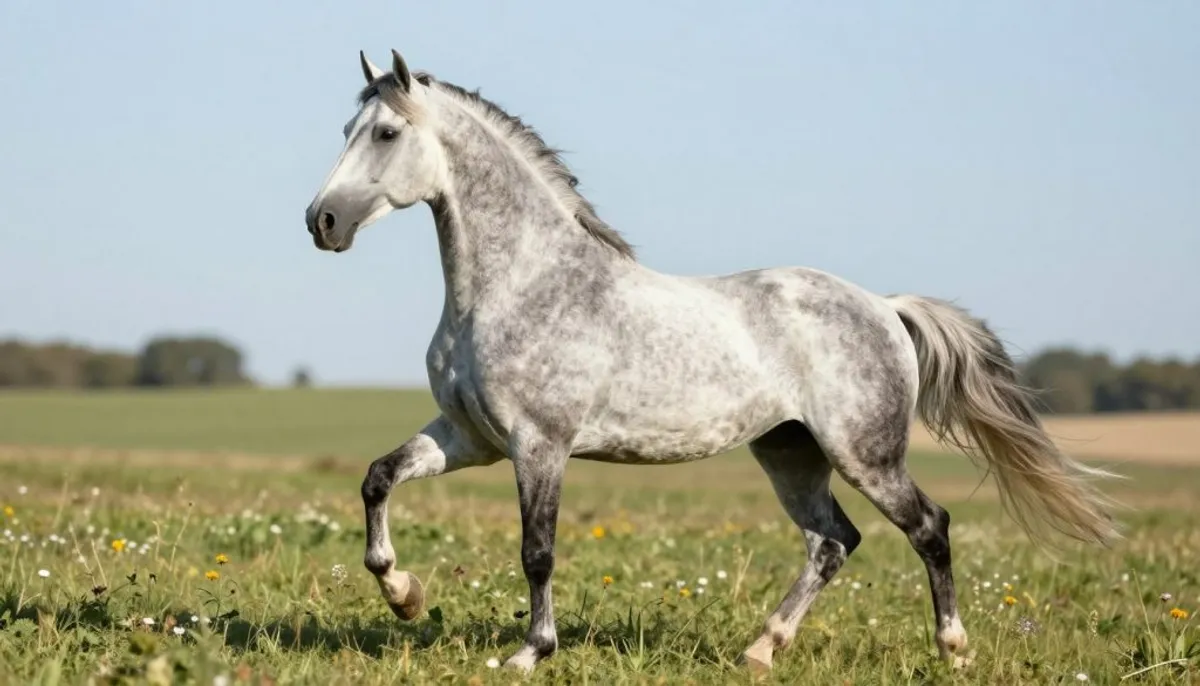
Silhouette, mane, balance, and presence
Its wavy mane and robust silhouette easily distinguish it. Its neck stands out well, supported by a strong back. This gives it an imposing appearance, even when still.
Not only does appearance matter, but so does balance. A well-proportioned body is essential for good weight distribution. This is vital in dressage, where the pose is gradually developed.
Movements: harmony, flexibility, and power
Its movements are admired for their balance: full of elasticity, height, and softness. The walk is assured, the trot rhythmic, and the canter steady. When its energy flows well, it seems to move with ease.
This union of harmony and strength is valuable in dressage, promoting collection and fluidity of transitions. With appropriate training, the horse progresses in balance without tension.
Temperament: sensitivity, intelligence, and horse-rider bond
The Andalusian is often seen as brave, sociable, and alert. Its sensitivity becomes an advantage if the rider is consistent. A stable environment strengthens a relationship of mutual trust.
Paying attention to the signals it sends is crucial: the orientation of the ears, the tension in the neck, and others. They help understand its reactions and manage its fears or stress.
| Observed marker | What it often reveals | Simple action to test | Interest for Andalusian horse training |
|---|---|---|---|
| Thick mane and well-defined neck | Presence, ease of placement if the back follows | Long warm-up at the walk, slight bends | Improves contact stability and straightness |
| Trot with bounce, without rushing | Available energy and coordination | Transitions walk–trot–walk, straight lines | Establishes a clean base for collection |
| Mobile ears, attentive gaze | Listening, curiosity, seeking guidance | Ask then quickly release, reward when calm | Enhances the finesse of aids and trust |
| Short breathing, stiff jaw | Stress, misunderstanding, or poorly measured effort | Return to walk, frequent pauses, resume simpler | Preserves relaxation, key to quality of gait |
| Seeks the rider's hand, calm at a standstill | Established relationship, need for stable markers | Fixed rituals: grooming, leading, stillness | Facilitates learning and regular progress |
Andalusian horse: choosing the right profile according to your level and project
Before visiting a stable, define your expectations: your goals, your availability, and the amount you can invest. The Andalusian is a versatile horse, but it excels under specific conditions. Consider the available support: lessons, ground training, and outdoor outings.
Defining the objective: leisure, dressage, breeding, performance
For leisure, choose a reliable horse outdoors, easy to direct and calm in transitions. For dressage, you need a horse with a flexible back, good impulsion from the hindquarters, and a delicate mouth. Performance requires a horse that attracts attention, remains calm with noise, and accepts costumes.
Start early for breeding: look at the background, appearance, health, and if the pair complements each other well. But remember, a good Andalusian must have natural balance, a raised neck, and enjoy contact. These qualities are important, but they must match your needs.
Age, experience, level of training, and horse's "aptitude"
A young horse is appealing but requires patience and experience. An older, already trained horse often allows for rapid and safe progress. A horse's aptitude is seen in its consistency, motivation, and understanding of requests.
In dressage, check that the horse maintains its posture without tension. A good Andalusian easily readjusts its balance. It also keeps a regular gait, even when turning.
Points of vigilance: conformation, gaits, behavior, work history
Start with a visual inspection. Examine the alignment of the legs, the condition of the hooves, weight distribution, and back alignment. Andalusians are often remarkable for their mane and presence. However, robustness is prioritized over beauty.
- Conformation: alignment of limbs, stability at rest, balanced feet.
- Gaits: wide walk, steady trot, controlled canter.
- Behavior: attentive ears, calm breathing, respect for personal space.
- Work history: frequency of sessions, rides, incidents, changes of ownership.
Mounted trial and handling: what to observe before making a decision
First, conduct a ground trial. Lead the horse forward, to a stop, backward, in a turn, then to a tie. A balanced Andalusian easily accepts the saddle, girthing, and reacts well without stress.
When mounted, follow a simple plan: move in a straight line, in a circle, change pace, then rest. To train an Andalusian, note its reaction to aids and its relaxation after effort. A good Andalusian shows its quality through its lightness, not its speed.
| Project | Sought profile | What you check during the trial | Point of attention |
|---|---|---|---|
| Leisure / outdoor | Calm horse, accustomed to varied environments | Clear walk, sharp stop, passage of objects, calm in hand | Stress management and reactions to surprises |
| Andalusian horse dressage | Flexibility, balance, responsiveness without tension | Transitions, bending, stability of contact, cadence | Regularity of gaits and recovery |
| Performance | Presence, availability, tolerance to noise | Stillness, responses on foot, gradual desensitization | Over-reactivity and tension in a new place |
| Breeding | Consistent model, health, reliable temperament | Complete handling, locomotion at trot, observation at rest | Traceability of work and veterinary follow-up |
Buying an Andalusian horse in France: where to buy and how to secure the purchase
In France, seriously buying an Andalusian horse requires preparation. First, observe the horse calmly, at rest, then in motion. A healthy Andalusian shows stable posture and calm breathing.
A complete visit takes place in a breeding farm or stable, with enough time. It is important to observe the animal in the box, in the paddock, being handled, and under saddle if possible. The important thing is to confirm that the horse behaves well in all these situations.
For a safe purchase, examine the horse from all angles. Look at its shape and how it moves. Pay attention to its balance and how it walks at different speeds.
Consider the horse's age; official documents help. But closely observe the horse: its back, muscles, and skin. An inadequately trained or developmentally delayed horse requires investigation.
- In hand: straight walk, easy to back up, flexibility.
- In situation: behavior during grooming, picking up feet, respect for spaces.
- At work: good response to commands, without resistance, quick recovery.
Signs of an uncomfortable horse can be subtle. Look for a tense tail, immobile ears, or difficulties during saddling. In a good stable, the horse remains calm even if the environment changes.
The condition of the horse's feet is crucial from the start. Ask when the last visit from the farrier was, the type of shoe used, and any history of foot problems. A horse with good feet means a horse ready for the future.
| Point to check | What you observe on site | What it secures |
|---|---|---|
| Conformation and proportions | Aligned forelegs, stable hocks, carried back, overall balance | Durability at work, comfort, and lower risk of lameness |
| Movements and gaits | Regularity at the walk, supple trot, rhythmic canter, clear transitions | Real potential, consistency with the announced level |
| Behavior in box/paddock | Curious horse, calm, without excessive agitation or isolation | Adaptation to lifestyle and stress management |
| Handling and feet | Gives all four feet, healthy horn, absence of abnormal odor or heat | Facilitates care, farriery follow-up, and foot hygiene |
Prepare well for the arrival of the horse: a clean box, good bedding, fresh water, and regular outings. Ensure that the air is healthy, not dusty, and well-ventilated. This is important after a move that can tire the horse.
Finally, maintain a stable routine for the horse. This includes constant markers and starting with light work. It does not matter if the horse is experienced. A secure transition shows a calm and well-adjusted horse.
Price of Andalusian horse: realistic budget and costs to anticipate
Before discussing money, know that the price of an Andalusian horse depends on several factors. Even if an Andalusian may seem inexpensive, its cost increases if it has been neglected. Thinking about a total budget from the start is important.
The right reflex is to request a complete file on the animal. This covers its training, care, and shoeing. It is essential to avoid unpleasant surprises and make a good choice.
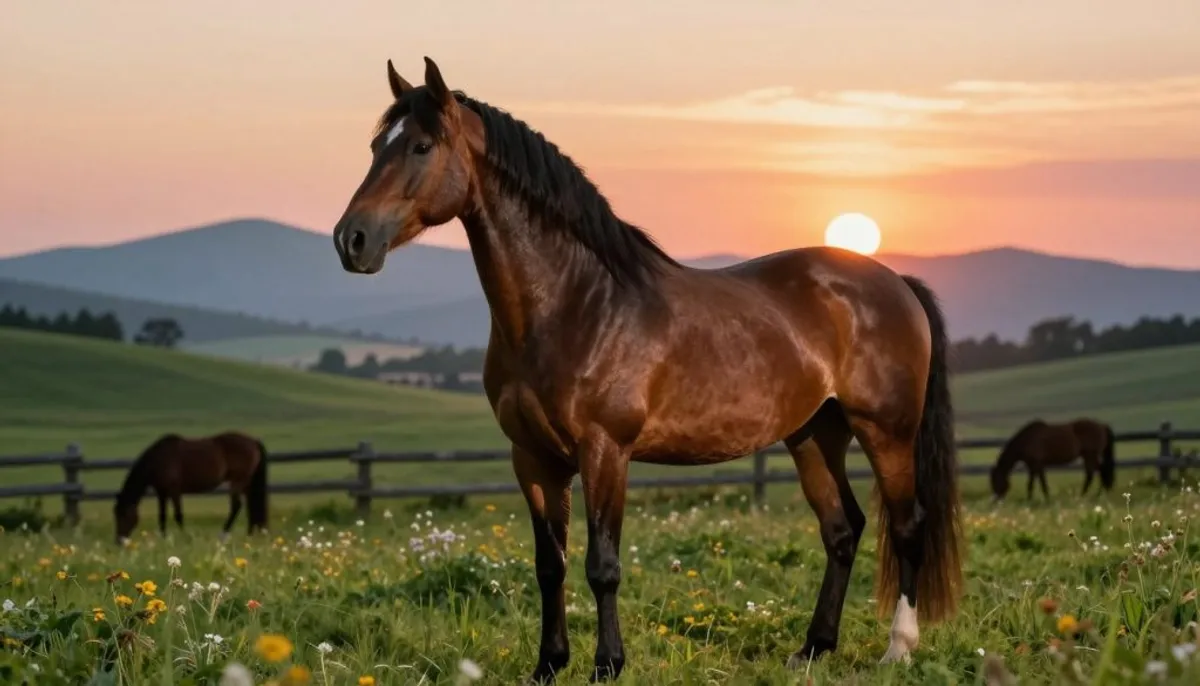
The price varies mainly according to the age and skills of the horse. A young horse costs less but requires more training. On the other hand, an experienced horse is ready to work and thus more expensive.
Lineage and appearance also play a role. A well-proportioned Andalusian horse, with a good gait and a stable mind, is more valuable. How it reacts to commands and its initial training are crucial.
| Observed criterion | What it changes | Point to check |
|---|---|---|
| Age and experience | Young: work to build; trained adult: more ready | Consistency between age, musculature, and actual riding level |
| Level of work | Advanced dressage and outings: higher value | Regularity, transitions, straightness, calmness outdoors |
| Lineage and valuation | Sport/breeding potential: direct impact on price | Documents, results, professional opinions, veterinary visits |
| Model and conformation | Less risk, better longevity at work | Wear of feet, symmetry, locomotion on hard ground |
After the purchase, expenses continue, especially for housing and prevention. Facilities like a box or paddock determine boarding costs. A regular routine is essential for the well-being of an Andalusian horse.
Farriery should be regular to avoid foot problems. Inadequate maintenance can limit the horse's abilities. Keeping a regular follow-up is key to maintaining its value.
It is also wise to anticipate veterinary visits to avoid emergencies. Monitoring problems allows for quick intervention. Transport and insurance costs should be considered, especially for horses intended for competition.
A common mistake is to ignore monthly maintenance costs. A well-maintained horse performs better, even if it costs more to maintain. When choosing, do not only look at the initial price.
Breeding Andalusian horses: understanding lineages, breeding, and the foal
Starting a breeding of Andalusian horses is simple: one seeks a healthy, balanced animal that conforms to standards. Lineages help maintain a specific identity while preserving necessary diversity. In the world of the Andalusian horse, nobility is key, but this requires thoughtful choices.
To choose the parents of a future Andalusian foal, it is important to be pragmatic. It is essential to consider their body structure, movements, health, and behavior. Good selection relies on concrete observations, not just a photo. Veterinary follow-up, weight control, and the quality of feeding are crucial.
Breeding and raising foundations: goals, selection, monitoring
- Choose a clear goal: sport, tradition, leisure, or specific conservation.
- Consider the appropriate age for breeding, generally around 2 and a half years.
- Ensure regular monitoring: health, nutrition, and behavior of the animal.
- Document each important step: mating, gestation, ultrasounds, and living conditions.
Birth, growth, socialization, and weaning of the foal
Gestation requires preparing the mare, ensuring her environment and nutrition are suitable. At birth, it is essential to check the foal's health and energy. Raising Andalusian horses aims to produce a curious yet respectful foal, with a good relationship with humans.
Foals grow quickly, so their nutrition must be well managed, with fibers and minerals. They learn social life with the herd. Weaning should be done gently, with consistent routines and daily outings.
Useful "classical" markers: age, vigor, longevity (order of magnitude)
| Marker | Order of magnitude | What it serves in daily life |
|---|---|---|
| Breeding ability | About 2 and a half years | Avoid early breeding for the health of the animal |
| Period of vigor/strength | 6 to 14 years | Plan work and breeding at the right time |
| Average lifespan | About 20 years | Prepare finances, career, and retirement of the horse in advance |
| Documented exceptional longevity | Old Turk: died in 1885 at 50 years minus 12 days | Show that attentive care can prolong life |
These markers help us better understand the life of an Andalusian horse. They provide a foundation for evaluating breeding practices while keeping the goal in mind: a horse that is well in its skin, useful, and lasts a long time.
Care and maintenance: nutrition, hygiene, health, and management of the Andalusian horse stable
An Andalusian horse is happier when everything is simple and regular. Having good routines from the start helps a lot. This improves their mood, posture, and the quality of their work.
Stable organization
A clean and well-organized box prevents irritations. It is crucial to have fresh air as it reduces dust. Floors are often checked to prevent falls.
Fences should be secure and visible. Having a reliable water trough and shelter is essential. All this helps the Andalusian horse stay calm every day.
Nutrition
Quality hay and grass form the basis of their diet. Concentrates are only added if necessary. For effective training, energy must be constant.
It is important to ensure they drink enough water every day. Meals should be spaced out, and changes in diet gradual. Certain foods, like chocolate and avocado, should be avoided.
Daily care
Grooming is important for cleanliness and detecting problems. Signs like swelling or tender areas should be monitored. The horse's behavior can indicate discomfort.
Minimizing stress for the horse is our goal. Maintaining a calm care routine makes all the difference. This daily well-being is reflected in their performance.
Health & prevention
A clear vaccination and deworming program is crucial. Any change in their health must be checked quickly. The environment plays a significant role in their health.
After training, proper recovery is necessary. Regular veterinary visits are essential for their overall health.
Farriery and hooves
Well-maintained feet are essential. Regular trimming and a clean environment prevent problems. Talking with the farrier helps adjust care according to their needs.
Be attentive to any changes in their gait. Even a slight discomfort can indicate a problem.
Premium equipment and made in France: focus on La Sellerie Française
The right equipment contributes to comfort. La Sellerie Française offers high-quality gear, entirely made in France. For dressage, this means better longevity and a refined finish.
Why choose custom-made and limited series for comfort and durability
Custom-made supports the horse better and enhances comfort. This is particularly useful for horses with physical peculiarities. A limited series also guarantees better quality and durable materials.
| Key point | Custom-made | Limited series |
|---|---|---|
| Comfort at work | Adjustments suited to the back, better stability in Andalusian horse dressage | Worked cut, careful balance, more consistent feel than entry-level |
| Pressure distribution | Fine adjustment of supports, useful for preserving the back | Followed panels and padding, choice of leather and foams more demanding |
| Durability | Facilitated repairs, parts designed to last | Stricter finishes, wear often more homogeneous |
| Consistency in daily life | Material that integrates into the Andalusian horse stable routine | Good compromise when wanting to ride often without multiplying purchases |
Conclusion
Choosing an Andalusian horse is primarily about grasping the essence of the PRE. This includes its compact body, majestic gaits, and fine psychology. Whether for leisure, dressage, performance, or breeding, the important thing is that the horse's character matches your project. This harmony between your expectations and the qualities of the Andalusian fuels passion over the long term.
Before making your purchase, follow a simple piece of advice. Observe the horse's construction, the fluidity of its movements, its true age, and its work capacity. A thorough examination and a transparent history minimize risks and protect your investment. This is particularly vital for breeding Andalusian horses, where details matter.
Keep in mind some key points to consider the future. The period of full strength for the Andalusian horse is generally between 6 and 14 years. Its average lifespan is about 20 years, and it can breed from 2 and a half years, with proper monitoring. A regular care regimen, including good nutrition, fresh water, preventive care, hoof care, and peaceful daily interactions, makes all the difference. With this care, an Andalusian horse shows its beauty without losing its strength.
In France, a well-selected, well-housed, and well-cared-for horse becomes a trustworthy and generous partner. To further enhance its well-being, equipment is as important as training. It must respect the horse's back and mouth. And to ensure everything is perfect until the end, choosing La Sellerie Française is wise for durable and well-fitted gear.
FAQ
Andalusian horse and Pura Raza Española (PRE): is it the same thing?
Yes, the Andalusian horse and PRE are often seen as identical in France. The PRE is the official Spanish name, while "Andalusian" highlights its Andalusian roots.
What are the most sought-after characteristics of the Andalusian horse?
People love its beautiful mane, strong build, and harmonious movements. Its “strength and elegance” show an ideal balance, perfect for riding.
Why is the Andalusian horse associated with nobility and grace?
For a long time, the Andalusian has been seen as noble, intelligent, and graceful. Its appearance and way of standing reinforce this image.
What is the origin of the Andalusian horse?
It mainly comes from Andalusia, in the south of Spain. Its fame has crossed borders, becoming a European, then global emblem.
What is the history of the Andalusian horse, from royal stables to today?
Its history begins with royal stables, before serving military and cultural purposes. Today, it is considered a living heritage. It is present in equestrian sport, performances, and Spanish traditions.
Has the Andalusian horse influenced other breeds?
Yes, the Andalusian horse has had a significant impact in Europe and America. It has helped create breeds like the Lusitano and the Lipizzan, thanks to its characteristics and skills.
In which disciplines does the PRE excel?
The PRE excels mainly in dressage due to its flexibility and balance. It also shines in equestrian performances and respects Spanish cultural traditions.
What temperament to expect from an Andalusian horse?
The PRE is known to be brave, sensitive, and intelligent. It forms strong bonds with the rider and responds well to healthy and consistent communication.
How to read the body signals of a PRE in daily life?
Look at its ears, posture, and how it breathes. Small changes can show if it feels stressed, uncomfortable, or confused, which helps avoid problems.
What profile of Andalusian horse to choose according to my project (leisure, sport, performance, breeding)?
First, define your goal: leisure, dressage, performance, or breeding. Then, choose a horse whose physique and character match your needs. Differences in lineage and experience are important.
What is the ideal age to buy an Andalusian horse?
It depends on your project and level of experience. A trained horse is often more reassuring for pleasure or competition. A young horse requires more time and attention.
What does "aptitude" mean when buying an Andalusian horse?
Aptitude includes its natural and consistent abilities: its movements, balance, learning capacity, and suitability for certain disciplines.
What points to check as a priority during the examination of the horse for sale?
Focus on its posture, movements, age, and whether it fits your project. The idea is to analyze its general health and aptitude.
How to frame the mounted trial and handling before an Andalusian horse sale?
Observe the horse on foot and mounted to assess its reaction, balance, and cooperation. A successful trial also includes some ground work to test its stress management.
Where to find a serious Andalusian horse sale in France?
For a serious search, visit a recognized breeding farm, a sport-oriented stable, or a respected professional. Observe the horse in its usual environment and ask for detailed information about its past and health.
Why do farriery and hoof hygiene matter from the purchase?
Foot care is crucial for the well-being and performance of the horse. Good maintenance prevents pain and movement problems, essential in dressage and performance.
What is the price of an Andalusian horse in France and what does it depend on?
The price varies according to age, aptitude, lineage, and training (dressage, performance). An experienced horse costs more, reflecting the investment in its training.
What costs to anticipate after the purchase, beyond the price?
Anticipate boarding, farriery, veterinary care, vaccinations, transport, and sometimes insurance costs. Think in terms of total costs, including feeding and prevention, rather than just the purchase price.
What common mistakes increase the budget of a PRE?
The common mistake is to overlook maintenance costs after the purchase. Poor dietary management, lack of foot care, inconsistent veterinary follow-up, or inadequate housing can increase costs. Good organization reduces the risk of health problems.
How to properly organize the stable of an Andalusian horse (box, paddock, security)?
Ensure that the boxes are well-ventilated and that the horse can go out regularly. Secure barriers, clean water, and a tidy shelter are crucial. Good air quality and a clean stable limit the risk of diseases.
What nutrition for a PRE: forage, supplements, and hydration?
Base its diet on hay and grass, adjusted to its needs. Supplements depend on its activity and health. Water is essential to avoid colic. Be cautious of certain harmful foods.
What daily care helps an Andalusian horse stay calm and fit?
Regular maintenance, checking its physical condition, and providing activities help it stay fit. PREs appreciate routine and attention, given their sensitivity.
What warning signs should prompt a call to the veterinarian?
If you notice lameness, respiratory issues, loss of appetite, or a change in its coat, contact a veterinarian. Prevention includes vaccinations and deworming, and a healthy environment.
Breeding Andalusian horses: at what age can a horse reproduce?
Reproduction can be considered from 2 and a half years. However, one must also consider its health, maturity, and the purpose of selection.
What age and longevity markers for the Andalusian horse breed?
An Andalusian is in peak form from 6 to 14 years, with an average lifespan of 20 years. Old Turk, an American horse, lived to nearly 50 years.
How does the follow-up of a foal in PRE breeding proceed?
The follow-up begins with gestation and continues after birth, including care, nutrition, and socialization. Special attention is paid to physical and emotional development.
Why invest in high-end equipment for an Andalusian horse?
Good equipment ensures comfort and performance, especially in dressage and performance. The quality and durability of the equipment avoid frequent replacements.
What does La Sellerie Française offer for a PRE rider in France?
La Sellerie Française (https://laselleriefrancaise.com) offers quality products, made in France. They provide custom or limited edition equipment, ensuring excellent craftsmanship.
Custom or limited series: what interest for the comfort and performance of the PRE?
Custom ensures a perfect fit for the horse, improving its comfort and movements. The limited series offers durable materials, ideal for rigorous training or performances.