
Welcome to the wonderful world of horses and racing. This guide explains everything about horse prices in France. You will learn how to buy a horse, how much it costs, and what you need to know before investing.
The equine sector in France is huge, generating more than 2 billion euros each year. It includes 230 racetracks, nearly 18,000 races, and over 11,500 owners. Even with a small budget, you can start: from 50€/month for co-ownership or around 10,000€ for full ownership. Additionally, there are rental options that allow you to earn money with your horse.
Setting a budget is crucial before buying a horse. Trotters sell for between 1,000 and 100,000€. Gallopers can cost up to 2.6 million euros! Yearlings have a price that varies based on their lineage, ranging from 1,500 to 150,000€. For maintenance, the average annual cost is 13,000€, but it can increase for a racehorse.
Making money with a horse is not guaranteed. On average, only 40 to 55% of costs are covered by winnings. But for an average trotter, you can expect around 15,000€ in winnings per year. Trainer fees and other professionals are based on these winnings. Several factors affect a horse's price and performance.
There are rules to follow to be in the race. You must have the approval of France Galop or LeTROT. And for equipment, La Sellerie Française offers high-quality products made by artisans in France.

Key points to remember
- A structured and deep market: 230 racetracks, ~18,000 races, and 11,500 owners.
- Gradual access: co-ownership from 50€/month, full ownership starting from around 10,000€.
- Price ranges: trotters 1,000–100,000€; gallopers up to 2.6M€+; ready-to-run horses from 10,000€.
- Recurring costs: average 13,000€/year; racehorses 20,000–40,000€/year depending on the discipline.
- Cautious profitability: 40–55% of costs covered on average; commissions taken only on winnings.
- Real risks: uncertain qualification, injuries, limited liquidity; diversify and cap exposure.
- Premium equipment: La Sellerie Française, artisanal know-how and made in France quality.
Understanding the French equine and racehorse market
The French racehorse market relies on strong institutions. France Galop and LeTROT are examples. To set a horse's price, one examines its activity, its place of sale, and who wants to buy it. But the purchase price is just the beginning: an overview helps to choose without stress.
Key data: 230 racetracks, 18,000 races/year, 11,500 owners
France has about 230 racetracks and holds nearly 18,000 races annually. This sector generates over 2 billion euros in revenue. There are also almost 11,500 active owners, monitored by France Galop and LeTROT.
This abundance ensures a regular supply of horses, from amateurs to champions. This helps establish a realistic budget for buying a horse.
Disciplines and price gaps: trot vs gallop
Trotters are generally more affordable. For a beginner, prices often range from 5,000 to 35,000 euros. However, this can go from 1,000 to 100,000 euros. In contrast, gallopers can be very expensive: a yearling can reach 2.6 million euros. The average price of a yearling is around 15,000 € excluding taxes.
International demand, prestige, and speculation explain these differences. For a first purchase, comparing costs can help in making a choice. This takes into account risk and total budget.
Where to buy: auctions, private sales, claiming races, group stables
- Auctions: Deauville shows well the interest in this market with quality catalogs and famous names. Prices can soar in the auction room.
- Private sales: directly from the breeder, a 2-year-old horse generally costs between 10,000 and 50,000 €. Negotiation is possible.
- Claiming races: here, the horse is sold at the price set after the race. An average trotter sells for around 5,000 €.
- Group stables: you can buy shares starting at around 50 €/month. Prices vary, with premium options requiring up to 25,000 € to start.
Each option impacts the final price of the horse: additional costs, veterinary checks, and the timing of the purchase matter. The rules of France Galop and LeTROT help secure the purchase.
The role of pedigree, age, and performance in value
Pedigree is crucial. Descendants of great champions are highly sought after. Age is also important: yearlings (1,500 to 150,000 €) are riskier. At 3 years old, potential becomes clearer.
Performance, health, and appearance directly influence price. Outside of racing, horses for leisure, sports, or training have their prices. This can range from 1,500 to 25,000 €.
| Criterion | Trot | Gallop | Impact on horse price |
|---|---|---|---|
| Market access | Large local supply, LeTROT | Strong international demand, France Galop | Sustained demand = higher prices in gallop |
| Observed ranges | 1,000–100,000 € (beginners 5,000–35,000 €) | Average yearlings ~15,000 € excluding taxes; peaks >2.6 M€ | Price gap structuring the horse cost comparison |
| Purchase channels | Auctions, private sales, claiming | Auctions, private sales, group stables | Chosen channel influences costs and access speed |
| Key factors | Performance, stamina, consistency | Pedigree, speed, black type | Increases value and equine cost |
| Buyer profiles | Owners focused on regular returns | Investors sensitive to prestige | Different buying strategies based on objectives |
Horse prices: ranges, factors, and estimation
The price of a horse changes based on several criteria. These criteria include discipline, age, and competition performance. To assess the price fairly, one must look at pedigree, physical condition, health status, and recent results.
Typical ranges: trotters 1,000–100,000€; gallopers up to 2.6 M€+
Prices start at 1,000€ for beginner trotters. They range between 5,000 and 35,000€. Active horses in claiming races are sold for 10,000 to 30,000€. The very good ones can even cost up to 100,000€.
Gallopers, on the other hand, can be worth up to 2.6 M€ for a yearling at Arqana sales. The average price of a yearling is around 15,000€ excluding taxes. However, those who have already proven their worth can easily exceed 100,000€. There are also cases that break sales records, in France and elsewhere.
Yearlings, ready-to-run, and reformed: how to read advertisements
A yearling is evaluated based on its origins and physical condition. Prices range from 1,500 to 150,000€ depending on the breeding. But beware, investing carries a risk: not all reach the expected qualification level.
To buy a ready-to-run, one looks at its performance and history. Prices start at 10,000€. This helps make a safe choice. Reformed horses cost between 500 and 3,000€. However, one must be cautious regarding their health and future after racing.
Horse price estimation: pedigree, conformation, veterinary examinations
Pedigree has a significant influence on a horse's price, both for its racing career and for breeding. Its physical conformation also affects its durability and risk of injury. These elements are crucial for setting a realistic price.
During the purchase, veterinary visits are essential. They include tests and examinations costing between 100 and 500€. It is advisable to invest in these examinations to avoid high costs later.
Horse value assessment and auction speculation (recent records)
Prices can vary greatly at auctions, especially for a well-bred yearling. Bidding increases due to rarity and competition among buyers. For example, Saônois, bought for 8–10,000€, won nearly 1.7 M€. Malavath was bought for 145,000€ and resold for 3.2 M€.
Speculation on horses creates significant price differences. A cheaply bought horse can become a star, while another very expensive one can disappoint. Hence the importance of evaluating horses methodically, combining data, on-the-ground expertise, and veterinary advice.
The total cost of ownership: from horse price to recurring expenses
Before diving in, it is crucial to calculate the initial horse price and future costs. An accurate horse cost comparison is essential for forecasting a suitable horse owner budget. The equine cost varies depending on practice and location, but certain horse maintenance costs remain constant.
In racing, expenses vary between Île-de-France and other regions. High boarding fees and special care quickly increase costs. It is wise to spread costs monthly to manage your horse owner budget without stress.
Annual equine cost: 20,000–40,000€ for a racehorse (observed averages)
A racehorse costs between 20,000 and 40,000€ per year. The average is noted at 13,000€, or 1,200 to 2,500€ per month. In Paris, it often ranges between 1,500 and 1,700€/month; elsewhere, it goes from 750 to 1,500€/month.
Even when injured, the horse incurs costs: housing, veterinary care, and farriery. The equine cost always includes these essential horse maintenance costs for its condition and well-being.
Horse cost comparison by discipline: trot 9,000–18,000€/year, gallop ~19,200€/year
The monthly cost for trot is 750 to 1,500€, or 9,000 to 18,000€ annually. For gallop, you need to budget around 1,600€/month, which makes ~19,200€ per year. This horse cost comparison shows the difference in expenses between disciplines and influences the horse price initially: a low purchase price does not mean low costs afterward.
For a sport or leisure horse, costs vary: pasture from 180–350€/month; box from 300–600€; and with services from 400–800€. The minimum annual cost is around 3,500€, a comfortable budget ranges from 5,000 to 7,000€, and to participate in competitions, it can rise to 8,000–12,000€, insurance included.
Expense items: boarding, training, vet, farriery, transport
| Item | Budget share | Concrete benchmarks |
|---|---|---|
| Boarding / housing | ~40% | Housing, feeding, daily monitoring |
| Veterinary | ~25% | Vaccinations, care, imaging (scanner ~500€ if needed) |
| Training | ~20% | Sessions, sports monitoring, race planning |
| Farriery | ~10% | Shoeing every 4–6 weeks; aluminum shoes 3–12€; steel up to ~11€ (excluding labor) |
| Transport & entries | ~5% | Van, travel, entry fees 15–50€ per race |
The main cost items are well defined. To ensure equipment lasts, choose quality and suitable products. La Sellerie Française offers high-end saddles and equipment made in France. This helps keep the horse owner budget under control in the long term.
Commissions on winnings: trainer and driver/jockey taken only in case of winnings
Commissions are taken from winnings only. An example of sharing in trot: 80% for the owner, 15% for the trainer, and 5% for the driver (this can vary). Thus, the horse owner budget is not impacted in months without winnings and rewards performance.
The horse price for purchase is just the beginning. The important thing is to anticipate the annual equine cost with a reliable horse cost comparison. This allows adjusting the horse maintenance costs according to sports objectives.
Acquisition methods and horse owner budget
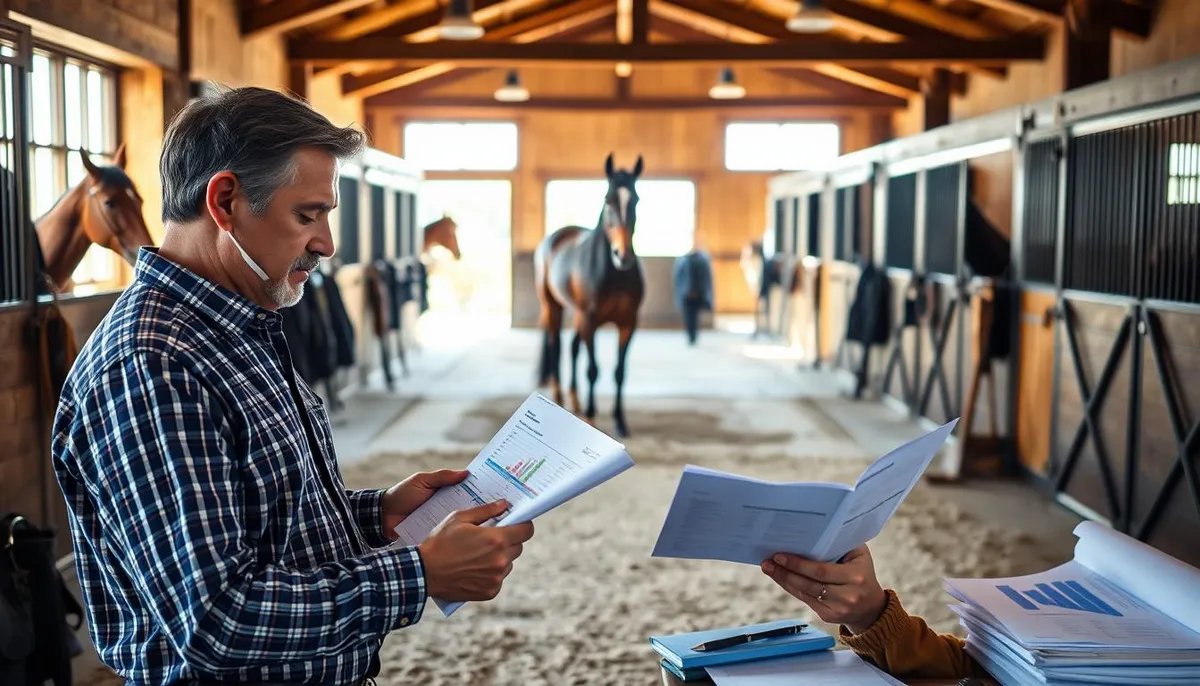
To enter the world of racing, you need to understand the horse owner budget. You can choose to fully buy a horse, own shares in horse co-ownership, join a group stable, or opt for horse rental. Your decision should take into account your budget, your risk appetite, and the time to invest.
Full ownership: France Galop/LeTROT approvals and required income
Obtaining full ownership requires mandatory approval from France Galop or LeTROT. This process takes 2 to 3 months and includes a verification of your income and criminal record.
In Île-de-France, you must earn around 75,000€ per year. In the provinces, this amount varies between 30,000 and 35,000€. For a horse, prices start at 30,000€. Trotters start at 5,000€. Also consider maintenance costs, which depend on your choice of discipline and trainer.
Co-ownership and syndicates: sharing risks and costs from 50€/month
Horse co-ownership allows you to share costs and risks. Shares range from 5 to 20% or more. Professionals often manage these arrangements, making management easier.
There are plans starting at 50€ per month in a group stable. Other options offer 10% for about 225€ per month. Premium plans start at a 25,000€ contribution. This helps manage your budget and plan expenses.
Rental and fractional investment: limited exposure, reduced entry ticket
Horse rental allows you to rent a horse for a season. You then give back 5 to 10% of the winnings to the owner. This option is good for those who want to minimize financial risks.
Platforms like Pur-Sang Patrimoine offer the opportunity to buy shares of horses starting from 2,000€. This allows you to gradually enter the world of racing. You can thus adjust your horse owner budget based on the results obtained.
Horse owner budget: entry scenarios and investment amounts
Here are some ways to adjust your equine investment amount to your profile. Check resources from France Galop and LeTROT. Ensure that stables and trainers are transparent.
| Scenario | Entry ticket | Recurring fees | Format | Key points |
|---|---|---|---|---|
| Discovery | 50–200€/month | Included or prorated | Group stable | Easy access, shared risk, education |
| Share 10% | Variable depending on the horse's value | ~225€/month | Horse co-ownership | Professional follow-up, controlled budget, shared winnings |
| “Accessible” full ownership | 10,000–35,000€ (beginner trotter) | 9,000–18,000€/year | Single owner | Total control, concentrated risk, approval required |
| Premium | Yearling 30,000–100,000€+ | 20,000–40,000€/year | Single owner | High sporting potential, expert selection |
| Seasonal rental | Rental contract | 5–10% of winnings + defined fees | Horse rental | Limited exposure, defined duration |
| Digital fractional | ~2,000€ per share | According to platform | Fractional investment | Reduced ticket, quick diversification |
Good practices: it is wise to go through a recognized broker. Analyze trainer statistics over at least 5 years. A minimum success rate of 15% is recommended. Document every expense as well. These actions protect your horse owner budget and your project.
Profitability, risks, and economic realities
Investing in a racehorse is juggling between numbers and passions. A precise horse value assessment is crucial. It balances the hope of victory with the discipline and age of the horse. The profitability of racehorses relies on three pillars: managing costs, ensuring good training, and maximizing winnings allocations. However, there are risks of equine investment to consider, making equine diversification a wise strategy.
Average earnings and allocations: average trotter ~15,000€/year
An average trotter earns nearly 15,000€ per year in winnings allocations. Usually, the first wins 50%, the second 25%, and so on. The recent decline in allocations makes balancing more difficult. This situation highlights the importance of a prudent horse value assessment.
Observed profitability: 40–55% of costs covered on average
In general, 40 to 55% of expenses are covered by winnings. Professional management improves racehorse profitability. However, achieving balance is difficult, especially with pressures on winnings allocations.
Success stories and valuation: Saônois, Timoko, capital gains and breeding
Saônois, bought for 8–10,000€, has earned around 1.7 M€. Timoko has accumulated over 5 M€ in winnings. Malavath went from 145,000€ to 3.2 M€ at resale. Breeding can also increase a horse's value. A stallion can earn up to 40,000€ per breeding. These stories show the possible rewards of patience and good horse value assessment, as well as the risks of equine investment.
Sporting/financial risks: qualification failure, injuries, limited liquidity
Nearly half of young horses do not qualify for competition. Injuries and other health issues can affect racehorse profitability. Fixed costs remain high, even without winnings, and selling can take time. These factors must be considered when assessing horse value.
Strategies: diversification, stable selection, 5% wealth threshold
It is advisable to have between 3 and 5 horses, often in co-ownership, to reduce risk. Choosing a recognized trainer can also increase winnings allocations. Many owners do not risk more than 5% of their wealth in this area. They start small and then reinvest winnings to mitigate risks of equine investment and improve their racehorse profitability.
Legal and tax aspects to know
Before diving in, understand the tax rules well. If you finance the horse but do not participate in sporting decisions, you are in non-intervening status. In this case, you do not pay taxes on race winnings. This helps manage your money better.
When reselling a horse, the tax rules are specific. If the sale is below 5,000 €, you will not have to pay tax. For a sale above this amount, capital gains are taxed at 28.10%. Let's take an example: you buy a horse for 20,000 € and sell it for 35,000 €. The capital gain is 15,000 €. After deductions, about 10,000 € are taxable. The tax then amounts to 2,810 €. Keep all your invoices and certificates well.
By choosing to become an "intervenor," by selecting the trainer or mixing breeding and ownership, the income becomes taxable. The amount of taxes can increase quickly. It is important to weigh this decision carefully.
When the activity is considered professional, it is possible to recover VAT. This applies to owners of multiple horses with regular income. You can deduct VAT on certain costs. To learn more, talk to a specialized accountant. The value of your horse can also influence the amount of your real estate tax (IFI).
To race, approval and compliance with the rules of France Galop and LeTROT are essential. This takes between 2 and 3 months. It is important to check your resources and criminal record. Sign clear contracts with the trainer and other professionals. This covers rates, responsibilities, and ownership of veterinary information.
Insurance for your horse is very important. It can cover liability, the risk of theft or death, and veterinary costs. These insurances help manage unexpected expenses and protect your activities.
On the ground, several rules must be followed. Ensure that identification and vaccinations are up to date. And if you keep the horse at home, check that everything is secure. Without the necessary approval, you will not be able to participate in competitions.
To start well, clearly define your objectives and keep your budget reasonable. Co-ownership is a good option to minimize risks. Use data from France Galop and LeTROT and choose your breeder wisely. Avoid offers that seem too good to be true.
| Theme | Key rule | Points of vigilance | Financial effect |
|---|---|---|---|
| Non-intervening status | Race winnings exempt | Total delegation of sporting decisions | Reduced cash flow, increased visibility |
| Capital gains | Threshold 5,000 €; capital gain on movable property 28,10% | Justifications, holding period, deductions | Possible tax on resale of the horse |
| Horse VAT | Recoverable in professional activity | Registration, dedicated accounting | Reduction of boarding/training costs |
| France Galop LeTROT obligations | Mandatory prior approval | Delays 2–3 months, document checks | Access to races and allocations |
| Equine insurance | Liability, mortality-theft, veterinary costs | Exclusions, deductibles, insured value | Smoothing risks and unforeseen costs |
Conclusion
In France, buying a horse varies greatly in price. It starts from a small amount for a leisure horse to millions for racing stars. Trotters are more affordable, with prices ranging from 1,000 to 100,000 €. For a promising young galloper, the price can soar beyond 2.6 million euros. A good assessment takes into account the horse's lineage, its condition, and veterinary examinations.
Annual costs for a horse also vary. They range between 9,000 and 19,200 €, depending on the discipline. For highly followed careers, this can rise between 20,000 and 40,000 €. Expenses include boarding, training, and other costs like transport. Purchase prices range from 50 € per month for a group placement to 100,000 € or more for a young horse of good lineage.
Financially, it is realistic to aim to cover 40–55% of expenses. One must be aware of the risk of young horses failing to qualify. It is advisable not to invest more than 5% of your wealth. Choose your stable wisely and demand a detailed assessment of the horse.
Investing in quality equipment can enhance performance and the horse's well-being. La Sellerie Française offers high-level gear made by French artisans. This represents a good investment for your budget and ensures a well-managed project, from purchase to competition.
FAQ
What is the purchase price of a racehorse in France?
Trotters often range from 1,000 to 100,000€. For beginners, prices go from 5,000 to 35,000€. For gallopers, yearlings are between 1,500 and 150,000€, with some even reaching 2.6 M€. There are also ready-to-run horses starting from 10,000€. For those looking for fun or sports, prices range from 1,500 to 8,000€ for leisure. For young sports, from 3,000 to 15,000€ and for trained horses, from 5,000 to 25,000€. Reformed horses cost between 500 and 3,000€.
How does horse price estimation work before purchase?
To estimate a horse, one evaluates its pedigree, conformation, and way of moving. One also looks at its performance history and conducts veterinary examinations. A basic veterinary examination costs between 100 and 300€; for a more comprehensive purchase visit, it is between 200 and 500€. The assessment takes into account the trainer, the horse's lineage like Galileo or Sea The Stars, and the auction or private sale market.
What is the average annual equine cost for a racehorse?
For a racehorse, budget between 20,000 and 40,000 € per year. This depends on the stable, the region, and the horse's follow-up. Trot costs between 9,000 and 18,000 € per year. Gallop is around 19,200 € annually. These costs continue even if the horse is injured or temporarily stopped.
What items make up the daily horse cost comparison?
Here are the main expense items: about 40% for boarding and housing. Then, 25% for veterinary and 20% for training. Farriery represents about 10%. Transport and entries are around 5%. Don’t forget liability insurance and for death or theft, which costs about 3% of the horse's value per year. There are also sometimes osteopathy and dentistry fees.
Where to buy a horse and what horse prices to expect?
There are four main ways to buy a horse. Auctions, like in Deauville, direct purchase from the breeder, purchase during claiming races where the horse is sold at the displayed price after the race, and group stables or syndicates. Auctions can drive prices up. Private sales allow for more negotiation. Shares in group stables start at around 50 € per month.
Trot or gallop: what are the differences in horse prices and costs?
Trot is more affordable with purchase prices between 1,000 and 100,000 €. Annual maintenance varies from 9,000 to 18,000 €. For gallop, yearlings can cost up to 2.6 M€. Annual maintenance is about 19,200 €. Trot and gallop races also differ in terms of rewards and competition level.
What are the prerequisites for full ownership of a racehorse?
You must obtain approval from France Galop for gallop or from LeTROT for trot, which takes 2 to 3 months. You need to show that you have sufficient income, around 75,000€ per year in Île-de-France, or 30-35,000€ in the provinces. They will also check your criminal record. Without this approval, you cannot race.
Does co-ownership help reduce the horse owner budget?
Yes, through syndicates, you can share costs and risks starting from 50€ per month. Common plans include 10% of a horse for about 225€ per month in maintenance. There are also premium offers requiring an initial contribution of 25,000€. This is a good way to start in the world of racing.
How does rental or fractional investment work?
With rental, you cover costs for a specified period. In return, you give between 5 and 10% of the winnings to the owner. Fractional investment allows you to buy shares starting from 2,000€. This makes investment more accessible and is managed by professionals.
What do the average earnings of a trotter cover?
A trotter earns on average 15,000€ per year. This covers about 40 to 55% of costs. Commissions for the trainer and driver are taken from winnings.
How are allocations distributed during a race?
Generally, 50% of winnings go to the first, 25% to the second, 15% to the third, 8% to the fourth, and 5% to the fifth. This distribution can change depending on the races, but it is a good basis for your calculations.
What are the main financial and sporting risks?
About 55% of young horses do not qualify. There are also risks of injuries, stoppages, low liquidity, and a fluctuating market. One must be prepared to risk losses and pay fixed costs, even without winnings.
What strategies can secure your equine investment amount?
Invest in 3 to 5 horses through co-ownership. Do not risk more than 5% of your wealth. Choose reliable stables and high-performing trainers. Gradually increase your investments, starting with 50 to 1,000 €, then more if the experience proves positive.
Do spectacular successes really exist?
Yes, but they are rare. Here are some examples: Saônois, bought for between 8,000 and 10,000 €, won 1.7 M€. Timoko has won over 5 M€. Malavath was bought for 145,000€ before being resold for 3.2 M€. These cases show the possibility of large gains, but they are not common.
What is the tax situation for a non-intervening owner?
If you let others make sporting decisions and training, your race winnings are exempt. For capital gains, if they exceed 5,000€, the rate is 28.10%. There are possible deductions depending on the holding period.
When does one switch to professional taxation?
If you participate in sporting management or combine breeding and ownership, your income may be considered professional. This includes charges and recoverable VAT. It is advisable to consult a specialized accountant.
How to read an advertisement for a yearling, ready-to-run, or reformed horse?
For a yearling, check the origins and quality of its movement. These horses have great speculative potential. Ready-to-run horses come with a history and videos of their races. You start investing from 10,000€. For a reformed horse, prices are lower, but make sure to check its health status and capabilities for a new career.
What good practices should be followed before buying?
Have the horse examined by a veterinarian, which costs between 100 and 300€. Study the pedigree and past performances of the horse. Consult statistics on the France Galop and LeTROT sites. Use a trusted broker and demand full transparency with the trainer.
What equipment budget and suppliers to prioritize?
Invest in quality equipment for the comfort and safety of the horse. For high-end gear, La Sellerie Française offers products made in France, either custom-made or in limited series by local artisans.
Is the French racing market deep and liquid?
The racing industry in France is robust, with over 2 billion euros in revenue. There are 230 racetracks, about 18,000 races per year, and nearly 11,500 owners. But reselling horses is not as straightforward as for financial assets. One must be prepared to wait and expect significant price variations.
How to integrate the equine cost into a realistic horse owner budget?
Consider different scenarios. To start, a group stable costs between 50 and 200€ per month. For 10% of a horse, budget around 225€ per month for maintenance. A beginner trotter costs between 10,000 and 35,000€ to purchase. Annual expenses for a horse range from 9,000 to 18,000€. For a premium level, with a yearling, plan for 30,000 to 100,000€ for purchase and between 20,000 and 40,000€ per year in maintenance.
Are commissions and fees due in the absence of winnings?
Commissions for the trainer and jockey are only due on winnings. However, boarding, training, farriery, care, and transport fees always need to be paid, whether there are winnings or not.
What useful keywords to compare and budget a purchase?
Use the following terms for your research: horse price, equine cost, horse rate, horse price estimation, horse cost comparison, horse owner budget, horse value assessment, and equine investment amount. This will help you better compare and plan your purchase.