
The Lusitano, or Puro Sangue Lusitano, symbolizes a unique equine elegance. It comes from the traditions of Portugal and was called the "horse of kings" in the past. Now, it is known for its style, balance, and equestrian performance.
The Lusitano horse has a compact body, measuring between 1.55 m and 1.60 m, and weighs about 500 kg. Its square build, short back, and powerful hindquarters allow it to move well. It moves lightly, with a smooth canter and a comfortable trot.
It is willing and courageous, yet remains gentle and close to people. A skilled rider is needed to best utilize its talents in Lusitano dressage and performance. It is valued for its precision, availability, and grace.
Here, we explore its origins, physical characteristics, applications in sports and the arts, and advice on breeding, care, and costs. A comprehensive guide to understanding this extraordinary partner.

Key Points
- Portuguese breed recognized for its equine elegance and equestrian performance.
- Compact morphology, “square” format, powerful hindquarters, and short back.
- Elevated gaits, natural collection, and ideal comfort for Lusitano dressage.
- Willing temperament, sensitive and close to humans, requiring an experienced rider.
- Excellence in sports, performances, and High School, with a modern baroque image.
- Upcoming sections: history, characteristics, uses, care, prices, and equipment.
Lusitano Origin and Breed History
This horse comes from the Iberian Peninsula. It is the symbol of a living tradition. Its Lusitano origin combines ancient heritages, maritime exchanges, and the needs of the terrain. Its Lusitano history develops thanks to Portuguese breeding and the famous riding schools.
Roots in Lusitania and an Ancient Stud Book
The name “Lusitano” comes from Lusitania, an ancient region of Portugal. The Romans already appreciated these horses for their combat skills. Later, royal breeding created an agile and compact horse.
The stud book dates back to the 19th century. It was common with the Andalusian before separating in the 20th century. The PSL stud book was then established for the Puro Sangue Lusitano and the PRE register for the Pure Spanish Breed. This distinction allowed for the development of specific national selections.
Genetic Relationships with the Barb and the Pure Spanish Breed
DNA analyses have shown a genetic proximity between the Iberian horse and the Barb. Migrations across the Strait of Gibraltar shared traits of speed and endurance. Most studies show a strong resemblance between the Lusitano and the PRE.
Before the official separation, Lusitanos and PRE were part of the same Iberian group. The different stud books then defined their specialties: bullfighting in Portugal and dressage in Spain. These family ties between the two breeds continue to be a subject of comparison.
From Cavalry and Bullfighting to Modern Arenas
Since antiquity, these horses were used in the army. In the 16th and 17th centuries, their agility was perfect for cavalry. Their selection for bullfighting enhanced their courage, calmness, and ability to maneuver.
In the 20th century, experts like Nuno Oliveira highlighted their talents. These horses are appreciated in modern dressage for their balance, gentleness, and ability to execute complex movements.
Recognition and Spread in France
France began importing these horses in the 1970s. Shortly after, an official register was established. The French Association of the Lusitano organizes this register and verifies the bloodlines.
French breeding has developed rapidly, improving the quality of these horses. The public discovers a versatile animal that is close to humans, often compared to the PRE. This evolution contributes to the strong presence of these horses in France, in sports, performances, or tradition.
| Period | Key Facts | Impact on the Breed |
|---|---|---|
| Antiquity – 17th Century | Iberian military use, exchanges with the Barb via Gibraltar | Endurance, maneuverability, composure |
| 19th – Mid 20th Century | Establishment of registers, separation PRE / PSL stud book | Clear identity against the Pure Spanish Breed |
| 20th Century | Rise of equestrian bullfighting, High School revived | Collection, balance, baroque expression |
| 1970s – Present | Spread in France, structuring by the AFL | Dynamic breeding, international visibility |
Lusitano Characteristics: Morphology, Coat Colors, and Temperament
The Lusitano is easily recognized by its compact shape and elegant movements. It is appreciated in dressage and working equitation. The Lusitano morphology, Lusitano coat colors, and Lusitano temperament show rigorous selection. These horses are known for being reliable and generous.

Height, “Square” Format, and Powerful Hindquarters
The height at the withers mainly ranges from 1.55 m to 1.65 m. At six years old, males often reach over 1.60 m and females 1.55 m. They weigh about 500 kg. This stature promotes functional Lusitano characteristics.
Their well-proportioned body has a short and strong back. They also have a wide loin and a rounded croup. Their hindquarters are very muscular, and their tails are set low. The legs are strong and dry, with long powerful hocks. Their neck, of medium size, is well-defined and muscular. This is a key sign of Lusitano morphology.
Profiles, Gaits, and Accepted Coat Colors
The Lusitano has a fine head with a profile ranging from straight to slightly convex. It sports large expressive eyes and fine ears. Its movement is elegant and natural. It has a lively walk, a comfortable trot, and a fluid canter.
There are many Lusitano coat colors, especially gray and bay. Colors like black, cream, palomino, and blue-eyed cream are rarer. Primitive markings can sometimes be seen. Chestnut has become very rare today.
A Willing, Courageous, and Sensitive Character
The Lusitano is known for its gentleness and stability. It is courageous, obedient, and remains calm even in difficult situations. This makes it an excellent choice for dressage and cattle work.
It is sensitive and generous, responding well to gentle commands. Under good guidance, it excels and becomes a reliable partner. In Portugal, many are still stallions, showcasing their bravery. This does not affect their docility if their education is well conducted.
Uses and Lusitano Dressage in Sports and Performance
The Lusitano combines finesse and energy, perfect for performance and competitions. It excels in both dressage and spectacular riding due to its gaits and calmness. Thus, the Lusitano horse shows its versatility.
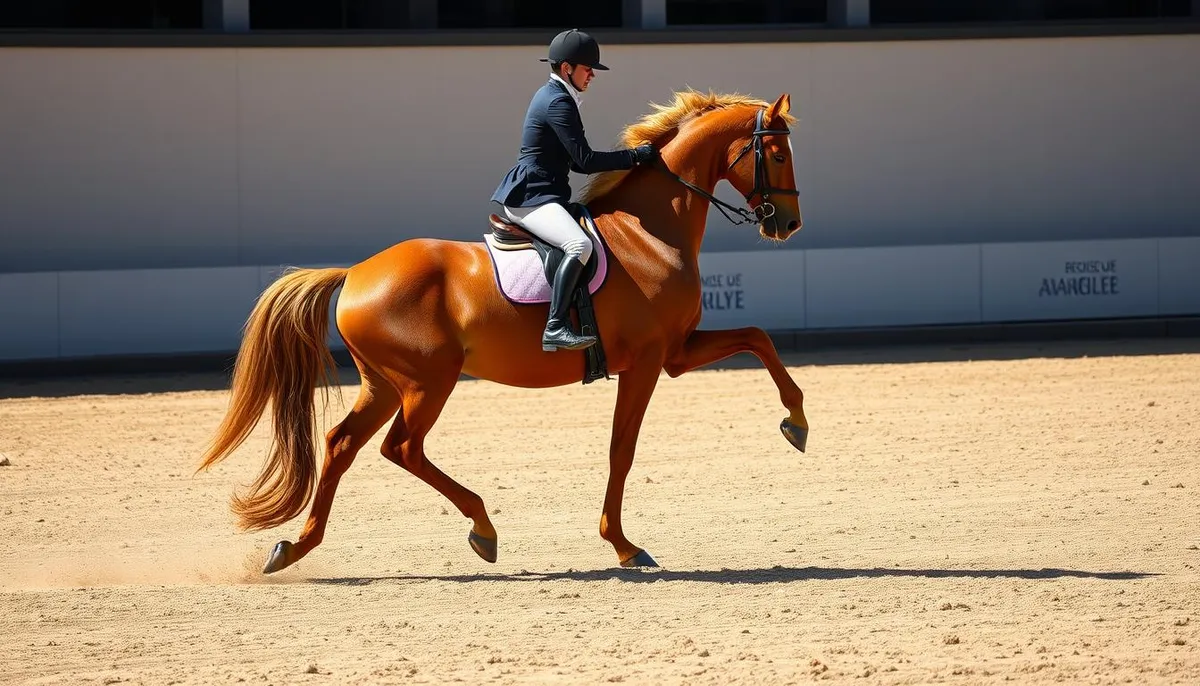
High School and Dressage Competitions
In high school, the Lusitano is recognized for its balance and flexibility. Nuno Oliveira made famous movements like the piaffe and passage. This enriches today’s Lusitano dressage.
In competitions, Lusitanos remain competitive despite the preference for larger horses. Orphée and Odin are examples of success in competition and at the Cadre Noir. They demonstrate the adaptability of the breed.
Working Equitation, Maneuverability, and Speed
Working equitation, inspired by pastoral tasks, blends dressage and speed. The Lusitano horse, with its responsiveness and bravery, is ideal. It changes pace quickly and remains calm.
In Portugal, this discipline is highly developed. It promotes obedience and dynamism. These skills also benefit Lusitano dressage, offering precise transitions and optimal control.
Portuguese Bullfighting, Driving, Jumping, and Leisure
Portuguese bullfighting emphasizes the horse's safety, without killing. Here, the Lusitano demonstrates its endurance and speed, a legacy of its past in the arenas.
In driving, Lusitanos reach high levels. For example, Manuel de Mello's team, driven by Félix-Marie Brasseur, excelled in 1996. Novilheiro, with John Whitaker, made a mark in show jumping in 1983.
These horses also shine in TREC and horse-ball. On stage, Templado inspired a performance where audience emotion and precision meet.
Lusitano Breeding, Care, Feeding, and Price of Lusitano Horses
The Lusitano is known for its balance and ease of learning. To effectively manage a Lusitano breeding, it is important to carefully select bloodlines. They also need to be well-fed and cared for daily.
Breeding in Portugal and France, Veiga and Andrade Lines
In Portugal, there are many breeding farms, especially in Ribatejo and Alentejo. In France, since the 1970s, Lusitano breeding has developed well, especially in the south.
Lines like Veiga and Andrade define the Lusitano horse. Veiga is known for its agility and Andrade for its beauty and elegance. Coudelaria Nacional and Alter-Real are other important lines that avoid inbreeding.
Exercise Needs, Routine Care, and Health
The Lusitano needs to go out every day. Short but regular training sessions are good for its health. Having an open stable helps reduce costs and improves their well-being.
They need to be groomed often and their skin checked. Gray horses can develop melanomas, so they need to be monitored. They are generally robust, but it is good to consult a veterinarian for regular health checks.
Suitable Rations, Energy Management, and Founder Prevention
The Lusitano mainly eats dry forage with little grain. Starch is limited and fiber is increased for a balanced diet. Ensuring a good level of minerals and vitamins is essential.
Feeding them in small portions and adjusting their rations according to their activity helps avoid blood sugar issues. This helps prevent certain diseases and maintain their energy for work under saddle.
Sale of Lusitano Horses: Quality Criteria and Price Estimation
The value of a Lusitano horse depends on its lineage, appearance, movements, and willingness. Success in competitions also increases its value.
The price varies based on age, skills, and training of the horse. Well-trained horses with good pedigrees sell for a higher price, in France and abroad.
High-End Equipment from La Sellerie Française
Equipment is key for the performance and comfort of the Lusitano. La Sellerie Française offers quality equipment, made in France. They have saddles, bridles, and other accessories, available in limited series or custom-made.
The choice of materials, such as leather, is important for comfort and stability. Good quality equipment is essential for the well-being of the Lusitano horse. This can even influence its price at sale.
Conclusion
The Lusitano horse is a symbol of harmony between past and present. Originating from Lusitania, it is close to the Barb and the Pure Spanish Breed. Its revival owes much to Nuno Oliveira. It benefits from an ancient stud book and is well established in France thanks to a dynamic national stud book.
This horse stands out for its square silhouette and power. It possesses spectacular gaits and a fighting spirit, making it excellent in several disciplines. The success of remarkable horses like Novilheiro and Odin illustrates this well.
Lusitano breeding relies on prestigious lines in Portugal and France. To keep it fit, exercise, care, and controlled feeding are crucial. La Sellerie Française offers suitable equipment that promotes performance in dressage and performance.
The Lusitano is known for its versatility and intelligence. Recognized for its elegance and abilities, it is appreciated everywhere. This horse offers numerous opportunities, whether in dressage, breeding, or during sales.
FAQ
What is a Lusitano horse (PSL) and why is it called the "horse of kings"?
The Lusitano, also known as Puro Sangue Lusitano, is a Portuguese horse with a baroque appearance. This horse was nicknamed the "horse of kings" in the 17th and 18th centuries due to its elegance and importance to royal courts in Europe. Today, it excels in dressage, High School, equestrian shows, and working equitation.
What is the origin of the Lusitano and what does its name mean?
The name "Lusitano" comes from ancient Lusitania, a region that is now Portugal. The breed has very ancient origins with a stud book established long ago. Until the mid-20th century, Andalusians and Lusitanos shared the same stud book. In the 1960s, they were officially separated into PSL for Portugal and PRE for Spain.
Is the Lusitano closely related to the Pure Spanish Breed and the Barb?
Yes, DNA studies show that Lusitanos, Pure Spanish Breeds, and Barbs are closely related. They share common ancestors around the Strait of Gibraltar. The Sorraia is not a direct ancestor of these modern Iberian horses.
How have martial history and bullfighting shaped the breed?
Used as a war horse since antiquity, the Lusitano has been selected for bullfighting and cattle work in Portugal. This selection has developed its courage, maneuverability, and ability to collect, ideal for dressage and performances.
When was the breed recognized in France?
The first Lusitano horses arrived in France in the 1970s. In 1987, the breed was officially recognized by the French National Stud, paving the way for registration. Since then, France has become an important breeding center, thanks to the French Association of the Lusitano.
What are the key morphological characteristics of a Lusitano horse?
The Lusitano has a medium height, between 1.55 and 1.65 m, and weighs about 500 kg. They have a compact shape, with a short but strong back, powerful croup, and muscular neck. They also have strong limbs, with solid joints and an expressive head.
What coat colors and gaits are typical for the PSL?
All coat colors are accepted, but gray and bay dominate. Black, cream, palomino, and blue-eyed cream horses are rare and valued. Their movement is lively, with an easy trot and rhythmic canter.
What is the temperament of the Lusitano?
It is known for being willing, courageous, sensitive, and close to humans. It is obedient and generous, excelling in the hands of expert riders. That said, its sensitivity requires an experienced rider.
Why does the Lusitano excel in dressage and High School?
Its natural ability to collect, along with its suppleness and balance, makes it perfect for classical dressage. Masters like Nuno Oliveira have valued these qualities. You can see them shine in international competitions and at major presentations.
Is the Lusitano effective in working equitation?
Absolutely. Its speed, agility, intelligence, and obedience place it at the forefront of working equitation. Portugal is indeed a reference in this area.
Does the Lusitano excel in other disciplines?
Yes, it is very versatile. Lusitanos participate in bullfighting, high-level driving, show jumping, and other equestrian sports. Their agility and mentality make them exceptional in all these activities.
Where can I find a reputable Lusitano breeding farm?
For quality breeding, head to Portugal, especially in Ribatejo and Alentejo. In France, breeding is more dispersed, particularly in the south. Among the famous lines are Veiga, Andrade, Alter-Real, and Coudelaria Nacional.
What are the differences between the Veiga and Andrade lines?
Veiga produces horses that are often more compact, famous for their agility, selected for bullfighting. Andrade horses are larger and more elegant, appreciated for dressage and High School. Crossbreeding between these lines seeks to combine athleticism and balance.
What daily care and exercise does a PSL need?
Daily outings and regular training are crucial. Careful grooming, skin and hoof checks, and maintenance of the hooves must be done without fail. An open stable can work, but a stable training rhythm must be maintained.
Does the Lusitano have specific health vulnerabilities?
This breed is generally robust. However, be cautious of melanomas in gray horses, especially in light areas. It is also prone to degenerative myeloencephalopathy. Hence, regular veterinary visits are important.
What diet is best for a Lusitano horse?
They thrive on a diet rich in fiber and moderate in energy. Favor quality forages, limit starch, and provide a balanced intake of minerals and vitamins. Meals should be divided and adjusted according to physical activity.
How can insulin resistance and founder be prevented in the PSL?
Limit starchy foods, prioritize fiber and trace elements, and ensure regular physical activity. In rich pastures, reduce grazing time and consider using a muzzle if necessary.
What criteria should be considered when selling a Lusitano horse?
Consider lineage, conformation to standards, gaits, hindquarters power, and character. Also, look at performance in dressage and working equitation. Don’t forget to check official documents and health tests.
What is the price of a Lusitano horse?
The price varies based on several factors such as age, lineage, color, and dressage skills. Younger horses are cheaper, while those trained for competition have a higher price. Rare coat colors and good training can increase the price, especially in France and Portugal.
Where to buy a Lusitano and how to secure the transaction?
Prefer reputable breeding farms in Portugal and France, and verified listings. Always conduct trials in the presence of a trainer. Request radiological examinations, a health certificate, and official traceability. A detailed contract protects both parties.
What dressage equipment suits the PSL's morphology?
A good balanced saddle and suitable girths are essential for its short back and strong neck. A fine, well-fitted bridle is appropriate, allowing for better contact due to its delicate mouth.
Why choose La Sellerie Française for a Lusitano horse?
La Sellerie Française offers high-end equipment, all made in France. Their products, from saddles to harnesses, are specifically designed to fit the unique morphology of the Lusitano, in both dressage and working equitation.
Is the Lusitano suitable for amateur riders?
Yes, with the right guidance. Their sensitivity requires a subtle hand. An intermediate or advanced rider, well-supported, will benefit from its generosity and diverse talents.
What are the "Lusitano characteristics" that appeal most in France?
The French appreciate its compact silhouette, strong croup, elegant movements, and ambitious character. Its performance in dressage and its appearance in competition turn heads.
Does coat color influence the sale price of a Lusitano horse?
Yes, although it is not the only criterion. Rare colors such as black, cream, palomino, or blue-eyed cream can increase the price, especially if the horse has a good lineage and a high level of training.
How to maintain the mane and tail of a PSL for performance?
Maintain them gently, use suitable shampoos, hydrate lightly, and protect them from friction. Fine hair benefits from careful braiding for dressage and working equitation competitions.
Does the Lusitano handle competitive driving?
Absolutely. Its build, strength, and natural calm make it an ideal partner for driving, whether alone or in teams. It has even made a name for itself internationally in this discipline.
What is the difference between PRE and PSL at a glance?
While they are close, the PSL is often more compact with a shorter back and well-developed croup, ideal for collection. The PRE is distinguished by a more arched neck and sometimes a longer body.
What is the ideal age to buy a Lusitano for dressage?
It depends on your goals. Between 4 and 5 years is the ideal age to form the basics. For more advanced dressage, aim for an age of 6 to 8 years to quickly enter Amateur or Pro competitions.